
RT duroid 6002 Aerospace PCB Manufacturing
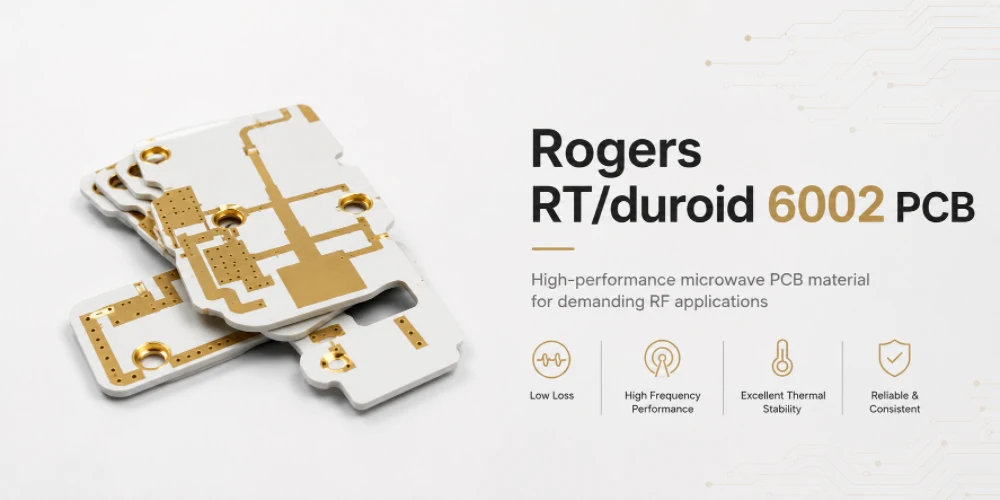
For aerospace and satellite RF boards, RT/duroid 6002 manufacturing is organized around dimensional stability, finished stackup control and qualification evidence. The page focuses on the production variables that can be measured and documented across prototype and repeat builds.
Figure 1. Rogers RT/duroid 6002 PCB manufacturing
RT duroid 6002 aerospace PCB manufacturing should connect the material choice to the qualification plan. Aerospace RF boards often need more than nominal electrical performance; thermal cycling, outgassing considerations, documentation and plated-hole reliability can affect the production route. Rogers RT/duroid 6002 PCB manufacturing is used when an RF board must keep electrical performance stable through thermal cycling, launch vibration, high-reliability assembly, and long service life. RT/duroid 6002 is a ceramic-filled PTFE composite with Dk 2.94 +/- 0.04, dissipation factor 0.0012 at 10 GHz, low thermal coefficient of Dk, and low z-axis CTE. Highleap Electronics manufactures RT/duroid 6002 boards for satellite payloads, phased-array feeds, radar modules, aerospace RF assemblies, and low-CTE hybrid stackups.
Table of Contents
Material scope: This page concerns PCB fabrication using the specified Rogers material. Highleap Electronics manufactures the finished board and PCBA; laminate manufacturing and material sales are outside our service scope.
When RT/duroid 6002 Is the Right PCB Material
RT/duroid 6002 is a strong choice when the PCB must combine low RF loss with stable mechanical behavior through thermal cycling. It is commonly selected for aerospace RF boards, satellite payload circuits, radar modules, phased-array feed networks, and metal-backed microwave assemblies where plated-through-hole reliability and dimensional stability matter as much as insertion loss.
It is not the first material to choose for every low-loss RF board. If the design only needs standard commercial microwave performance, another Rogers laminate may be more practical. RT/duroid 6002 becomes valuable when the board has tight thermal-mechanical requirements, bonded carriers, high-reliability documentation, or a service environment where repair is difficult. The program-specific acceptance requirements should be included in RT/duroid 6002 quotation inputs before a supplier commits to cost and delivery.
Low-CTE Reliability Is the Real Reason to Choose RT/duroid 6002
The main manufacturing question is not simply whether the RF loss is low. Many low-loss PTFE laminates can support microwave transmission lines, but RT/duroid 6002 is chosen when the mechanical reliability of the PCB is part of the RF design. Its low z-axis CTE helps reduce plated-through-hole stress during thermal cycling, and its in-plane expansion is close enough to copper to support dimensionally stable microwave features.
For aerospace and satellite boards, this matters because the board may be bonded to a metal carrier, exposed to vacuum thermal cycling, or used in a sealed RF module where field repair is impossible. Highleap therefore reviews the stackup as a reliability structure, not just as a laminate selection. Copper weight, dielectric thickness, hole size, plating thickness, annular ring, metal backing, adhesive system, final routing, and inspection records all need to support the same thermal-mechanical goal. If components are included in the order, assembly on approved RT/duroid 6002 boards requires the BOM, attachment process and final inspection to share the fabrication revision.
In practical quoting, the most important discussion is usually whether the drawing gives enough control over the finished structure. If the drawing only says “RT/duroid 6002” but does not define the dielectric thickness, copper, plating, surface finish, carrier bonding, impedance coupon, or acceptance records, two suppliers can quote very different boards. A buyer preparing an aerospace RF order should lock these items before prototype release so the prototype can become the production baseline.
- Use RT/duroid 6002 when low CTE and low loss are both part of the design requirement.
- Define plated-hole reliability requirements early, especially for thermal cycling or metal-backed assemblies.
- Keep stackup, coupon design, drill rules, and inspection records stable from prototype to repeat build.
RT/duroid 6002 Properties Relevant to Reliability
| Item | Manufacturing meaning |
|---|---|
| Process Dk | 2.94 +/- 0.04, useful for low-Dk RF transmission lines and hybrid microwave layouts. |
| Dissipation factor | 0.0012 at 10 GHz, supporting low-loss microwave circuits. |
| CTE profile | Low expansion helps protect plated through holes and bonded metal-carrier assemblies. |
| Material family | Ceramic-filled PTFE requires a fabrication route different from standard FR-4. |

DFM and Stackup Review Before Quoting
A reliable quote starts with the complete Gerber set, drill files, netlist, board outline, stackup drawing, material callout, copper weight, surface finish, solder mask notes, impedance targets, and any assembly requirements. Highleap checks whether the design can be fabricated repeatably before tooling starts.
| DFM item | What to check |
|---|---|
| Plasma preparation | PTFE hole walls need proper surface activation before electroless copper. |
| Hybrid stackup review | Check transitions to FR-4, RO4350B, metal carriers, copper coins, or thermal spreaders. |
| Documentation | Aerospace and satellite builds often require material traceability, microsections, and first article records. |
Manufacturing Process Controls
The process route should be selected before material is released to production. Typical controls include material verification, inner layer inspection, lamination review, drill quality, hole-wall preparation, copper plating, solder mask registration, surface finish, routing accuracy, electrical test, and final inspection. Highleap can define the inspection and qualification evidence around the released stackup. Critical controls may include material identification, lamination records, dimensional inspection, plated-hole checks and additional environmental or RF testing when specified by the program. Exact material property values should be checked against the current supplier documentation for the specified grade and construction.
For repeat aerospace or high-reliability builds, keep material traceability, approved stackup, drilling route, plating window, inspection records and change control consistent with the qualified build. A process or material change should be treated as an engineering change, not merely a purchasing substitution.
RFQ Package and Production Records
Best-fit applications include satellite transponder filters, beam-forming networks, low-CTE RF modules, airborne radar assemblies, ground-station front ends, and hybrid microwave boards where plated-hole reliability and dimensional control are as important as RF loss.
Send Gerber files, drill data, stackup notes, RT/duroid 6002 thickness, copper weight, surface finish, impedance targets, metal carrier requirements, test coupons, documentation requirements, prototype quantity, production quantity, and expected reorder schedule.
For RT/duroid 6002 high-reliability builds, useful evidence includes material traceability, finished-thickness checks, microsection or plated-hole inspection, impedance verification and the environmental or thermal qualification data required by the program. For an aerospace RFQ, send the current drawing, material grade, stackup, reliability requirements, quantity and documentation requirements. The quotation can then separate standard production from qualification work.

Recommended Posts
TMM4 Filter PCB Manufacturing
TMM4 filter PCB manufacturing is controlled by the...
TMM3 PCB Manufacturing for RF Modules
TMM3 PCB manufacturing is most useful where the RF module...
TMM6 PCB Fabrication
TMM6 fabrication is the process-control page for a mid-Dk...
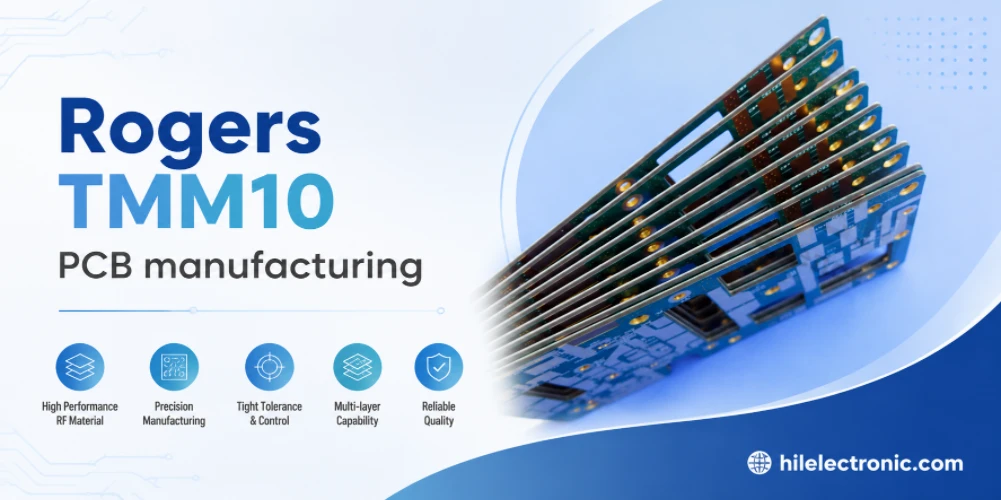
TMM10 PCB Manufacturing for Compact RF Designs
Table of contentsHow TMM10 Shrinks RF StructuresTMM10 vs...
How to get a quote for PCBs
Let’s run DFM/DFA analysis for you and get back to you with a report. You can upload your files securely through our website. We require the following information in order to give you a quote:
-
- Gerber, ODB++, or .pcb, spec.
- BOM list if you require assembly
- Quantity
- Turn time
For PCBA services, please provide your BOM (Bill of Materials) and any specific assembly instructions. We also offer DFM/DFA analysis to optimize your designs for manufacturability and assembly, ensuring a smooth production process.