
Heavy Copper PCB Stack-up: Balancing Performance and Manufacturability

Introduction
Heavy copper PCB stack-up design represents a critical engineering challenge in modern power electronics applications. Defined by copper weights of 3 oz/ft² or greater, heavy copper PCBs demand specialized stack-up configurations that differ fundamentally from standard circuit boards. The stack-up architecture directly influences signal integrity, thermal dissipation pathways, mechanical robustness, and ultimately, manufacturability.
This article examines how to achieve optimal heavy copper PCB stack-up design by reconciling performance requirements with practical fabrication constraints.
Understanding the Role of Heavy Copper PCB Stack-up
Electrical and Thermal Functions of Stack-up Design
The stack-up configuration in heavy copper PCBs governs three fundamental aspects: current-carrying capacity, heat dissipation efficiency, and structural integrity under thermal stress. Unlike standard PCBs where copper thickness rarely exceeds 2 oz, heavy copper boards feature asymmetric copper distribution that creates unique challenges during lamination. Thicker copper layers reduce resin flow during pressing, potentially causing voids or delamination if dielectric thickness is inadequately specified.
Standards and Copper Thickness Considerations
IPC-2221 and IPC-6012 standards provide baseline requirements for copper thickness and layer construction, yet heavy copper applications often push beyond these specifications. The primary distinction in multilayer PCB design lies in how copper mass affects the thermal expansion coefficient mismatch between layers. A 6 oz inner layer expands differently than a 3 oz outer layer during temperature cycling, creating internal stresses that require explicit consideration from the initial layout phase.
Key Design Considerations for Heavy Copper PCB Stack-ups
Copper Distribution and Symmetry
Balanced copper thickness across the stack-up minimizes warpage and internal stress during lamination and thermal cycling. When upper and lower layers differ greatly in copper weight, expansion mismatch can cause bow or twist, reducing assembly yield. Designers should mirror copper distribution around the board centerline and adjust plane patterns to maintain electrical balance and structural stability.
Dielectric Thickness and Resin Flow Control
Proper dielectric thickness ensures sufficient resin flow to fill the rough surface of thick copper foils. Inadequate spacing leads to voids or delamination that weaken insulation reliability. Since copper etch-back reduces effective dielectric thickness, designers should add 0.002–0.003 inches to nominal prepreg values when copper exceeds 4 oz to maintain consistent insulation quality.
Via Structures and Plating Challenges
Via integrity relies on achieving uniform copper deposition, which becomes difficult with heavy outer layers. Blind and buried vias help reduce current path length, improve thermal conduction, and enhance plating uniformity compared to full through-holes. Though they require sequential lamination, these structures deliver superior performance in high-current designs.
Thermal and Mechanical Balancing
Thick copper layers near heat sources act as internal heat spreaders, improving thermal dissipation and mechanical rigidity. Maintaining copper symmetry prevents differential expansion and flexure during operation. Thermal simulation at the design stage helps identify stress points and optimize stack-up reliability under load.
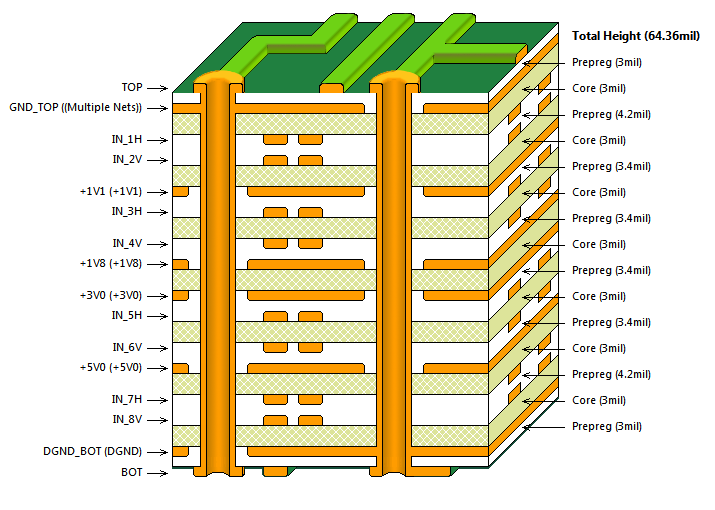
Thick & Heavy Copper PCB Stack-up
Manufacturing Limitations and Practical Guidelines
Lamination Process Constraints
Single-layer copper weights exceeding 10 oz fundamentally alter lamination parameters, requiring extended pressing cycles at modified temperatures. The thermal mass of extreme heavy copper slows heat transfer during lamination, necessitating longer dwell times that risk resin over-cure in adjacent thin layers. Most fabricators limit maximum single-layer copper to 8-10 oz for multilayer heavy copper PCB stack-ups.
Dielectric and Registration Tolerances
Minimum achievable dielectric thickness correlates directly with copper weight, as thicker copper creates more surface relief demanding additional resin:
- 4-6 oz copper – Minimum 0.006-0.008 inch dielectric thickness between layers.
- 8-10 oz copper – Minimum 0.010 inch or greater dielectric thickness required.
- Solder mask registration – Accuracy degrades on heavy copper due to surface topography, requiring expanded tolerances.
Design Validation Approach
Engineering teams should engage manufacturing partners during preliminary stack-up design to establish realistic parameter limits. Thermal and mechanical simulation validates lamination feasibility, identifying potential resin flow issues or stress concentrations before committing to fabrication. This proactive approach prevents costly redesign cycles when initial builds fail qualification testing.
Optimized Heavy Copper PCB Stack-up for Power Electronics
A practical 6-layer heavy copper PCB stack-up for DC-DC converter applications demonstrates effective design principles. The configuration positions 6 oz copper on internal layers 3 and 4 as primary power and ground planes, with 3 oz copper on outer layers 1 and 6 for signal routing. Layers 2 and 5 utilize 2 oz copper for control signals, creating a balanced structure.
This multilayer stack-up configuration provides approximately 0.008 inch dielectric thickness between the heavy internal layers, sufficient for reliable insulation while managing resin flow. The symmetric copper distribution prevents warpage, and the graduated copper weight from outer to inner layers creates a mechanically stable structure resistant to thermal stress. Total board thickness remains at 0.093 inches, compatible with standard assembly processes.
Power electronics designs benefit from this heavy copper PCB stack-up through:
- Reduced DC resistance – Internal 6 oz planes support current densities exceeding 10 A/mm² with minimal voltage drop.
- Improved thermal spreading – Thick copper layers efficiently conduct heat away from power semiconductors.
- Enhanced ground plane integrity – Heavy ground plane provides superior noise suppression for control circuits.
Conclusion
Effective heavy copper PCB stack-up design requires systematic attention to copper weight distribution, dielectric specifications, via structures, and thermal-mechanical balance. Success depends on understanding manufacturing constraints that govern resin flow, lamination stress, and plating uniformity in boards with copper weights from 3 to 10 oz. Engineers who integrate these considerations during initial layout achieve superior reliability and manufacturability.
Highleap Electronics Heavy Copper PCB Capabilities:
- Advanced stack-up engineering – Collaborative design development to optimize copper distribution, dielectric selection, and thermal management for demanding applications.
- Proven fabrication expertise – Manufacturing experience with copper weights up to 10 oz across 4-layer to 12-layer configurations, ensuring consistent quality and yield.
- Process validation support – Comprehensive thermal and mechanical simulation services to verify stack-up feasibility before production commitment.
Partner with Highleap Electronics for multilayer heavy copper PCB fabrication that balances electrical, thermal, and mechanical performance in power systems. Our engineering team ensures your designs meet both specification requirements and manufacturing realities. Contact us to discuss your heavy copper PCB stack-up requirements.

Recommended Posts
TMM4 Filter PCB Manufacturing
TMM4 filter PCB manufacturing is controlled by the...
TMM3 PCB Manufacturing for RF Modules
TMM3 PCB manufacturing is most useful where the RF module...
TMM6 PCB Fabrication
TMM6 fabrication is the process-control page for a mid-Dk...
TMM13i PCB Manufacturing
TMM13i PCB manufacturing is aimed at ultra-compact RF...
How to get a quote for PCBs
Let‘s run DFM/DFA analysis for you and get back to you with a report. You can upload your files securely through our website. We require the following information in order to give you a quote:
-
- Gerber, ODB++, or .pcb, spec.
- BOM list if you require assembly
- Quantity
- Turn time
In addition to PCB manufacturing, we offer a comprehensive range of electronic services, including PCB design, PCBA, and turnkey solutions. Whether you need help with prototyping, design verification, component sourcing, or mass production, we provide end-to-end support to ensure your project’s success.
For PCBA services, please provide your BOM (Bill of Materials) and any specific assembly instructions. We also offer DFM/DFA analysis to optimize your designs for manufacturability and assembly, ensuring a smooth production process.