
Transistor Circuit Diagram: Symbols, Reading, and Build
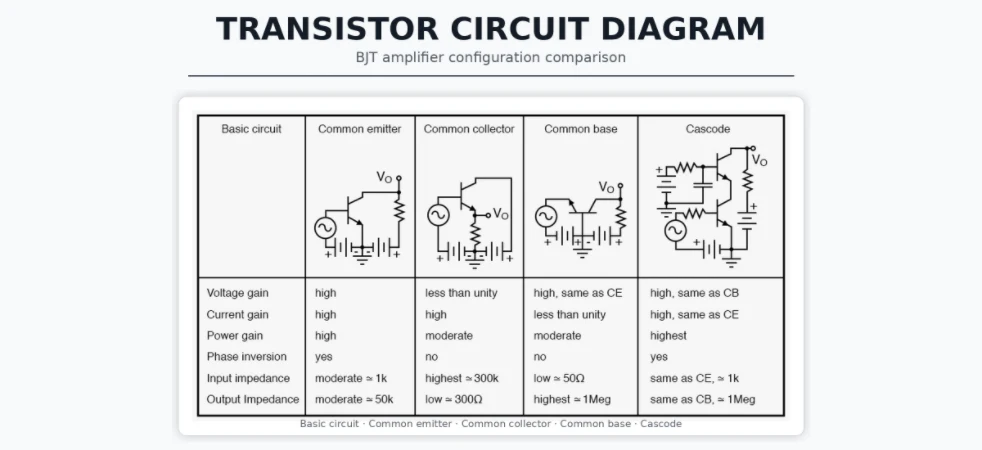
Figure 1. A transistor circuit diagram must be reviewed before PCB layout so pinout, current path, grounding, and thermal needs are clear.
A transistor circuit diagram is a schematic drawing that shows how one or more transistors connect to other components — resistors, capacitors, power, and signal lines — using standard symbols instead of pictures of the parts. It tells you how a circuit switches, amplifies, or regulates a signal, and it is the starting point for turning an idea into a working printed circuit board.
- A transistor circuit diagram uses standard symbols for BJTs and MOSFETs, not images of the physical devices.
- Reading one means identifying each transistor’s type, its three terminals, and the role it plays: switch, amplifier, or follower.
- BJTs are current-controlled and MOSFETs are voltage-controlled; the symbol and bias network reveal which one you are looking at.
- A clean schematic with correct symbols, footprints, and reference designators is what makes the board manufacturable.
Table of Contents
- What Is a Transistor Circuit Diagram?
- Transistor Symbols for BJTs and MOSFETs
- How to Read a Transistor Schematic
- Common Transistor Circuit Configurations
- BJT vs MOSFET: How to Tell Them Apart
- From Transistor Schematic to a Manufactured PCB
- PCB Layout Tips for Transistor Circuits
- Frequently Asked Questions
What Is a Transistor Circuit Diagram?
A transistor circuit diagram represents an electronic circuit symbolically. Every component appears as a standardized symbol, and lines between them show the electrical connections, or nets. The diagram communicates two things at once: how the parts are wired, and what the circuit is meant to do. Because it is symbolic, the same diagram can be built on a breadboard, a prototype, or a finished production board without changing.
Key elements of the diagram
- Transistor symbols: each transistor is drawn with its three terminals so its type and polarity are clear.
- Reference designators: labels such as Q1, Q2, R3, and C4 identify every part uniquely.
- Nets and nodes: the connecting lines define which pins share an electrical connection.
- Bias components: resistors and sometimes capacitors set each transistor’s operating point.
- Power and ground rails: supply voltage and ground give the circuit its reference points.
- Signal labels: input and output markings show where a signal enters and leaves.
A correct, well-labeled schematic is the foundation of any build. Once it is verified, it becomes the source of truth for layout and for transistor board assembly, so the time spent getting it right is never wasted.
Transistor Symbols for BJTs and MOSFETs
Two families of transistors dominate most circuits: bipolar junction transistors (BJTs) and metal-oxide-semiconductor field-effect transistors (MOSFETs). Each has its own symbol, and the symbol encodes both the device type and its polarity. Learning four core symbols covers the large majority of diagrams you will meet.
Key transistor symbols
- NPN BJT: three terminals (base, collector, emitter) with the emitter arrow pointing outward.
- PNP BJT: the same layout, but the emitter arrow points inward toward the base.
- N-channel MOSFET: gate, drain, and source, usually with the body arrow pointing inward.
- P-channel MOSFET: the same structure with the arrow direction reversed.
- Terminal labels: B/C/E for BJTs and G/D/S for MOSFETs remove any ambiguity.
| Symbol | Terminals | Arrow / Marker | Typical Use |
|---|---|---|---|
| NPN BJT | Base, Collector, Emitter | Emitter arrow points out | Low-side switch, amplifier |
| PNP BJT | Base, Collector, Emitter | Emitter arrow points in | High-side switch, complementary stage |
| N-channel MOSFET | Gate, Drain, Source | Body arrow points in | Efficient low-side switching, power |
| P-channel MOSFET | Gate, Drain, Source | Body arrow points out | High-side switching, load control |
Getting the symbol direction right is more than a drawing detail; it determines how the part is wired and biased. Our engineers check symbols and footprints against datasheets as part of how our China PCB factory prepares a design for production.
How to Read a Transistor Schematic
Reading a transistor schematic is a repeatable process. Rather than trying to understand the whole diagram at once, you work through it terminal by terminal and stage by stage until the function becomes clear.
Key steps to read it
- Identify each transistor: note whether it is a BJT or MOSFET and its polarity.
- Locate the three terminals: mark base/gate, collector/drain, and emitter/source.
- Trace power and ground: find the supply rail and the common ground reference.
- Read the bias network: the resistors around the control terminal set the operating point.
- Follow the signal path: trace from input through each stage to the output.
- Note feedback: watch for components that route the output back to an input.
Once you can read a schematic this way, wiring mistakes become far easier to catch before they ever reach a board.
Common Transistor Circuit Configurations
Most transistor diagrams are built from a handful of recurring configurations. Recognizing them on sight makes any schematic faster to understand, because you can name a block instead of analyzing it from scratch.
Key transistor circuits
- Switch: the transistor is driven fully on or fully off to control a load.
- Common-emitter amplifier: a classic voltage-gain stage built around a BJT.
- Emitter or source follower: provides current gain and buffering with near-unity voltage gain.
- Current mirror: copies a reference current into one or more branches.
- Push-pull output: a complementary pair drives a load efficiently in both directions.
- H-bridge: four transistors reverse the current through a motor or coil.
When these blocks repeat across a design, the diagram becomes a sequence of familiar stages rather than a wall of symbols.
A handful of configurations cover most transistor diagrams. In a switch the transistor is driven fully on or off to control a load such as a relay or an LED. A common-emitter stage uses a BJT to amplify a signal, inverting it and adding voltage gain. An emitter or source follower buffers a signal with near-unity voltage gain but useful current gain. A push-pull output pairs complementary devices to drive a load efficiently in both directions. Recognising these blocks lets you read a schematic as a sequence of familiar stages rather than a wall of symbols.

Figure 2. Transistor schematic details must be translated into PCB layout rules for grounding, routing, current path, and thermal control.
BJT vs MOSFET: How to Tell Them Apart
Beyond the symbol, BJTs and MOSFETs differ in how they are controlled, and that difference shapes the surrounding circuit. A BJT is controlled by the current into its base, while a MOSFET is controlled by the voltage on its gate. The bias network around the device usually makes the type obvious even before you read the part number.
Key differences
- Control method: BJTs respond to base current; MOSFETs respond to gate voltage.
- Drive component: a base resistor feeds a BJT; a gate resistor and high gate impedance feed a MOSFET.
- Conduction loss: power MOSFETs offer very low on-resistance for efficient switching.
- Switching speed: MOSFETs generally switch faster, which matters in power conversion.
- Use cases: BJTs suit small-signal and simple drives; MOSFETs dominate power switching.
| Parameter | BJT | MOSFET |
|---|---|---|
| Controlled by | Base current | Gate voltage |
| Input impedance | Lower | Very high |
| On-state loss | Vce(sat) voltage drop | Low Rds(on) resistance |
| Best at | Small-signal, simple drive | Power switching, high speed |
The choice affects current handling and heat, which is why power-transistor designs need careful copper and thermal planning — an area we support through our power electronics builds.
From Transistor Schematic to a Manufactured PCB
A schematic is only the first stage. To become a physical board, it passes through a defined flow: the symbols gain real footprints, the connections become a netlist, and the netlist drives a layout that a factory can build.
Key steps to manufacturing
- Verify symbols and footprints: confirm each transistor symbol maps to the correct package.
- Assign packages: match every part to a purchasable manufacturer part number.
- Generate the netlist: capture every connection for the layout tool.
- Lay out the board: respect current, thermal, and noise requirements.
- Run a DFM review: catch footprint, spacing, and thermal issues before production.
- Fabricate and assemble: build the bare board and populate the components.
Before committing to volume, it helps to validate the design with a manufacturability check and a small build through our prototype assembly runs, so problems are found on a handful of boards rather than a full production lot.
PCB Layout Tips for Transistor Circuits
A correct schematic does not guarantee a reliable board. The layout decides how well a transistor circuit handles current, heat, and noise, especially when power devices are involved.
Key layout practices
- Size the power traces: collector and drain currents need wide enough copper to limit heating.
- Add thermal copper: pour copper and use vias to move heat away from power transistors.
- Place the gate resistor close: keep it near the MOSFET gate to control ringing.
- Keep feedback loops tight: short loops reduce noise pickup in amplifier stages.
- Separate grounds thoughtfully: keep noisy power ground from sensitive signal ground.
- Consider metal-core for high power: a metal substrate spreads heat from hot devices.
For circuits that push real power, these choices often point toward a metal-core board or a robust multilayer rigid construction, and they are exactly the kind of detail we review as part of our full manufacturing service.
Frequently Asked Questions
What is a transistor circuit diagram?
It is a schematic that shows how transistors connect to other components using standard symbols. It conveys both the wiring of the circuit and its function — whether the transistors switch, amplify, or buffer a signal.
How do I identify an NPN versus a PNP transistor in a schematic?
Look at the emitter arrow. On an NPN symbol the arrow points outward, away from the base; on a PNP symbol it points inward, toward the base. The surrounding bias and supply connections usually confirm the polarity.
What are the three terminals of a transistor?
A BJT has a base, a collector, and an emitter. A MOSFET has a gate, a drain, and a source. The control terminal (base or gate) governs the current flowing between the other two.
How can I tell a BJT from a MOSFET on a diagram?
Check the control terminal and its drive network. A base fed through a resistor that draws current indicates a BJT, while a gate connected to a high-impedance node driven by voltage indicates a MOSFET. The symbols differ as well, with MOSFETs typically showing a gate separated from the channel.
What does the arrow on a transistor symbol mean?
The arrow marks the emitter or the body diode direction and indicates conventional current flow. Its direction is what distinguishes NPN from PNP and N-channel from P-channel devices.
Do transistor circuits need special PCB layout?
Power transistor circuits do. They benefit from wide current-carrying traces, thermal copper and vias, careful gate-drive routing, and sometimes a metal-core substrate. Small-signal stages mainly need tidy grounding and short feedback paths.
Can you build a board directly from my schematic?
Yes. If you provide a complete schematic with verified symbols and a bill of materials, we can assign footprints, complete the layout, run a manufacturability review, and fabricate and assemble the board so the design becomes a tested product.

Recommended Posts

Isola Astra MT77 PCB Manufacturing
Figure 1. Isola Astra MT77 PCB ManufacturingIsola Astra...

Nelco N4000-13 PCB Material and Manufacturing Guide | Highleap Electronics
Figure 1. Nelco N4000-13 PCBNelco N4000-13 PCB is a...

Copper Clad Laminate: Complete Material Selection Guide for PCB Engineers
Every electrical property that matters in a printed...

Inside a China Ceramic PCB Factory: Process Control Across Power/LED/RF/Medical
Table of Contents Inside a China Ceramic PCB Factory: How...
How to get a quote for PCBs
Let‘s run DFM/DFA analysis for you and get back to you with a report. You can upload your files securely through our website. We require the following information in order to give you a quote:
-
- Gerber, ODB++, or .pcb, spec.
- BOM list if you require assembly
- Quantity
- Turn time
For PCBA services, please provide your BOM (Bill of Materials) and any specific assembly instructions. We also offer DFM/DFA analysis to optimize your designs for manufacturability and assembly, ensuring a smooth production process.