
Audio DSP: How It Works, What It Does, and How the PCB Behind It Gets Built
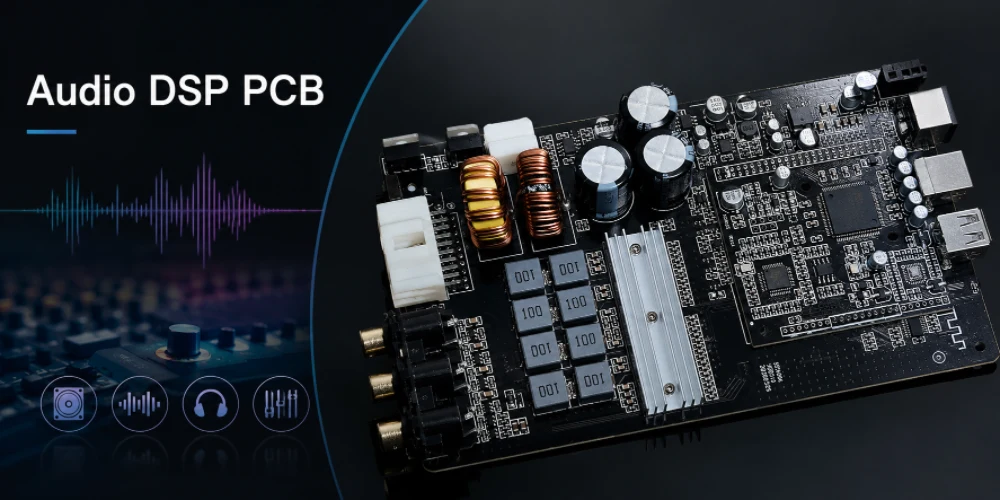
The noise-canceling headphones that make an airplane cabin disappear, the hearing aid that can distinguish a voice from background noise in a crowded restaurant, the home theater receiver that maps five audio channels to eleven speakers in a room it has never heard before — these are all audio DSP at work. Digital signal processing for audio has been around since the early 1980s, but what has changed is where it shows up. What was once confined to professional recording studios and broadcast facilities now runs on chips costing a few dollars, inside products that millions of people use every day. The processing power and sophistication of the algorithms have grown enormously; the PCBs that host these chips have grown correspondingly more demanding to design and build. This article is a complete guide to audio DSP from the algorithm level to the manufacturing floor.
What Audio DSP Actually Does
At its simplest, an audio DSP sits in the middle of an audio signal chain. An analog-to-digital converter (ADC) samples the incoming audio — typically at 44.1 kHz, 48 kHz, 96 kHz, or 192 kHz depending on the application — turning a continuous waveform into a stream of numbers. The DSP receives those numbers, performs mathematical operations on them, and produces a new stream of numbers representing the processed audio. A digital-to-analog converter (DAC) turns those numbers back into an analog signal for amplification and reproduction.
The key phrase is real time. Unlike offline audio processing — rendering an effect in a DAW, for example — an audio DSP must process every sample within a fixed time window: one sampling period. At 48 kHz that is approximately 20.8 microseconds per sample. The DSP core’s job is to complete all its algorithms for all channels within that window, on every single sample, indefinitely, without ever missing a deadline. This real-time constraint is why audio DSPs have architectural features — dedicated multiply-accumulate hardware, zero-overhead loops, hardware-scheduled I/O — that make them much more efficient at this specific workload than a general-purpose CPU.
What “processing” means in practice varies enormously by application:
- In a loudspeaker system, the DSP splits the audio into frequency bands and routes each band to the correct driver, applies time delays to align each driver’s wavefront, and limits output to protect drivers from overexcursion.
- In a noise-canceling headphone, the DSP takes a microphone signal from outside the earcup, inverts and delays it, and adds it to the audio signal to cancel ambient noise acoustically.
- In a hearing aid, the DSP compresses the dynamic range so that soft sounds become audible without loud sounds being uncomfortable, applies directional filtering to emphasize the signal in front of the wearer, and suppresses feedback between the microphone and receiver.
- In a recording studio console, the DSP applies parametric equalization to each channel, runs multi-band compression and limiting, adds reverb and delay effects, and routes signals to multiple output buses — simultaneously, on dozens of channels.
Each of these is a different set of algorithms, but they all share the same fundamental structure: DSP core, ADC inputs, DAC outputs, and a real-time execution requirement. The PCB design consequences of this structure are the subject of the later sections of this article.
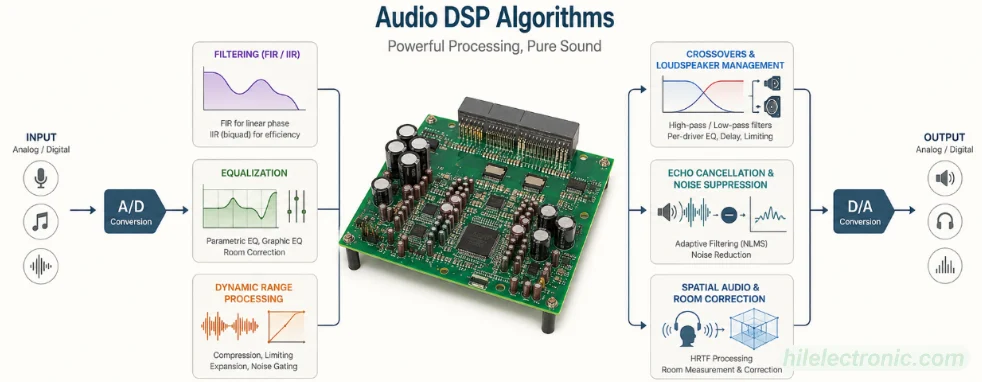
Four fundamental audio DSP algorithm families: equalization (shaping the frequency response), dynamic range compression (controlling level variations), crossover filtering (routing frequencies to appropriate outputs), and spectral analysis via FFT (used in noise cancellation, room correction, and codec processing).
Core Audio DSP Algorithms
Audio DSP algorithms fall into a few practical groups: shaping sound, controlling speaker behavior, improving voice clarity, and creating spatial effects. Together, they define how much processing power an audio DSP chip needs.
Key Algorithm Groups
- Sound shaping: FIR and IIR filters, parametric EQ, graphic EQ, and room correction adjust frequency balance, phase behavior, and tonal accuracy.
- Speaker control: Digital crossovers, delay, limiting, and per-driver EQ help route audio to the right speaker driver while protecting the system.
- Level control: Compressors, limiters, expanders, and noise gates manage loudness and prevent distortion or overload.
- Voice processing: Echo cancellation and noise suppression improve call quality by reducing feedback, room noise, and unwanted background sound.
- Spatial processing: HRTF, Dolby Atmos, DTS:X, and advanced room correction create a stronger sense of space, direction, and immersion.
In practice, these functions often run together. A smart speaker, for example, may use EQ, crossover filtering, limiting, echo cancellation, and noise suppression at the same time.
Simple EQ and crossover tasks can run on modest DSPs. Advanced room correction, adaptive echo cancellation, and spatial audio need more memory, more multiply-accumulate performance, and lower-latency processing.
How These Algorithms Affect Chip Selection
| Use Case | Typical DSP Workload |
|---|---|
| Active speakers | EQ, crossovers, delay, limiting |
| Hearing aids | Filtering, compression, feedback control, noise reduction |
| Conferencing devices | Echo cancellation, beamforming, noise suppression |
| Home theater systems | Room correction, bass management, surround rendering |
| Headphones and earbuds | EQ, ANC, transparency mode, spatial audio |
The main takeaway is simple: the more adaptive, multi-channel, or spatial the audio processing becomes, the more capable the DSP chip must be.
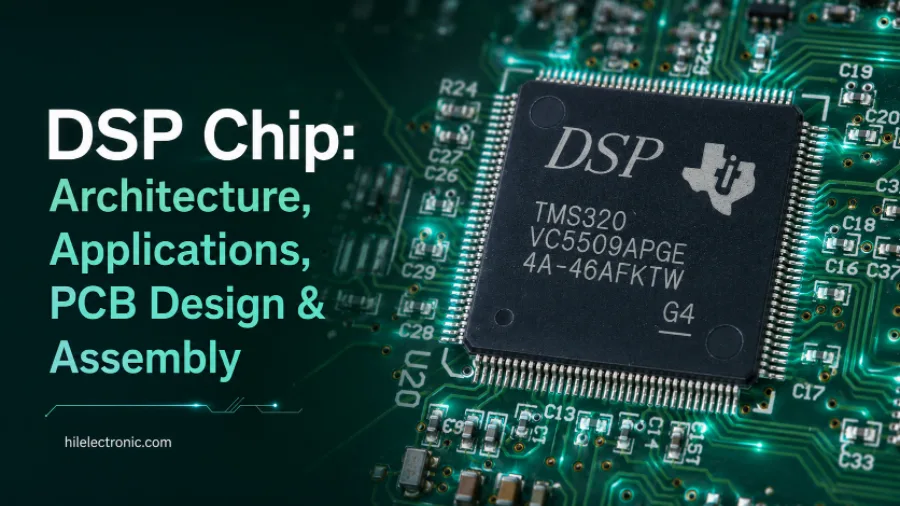
Audio DSP chips span a wide range from self-contained single-chip audio systems with integrated ADCs and DACs (lower left) to multi-core high-performance processors for professional and automotive applications (right).
Audio DSP Applications Across Industries
Audio DSPs are used anywhere sound needs to be cleaned, shaped, protected, or spatially controlled. The workload varies by product type: some devices prioritize low power and small size, while others need high channel counts, low latency, and advanced real-time processing.
Main Application Areas
| Industry | Typical DSP Tasks | Design Priority |
|---|---|---|
| Consumer electronics | ANC, EQ, wake-word detection, spatial audio, room correction | Small size, low power, audio quality |
| Automotive audio | Cabin EQ, time alignment, bass enhancement, road-noise control | Reliability, temperature tolerance, vibration resistance |
| Professional audio | Multi-channel mixing, EQ, compression, delay, loudspeaker management | Low latency, high channel count, floating-point performance |
| Hearing health | Speech enhancement, noise reduction, feedback cancellation, compression | Ultra-low power, miniature PCB design |
| Telecom and conferencing | Echo cancellation, beamforming, noise suppression, automatic gain control | Clean microphone paths, scalable processing |
Portable products usually need compact, low-power DSPs. Automotive and professional systems need more processing headroom, more I/O, and stronger reliability requirements.
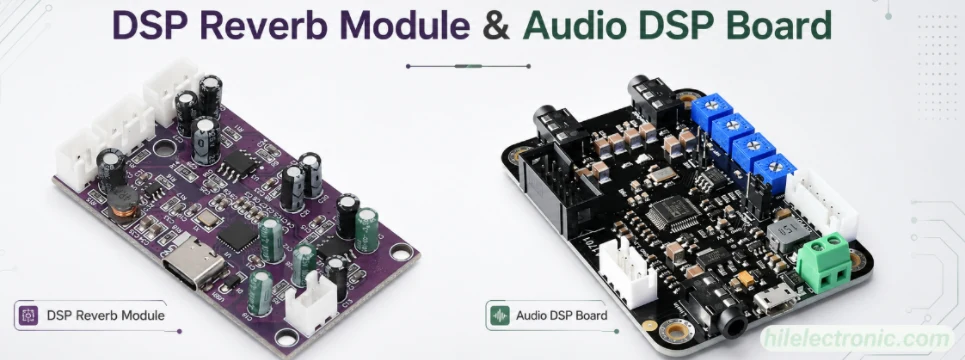
Audio DSP PCB Design: The Mixed-Signal Challenge
An audio DSP PCB is inherently a mixed-signal design: it contains both the high-fidelity analog circuitry (ADC input stages, DAC output filters, audio input amplifiers) that determines the system’s signal-to-noise ratio, and the digital switching circuitry (DSP core, clock, memory interfaces) that generates noise at clock frequency harmonics. The fundamental design challenge is preventing the digital noise from reaching the analog section — because a noise floor degradation that an oscilloscope might not even display clearly is audible in an audio context. Human hearing can detect artifacts 90–120 dB below the signal level; this is not a forgiving environment for electronic design.
Floor planning: the first and most important layout decision
The most effective noise mitigation technique is physical separation. If the ADC, DAC, analog input amplifiers, and audio signal traces are placed in one region of the board — the analog zone — and the DSP chip, digital memory, clock oscillator, and switching regulator are placed in a separate region — the digital zone — the ground currents from digital switching naturally stay in the digital zone without flowing through the analog section’s ground path. Once the floor plan is correct, every other noise mitigation technique works better because it has less to do. Reversing this decision — placing the DSP chip adjacent to the ADC input stage, for example — makes the analog signal chain’s noise performance very difficult to recover regardless of how carefully the rest of the layout is executed.
The floor planning rules for audio DSP PCBs:
- Place the analog input section — connector, input filter, any preamp, and ADC — together, away from the DSP chip and clock circuitry.
- Place the DAC and output filter together on the analog side, routing the analog output away from the DSP before reaching any connector or output amplifier.
- The DSP chip, its decoupling capacitors, clock oscillator, and any associated SPI flash or EEPROM go in the digital zone.
- The power supply section — especially any switching regulator — goes at the board periphery, away from both analog and digital signal paths, with its inductor and switch node oriented so that magnetic flux doesn’t couple into nearby traces.
- If an I²S or TDM digital audio interface connects the DSP to an external codec, route that interface through a neutral zone between the analog and digital sections rather than through either section.
Signal routing rules for audio DSP boards
Analog audio traces are the highest-priority signals to protect. They should be short, routed away from the clock and its harmonics, and never adjacent to high-current power supply traces. Digital clock traces — including the MCLK and BCLK signals of I²S interfaces — radiate at their fundamental frequency and harmonics and should be treated with similar discipline to a crystal oscillator: short, guarded, and on an internal layer with a reference plane above and below where possible. The general routing hierarchy for audio DSP boards: keep analog audio traces as short as possible; keep clock lines away from analog paths; route power supply connections as late as possible (after all signal routing is done).
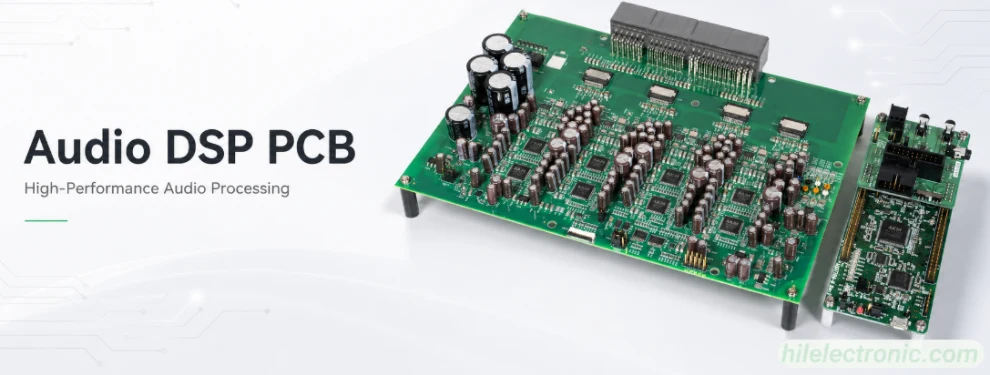
Grounding, Planes, and Partitioning on Audio DSP PCBs
For audio DSP PCB design, the safer approach is usually a single continuous ground plane with clear analog and digital layout zones. This avoids the EMI risk created by split ground planes while still keeping return currents under control.
Layout Principles
- Use one solid ground plane: It gives every signal a short, low-impedance return path.
- Separate by placement, not by cutting copper: Keep analog circuits in the analog zone and digital circuits in the digital zone.
- Avoid routing across plane gaps: A split or slot can force return current into a large loop and increase EMI.
- Control crossing points: Signals such as I²S should cross between zones at one defined location.
- Add via stitching where needed: Ground vias can help contain noise and improve shielding around sensitive analog sections.
Do not rely on split ground planes to fix noise. A continuous ground plane, correct component placement, controlled signal routing, and local shielding are usually more reliable.
Power Supply Design for Low-Noise Audio DSP Boards
An audio DSP board needs both efficient digital power and clean analog power. The power architecture should keep switching noise away from ADCs, DACs, clocks, and analog audio paths.
Power Design Summary
| Area | Preferred Approach | Reason |
|---|---|---|
| Digital supply | Use a buck regulator in the digital zone | Efficient for DSP cores and logic loads |
| Analog supply | Use low-noise LDO regulation | Reduces ripple before it reaches ADCs and DACs |
| Decoupling | Place capacitors close to every supply pin | Improves stability, noise floor, and dynamic range |
| Sequencing | Follow the DSP datasheet power-up order | Prevents startup and initialization failures |
Use switching regulators where efficiency matters, LDOs where noise matters, and keep the layout compact around regulators, supply pins, and return paths.
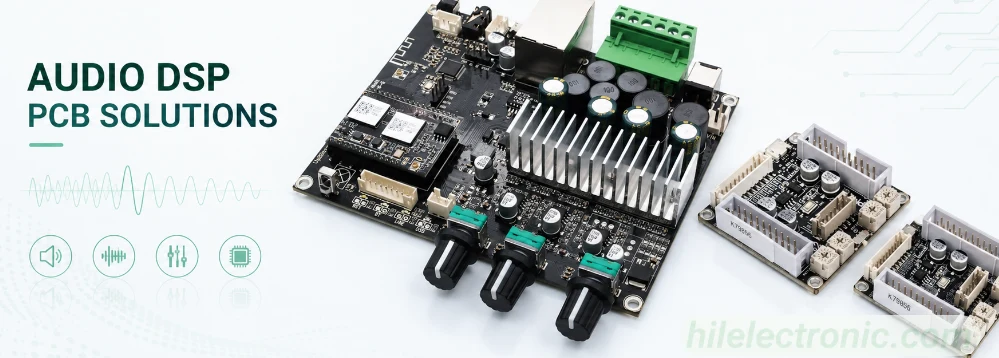
ADC and DAC Layout on Audio DSP PCBs
The ADC and DAC are the interfaces between the analog audio world and the DSP’s digital domain. Their placement, supply design, and the routing of their input and output traces have a direct effect on the audio system’s signal-to-noise ratio, dynamic range, and distortion performance.
Anti-aliasing filter placement and routing
Before an ADC’s input, an anti-aliasing filter — a low-pass filter that removes any signal content above the Nyquist frequency (half the sample rate) — is required to prevent aliasing artifacts. For a 48 kHz sample rate, the anti-aliasing filter must attenuate signals above 24 kHz significantly. The filter components (resistors and capacitors for an RC filter, or op-amp and passive components for an active Sallen-Key or MFB topology) sit immediately before the ADC’s analog input pin and should be routed with short traces to minimize pickup of high-frequency interference. If the input signal comes from a long trace run from a connector, that trace acts as an antenna; placing an RC filter close to the connector input reduces the energy that reaches the ADC.
DAC output filter and output stage
The DAC output is a stepped waveform — it changes in discrete jumps at the sample rate, and contains imaging artifacts at harmonics of the sample rate that must be removed by a reconstruction filter before the signal reaches an amplifier or connector. The reconstruction filter (typically a passive RC or an active op-amp filter) sits immediately after the DAC output pin, in the analog zone. The output amplifier — an op-amp buffer or a class-D driver — follows it. Routing the DAC output through any part of the digital zone between the DAC and the filter creates an opportunity for clock-frequency interference to be added to the analog signal; this must be avoided by keeping the entire DAC output path in the analog zone from DAC pin to output connector.
Differential signal paths for high-performance ADCs and DACs
Higher-performance audio ADCs and DACs use differential signal paths — two complementary signals carrying the audio, rather than a single-ended signal referenced to ground. Differential signaling offers common-mode noise rejection: any noise coupled equally onto both traces is subtracted out at the receiving input. This is why professional audio interfaces use balanced connections (XLR, TRS with tip-ring-sleeve), and why the PCB trace routing for the analog signal path on a high-end audio DSP board routes the signal as a differential pair all the way from input connector to ADC input, and from DAC output to output connector. Maintaining equal lengths, equal trace widths, and equal routing geometry between the two traces in a differential pair is essential to preserving the common-mode rejection — just as important as for high-speed digital differential pairs, but for opposite (noise immunity rather than signal integrity) reasons.
Clock and jitter: why audio ADC and DAC performance depends on PCB clock quality
The sample clock that governs when the ADC samples the analog input and when the DAC updates its output must be extremely stable. Clock jitter — variation in the timing of clock edges — converts directly to noise on the converted signal by a mechanism called aperture jitter. For a 24-bit DAC operating at a full-scale 20 kHz signal, the aperture jitter required to keep jitter noise below the quantization noise floor is less than 1 ps RMS. This is achievable with a good VCXO or TCXO oscillator and careful PCB layout — short clock traces, a clean supply for the oscillator, no routing adjacent to switching regulators — but it is easily degraded by poor layout choices. Asynchronous sample rate converters (ASRCs) are used in some designs precisely to re-clock the audio data from a low-jitter local clock, eliminating the dependency on an incoming clock’s jitter quality.
Audio DSP PCB Fabrication and Assembly at Highleap Electronics
Highleap Electronics is a PCB fabrication and assembly factory. Audio DSP boards represent a category we build regularly — from small-batch active loudspeaker controller boards and hearing instrument PCBs through automotive audio DSP modules and professional audio interface cards at volume. The manufacturing requirements for audio DSP boards carry some specific characteristics that standard PCB production doesn’t always address without explicit consideration.
Fabrication requirements specific to audio DSP boards
The controlled-impedance requirement on audio DSP boards is different from a purely digital design. Whereas a digital board primarily needs controlled impedance for its high-speed digital interfaces (DDR, PCIe), an audio board has an additional analog impedance requirement: the analog audio traces from input connectors to ADC, and from DAC to output connectors, need to maintain specified source and load impedances to avoid frequency-response variations that are audible. The stack-up confirmation must account for both the analog and digital impedance requirements — which may call for different trace widths on different layers. We provide confirmed stack-up calculations using actual laminate Dk values from our manufacturing process for every controlled-impedance design, including audio DSP boards.
Ground plane quality matters acutely on audio boards. Any void, slot, or irregular copper removal from the ground plane layer beneath the analog signal section — caused by via clearances, poor floor planning, or careless copper pour management — disrupts the return current path for sensitive analog signals and raises the noise floor. Our pre-fabrication DFM review checks ground plane continuity in the analog section as a specific audit item for audio designs, not a generic plane-fill check.
For automotive audio DSP boards, the fabrication specification must additionally address:
- High-temperature laminate material qualified to the product’s thermal cycling requirements (ISOLA 370HR or equivalent where standard FR-4 is insufficient).
- Conformal coating compatibility — automotive boards are often conformally coated after assembly, requiring appropriate surface finish and component clearance specifications.
- Extended temperature range surface finishes — ENIG (Electroless Nickel Immersion Gold) is preferred over HASL for automotive applications where solderability must remain consistent over the product’s life.
Assembly considerations for audio DSP boards
The ADAU1701 in its 48-LQFP package is a relatively accessible SMT component — a 7 mm × 7 mm body with 0.5 mm lead pitch, within the capability of standard SMT equipment with no special process requirements. The ADAU1452 in its 144-TQFP package and the SHARC family’s larger BGA variants require finer placement accuracy and, for BGAs, X-ray inspection post-reflow as standard — the same BGA assembly discipline described in our DSP Chip PCB article applies here.
The analog section’s passive components deserve care at the assembly stage. The anti-aliasing filter capacitors, DAC output filter capacitors, and supply decoupling ceramics for the ADC and DAC should be verified for correct orientation (where polarity matters) and for value tolerance — a 1% capacitor in a critical audio filter position producing a frequency-response error is one of the more common audio board performance failures that passes a simple go/no-go electrical test but produces audible colorations. Our production testing for audio DSP boards includes at-frequency electrical verification of the analog signal chain where the customer provides test vectors and pass/fail criteria, not just continuity and component presence checks.
For hearing aid and wearable audio DSP boards — where the PCB may be a rigid-flex or ultra-thin design with 0201 and 01005 components — the assembly process requires equipment and operator discipline that is distinct from standard consumer electronics assembly. We handle these builds as specialized programs with dedicated process setup and first-article inspection before production quantities are released.
Component sourcing for audio DSP programs
Audio DSP programs depend on components that occasionally face supply constraints: ADAU1701 and ADAU1452 have experienced lead times of 20–52 weeks during high-demand periods; crystal oscillators and precision audio capacitors (film and NP0/C0G types) similarly tighten in supply during demand surges. Our component sourcing service sources DSP chips and associated analog components through authorized distribution channels. For programs with long production commitments, we advise on safety stock strategies to keep production running through supply disruptions.
Whether you’re building the first prototype of an active loudspeaker with an ADAU1701 at its core, scaling a Bluetooth DSP earphone to volume production, or bringing an automotive audio processing module to the factory for the first time, the design-to-production path starts with a DFM review that confirms the board is manufacturable and that the mixed-signal floor plan is correct before the first board is fabricated. That review is free, and it is the most cost-effective part of the production process.
Audio DSP FAQs
What is the most popular audio DSP chip for DIY and embedded projects?
The Analog Devices ADAU1701 is the most widely used dedicated audio DSP for embedded product design and a popular choice for DIY active speaker projects. It integrates a 28/56-bit DSP core, two ADCs, four DACs, and I²S/SPI interfaces on a single chip, runs standalone from an external EEPROM, and is programmed graphically using Analog Devices’ free SigmaStudio software without writing code. The ADAU1452 is the higher-performance successor for designs requiring more processing power or more I/O channels.
What is the difference between audio DSP and a regular amplifier?
An amplifier changes the level of an audio signal — it makes it louder or matches it to a load impedance. An audio DSP processes the signal mathematically: it can change its frequency content (equalization), change its dynamic range (compression/limiting), split it into frequency bands (crossover), measure and cancel noise (ANC), add spatial effects, and apply time delays. Most modern audio systems use both: a DSP to process the signal and an amplifier to drive the speakers. Many integrated audio products combine both on the same PCB.
What is active noise cancellation and how does DSP enable it?
Active noise cancellation (ANC) uses a microphone to sample the noise before it reaches the listener’s ear, inverts the phase of that sampled noise signal (multiplying every sample by −1), and adds the inverted signal to the audio output. When the inverted noise reaches the ear simultaneously with the original noise arriving through the air, the two cancel — attenuating the perceived noise level by 25–40 dB for low-frequency content. The DSP handles the inversion, the delay adjustment (so the inverted signal arrives at the right time), and adaptive algorithms that update the cancellation signal as the noise environment changes. All of this runs in real time at the audio sampling rate; it is only practical on a dedicated DSP core because a general-purpose CPU would consume too much power for the battery life a headphone requires.

Recommended Posts

Isola Astra MT77 PCB Manufacturing
Figure 1. Isola Astra MT77 PCB ManufacturingIsola Astra...

Nelco N4000-13 PCB Material and Manufacturing Guide | Highleap Electronics
Figure 1. Nelco N4000-13 PCBNelco N4000-13 PCB is a...

Copper Clad Laminate: Complete Material Selection Guide for PCB Engineers
Every electrical property that matters in a printed...

Inside a China Ceramic PCB Factory: Process Control Across Power/LED/RF/Medical
Table of Contents Inside a China Ceramic PCB Factory: How...
How to get a quote for PCBs
Let’s run DFM/DFA analysis for you and get back to you with a report. You can upload your files securely through our website. We require the following information in order to give you a quote:
-
- Gerber, ODB++, or .pcb, spec.
- BOM list if you require assembly
- Quantity
- Turn time
For PCBA services, please provide your BOM (Bill of Materials) and any specific assembly instructions. We also offer DFM/DFA analysis to optimize your designs for manufacturability and assembly, ensuring a smooth production process.