
Aluminum LED PCB Design and DFM Guide

LED junction temperature is the single variable that determines lumen depreciation rate, color shift, and time to failure. Everything in aluminum LED PCB design either contributes to or reduces junction temperature. A designer who understands the thermal chain from junction to ambient can make layout decisions that recover 10–20°C of margin from a given heatsink. A designer who treats the PCB as a mechanical mounting substrate and leaves thermal optimization to the heatsink vendor gives back that margin unnecessarily. This guide covers the design decisions that matter.
The Thermal Chain: Where Heat Goes and Where It Stalls
Article Navigation
- The Thermal Chain: Where Heat Goes and Where It Stalls
- Running Thermal Simulation Before Committing to Layout
- LED Pad Geometry: Footprint Accuracy and Solder Joint Reliability
- Copper Trace Width for High-Current LED Strings
- Keepout Zones and Creepage Distance for Integrated LED Drivers
- DFM Rules Specific to Aluminum LED PCB Layout
- Design Handoff Checklist for Aluminum LED PCB Fabrication
- FAQ
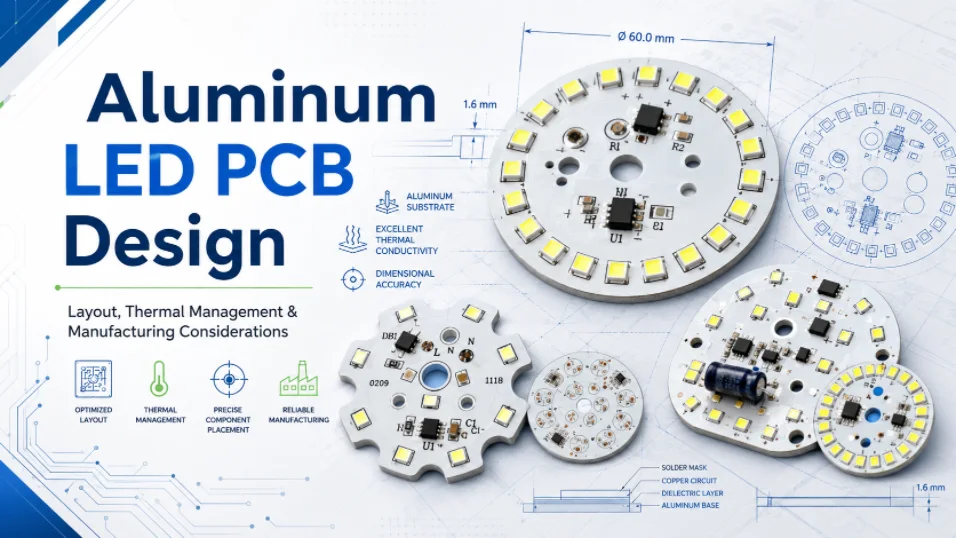
Heat flows from LED junction → LED package → solder joint → copper pad → dielectric layer → aluminum base → heatsink → ambient. Each interface has a thermal resistance value, and the PCB contributes three: the solder joint resistance, the copper-to-dielectric interface, and the dielectric layer itself.
Dielectric resistance is the dominant PCB thermal term:
- At 1.0 W/m·K, 100 µm dielectric: θ_dielectric ≈ 1.0°C/W per cm² of pad area
- At 2.0 W/m·K, 100 µm: θ_dielectric ≈ 0.5°C/W per cm²
- At 3.0 W/m·K, 100 µm: θ_dielectric ≈ 0.33°C/W per cm²
For a 3W LED on a 3 × 3 mm pad, the difference between 1.0 and 3.0 W/m·K dielectric is approximately 5°C of junction temperature at the die. Scale that across a 150W fixture with 50 LEDs and the system-level impact is significant.
The aluminum base adds negligible thermal resistance if it is adequately thick (≥1.0 mm) and the interface to the heatsink uses appropriate TIM (thermal interface material). The base-to-heatsink interface is often the largest thermal resistance in the assembly — but it is outside the PCB designer’s direct control.
Running Thermal Simulation Before Committing to Layout
Thermal simulation before PCB layout prevents two expensive errors: building a board that cannot cool adequately at rated power, and over-specifying the dielectric at unnecessary cost.
FEA inputs for aluminum LED PCB simulation:
- LED package thermal resistance (θ_j-s, from datasheet)
- LED forward power at operating current
- Pad and thermal slug dimensions
- Dielectric grade and thickness (this is the parameter you are solving for)
- Aluminum base dimensions and alloy
- Heatsink resistance and mounting interface TIM value
- Ambient temperature (worst-case: typically 50–60°C for enclosed luminaires)
What the simulation output tells you:
- Maximum LED junction temperature — compare against T_j rating (typically 125–150°C for modern LED packages)
- Hot spots from LED clustering — if LEDs are placed too close, thermal resistance from neighboring LED heat sources adds to junction temperature
- Required dielectric Tc to stay within junction temperature budget
Highleap Electronics provides MCPCB thermal simulation support for customers who need to validate their stack specification before committing to production. This is particularly useful when the choice between 2.0 and 3.0 W/m·K dielectric affects material cost significantly.
LED Pad Geometry: Footprint Accuracy and Solder Joint Reliability
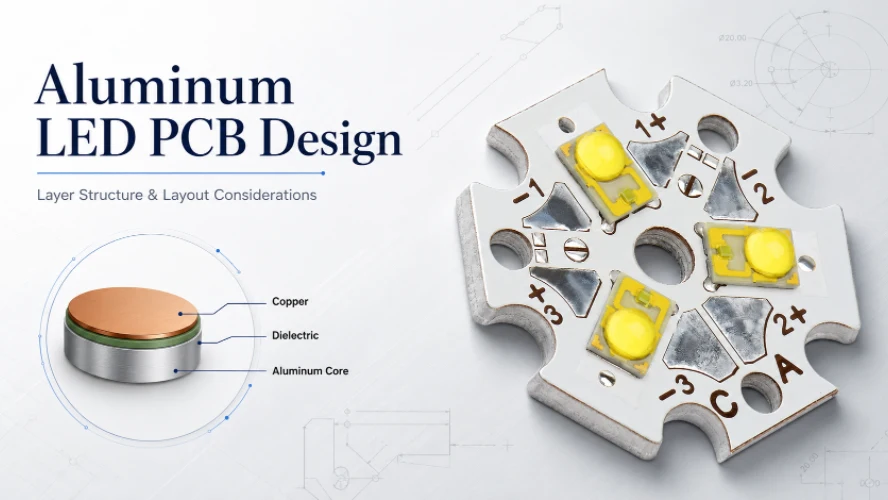
Pad geometry on aluminum LED PCBs has tighter consequences than on standard FR-4 because the aluminum base’s thermal mass is high and reflow temperature control is harder. Common pad design errors:
Oversized thermal pads: A thermal slug pad larger than the LED package’s slug footprint creates a solder reservoir during reflow that can wick solder from signal pads, causing insufficient joint formation at signal/anode/cathode pads. Size the thermal pad 0–0.1 mm per side larger than the package thermal slug, not 0.3–0.5 mm as sometimes specified for FR-4.
Solder mask opening ratio: For large thermal pads (>3 × 3 mm), use a segmented solder mask opening — multiple smaller openings rather than one fully exposed pad — to control paste volume and prevent voiding. Target 50–70% copper area exposure for pads ≥ 9 mm².
Pad coplanarity: Aluminum boards with dielectric thickness variation warp slightly during reflow. Pad coplanarity of ≤0.05 mm is achievable with controlled dielectric thickness. If your paste printing relies on tight coplanarity, discuss this with the factory as a controlled specification. Examine how solder mask design on PCBs affects assembly yield on metal core substrates.
Copper Trace Width for High-Current LED Strings
The IPC-2152 standard (formerly IPC-2221) provides the reference for trace width vs. current capacity. On aluminum LED PCBs, use the internal layer trace tables rather than external layer — because the trace is on the surface but the aluminum base absorbs heat from below, partially replicating internal layer thermal behavior.
Practical trace width guidelines for 1 oz copper on aluminum LED PCBs, 10°C rise:
| Current | Minimum Trace Width |
|---|---|
| 0.5 A | 0.25 mm |
| 1.0 A | 0.5 mm |
| 2.0 A | 1.0 mm |
| 5.0 A | 2.5 mm |
| 10.0 A | 5.0 mm |
For currents above 5 A, move to 2 oz or 3 oz copper. The trace width required at 1 oz for 10 A (5 mm) consumes layout area that is better used for additional LEDs in high-density designs. Explore heavy copper PCB design principles when copper weight exceeds 2 oz.
Keepout Zones and Creepage Distance for Integrated LED Drivers
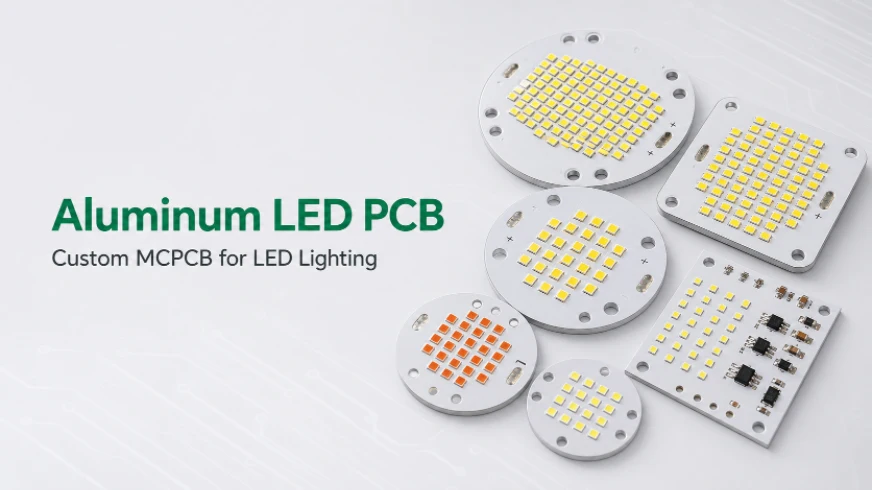
Many aluminum LED PCB designs integrate the LED driver circuitry on the same board as the LED array. This creates a high-voltage region (driver input side: 100–350V AC or DC) adjacent to the low-voltage LED string. Design rules:
Creepage distance: IEC 60950-1 and IEC 62368-1 define creepage and clearance requirements between high-voltage and low-voltage conductors. For reinforced insulation at 250V AC working voltage, minimum creepage distance on a PCB is 6.4 mm (Pollution Degree 2, Material Group IIIa). On aluminum LED PCBs where the aluminum base is at chassis potential, the distance from any live conductor to the nearest board edge or mounting hole also requires creepage analysis.
High-voltage keepout from mounting holes: Aluminum mounting holes connect the base to the fixture chassis. Any high-voltage trace must maintain creepage/clearance distance from these holes, accounting for the conductive fastener diameter.
Driver IC thermal pads: Some LED driver ICs have exposed thermal pads at high voltage potential (not ground). Verify pad voltage before defining solder mask openings and copper pours near these components.
DFM Rules Specific to Aluminum LED PCB Layout
Design for Manufacturability on aluminum substrates differs from FR-4 in several areas:
No vias in thermal pads: Unlike FR-4 where via-in-pad with copper fill is sometimes used, aluminum LED PCBs do not support buried or blind vias. All routing must be accomplished in the single copper layer. Copper pours and wide traces replace via-based heat spreading.
Minimum annular ring for aluminum drilling: Due to aluminum’s abrasion of drill tooling, drill wander is slightly higher than on FR-4. Minimum annular ring for plated-through holes on aluminum LED PCBs should be 0.25 mm, not 0.15 mm as might be acceptable on FR-4.
Component keepout from V-score lines: Standard keepout from V-score is 0.5 mm for components on FR-4. On aluminum, the V-score blade depth variation can be ±0.1 mm, and the aluminum score creates a slight surface disruption. Increase component keepout from V-score lines to 0.75 mm on aluminum LED PCBs.
Edge plating not available: Aluminum LED PCBs do not support edge plating. Any electrical connection requirement at the board edge must be made through pads pulled back from the edge by ≥0.5 mm.
For a complete DFM review before submitting your design for production, use the PCB DFM checklist as a pre-submission reference.
Design Handoff Checklist for Aluminum LED PCB Fabrication
Before sending files to the manufacturer:
- Gerber files: copper layer, solder mask top, silkscreen top, board outline (DXF or dedicated Gerber layer)
- Drill file: all holes with diameters, plated/non-plated designation
- Stack-up specification: aluminum grade, thickness, dielectric Tc grade, copper weight, total board thickness
- Surface finish specification: ENIG gold/nickel thickness, or HASL/OSP
- Hi-pot voltage requirement
- IPC class (2 or 3)
- Controlled specifications: dielectric thickness tolerance, copper thickness tolerance
- Solder mask color and opening ratio on large thermal pads
- Mounting hole chamfer or countersink details if required
Highleap Electronics’ engineering team performs a free DFM review on submitted files before quoting, identifying any of the above issues before they become production defects or rejected boards. The review is returned within 1–2 working days.
FAQ
What simulation tool should I use for aluminum LED PCB thermal design? ANSYS Icepak and Mentor FloTHERM are full FEA tools with material libraries for MCPCB dielectrics. For quicker results during initial design, LED manufacturer simulation tools (Lumileds SiteMap, OSRAM LED Expert) include simplified thermal models. Any simulation is better than no simulation — even a spreadsheet model of junction-to-ambient thermal resistance catches major design errors before prototyping.
How do I handle ground and power planes on a single-layer aluminum LED PCB? Single-layer boards have no ground plane in the traditional FR-4 multilayer sense. Power and ground (or current return) must be routed as separate traces. Copper pours on unused area can serve as local current return paths but are not electrically connected to the aluminum base. The aluminum base is either chassis ground or floating, depending on the fixture design — not automatically a circuit ground.
What pad finish should I specify for COB LED arrays on aluminum boards? ENIG is the correct choice for COB (chip-on-board) LED PCB assembly. The flat, reproducible surface is essential for die attach and wire bonding processes used in COB production. HASL’s surface variation is incompatible with the bond height tolerances in COB assembly.
How does the aluminum base affect SMT reflow profile? The aluminum base absorbs heat during ramp-up, requiring a slower ramp rate (maximum 2°C/s) and potentially higher peak zone temperature to achieve adequate pad temperature. The base also retains heat after leaving peak zones, extending the time above liquidus. Request a dedicated reflow profile from your assembly partner if switching from FR-4 to aluminum LED PCBs.

Recommended Posts
Taconic RF 35 vs RO4350B PCB
Table of contentsRF-35 vs RO4350B Procurement and...
TMM4 Filter PCB Manufacturing
TMM4 filter PCB manufacturing is controlled by the...
TMM3 PCB Manufacturing for RF Modules
TMM3 PCB manufacturing is most useful where the RF module...
TMM6 PCB Fabrication
TMM6 fabrication is the process-control page for a mid-Dk...
How to get a quote for PCBs
Let‘s run DFM/DFA analysis for you and get back to you with a report. You can upload your files securely through our website. We require the following information in order to give you a quote:
-
- Gerber, ODB++, or .pcb, spec.
- BOM list if you require assembly
- Quantity
- Turn time
For PCBA services, please provide your BOM (Bill of Materials) and any specific assembly instructions. We also offer DFM/DFA analysis to optimize your designs for manufacturability and assembly, ensuring a smooth production process.