
Copper Coin PCB for Power Modules: A Thermal Management Solution

Rising Thermal Challenges in Power Module PCBs Design
Power semiconductor modules using IGBT, SiC, and GaN technologies have become critical components in electric vehicles, industrial inverters, and high-efficiency power supplies. As switching frequencies increase and power densities rise, traditional substrates such as metal-core PCB and direct bonded copper struggle to manage heat effectively. Junction temperatures can exceed safe limits, compromising device reliability and shortening operational lifespans.
The core challenge lies in establishing efficient heat extraction paths from the semiconductor die to the external cooling system. Conventional FR4-based boards offer inadequate thermal conductivity, while ceramic substrates such as DBC deliver excellent performance at high cost and manufacturing complexity. Copper coin PCB technology addresses this gap by embedding localized high-conductivity thermal vias directly beneath power devices, creating efficient vertical heat channels within standard PCB structures.
Thermal Design Requirements of Power Module PCBs
Heat Flow Path in Power Modules
Power module PCBs designs dissipate heat along a defined path: semiconductor junction to die attach layer, substrate, baseplate, and finally to the heatsink. Each interface contributes thermal resistance, and the substrate layer often represents a significant bottleneck. For IGBT PCB and SiC power PCB applications, minimizing this resistance is essential to maintaining junction temperatures within safe operating ranges.
High Power Density Demands
SiC and GaN devices operate at higher voltages and frequencies than silicon IGBTs, resulting in concentrated heat flux at smaller die areas. Heat flux densities can reach 100-300 W/cm², demanding substrates with both high thermal conductivity and mechanical stability. Traditional PCB materials cannot handle these levels without risking delamination or thermal runaway.
Critical Substrate Performance Criteria
Power module PCBs designs must satisfy three primary requirements:
- Low thermal resistance – Efficient heat conduction from active devices to cooling systems
- High mechanical stability – Withstanding thermal cycling and vibration stresses
- Reliable electrical insulation – Preventing breakdown between high-voltage traces
Copper coin PCB technology meets these demands by combining localized copper mass with standard dielectric materials.

Copper Coin PCB for Heat Dissipation
Copper Coin PCB Structure for Power Module Applications
Embedded Copper Coin Architecture
Copper coin PCB employs thick copper cylinders or blocks embedded within the board structure, positioned directly beneath power semiconductor devices. Three manufacturing approaches exist: press-fit coins inserted into precision-machined cavities, fully embedded coins laminated during board fabrication, and inlay structures where coins form part of the inner layer stack. Each method creates a low-resistance thermal path from component to heatsink.
Vertical Thermal Conductivity Enhancement
Standard PCB copper traces conduct heat laterally with limited vertical thermal transfer through thin dielectric layers. Copper coins establish direct vertical channels with cross-sectional areas matching or exceeding the semiconductor footprint. This focused heat extraction reduces junction-to-case thermal resistance by 40-60% compared to conventional MCPCB structures, enabling higher current densities in power module PCBs assemblies.
Structural Comparison with Traditional Substrates
FR4 boards rely on thin copper layers separated by low-conductivity epoxy resin, creating high thermal resistance. MCPCB adds a metal core but retains a dielectric isolation layer that limits heat transfer. DBC bonds copper directly to ceramic, eliminating intermediate layers but requiring specialized processing. Copper coin PCB combines the manufacturing flexibility of FR4 with thermal performance approaching ceramic substrates.

Copper Coin Structure
Power Module PCBs Substrate Comparison: Copper Coin vs DBC and MCPCB
| Feature | DBC (Al₂O₃/AlN) | MCPCB | Copper Coin PCB |
|---|---|---|---|
| Thermal Conductivity | 170-230 W/mK | 1-4 W/mK | 80-150 W/mK (local) |
| Electrical Isolation | Ceramic (high voltage) | Dielectric layer | FR4 + Local insulation |
| Cost per Module | High | Medium | Medium |
| Manufacturing Lead Time | 4-6 weeks | 2-3 weeks | 2-4 weeks |
| Rework Capability | Difficult | Limited | Standard PCB process |
Cost-Effective Thermal Solution
DBC substrates deliver superior thermal performance but require ceramic materials and high-temperature bonding processes that increase costs by 3-5× compared to PCB-based solutions. Copper coin PCB achieves 70-80% of DBC thermal performance at approximately 40-50% of the cost, making it viable for mid-power applications where DBC margins cannot be justified. For SiC power PCB designs under 50 kW, copper coins often provide the optimal cost-performance balance.
Manufacturing and Supply Chain Advantages
Standard PCB fabrication equipment handles copper coin processing with minor tooling additions for cavity machining and coin placement. This compatibility reduces capital investment and allows existing PCB manufacturers to enter the power module market. DBC production requires specialized ceramic processing lines with limited global capacity, creating supply chain constraints during demand surges.
Reliability and Testing Considerations for Power Module PCBs
Thermal Cycling and Interface Integrity
Power modules undergo repeated heating and cooling during normal operation, creating mechanical stress at material interfaces. The copper-to-FR4 bond in copper coin PCB must withstand thermal expansion mismatches without delamination. Accelerated thermal cycling tests per IPC-9701 standard typically run -40°C to +125°C for 1000-2000 cycles to verify interface stability for automotive and industrial applications.
Peel Strength and Bonding Quality
Copper coin attachment relies on either mechanical press-fit retention or adhesive bonding during lamination. Press-fit designs achieve 15-25 N/mm peel strength through interference fit and thermal expansion locking. Laminated coins using high-temperature epoxy prepreg reach 20-30 N/mm, comparable to standard power module PCBs copper-to-core bonds. Testing protocols follow IPC-6012 Class 3 requirements for high-reliability applications.
Long-Term Thermal Performance Validation
Copper coin PCB thermal resistance can increase over time if interface degradation occurs due to oxidation or adhesive aging. Extended temperature exposure tests at 125-150°C for 2000-3000 hours assess long-term stability. Well-designed copper coin structures show less than 5% thermal resistance increase after aging, maintaining performance throughout typical 10-15 year product lifetimes in IGBT PCB applications.

Copper Coin PCB
Design and Manufacturing Guidelines for Copper Coin Power Module PCBs
Coin Geometry and Placement Strategy
Copper coin diameter should match or slightly exceed the power device footprint, typically 10-30 mm for discrete IGBTs and 20-50 mm for power modules. Coin thickness ranges from 1.5-3.0 mm depending on total PCB thickness and required thermal mass. Positioning coins directly beneath semiconductor die attach areas minimizes lateral heat spreading requirements and reduces junction temperature by 10-20°C compared to offset placement.
Manufacturing Process Control
Critical manufacturing parameters for power module PCBs with copper coins include:
- Cavity machining tolerance – ±0.05 mm precision ensures proper coin fit without air gaps
- Surface preparation – Mechanical abrasion or plasma treatment reduces interface thermal resistance from 0.3-0.5 K·cm²/W to 0.1-0.2 K·cm²/W
- Lamination control – Optimized pressure and temperature profiles achieve full contact without board warpage
Interface Thermal Resistance Optimization
The total thermal path includes copper coin interfaces with both PCB laminate and external components. Die attach layer thermal resistance typically dominates at 0.2-0.5 K/W for IGBT modules, while coin-to-PCB interface contributes 0.1-0.3 K/W. Solder layer thickness between component and coin surface should be minimized to 50-100 μm for optimal performance.
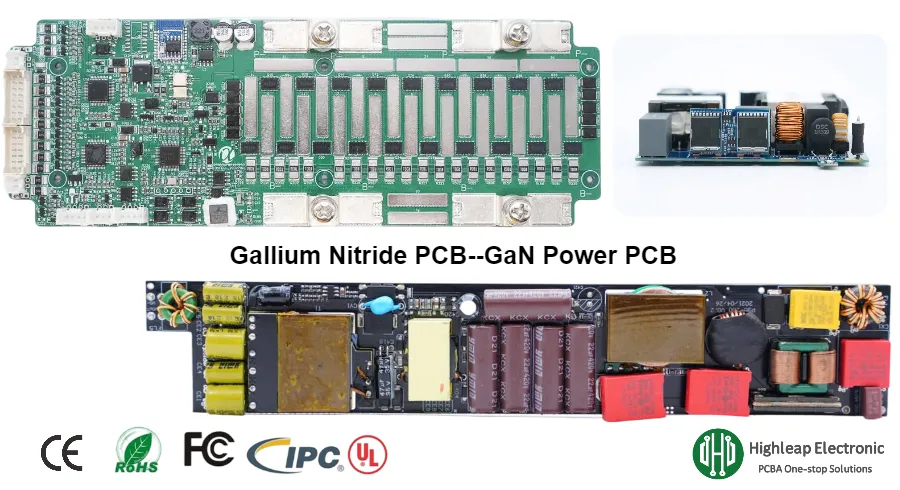
GaN Power PCB
Applications: SiC and GaN Power Module PCBs Solutions
Electric Vehicle Inverter Modules
SiC power modules in EV traction inverters operate at 400-800V with switching frequencies of 10-20 kHz, generating concentrated heat loads of 150-300W per device. Copper coin PCB enables compact three-phase inverter designs with multiple SiC MOSFETs sharing a common thermal plane. Junction temperatures remain below 150°C even during peak acceleration, ensuring reliable operation over 200,000 km vehicle lifetime.
Server and Telecom Power Supplies
GaN power modules for 48V DC-DC converters in data centers require substrates supporting high-frequency operation at 500 kHz-1 MHz. Copper coin power module PCBs provides low thermal resistance while maintaining low parasitic inductance through optimized trace layouts. Power densities exceeding 60 W/in³ become achievable, reducing server power supply footprint by 30-40% compared to silicon-based designs on MCPCB.
Industrial Motor Drives and Solar Inverters
Three-phase industrial drives using IGBT modules from 5-50 kW benefit from copper coin PCB thermal management without DBC substrate costs. Solar inverters operating at 97-99% efficiency still dissipate 50-200W as heat in power semiconductors. Copper coin structures enable fanless operation in outdoor enclosures by efficiently conducting heat to aluminum extrusion heatsinks.
Efficient and Reliable Power Module PCBs Platforms
Copper coin PCB technology delivers balanced thermal performance and manufacturing practicality for modern power semiconductor modules. By creating localized high-conductivity paths within standard PCB structures, this approach achieves 70-80% of DBC thermal performance at significantly lower cost and greater manufacturing flexibility. The technology proves particularly effective for SiC power PCB and GaN applications in the 5-50 kW range, where DBC economics remain challenging while thermal demands exceed MCPCB capabilities.
As power densities continue increasing with wide-bandgap semiconductors, copper coin PCB provides a scalable platform that PCB manufacturers can implement without specialized equipment investments. The combination of proven reliability through thermal cycling validation, compatibility with standard assembly processes, and cost-effectiveness positions copper coin technology as a practical solution for automotive, industrial, and renewable energy power electronics.
Highleap Electronics Power Module PCBs Capabilities
With over 15 years of expertise in advanced PCB fabrication and power module assembly, Highleap Electronics delivers comprehensive copper coin PCB solutions:
- Thermal simulation and design optimization – FEA modeling to verify thermal performance before production
- Precision copper coin embedding – Cavity machining tolerance to ±0.05 mm with controlled lamination processes
- Full turnkey assembly services – Component sourcing, SMT placement, and final testing for IGBT, SiC, and GaN modules
- Quality validation testing – Thermal cycling per IPC-9701, peel strength testing, and long-term reliability assessment
Contact our engineering team to discuss how copper coin power module PCBs technology can optimize thermal management for your next high-power application.

Recommended Posts
Prototype PCB Assembly: From Design Files to Tested Boards
Highleap Electronics builds prototype PCB assemblies for...
Hard Gold Finger PCB Manufacturing: Plating and Beveling
Hard gold finger PCB manufacturing is used when a circuit...
Small PCB Panelization: Array Design and Depaneling
Imagine a 26 × 18 mm circuit that must pass through...
PCB Panelization for Volume Production: Cost and Yield
A fabrication panel that holds more boards is not...
How to get a quote for PCBs
Let‘s run DFM/DFA analysis for you and get back to you with a report. You can upload your files securely through our website. We require the following information in order to give you a quote:
-
- Gerber, ODB++, or .pcb, spec.
- BOM list if you require assembly
- Quantity
- Turn time
In addition to PCB manufacturing, we offer a comprehensive range of electronic services, including PCB design, PCBA, and turnkey solutions. Whether you need help with prototyping, design verification, component sourcing, or mass production, we provide end-to-end support to ensure your project’s success.
For PCBA services, please provide your BOM (Bill of Materials) and any specific assembly instructions. We also offer DFM/DFA analysis to optimize your designs for manufacturability and assembly, ensuring a smooth production process.