
Custom Aluminum LED PCB Application Guide

A custom aluminum LED PCB designed for an automotive tail lamp and one designed for a horticulture grow light share the same basic structure — copper circuit on dielectric on aluminum base — and almost nothing else. Power density, thermal cycle severity, vibration profile, moisture exposure, regulatory requirements, and replacement cycle cost are all different by application. This article maps the custom aluminum LED PCB specification decisions that are driven by end-use environment, not by generic “best practice.”
Automotive LED PCBs: Thermal Shock, Vibration, and Functional Safety
Article Navigation
- Automotive LED PCBs: Thermal Shock, Vibration, and Functional Safety
- Horticultural LED PCBs: Full-Spectrum Power Density and Heat Load
- Marine and Outdoor LED Arrays: Corrosion and Environmental Exposure
- Medical and Surgical Lighting: Biocompatibility and Sterilization
- High-Bay Industrial Lighting: High-Current Design and Bus Bar Integration
- Matching Aluminum Grade and Dielectric to Each Application
- FAQ
Automotive LED applications span headlamps, tail lamps, interior ambient lighting, and dashboard illumination. The thermal and mechanical environment is uniquely demanding:
Thermal cycling: Automotive LED boards cycle from −40°C to +125°C or higher in engine bay applications. Standard polymer-composite dielectrics experience CTE mismatch stress at these extremes. Custom automotive LED PCBs use dielectric grades with higher Tg (>150°C) and lower CTE, verified through thermal shock testing per AEC-Q200 or JEDEC JESD22-A104.
Vibration: Road vibration generates 5–2000 Hz mechanical stress. Solder joint failures on aluminum LED PCBs in vibrating environments are primarily fatigue-driven. Custom specifications include: ENIG surface finish (not HASL, which creates non-planar solder joints), larger pad-to-body clearance on LED packages, and in some cases potting of the assembly after reflow.
IATF 16949 and PPAP: Automotive supply chains require IATF 16949-compliant manufacturing and PPAP (Production Part Approval Process) documentation for any board entering a vehicle. This includes dimensional measurement reports, capability studies (Cpk for dielectric thickness, copper thickness), and process FMEAs. Highleap Electronics supports PPAP-level documentation for automotive LED customers.
Current sink sharing: Automotive LED strings often share a common current sink with firmware-controlled dimming. Custom aluminum LED PCBs for these applications require trace routing that isolates current strings to prevent thermal cross-coupling that causes uneven dimming perception.

Horticultural LED PCBs: Full-Spectrum Power Density and Heat Load
LED grow lights represent the highest continuous power density application for aluminum LED PCBs in volume production. A typical 720W horticulture fixture runs 9–12 W/cm² over the LED array area, with no off-cycle cooling. The custom PCB requirements:
Dielectric selection: 2.0–3.0 W/m·K dielectric is standard for horticulture. At 3.0 W/m·K, LED junction temperature for a 10 W die can be 12–18°C lower than at 1.0 W/m·K under identical conditions, extending L70 lifetime from ~30,000 to 50,000+ hours.
White solder mask: Horticultural LED arrays combine red, blue, far-red, and white LEDs. White solder mask reflects photons that miss the primary optic back into the canopy, recovering 4–7% of total photon output without any electrical change.
Copper weight: Full-spectrum arrays drawing 3–8 A per string require 2 oz copper minimum. For fixtures above 600W, 3 oz copper traces prevent resistive heating from adding to the LED thermal load and degrading PAR uniformity across the array.
Panel dimensions: Horticulture boards are often full-fixture width — 250 × 500 mm or 200 × 600 mm is common. Confirm factory aluminum panel size capability before finalizing board dimensions. Highleap Electronics supports large-format PCB production for aluminum substrates.
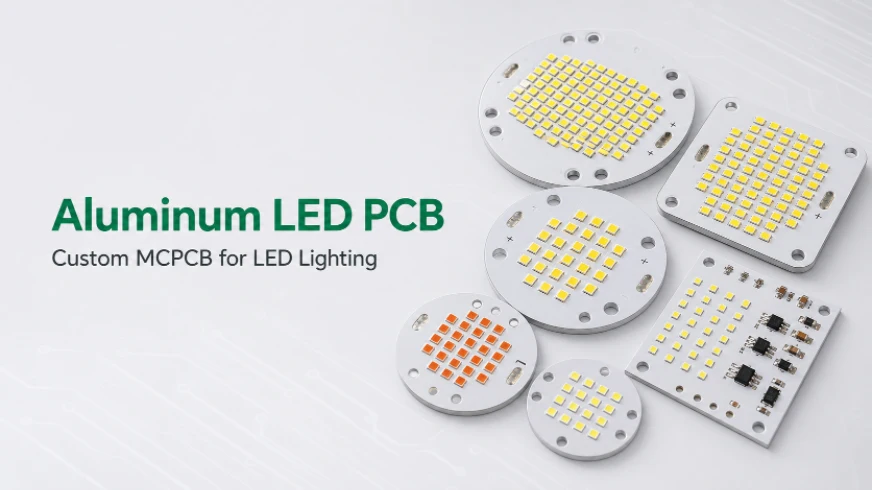
Marine and Outdoor LED Arrays: Corrosion and Environmental Exposure
LED boards in marine, outdoor, and coastal environments face continuous humidity, salt spray, and UV exposure. The aluminum base itself is reasonably corrosion-resistant, but edge exposure and mounting hole surfaces are vulnerable without treatment.
Aluminum alloy choice: 5052 over 1050 for any marine or outdoor application. The magnesium content in 5052 provides significantly better saltwater corrosion resistance, which matters where board edges or the bottom surface contact saline moisture.
Conformal coating: After LED assembly, conformal coating (acrylic, silicone, or polyurethane) protects copper traces, solder joints, and component bodies from moisture ingress. The aluminum base itself is not coated — it functions as the heatsink and must contact the fixture housing. Designing the PCB for conformal coating requires solder mask coverage extending fully to board edges and clear marking of coating exclusion zones around thermal pads.
ENIG surface finish mandatory: Outdoor and marine boards assembled seasonally or stored in humid warehouses cannot use OSP (which degrades in humidity) or HASL (which begins surface oxidation within months of production). ENIG’s gold layer provides reliable solderability with 12+ months shelf life even in high-humidity storage.
IP rating considerations: The PCB is not the IP-rated element — the luminaire housing is — but the LED board design determines how easily the housing can achieve IP65 or IP67. Boards with connectors and wire exit points at non-sealed locations introduce moisture ingress risk at the housing design level. Custom outdoor aluminum LED PCBs should be reviewed against the housing seal design early in product development.

Medical and Surgical Lighting: Biocompatibility and Sterilization
Surgical shadowless lights, endoscope illumination rings, dental curing lamps, and phototherapy panels place the LED board in or near clinical environments. Custom requirements:
Material biocompatibility: The dielectric and solder mask must be free from substances restricted under ISO 10993 or equivalent. Standard commercial dielectric grades may contain flame retardants that are not restricted for PCB applications but are not tested for biocompatibility. Request a full material declaration from the factory for any board entering a medical device.
Sterilization compatibility: If the luminaire housing is autoclaved (steam, 121°C, 30 min), the aluminum LED PCB must survive repeated sterilization cycles without solder joint fatigue or dielectric delamination. Autoclave survival testing is not standard in PCB manufacturing — it must be specified and tested as part of medical device validation. Highleap Electronics supports medical PCB assembly qualification programs.
Color rendering and spectral control: Medical lighting requires Ra ≥ 90 (general illumination) or specific spectral peaks for tissue visualization. Custom LED selection and grouping — mixing color-binned LEDs on a single board — requires custom pad layout and thermal management for each LED type at its operating current.
High-Bay Industrial Lighting: High-Current Design and Bus Bar Integration
Industrial high-bay fixtures (150–600W) push aluminum LED PCBs to their current-carrying limits. Standard 1 oz copper traces cannot carry the 10–20 A strings in these fixtures without unacceptable resistive heating.
Bus bar design: Custom aluminum LED PCBs for high-bay applications use 3 oz copper or embedded bus bars — thick copper segments routed as power rails separate from signal traces. Bus bar design requires thermal simulation to confirm that trace temperature rise from resistive heating is included in the LED junction temperature budget.
Multiple LED string topology: Large fixtures run multiple parallel LED strings for current balancing and redundancy. Custom PCB layout must ensure equal string length for matched forward voltage at operating temperature, and isolation between strings adequate for the driver’s common-mode voltage specifications.
Thermal simulation before layout: For high-bay applications, MCPCB thermal simulation before committing to layout identifies hot spots from current concentrations and LED clustering before the board is built. Simulation inputs include LED power at operating current, trace resistance from copper weight and geometry, dielectric Tc, and ambient temperature.
Matching Aluminum Grade and Dielectric to Each Application
| Application | Recommended Aluminum Alloy | Dielectric Tc | Copper Weight |
|---|---|---|---|
| Automotive (cabin) | 5052 | 2.0 W/m·K, high Tg | 1–2 oz |
| Automotive (headlamp) | 5052 | 3.0 W/m·K, high Tg | 2 oz |
| Horticulture | 1050 | 2.0–3.0 W/m·K | 2–3 oz |
| Marine/outdoor | 5052 | 2.0 W/m·K | 1–2 oz |
| Medical | 1050 | 2.0 W/m·K, biocompatible | 1 oz |
| Industrial high-bay | 1050 | 3.0 W/m·K | 3 oz |
FAQ
What dielectric thermal conductivity do I need for a 10 W LED? At 10 W per die on a standard 3535 or 5050 package, 2.0 W/m·K dielectric at 100 µm thickness produces a dielectric thermal resistance of approximately 0.5–0.8°C/W. Junction temperature rise from the dielectric alone at 10 W is 5–8°C. For junction temperature budgets tighter than this, move to 3.0 W/m·K.
Can I use the same aluminum LED PCB design for both indoor and outdoor applications? Not reliably. Outdoor applications require 5052 aluminum alloy, ENIG surface finish, conformal-coating-compatible solder mask, and edge treatment. Indoor designs using 1050 alloy, OSP finish, and no edge treatment will fail in outdoor environments.
Does automotive LED PCB design require AEC-Q200 qualification? AEC-Q200 applies to passive components, not to the PCB substrate itself. However, automotive customers typically require the PCB to survive the same temperature cycling and vibration profiles that AEC-Q200 defines for passives, validated through system-level qualification testing.
How does high-current trace design affect custom aluminum LED PCB layout? At 3 oz copper, a 3 mm wide trace carries approximately 8–10 A with a 10°C rise above ambient. For 15–20 A strings, trace width must increase to 5–8 mm or bus bar copper (>4 oz) must be used. These widths significantly constrain LED placement density and require early consideration in custom LED PCB design.

Recommended Posts
TMM4 Filter PCB Manufacturing
TMM4 filter PCB manufacturing is controlled by the...
TMM3 PCB Manufacturing for RF Modules
TMM3 PCB manufacturing is most useful where the RF module...
TMM6 PCB Fabrication
TMM6 fabrication is the process-control page for a mid-Dk...

TMM10 PCB Manufacturing for Compact RF Designs
Table of contentsHow TMM10 Shrinks RF StructuresTMM10 vs...
How to get a quote for PCBs
Let‘s run DFM/DFA analysis for you and get back to you with a report. You can upload your files securely through our website. We require the following information in order to give you a quote:
-
- Gerber, ODB++, or .pcb, spec.
- BOM list if you require assembly
- Quantity
- Turn time
For PCBA services, please provide your BOM (Bill of Materials) and any specific assembly instructions. We also offer DFM/DFA analysis to optimize your designs for manufacturability and assembly, ensuring a smooth production process.