
Fiber Optic Canister PCB Manufacturing and Assembly for Tethered UAV Ground Systems

Inside a tethered UAV system, the canister is far more than a mechanical container for fiber. It is the ground-side control point for optical transmission, payout supervision, tether health monitoring, and, in many systems, power delivery to the aircraft. The electronics inside that canister determine whether the link remains stable, whether faults are detected in time, and whether the entire ground-side system can perform reliably in field conditions.
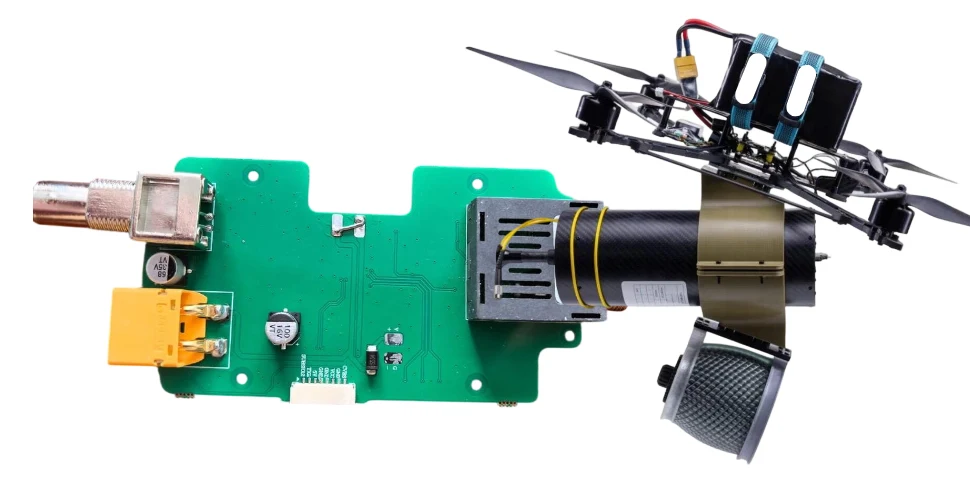
That is why the fiber optic canister PCB plays a central role in system performance. It connects optical interfaces, control logic, sensing, protection, and operator-side functions into one board-level platform. Highleap Electronics supports these programs through advanced multilayer PCB fabrication and precision build services for UAV electronics, while also providing PCB fabrication and assembly for a wide range of custom drone PCB applications.
Table of Contents
Ground-Side System Function of the Canister PCB
Within a fiber-linked UAV architecture, the canister PCB acts as the electronic core of the ground-side tether module. Its role is not limited to signal routing. In most practical systems, it coordinates several functions at once: communication handoff, deployment-state awareness, control logic, fault supervision, interface management, and sometimes high-voltage or high-power tether support.
The exact board role depends on the mission profile and the type of canister being used. In lower-cost expendable systems, the board may be optimized around simpler monitoring and controlled release. In reusable tethered systems, the board often becomes a more capable control platform with richer diagnostics, active supervision, interface electronics, and longer service-life expectations.
Typical system responsibilities include:
- Managing the ground-side optical path between external electronics and the tether link
- Supervising payout or retrieval state in systems with active cable handling
- Monitoring line integrity to detect attenuation, interruption, or abnormal deployment behavior
- Interfacing with operator or vehicle systems through serial, Ethernet, or dedicated control channels
- Coordinating power, sensing, and protection functions when the tether carries more than data
Because these responsibilities sit at the intersection of communication, control, and field reliability, the canister board must be treated as a system board rather than a peripheral accessory. In larger UAV platforms, it often works alongside the ground-to-air fiber tether electronics that manage the broader link architecture.
Optical Monitoring, Link Control, and Fault Detection
One of the most important functions inside a fiber optic canister is maintaining confidence in the communication path. The canister PCB is usually the best location for this because the ground side has more available power, more space for interface electronics, and fewer airborne constraints than the UAV side.
At the most basic level, the board must know whether the link is healthy. This may involve optical power monitoring, receive-margin supervision, continuity checks, and fault signaling back to the rest of the system. In more advanced designs, the board may support diagnostic functions that distinguish between partial loss, connector degradation, bend-induced attenuation, payout-related stress, or full fiber break.
Depending on the architecture, the canister PCB may also support:
- Electrical-to-optical and optical-to-electrical conversion for ground-side equipment
- Conditioned optical pass-through where the canister acts as an intelligent link point
- Multi-channel optical management in systems using more than one data path
- Independent fault signaling so break detection is not fully dependent on the main processor state
This function becomes even more important when the UAV system includes active spool or deployment logic. In those cases, the communication board may need to share status with the fiber pay-out control board so that tether handling and optical monitoring remain coordinated rather than isolated.
Power Handling and Electrical Isolation Inside the Canister
Many canister-based UAV systems carry not only optical data, but also electrical power through the tether. Once power delivery is added, the canister PCB stops being a pure interface board and becomes a mixed-domain electronics platform that must safely manage communication, control, and power functions in the same assembly.
This introduces a different class of design requirement. The board may need to support DC power injection, conversion, distribution, regulation, and protection while keeping the optical and logic sections electrically isolated from high-energy paths. In reusable ground stations, these power sections may range from moderate support electronics to substantial conversion stages for longer-endurance tethered UAVs.
Key requirements often include:
- High-voltage or high-power routing discipline across tether-fed power sections
- Isolation barriers between communication electronics and power domains
- Fault protection for over-current, short-circuit, ground fault, or abnormal cable events
- Thermal control for converters, protection devices, and power-stage components
- Clear creepage and clearance strategy through layout, slots, spacing, and enclosure design
On boards that combine optical signaling with power transfer, noise control also becomes critical. Switching activity, return paths, and thermal concentration can all affect nearby control and interface sections if the PCB is not partitioned correctly. That is one reason canister boards often share some design priorities with anti-interference PCB strategies used in UAV platforms where high-energy and signal-sensitive sections must coexist on one platform.
Mechanical Reliability and Environmental Protection
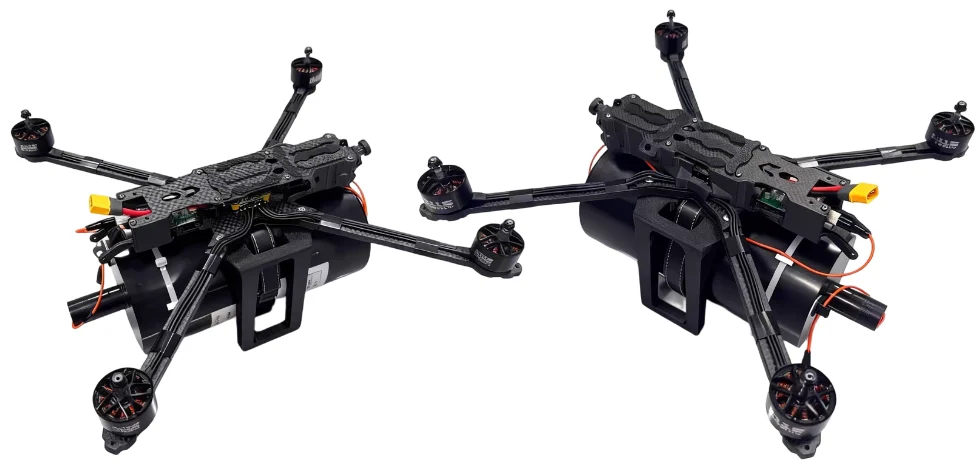
Ground-side tether hardware sees a very different environment from a typical indoor electronics assembly. Canister boards may be exposed to transport shock, dust, moisture, vibration, enclosure heating, repeated cable motion, field handling, and long storage intervals. A board that performs well in the lab can still fail in service if those environmental conditions are not accounted for in the design and build process.
Mechanical reliability starts with the PCB structure itself. Board thickness, mounting method, connector reinforcement, and support point placement all affect how well the assembly tolerates dynamic loading. This is especially important in systems where connectors, cable interfaces, payout modules, or operator-side wiring place local mechanical stress on the board.
Environmental protection typically involves several layers:
- Conformal coating or selective protection against moisture and contamination
- Thermal conduction design to move heat into the enclosure or chassis
- Sealed or semi-sealed housing integration for outdoor and field use
- Connector and interface protection for repeated service and exposure
- Hardware-level fault behavior for jam, overload, break, or deployment failure events
Operational reliability also depends on how the board behaves when the unexpected happens. Critical events such as line break, payout jam, over-tension, or abnormal power conditions should trigger controlled responses even if the main software is delayed or partially compromised. This is particularly important in systems where communication continuity is central to mission success.
For canister hardware installed near power electronics or communications subsystems, electromagnetic behavior may also matter. In those cases, the board may benefit from design and fabrication practices similar to EMI-resistant layouts for drone electronics, especially where enclosure density and mixed-domain integration are high.
PCB Fabrication and Assembly Requirements for Canister Hardware
Fiber optic canister PCBs are demanding from a manufacturing perspective because they often combine optical interfaces, control electronics, power circuitry, rugged connectors, and field-oriented reliability expectations in one assembly. A board like this cannot be treated as a simple low-cost interface PCB if the end product is expected to survive real deployment conditions.
From the fabrication side, important requirements may include:
- Multilayer stackups for organized routing, domain separation, and power distribution
- Heavier copper or selective copper strategy where the board carries meaningful power
- Controlled impedance sections for signal-sensitive or high-speed interfaces
- Milling, slots, and isolation geometry for electrical separation and mechanical accommodation
- Material choices driven by temperature, environment, and service life rather than lowest cost alone
From the assembly side, the requirements are just as demanding. Mixed-technology builds may include fine-pitch SMT, optical modules, large connectors, power devices, mechanical reinforcements, and selective coating processes. Cleanliness, assembly order, inspection coverage, and functional testing all affect field performance. For programs that need sourcing and build coordination in one workflow, Highleap also supports turnkey PCB assembly workflows that combine procurement, build planning, and production execution.
For UAV programs with more integrated board structures, canister electronics may also connect conceptually with rigid-flex drone board design, especially where packaging efficiency, connector reduction, or complex internal routing are part of the larger system strategy.
As a fabrication partner with in-house PCB assembly capability, Highleap Electronics supports engineering prototypes, pilot builds, and repeat production for canister PCB projects that require one-stop coordination across manufacturing, assembly, inspection, and supply control. For broader integration beyond bare boards and PCBA, this can also extend into a full electronic manufacturing service workflow.
FAQ
What is a fiber optic canister PCB?
It is the electronic control and interface board used inside a fiber canister, tether module, or ground-side deployment unit for UAV systems. It may manage optical communication, tether supervision, control logic, and power-related functions.
Is a canister PCB the same as a spool PCB?
Not necessarily. In many systems, the canister PCB handles the ground-side or deployment-side electronics, while spool-related boards may manage payout or airborne-side functions. The exact division depends on the system architecture.
Can one canister board handle both optical communication and tether power?
Yes. Many tethered UAV systems combine both functions, but this requires careful isolation, protection, and mixed-domain PCB design.
What is the main difference between expendable and reusable canister boards?
Expendable boards are usually optimized for cost and single-use reliability, while reusable boards are designed for repeated operation, richer monitoring, and longer service life.
Can Highleap Electronics support fabrication and assembly for this type of board?
Yes. Highleap Electronics provides PCB fabrication and PCB assembly for advanced UAV electronics, including canister boards that combine optical, control, and power functions.
More than a simple interface board, a fiber optic canister PCB serves as the electronic foundation for optical link control, tether supervision, protection logic, and, in many systems, power transfer inside a UAV ground-side module. For projects that require stable canister electronics, Highleap Electronics provides integrated PCB fabrication and PCB assembly support from engineering prototype to repeatable production.

Recommended Posts
Custom Smart Motorcycle Helmet PCB for Connected Riding
A smart motorcycle helmet may combine an intercom,...
Wearable Haptic Vest PCB Manufacturing & Assembly for Multi-Zone Haptic OEMs
In a wearable haptic vest, the wearer notices the...
Wearable Temperature Logger PCB Manufacturing & Assembly for BLE Sensor OEMs
A wearable temperature logger PCB is the electronic board...
Connected Safety Helmet PCB Manufacturing & Assembly for Industrial IoT OEMs
A Connected Safety Helmet PCB is an industrial IoT...
How to get a quote for PCBs
Let us run DFM/DFA analysis for you and get back to you with a report.
You can upload your files securely through our website.
We require the following information in order to give you a quote:
-
- Gerber, ODB++, or .pcb, spec.
- BOM list if you require assembly
- Quantity
- Turn time