
How a PCB Is Made: Fabrication Process Guide

Figure 1. how a PCB is made
Making a printed circuit board means turning a design into a physical board with copper traces, holes, and a protective finish. There are two very different ways to get there: making one yourself at home with etching or milling, and having one fabricated in a professional factory. Both produce a working board for the right project, but they differ enormously in capability, finish, and reliability. This guide explains how to make a PCB both ways, what the home methods can and cannot do, and how a factory builds a board step by step, so you can choose the right route for what you are building.
Key takeaways
- Home methods, toner transfer, UV photoresist, and CNC milling, can make simple one- or two-layer boards quickly and cheaply.
- DIY boards lack reliable plated-through holes, soldermask, professional finishes, controlled impedance, and fine features.
- Professional fabrication adds plated holes, multiple layers, soldermask, silkscreen, surface finishes, and electrical testing.
- Switch to a manufacturer when you need more than two layers, plated vias, fine traces, a finish, or repeatable quality.
- A fabricator that also assembles can take you from bare board to finished, populated board with one set of files.
Table of Contents
From Design to Physical Board: The Big Picture
However a board is made, it starts the same way: a design captured in EDA software produces a set of manufacturing files, principally Gerber files for each copper and mask layer and a drill file for the holes. Making the board is the process of realizing those files in copper-clad laminate.
The core idea is always to define copper where you want it and remove it everywhere else, then add holes and protective layers. Home methods do this with chemistry or a cutting tool on a single piece of copper-clad board. Factories do it with photolithography, precision drilling, electroplating, and a series of controlled chemical and thermal steps that home setups cannot match. Understanding that shared goal makes the differences between the two routes easy to see.
Making a PCB at Home
DIY fabrication is a satisfying way to get a simple board fast, often the same day. There are three common approaches.
Toner transfer
You print the copper pattern onto special paper with a laser printer, iron or heat-press it onto the copper-clad board so the toner bonds as an etch resist, then etch away the bare copper. It is cheap and needs little equipment, but resolution is limited and results vary with technique.
UV photoresist
You use a board (or a coating) sensitive to UV light, expose it through a printed mask of your pattern, develop it, and etch. This gives finer, more repeatable results than toner transfer and is the better home method when you need cleaner traces.
CNC milling (isolation routing)
Instead of chemistry, a small CNC machine mechanically cuts away copper around your traces, isolating them. Milling avoids etchant entirely and can also drill holes, but tooling, depth control, and trace width set practical limits.
Etching
The chemical methods finish with etching, dissolving the exposed copper. Common etchants are ferric chloride or a hydrogen-peroxide-and-acid mix. Etchants are corrosive and require care, ventilation, and proper disposal, the part of DIY that demands the most caution.
The Limits of DIY Boards
Home methods are capable for simple work but hit hard limits that a professional process does not. The table makes the gap concrete.
| Capability | DIY at home | Professional fabrication |
|---|---|---|
| Layers | Practically 1, sometimes 2 | Many layers, routinely 4–32+ |
| Plated-through holes | No reliable plating; manual rivets at best | Electroplated vias connecting layers |
| Minimum trace/space | Roughly 0.4–0.5 mm | Far finer, well below 0.1 mm on advanced lines |
| Soldermask & silkscreen | Usually none | Standard, in your choice of color |
| Surface finish | Bare copper (tarnishes) | ENIG, HASL, and others |
| Controlled impedance | Not achievable | Specified and verified |
The biggest practical limitation is the lack of reliable plated-through holes, which makes multi-layer boards and robust vias effectively impossible at home. Add the absence of soldermask, a proper finish, and fine-feature capability, and it becomes clear why DIY suits prototypes and learning but not products. For anything that needs those features, professional PCB manufacturing is the route.
How a Factory Makes a PCB, Step by Step
A professional fabricator builds a board through a long sequence of precise, controlled steps. The exact flow varies with layer count, but a multi-layer board follows roughly this path.
- Inner-layer imaging. The inner copper layers are coated with photoresist, exposed to the layer pattern, developed, and etched, defining the inner traces.
- Lamination. Inner layers are stacked with prepreg (resin-impregnated glass) and bonded under heat and pressure into a solid multi-layer panel.
- Drilling. Holes for vias and components are drilled precisely, mechanically or by laser for the smallest microvias.
- Plating. The drilled holes and surfaces are electroplated with copper, creating the plated-through holes that connect layers, the step DIY cannot replicate.
- Outer-layer imaging and etch. The outer copper is patterned and etched the same way as the inner layers.
- Soldermask. The protective mask is applied and cured, leaving openings only where solder is needed, then it is colored.
- Silkscreen. Component labels, reference designators, and markings are printed.
- Surface finish. Exposed pads receive a finish such as ENIG or HASL to keep them solderable and corrosion-resistant.
- Electrical test. Boards are tested for opens and shorts against the netlist to confirm the copper is correct.
- Routing and profiling. Boards are cut from the panel to their final shape, often left in a panel with rails for assembly.
Every step is monitored, which is what gives factory boards their consistency and reliability. Advanced lines push this further with laser-drilled microvias and tight impedance control for demanding designs, the territory of high-speed PCB manufacturing. The same controlled process is also what makes specialized constructions possible, from flexible PCBs to rigid-flex boards that no home method can approach.
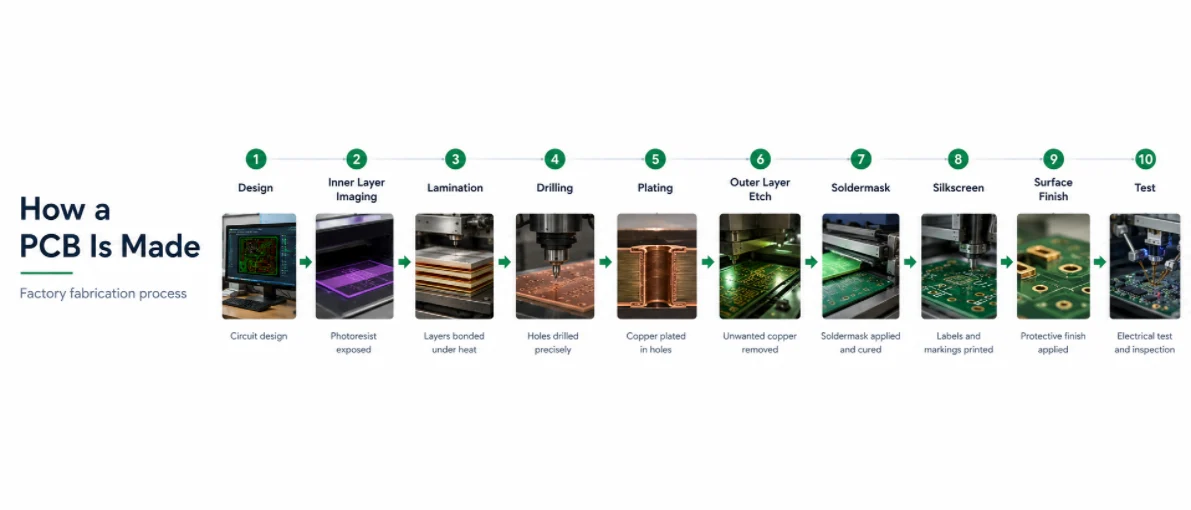
Figure 2. how a PCB is made details
Choosing Materials, Layers, and Surface Finishes
Part of moving to professional fabrication is choosing materials and finishes you simply cannot get at home. A handful of decisions recur on almost every board.
Base material and copper weight
Most boards use FR4, a glass-reinforced epoxy laminate. Its glass-transition temperature (Tg) should suit the assembly process, lead-free reflow runs hotter and benefits from a higher-Tg material. Copper weight, often one ounce and heavier for power circuits, sets how much current a trace can carry. High-frequency and high-speed designs may call for specialized laminates beyond standard FR4, which is the territory of high-speed PCB manufacturing.
Layer count and stack-up
A home-etched board is realistically one or two layers. A factory routinely builds four, six, or many more, with controlled stack-ups and reliable plated vias connecting them. More layers give you room to route dense designs, separate power and ground planes, and manage signal integrity, none of which a DIY process can match.
Surface finish
The surface finish keeps the exposed copper solderable and protected. The common options trade flatness, shelf life, and cost.
| Finish | Characteristics | Good for |
|---|---|---|
| ENIG | Flat, durable, corrosion-resistant; higher cost | Fine-pitch parts, long shelf life, demanding boards |
| HASL | Solder-coated, robust, low cost; less flat | General-purpose boards with larger features |
| OSP | Flat organic coating, low cost; shorter shelf life | Cost-sensitive boards soldered soon after fabrication |
| Immersion silver / tin | Flat, mid-range cost | Flat-surface alternatives to ENIG |
For most first professional boards, ENIG or HASL covers it, ENIG when you have fine-pitch parts or need long storage, HASL when cost matters and the features are larger. A manufacturer can recommend a finish to suit your design and budget as part of standard PCB manufacturing.
When to Move From DIY to a Manufacturer
DIY is excellent for learning, quick experiments, and the very first version of a simple board. Move to a professional fabricator when any of these become true:
- You need more than two layers, or reliable plated-through vias.
- Your design has fine traces or small parts beyond what etching or milling can resolve.
- You want soldermask, silkscreen, and a proper surface finish for reliability and ease of assembly.
- You need controlled impedance for high-speed or RF signals.
- You need more than a couple of identical boards, or consistent, repeatable quality.
The economics often favor a manufacturer sooner than people expect, because prototype quantities are inexpensive and the boards arrive finished, tested, and ready to assemble. A quick DFM review before ordering catches issues that a home process would simply fail to build at all.
Getting the Board Assembled
Making the bare board is only half of building electronics; the components still have to be soldered on. A simple through-hole board you can hand-solder, but anything with fine surface-mount parts is far easier and more reliable to have assembled.
This is where a one-stop manufacturer is convenient: the same Gerber, drill, BOM, and pick-and-place files that fabricate the board also drive PCB assembly, so a single partner takes your design from files to a finished, populated board. As your project grows, the same files scale into high-volume PCB assembly without re-engineering. Building and assembling under one roof also keeps quality and accountability in one place.
Make a board at home to learn and to test ideas quickly; move to professional fabrication when you need layers, plated holes, a finish, or repeatable quality. Knowing how each route works lets you pick the right one at each stage of a project. You can read more about Highleap Electronics and our fabrication and assembly capabilities.
Frequently Asked Questions
Can I really make a PCB at home?
Yes, for simple one- or two-layer boards. Toner transfer, UV photoresist, and CNC milling all work, finished by etching for the chemical methods. They are great for prototypes and learning, but they cannot match a factory’s plated holes, soldermask, finish, or fine features.
Why can’t DIY boards have plated-through holes?
Plating holes requires electroplating copper through the drilled barrels, an industrial chemical process. Home methods can at best add manual rivets, which are far less reliable. The lack of plated vias is the main reason DIY is limited to one or two layers.
What is the minimum trace width I can make at home?
Roughly 0.4 to 0.5 mm is a realistic limit for typical DIY methods, depending on technique. Professional fabrication resolves far finer features, well below 0.1 mm on advanced lines, which is why dense or fine-pitch designs need a manufacturer.
When should I stop making boards myself and order them?
When you need more than two layers, plated vias, fine traces, soldermask and a finish, controlled impedance, or more than a couple of consistent boards. Prototype quantities from a fabricator are inexpensive and arrive finished and tested.
What files does a manufacturer need to make my board?
Gerber files for each layer and an NC drill file for the holes. If you also want assembly, add a bill of materials and a pick-and-place file. Specify board thickness, copper weight, soldermask and silkscreen colors, finish, and any impedance requirements.
Can the same company make and assemble my board?
Yes. A one-stop manufacturer uses the same set of files to fabricate the bare board and to assemble the components, taking your design from files to a finished board and scaling from prototypes to high volume without switching vendors.
Which surface finish should I choose for my board?
For most boards, ENIG or HASL is the practical choice. Choose ENIG when you have fine-pitch components or need a long shelf life, since it is flat and durable; choose HASL when cost matters and the features are larger. OSP is a low-cost flat option for boards that will be soldered soon after fabrication.

Recommended Posts
TMM4 Filter PCB Manufacturing
TMM4 filter PCB manufacturing is controlled by the...
TMM6 PCB Fabrication
TMM6 fabrication is the process-control page for a mid-Dk...
TMM3 PCB Manufacturing for RF Modules
TMM3 PCB manufacturing is most useful where the RF module...
TMM10 PCB Manufacturing for Compact RF Designs
Table of contentsHow TMM10 Shrinks RF StructuresTMM10 vs...
How to get a quote for PCBs
Let‘s run DFM/DFA analysis for you and get back to you with a report. You can upload your files securely through our website. We require the following information in order to give you a quote:
-
- Gerber, ODB++, or .pcb, spec.
- BOM list if you require assembly
- Quantity
- Turn time
For PCBA services, please provide your BOM (Bill of Materials) and any specific assembly instructions. We also offer DFM/DFA analysis to optimize your designs for manufacturability and assembly, ensuring a smooth production process.