
Robot Sensor PCB Assembly for Low-Noise and Calibration-Ready Boards
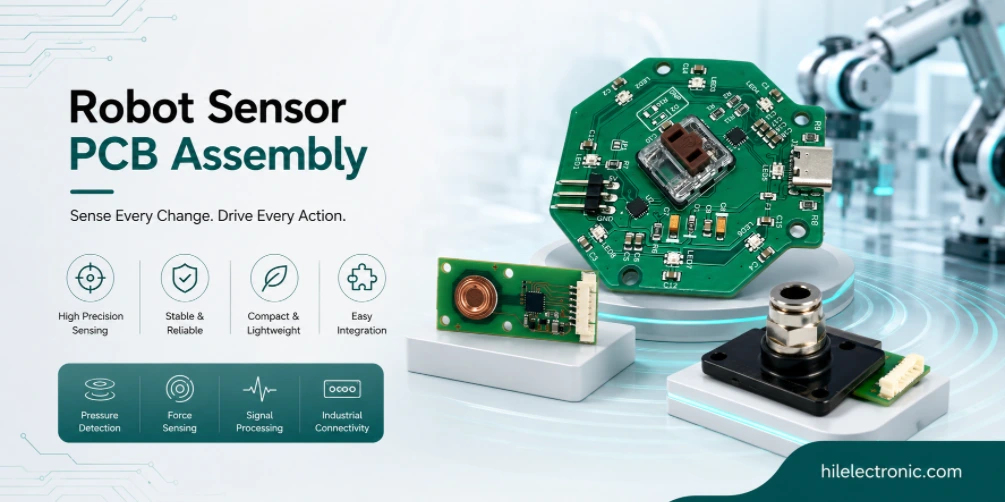
Robot sensor PCB assemblies convert physical reality into electrical data the robot can trust. They read IMUs, encoders, force and torque sensors, current sensors, position sensors, temperature sensors, and application-specific measurement devices, then condition, digitise, calibrate, and communicate those measurements to the control system. Because sensor information drives motion, safety, navigation, and diagnostics, small errors on these boards can become visible robot-level failures.
This guide focuses on sensor PCBs as an industry category, not only as a manufacturing service. It explains how sensor front ends differ from ordinary digital boards, which signal-conditioning choices matter, why calibration and traceability belong in production, and what engineers should check before releasing sensor PCB files for fabrication and assembly.
What Robot Sensor PCBs Actually Do
Role in the Robot System
Robot sensor PCBs condition and digitise the analog signals from the robot’s sensor complement — IMUs, encoders, force sensors, current sensors, position sensors, and specialty measurement devices. Sensor front-ends have specific engineering requirements around noise, resolution, dynamic range, and calibration. What makes robot sensor boards distinct:
- Low-noise analog: sensor signals often in the microvolt to millivolt range. Amplification, filtering, and ADC selection all sized for the noise budget.
- Multi-channel integration: one sensor board often reads many channels simultaneously. Cross-channel isolation and consistent per-channel calibration matter.
- Sensor-specific conditioning: strain gauges need bridge conditioning; thermocouples need cold junction compensation; encoders need line receivers. Each sensor type has its own front-end.
- Environmental robustness: sensors often operate at extremes the rest of the robot avoids. Temperature range, mechanical vibration, and shielding all sized for the sensor location.
- Calibration: per-unit calibration data typically captured during production. Adjusts for sensor variation and preserves accuracy across units.
Design Risks to Control
Sensor board reliability affects downstream signal processing quality across the robot’s entire service life. A sensor board with drift produces measurements that change gradually, potentially undetected; a sensor board with intermittent noise produces measurements that are correct on average but occasionally wrong. Both failure modes degrade robot performance in ways that are hard to compensate at higher levels of the software stack.
Sensor placement on the robot mechanical structure often constrains the sensor board’s physical requirements as much as the sensor’s electrical requirements. A sensor deep in a robot arm needs a compact sensor board; a sensor exposed to the environment needs environmental protection. Programs that align sensor board design with mechanical location produce integrated systems; programs that treat sensor board design separately sometimes discover mechanical constraints at integration.
At the system level, the board should be specified by function, environment, lifetime, and test coverage rather than by schematic alone. This prevents the common error of building a technically correct PCB that is difficult to fixture, hard to service, or insufficiently robust once installed in the robot.
Sensor Types and Their Front-End Requirements
Selection Criteria for Sensor Types and Their Front-End Requirements
Sensor type drives the front-end design. The main sensor categories and their conditioning requirements are:
- IMU: digital 6-DoF or 9-DoF with integrated ADC. Interface typically SPI or I²C. Placement and mechanical mounting affect measurement quality.
- Encoder: line receiver for differential signals; single-ended for less demanding applications. Interpolation electronics for high-resolution analog encoders.
- Force and torque: bridge conditioning for strain gauge sensors. Instrumentation amplifier plus ADC with per-unit calibration.
- Current sensing: shunt with instrumentation amplifier or Hall-effect sensor with isolation. Bandwidth and accuracy per application.
- Position sensing: linear or rotary potentiometer, magnetic angle sensor, or LVDT. Each requires specific conditioning.
- Temperature sensing: thermocouple with cold junction, RTD with excitation, or digital temperature sensor. Selection matches accuracy and range requirements.
How Sensor Types and Their Front-End Requirements Affects Cost and Reliability
Sensor selection also depends on what the robot’s software can actually use. A high-resolution encoder that outstrips the control loop’s ability to process it wastes capability; a low-noise IMU with more precision than the state estimator can leverage similarly wastes cost. Matching sensor capability to software capability produces efficient designs; over-specifying sensors pays for unused capability.
Sensor technology continues to evolve. New MEMS IMUs offer improved noise performance at similar cost; new magnetic encoders offer higher resolution at lower cost than optical predecessors. Programs that review sensor technology periodically identify cost or performance improvements available to new designs; programs that reuse older sensor selections across product generations sometimes lag behind current technology.
The practical rule is to choose the simplest construction that still meets the signal, safety, thermal, and mechanical requirement. Over-specification raises cost, while under-specification creates rework during test or field deployment.
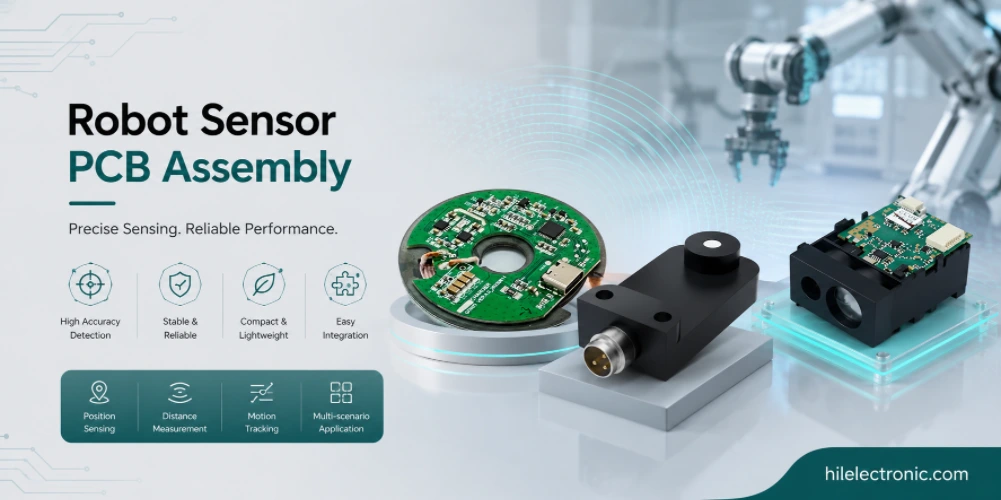
Before the analog front end is frozen, Highleap compares the sensing board with the fieldbus interface design and the wider robot electronics architecture so grounding, shielding, and return paths are not reviewed in isolation.
Signal Conditioning: Amplification, Filtering, Isolation
Key Design Choices for Signal Conditioning
Signal conditioning discipline is what separates well-designed sensor boards from marginal ones. The main techniques are:
- Instrumentation amplifiers: high input impedance and CMRR for differential signals. Standard for bridge and shunt sensing.
- Anti-alias filtering: before the ADC to reject signals above Nyquist. Cut-off frequency chosen for the specific application.
- Reference stability: ADC reference voltage stability directly affects measurement accuracy. Low-tempco references for demanding applications.
- Shielding: shielded cables and shielded traces where noise pickup would degrade measurement.
- Grounding: clean analog ground separated from digital and power ground. Star or split-ground topologies to prevent noise coupling.
- Isolation: some sensor applications need galvanic isolation from robot power. Optical, magnetic, or capacitive isolation depending on the specific requirement.
Manufacturing and Reliability Considerations
Isolation on sensor boards can prevent whole categories of noise problems that filtering cannot completely resolve. A sensor front-end galvanically isolated from robot digital power can reject noise that would otherwise couple through common-mode paths. Isolation costs more per channel but often pays back through simplified filtering and improved measurement quality.
Grounding architecture on sensor boards deserves specific attention beyond general layout guidelines. Analog ground, digital ground, chassis ground, and shield ground all serve different purposes and their interconnection strategy affects measurement quality directly. Programs that design grounding deliberately at the schematic and layout stage produce clean measurements; programs that rely on general routing often see noise from ground currents.
ADC Selection: Sigma-Delta, SAR, Pipeline, Integrated
Selection Criteria for ADC Selection
ADC selection sets the resolution and speed of the sensor measurement chain. The main ADC categories are:
- Sigma-delta: high resolution (16-24 bit) at moderate sampling rate. Standard for precision sensor applications.
- SAR: moderate resolution (12-16 bit) at higher sampling rate. Standard for general sensor applications.
- Pipeline: high sampling rate at moderate resolution. Used where high bandwidth matters.
- Integrating: high accuracy for slow-varying signals. Common in metrology applications.
- Integrated: ADC on the same chip as the sensor (typical for IMU, some current sensors). Simplifies design and cabling.
How ADC Selection Affects Cost and Reliability
ADC selection at design time also considers data rate and communication overhead. A 24-bit sigma-delta ADC produces 24 bits per sample that must be transmitted to the processor; at high sample rates the communication bandwidth matters. Matching ADC to actual bandwidth requirement (versus specification maximum) preserves bandwidth for other traffic.
ADC input protection sometimes limits usable dynamic range. Input protection resistors add offset and noise that reduce achievable measurement precision. Programs that specify protection carefully — matching protection to plausible fault conditions rather than worst-case abuse — preserve measurement quality while providing adequate protection.
Communication: SPI, I²C, CAN, RS-485, Ethernet, EtherCAT
Interface and Layout Requirements
Communication back to the main controller carries the digitised sensor data. The interface choice depends on data rate, distance, and noise environment. The main options are:
- SPI: on-board sensor communication. Fast and simple; short distance only.
- I²C: on-board multi-sensor communication. Slower than SPI but multi-device.
- CAN: robust communication over cables. Good noise immunity; moderate data rate.
- RS-485 or RS-422: differential serial over cables. Good noise immunity; adequate for moderate data rate.
- Ethernet: high bandwidth for demanding sensor applications. Standard on vision and high-data-rate sensing.
- EtherCAT: deterministic Ethernet for coordinated multi-sensor applications.
EMC, Timing, and Test Considerations
Communication interface choice on sensor boards also affects cable design and connector selection. SPI over short board-to-board interfaces uses simple flat cable; CAN over meters of cable in industrial applications uses shielded twisted pair. The interface choice ripples through the overall system design and cost.
Redundant communication paths on safety-critical sensor boards preserve measurement availability during single-point failures. A sensor with primary CAN plus backup analog output maintains function even if the primary interface fails. The additional cost is small compared to the reliability improvement on safety-critical applications.
For production release, sensor calibration also depends on the plant’s board-level test process, especially when sensor data is used by a machine vision subsystem or a safety controller.
Per-Unit Calibration and Traceability
Key Design Choices for Per-Unit Calibration and Traceability
Per-unit calibration during production is standard on precision sensor boards. Calibration captures the specific per-unit variation that manufacturing tolerance produces, storing correction coefficients in non-volatile memory. The main calibration steps are:
- Reference measurement: sensor under known input conditions. Reference sensor or reference physical input applied.
- Coefficient calculation: offset, gain, linearity, and sometimes temperature coefficients calculated from measurements.
- Storage: coefficients stored in EEPROM, flash, or memory on the sensor board itself.
- Verification: post-calibration measurement confirming corrected output meets specification.
- Traceability: per-unit calibration data linked to serial number and reference used.
Manufacturing and Reliability Considerations
Calibration procedure design affects both accuracy and production throughput. A calibration procedure requiring lengthy stabilisation or complex reference setup slows production; a procedure using simple stable references runs quickly. Programs that design the calibration procedure alongside the sensor board itself produce sensor systems that manufacture efficiently; programs that treat calibration as a separate concern sometimes discover calibration bottlenecks at production ramp.
Calibration data storage architecture affects both production and service. Coefficients stored in EEPROM on the sensor board itself travel with the board; coefficients stored in the host controller are lost if the controller is replaced. Programs that store per-unit calibration on the sensor board itself preserve calibration across host changes; programs that store centrally simplify sensor board design but complicate service.
For adjacent design decisions, see the robot control board PCB integration guide and the robot PCB assembly and functional test guide.
Manufacturing Sensor PCBs at Highleap
DFM Review Before Production
Highleap manufactures sensor boards with the analog process discipline sensor boards need. Low-noise assembly, calibration support, and shielded packaging. The specific capabilities include:
- Multilayer with plane: clean analog and digital ground planes. Layer count typically 4-8 for sensor boards.
- Assembly for analog: placement and inspection preserving analog signal integrity. Cleaning where required to prevent leakage.
- Calibration support: per-unit calibration during production. Requires customer-provided calibration procedure and reference.
- Test with sensor stimuli: functional test with reference sensor signals or simulated inputs.
- Shielded assembly: on-board shields, shielded cables, and enclosure-level shielding for the most demanding applications.
- Documentation: per-unit calibration data and test records supporting sensor traceability.
Test, Traceability, and Build Handoff
Highleap’s sensor board manufacturing includes the specific discipline that precision analog electronics needs. Assembly cleanliness that prevents leakage on high-impedance inputs, thermal profile that preserves sensitive component parameters, and inspection that catches issues that could compromise measurement quality.
Manufacturing sensor boards well also requires understanding the specific sensor technologies well enough to preserve them through assembly. MEMS sensors sensitive to mechanical stress need care during placement and reflow; MOSFET-input amplifiers sensitive to leakage need cleanliness discipline; precision references sensitive to thermal shock need controlled cooling profiles.
Robot Sensor PCB FAQs
What is a robot sensor PCB assembly?
A robot sensor PCB assembly is a board that conditions, digitises, calibrates, and communicates measurement signals from robot sensors. It may handle analog inputs such as strain gauges and thermocouples, digital sensors such as IMUs, or mixed sensor channels. The goal is stable, low-noise, repeatable data for control, perception, safety, and diagnostics.
Which sensors usually need a dedicated sensor PCB?
Dedicated boards are common for force and torque sensors, precision encoders, current sensors, IMUs mounted away from the main controller, temperature arrays, pressure sensors, and custom measurement modules. A separate sensor PCB is useful when the sensor location, noise budget, connector layout, calibration process, or environmental exposure differs from the main control board.
How is noise reduced on robot sensor PCBs?
Noise is reduced through short analog paths, proper grounding, low-noise amplifiers, differential routing, filtering, shielding, clean reference supplies, and physical separation from motor-drive switching paths. The exact approach depends on the signal level and bandwidth. A microvolt-level bridge sensor needs much stricter layout and filtering than a digital IMU using SPI.
Why does per-unit calibration matter for sensor boards?
Per-unit calibration corrects offset, gain, non-linearity, and sometimes temperature drift caused by sensor tolerance, analog component tolerance, and assembly variation. Without calibration, two boards built from the same design can produce different readings. Calibration data gives the robot controller consistent measurements across units and across production batches.
What ADC type is best for robot sensor measurements?
The best ADC depends on speed, resolution, and noise requirements. Sigma-delta ADCs are strong for high-resolution, lower-bandwidth measurements such as force and temperature. SAR ADCs suit faster control-loop measurements. Integrated sensor ADCs are practical for compact digital sensors. The ADC should be selected against the actual measurement bandwidth and accuracy budget.
Which communication interfaces are common on robot sensor boards?
Common interfaces include SPI and I²C for local digital sensors, CAN or CAN FD for robust distributed modules, RS-485 for longer cable runs, and Ethernet or EtherCAT for higher-bandwidth or deterministic sensor networks. The interface choice should match cable length, update rate, EMC environment, and whether the sensor data is safety-critical.
How should robot sensor PCBs be tested in production?
Production test should verify power rails, communication, sensor-channel continuity, analog noise level, calibration storage, and functional response to a known stimulus when practical. Precision boards should keep calibration and test records by serial number. For safety-related sensors, test coverage should also verify fault detection and defined failure behaviour.
What files are needed to manufacture a calibrated sensor PCBA?
A complete package normally includes Gerbers or ODB++, drill files, stack-up notes, BOM with approved alternates, pick-and-place data, assembly drawings, calibration procedure, test limits, firmware or programming instructions, and connector or fixture requirements. Calibration references and accepted tolerance limits should be provided before the first article build.

Recommended Posts
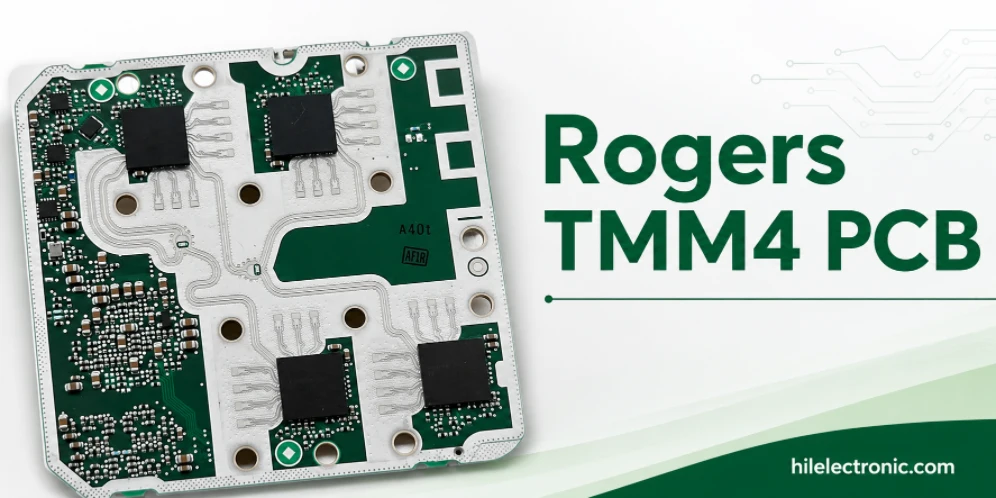
TMM4 Filter PCB Manufacturing
TMM4 filter PCB manufacturing is controlled by the...
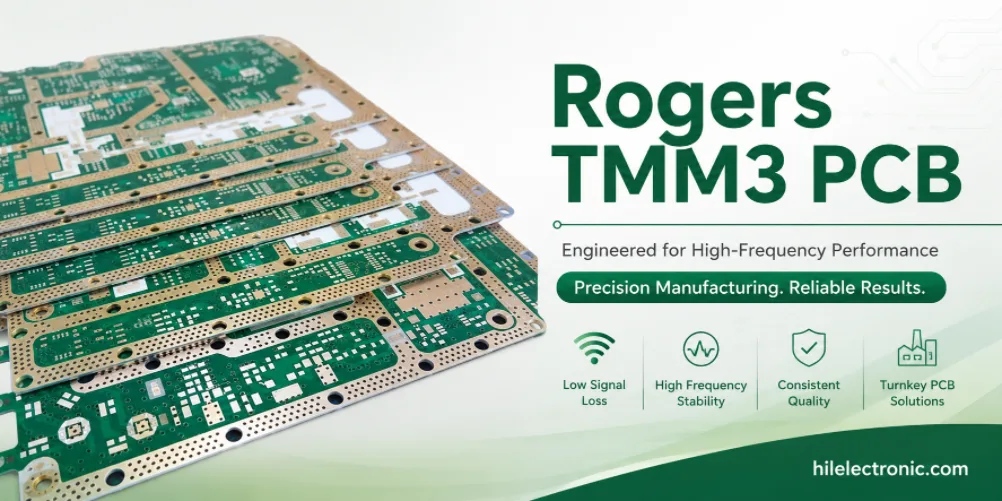
TMM3 PCB Manufacturing for RF Modules
TMM3 PCB manufacturing is most useful where the RF module...
TMM6 PCB Fabrication
TMM6 fabrication is the process-control page for a mid-Dk...
TMM10 PCB Manufacturing for Compact RF Designs
Table of contentsHow TMM10 Shrinks RF StructuresTMM10 vs...
How to get a quote for PCBs
Let’s run DFM/DFA analysis for you and get back to you with a report. You can upload your files securely through our website. We require the following information in order to give you a quote:
-
- Gerber, ODB++, or .pcb, spec.
- BOM list if you require assembly
- Quantity
- Turn time
For PCBA services, please provide your BOM (Bill of Materials) and any specific assembly instructions. We also offer DFM/DFA analysis to optimize your designs for manufacturability and assembly, ensuring a smooth production process.