
Rogers LoPro PCB Fabrication and Assembly

LoPro is addressed here through the copper interface of the finished PCB. Foil selection affects conductor-loss assumptions and fabrication details, so the copper specification should be tied to the released RF stackup rather than selected as an isolated purchasing item.
Figure 1. Rogers LoPro-RO4000 LoPro
LoPro PCB fabrication is best evaluated through the complete transmission-line construction. A lower conductor surface profile can matter in RF designs, but the benefit only appears when the finished copper, dielectric thickness and geometry are held consistently through fabrication. Material scope: This page concerns PCB fabrication using the specified Rogers material. Highleap Electronics manufactures the finished board and PCBA; laminate manufacturing and material sales are outside our service scope.
Rogers LoPro is a reverse-treated copper foil designed to dramatically reduce conductor-side surface roughness at the foil-to-dielectric interface, cutting PCB insertion loss at mmWave and high-speed digital frequencies. With a treated-side surface roughness of approximately 0.4 µm Rz — versus 2–4 µm for standard electrodeposited (ED) foil — LoPro delivers measurable insertion loss reductions of 0.05–0.15 dB/inch at 28 GHz, 0.10–0.25 dB/inch at 77 GHz, and similar gains at 40 GHz SerDes data rates, all while maintaining peel strength acceptable for fine-line PCB fabrication. Applied to Rogers RO4000-series, RO3000-series, and other high-frequency laminates, LoPro foil enables longer trace lengths, smaller antenna feed networks, and lower-loss backplane interconnects in 5G, automotive radar, AI server, and aerospace applications. The copper specification should connect the loss model with HVLP foil selection through fabrication and assembly, including handling and bonding requirements.
Table of Contents
- Why Copper Foil Roughness Matters for PCB Loss
- Rogers LoPro Foil Construction & Surface Profile
- Quantified Loss Reduction: Measurements at 5G, mmWave, and Digital Rates
- LoPro vs Standard ED, RTF, HVLP, and VLP Foils
- Where to Specify LoPro: Material and Application Fit
- PCB Design and Fabrication Implications
- Highleap Manufacturing Capability for LoPro Builds
1. Why Copper Foil Roughness Matters for PCB Loss
At low frequencies, current flows uniformly through the cross-section of a PCB trace, and the conductor’s bulk resistivity dominates loss. Above roughly 1 GHz, the skin effect concentrates current near the surface of the conductor — and crucially, near the rougher of the two surfaces of a PCB trace, which is the side facing the dielectric. By 10 GHz, current penetration depth in copper drops to about 0.66 µm; by 77 GHz it falls below 0.25 µm. Once skin depth approaches the scale of surface roughness features, the conductor effectively gets longer because current must follow the contour of every peak and valley on the rough surface.
The Hammerstad–Jensen and Huray models
Two analytical frameworks dominate PCB loss modeling. The Hammerstad–Jensen model treats surface roughness as a saturating loss multiplier — once roughness Rq exceeds approximately twice the skin depth, the loss factor approaches 2× the smooth-copper value. The Huray “snowball” model fits surface roughness as a collection of spherical particles, providing better accuracy above 10 GHz where the simpler Hammerstad model under-predicts loss.
The practical implication for design teams is clear: at 5G mid-band frequencies (3.5 GHz, skin depth approximately 1.1 µm), standard ED copper with Rz of 3–4 µm produces a 1.4–1.6× loss multiplier versus ideal smooth copper. At 77 GHz automotive radar frequencies, the same foil produces nearly 2× the smooth-copper loss. LoPro foil, with Rz of approximately 0.4 µm, holds the loss multiplier near 1.05× even at 77 GHz — recovering most of the conductor-loss budget that standard ED copper consumes.
Why the treated side matters more than the drum side
Electrodeposited copper foil has two distinct surfaces. The drum side, where the foil grew against the polished rotating drum during electrodeposition, is naturally smooth (Rz under 1 µm). The matte or treated side, originally the growth tip surface, is rough. Standard ED foil is typically used with the rough treated side bonded to the dielectric, because the roughness mechanically anchors the foil to the resin during lamination — providing the peel strength needed to survive processing and assembly.
The skin-effect physics, however, means current flows on whichever side faces the dielectric — usually the rough side. So while roughness improves mechanical bonding, it directly increases RF loss. Reverse-treated foils like Rogers LoPro break this dilemma by chemically treating the smoother drum side for adhesion, then orienting that smoother side toward the dielectric. The result: low-roughness conductor-dielectric interface with adequate peel strength.
2. Rogers LoPro Foil Construction & Surface Profile
Rogers LoPro is a reverse-treated foil (RTF) variant developed specifically for laminate-side application onto Rogers RO4000-series, RO3000-series, and certain Rogers-Arlon legacy materials. The construction is intentionally engineered to expose the smooth drum side of the foil to the dielectric, with a proprietary adhesion-promoting treatment applied to that smooth side rather than to the matte side.
Key surface and physical properties
- Treated-side Rz (10-point average roughness): approximately 0.4 µm — about one-fifth that of standard ED foil.
- Treated-side Ra (arithmetic average roughness): approximately 0.15 µm.
- Peel strength to Rogers RO4350B: typically 0.7–0.9 N/mm at 25°C, sufficient for IPC Class 3 manufacturing.
- Standard weights: 0.5 oz (17 µm), 1 oz (35 µm), and 2 oz (70 µm) for typical RF and high-speed digital applications.
- Thermal stability: compatible with both standard FR4 lamination cycles (180°C) and Rogers RO3000-series PTFE-based cycles (up to 380°C with appropriate prepreg selection).
- Color: the treated side has a distinctive dark brown or nearly black appearance compared to the pink-tan color of conventional ED foil — useful for incoming inspection identification.
Treatment chemistry and bonding mechanism
Where standard ED foil relies on mechanical interlocking of resin into rough peaks and valleys, LoPro relies on chemical bonding. A multi-layer surface treatment — typically including a zinc-nickel anti-tarnish flash, a silane coupling agent, and a chromate passivation layer — bonds the smooth drum surface to the cured dielectric. The chemistry provides both moisture resistance and copper-to-resin adhesion adequate for Class 3 PCB acceptance.
How LoPro differs from other low-profile foils
LoPro is one of several low-profile foils available to PCB designers, each with distinct construction and target applications. Understanding these distinctions matters when specifying a build: the foil is part of the material system, and substituting one low-profile foil for another can affect peel strength, etch behavior, and final electrical performance even on the same laminate.
3. Quantified Loss Reduction: Measurements at 5G, mmWave, and Digital Rates
The performance case for LoPro is best made with measured data. The numbers below summarize typical insertion-loss measurements across common PCB applications, taken on coplanar waveguide and microstrip structures fabricated by qualified PCB suppliers including Highleap. All measurements compare otherwise identical builds — same laminate, same trace geometry, same finish — differing only in the copper foil treatment.
Sub-6 GHz 5G base station antenna feed
- Substrate: RO4350B, 0.508 mm.
- Trace: 1.13 mm wide 50Ω microstrip.
- Standard ED foil loss at 3.5 GHz: 0.034 dB/inch.
- LoPro foil loss at 3.5 GHz: 0.024 dB/inch.
- Loss reduction: approximately 30%, or 0.10 dB on a 10-inch feed line.
28 GHz mmWave 5G FR2 patch antenna array
- Substrate: RO4835, 0.254 mm.
- Trace: 0.50 mm wide 50Ω microstrip.
- Standard ED foil loss at 28 GHz: approximately 0.22 dB/inch.
- LoPro foil loss at 28 GHz: approximately 0.15 dB/inch.
- Loss reduction: roughly 0.07 dB/inch — significant for series-fed array distribution networks.
77 GHz automotive radar antenna
- Substrate: CLTE-XT, 0.127 mm.
- Trace: 0.20 mm wide 50Ω microstrip.
- Standard ED foil loss at 77 GHz: approximately 0.52 dB/inch.
- LoPro foil loss at 77 GHz: approximately 0.32 dB/inch.
- Loss reduction: nearly 40% — often the difference between meeting and missing a radar link-budget target.
High-speed digital — 25 Gbps and 56 Gbps PAM4
For high-speed digital signaling, the relevant figure of merit is insertion loss at the Nyquist frequency: half the symbol rate for NRZ, half the symbol rate (in baud) for PAM4. For 25 Gbps NRZ, the Nyquist is 12.5 GHz; for 56 Gbps PAM4 (28 Gbaud), the Nyquist is 14 GHz. On Megtron 6 or I-Tera MT40 stripline routing at these frequencies, LoPro typically reduces total channel loss by 1.5–2.5 dB over a 30-inch backplane trace — enough to extend reach by one or two layer transitions, or to allow 1–2 dB additional margin in the equalization budget.
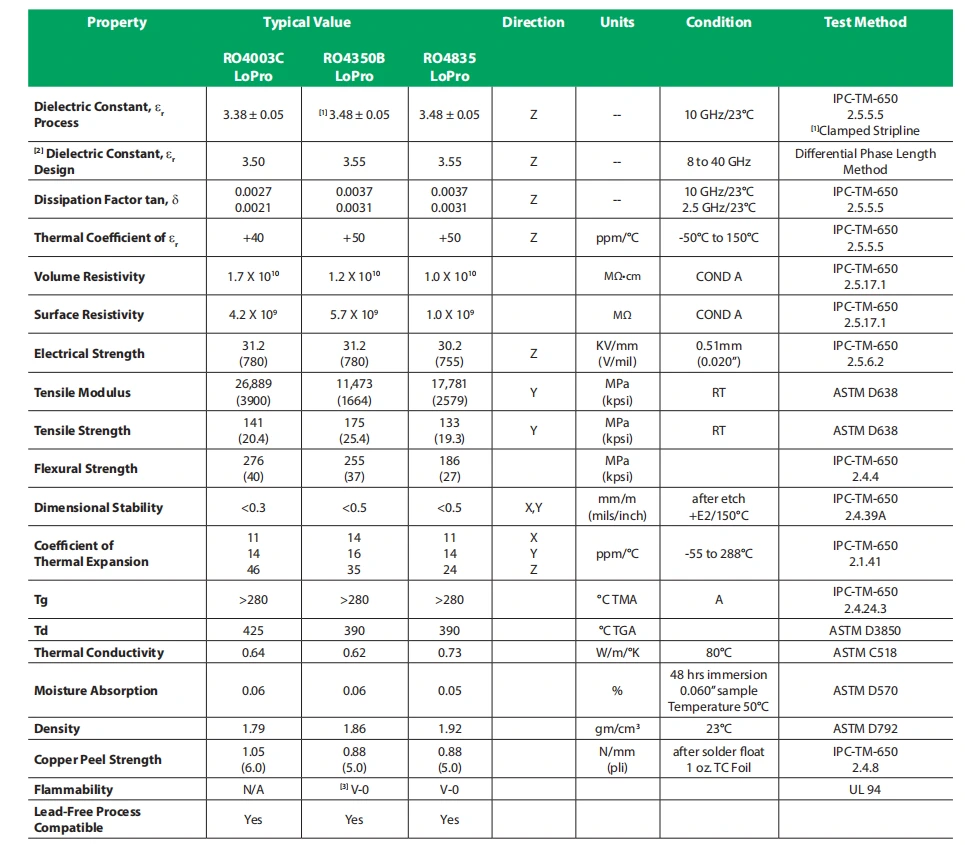
Figure 2. Rogers LoPro Datasheet
4. LoPro vs Standard ED, RTF, HVLP, and VLP Foils
The PCB copper foil landscape includes several roughness classes, each with distinct characteristics:
| Foil Type | Treated-Side Rz | Typical Peel | Cost vs ED | Primary Use |
|---|---|---|---|---|
| Standard ED | 3–5 µm | 1.0–1.4 N/mm | 1.0× | General FR4 PCBs |
| RTF (reverse-treated) | 2–4 µm | 0.8–1.0 N/mm | 1.1–1.2× | Mid-loss high-speed |
| VLP (very-low-profile) | 1.5–2.5 µm | 0.7–0.9 N/mm | 1.2–1.4× | Low-loss digital |
| HVLP (hyper-VLP) | 0.8–1.5 µm | 0.6–0.8 N/mm | 1.5–2.0× | mmWave, 56G+ PAM4 |
| Rogers LoPro | ~0.4 µm | 0.7–0.9 N/mm | 1.6–2.2× | Premium mmWave, RF |
| Astra (Mitsui) / HVLP3 | ~0.7 µm | 0.7–0.9 N/mm | 1.6–2.0× | Premium digital/RF |
Selection guidance
- For sub-6 GHz RF and digital signals below 10 Gbps, the loss-budget improvement from LoPro is often not worth the cost premium; HVLP or even VLP suffices.
- For 5G mid-band antennas (3.5–4.2 GHz), specify VLP minimum; LoPro becomes valuable for long feed networks or critical-margin designs.
- For 28 GHz mmWave 5G and above, LoPro or equivalent HVLP3-class foil is essentially required — standard ED produces unacceptable conductor loss.
- For 56G/112G PAM4 high-speed digital, LoPro or HVLP3 is the baseline; some designs add adjustments such as resin coated copper (RCC) to push performance further.
- For automotive 77 GHz radar, LoPro on a low-loss laminate like CLTE-XT is the industry standard combination.
5. Where to Specify LoPro: Material and Application Fit
LoPro is a foil treatment, not a laminate — so it must be applied on top of a laminate that benefits from low conductor roughness. The combinations below cover the most common engineering scenarios.
Rogers RO4000-series with LoPro
- RO4350B + LoPro: the workhorse combination for sub-6 GHz to 28 GHz wireless infrastructure, 5G antennas, and microwave subsystems. RO4350B’s Df of 0.0037 paired with LoPro reduces total insertion loss to about half what RO4350B + standard ED achieves at 10 GHz.
- RO4003C + LoPro: commonly used in broadband RF amplifiers, defense receivers, and ground-station electronics where Df 0.0027 matters and LoPro extracts the laminate’s full performance.
- RO4835 + LoPro: RO4835 is specifically engineered as an antenna laminate for outdoor 5G applications; LoPro is often the default foil specification for mmWave outdoor antenna patches.
- RO4360G2 + LoPro: high-Dk (6.15) hydrocarbon ceramic laminate; LoPro is recommended for designs where the small antenna size from high Dk must be paired with low feed-line loss.
Rogers RO3000-series with LoPro
- RO3003 + LoPro: automotive 77 GHz radar antenna boards almost universally specify this combination.
- RO3006 / RO3010 + LoPro: compact GPS antennas and ultra-miniature RF applications; the high-Dk laminates pair with LoPro to deliver both miniaturization and low conductor loss.
Hybrid stackups with FR4
In hybrid stackups combining Rogers high-frequency laminates on outer RF layers with FR4 on inner digital/power layers, LoPro is specified on the Rogers cores only. The FR4 layers typically use standard ED or RTF foil — there’s no electrical benefit from LoPro on layers that carry only low-frequency or DC signals, and the cost premium would be wasted. Highleap routinely processes hybrid builds with LoPro on Rogers cores and standard foil on FR4 in the same lamination cycle.
6. PCB Design and Fabrication Implications
Specifying LoPro foil affects several aspects of PCB design and fabrication. Engineering teams should understand these implications before committing to a build, as some require artwork adjustments or process specifications that differ from standard ED foil practice.
Etch compensation differs from standard foil
LoPro’s smooth surface etches slightly differently from standard ED foil — etchant access is more uniform across the conductor surface, producing crisper trace edges and tighter trace-width tolerance. PCB suppliers familiar with LoPro typically reduce etch compensation by 0.005–0.010 mm versus standard foil. For controlled-impedance designs, this translates to artwork that is approximately 0.01 mm narrower for the same finished trace width — a difference that matters for fine-line designs below 0.10 mm trace width.
Peel strength considerations during assembly
LoPro’s peel strength of 0.7–0.9 N/mm is lower than standard ED (1.0–1.4 N/mm), but remains within IPC-6012 Class 3 acceptance limits. The practical implications are:
- Avoid mechanical stress on copper features during rework; use hot-air rework rather than soldering iron tip force where possible.
- Specify ENIG or immersion silver rather than HASL — the thermal shock of HASL can stress the foil-laminate interface, particularly on thin-core builds.
- For pad-on-via or HDI structures, verify peel strength on coupons before releasing the design to volume production.
- For wirebond assembly, electroplated gold over nickel is preferred; the additional plating thickness reinforces the pad against bonding force.
Plating and surface finish compatibility
LoPro is fully compatible with all standard PCB surface finishes — ENIG, immersion silver, OSP, electrolytic hard gold, and electrolytic soft gold. ENIG and immersion silver are the most common choices for RF and mmWave applications because they preserve trace flatness and minimize PIM. HASL is generally discouraged on LoPro builds due to surface texture and copper stress concerns.
Drilling and via formation
LoPro affects only the outer copper-laminate interface and has no impact on drilling, via plating, or hole-wall preparation. Mechanical drill, controlled-depth drill, and laser microvia processes proceed identically to standard ED foil builds. The same applies to plasma desmear on PTFE-based hybrid stackups — process windows are unaffected by the choice of outer-layer foil. Highleap reviews the copper specification together with the RF stackup and etch strategy. Critical traces should be tied to the actual finished dimensions, while assembly files should preserve the same land and keep-out assumptions used in the RF layout. Exact material property values should be checked against the current supplier documentation for the specified grade and construction. For a design using that laminate, RO3003G2 builds with specified copper profiles should identify the precise copper construction rather than rely on a low-profile label alone.
7. Highleap Manufacturing Capability for LoPro Builds
Highleap Electronics manufactures Rogers LoPro PCBs in 2- to 24-layer configurations across the full Rogers RO4000-series, RO3000-series, RT/duroid, and CLTE families. Our high-frequency line operates with dedicated registration tooling for fine-line LoPro builds, controlled-impedance fabrication to ±5% on critical RF nets, and 100% impedance test on every panel. Standard offerings include 0.5 oz, 1 oz, and 2 oz LoPro foil on all qualified Rogers cores, with finishes including ENIG, immersion silver, electrolytic hard gold, OSP, and electrolytic soft gold for wirebond applications.
For mmWave applications — 28 GHz 5G antennas, 77 GHz automotive radar, and aerospace Ka-band — Highleap supports laser direct imaging at 25 µm resolution, controlled-depth back drilling for stub minimization, and PPAP-aligned documentation for automotive Tier-1 customers. For 56G/112G PAM4 backplane builds, our high-speed line supports controlled stackups on I-Tera MT40, Tachyon 100G, and Megtron 7 laminates with LoPro on critical signal layers and standard foil on power and ground layers, optimizing both cost and performance. Customers requiring full insertion-loss characterization data with each delivery can specify coupon-level S-parameter testing as part of the order.
Submit Gerber files, drill data, and stackup specifications through our online quote portal for a project-specific response. Include the foil specification (LoPro, HVLP, VLP, or standard ED) in the fabrication notes; for designs where the foil choice is uncertain, our engineering team can review the application and recommend a foil based on frequency, loss budget, and cost target. We support prototype prototypes in 5–10 working days and volume production with documentation aligned to the applicable customer and site quality scope; certificate scope should be confirmed for the quoted facility. For related Rogers laminate selection, see our pages on RO4350B, RO3003, Rogers PCB manufacturing, and high-frequency PCB materials. For quotation, state the required copper profile, finished dielectric thickness, impedance tolerance, surface finish and quantity. When assembly is required, include the BOM and placement data so the final cost reflects the entire build.

Recommended Posts
TMM4 Filter PCB Manufacturing
TMM4 filter PCB manufacturing is controlled by the...
TMM3 PCB Manufacturing for RF Modules
TMM3 PCB manufacturing is most useful where the RF module...
TMM6 PCB Fabrication
TMM6 fabrication is the process-control page for a mid-Dk...
TMM10 PCB Manufacturing for Compact RF Designs
Table of contentsHow TMM10 Shrinks RF StructuresTMM10 vs...
How to get a quote for PCBs
Let’s run DFM/DFA analysis for you and get back to you with a report. You can upload your files securely through our website. We require the following information in order to give you a quote:
-
- Gerber, ODB++, or .pcb, spec.
- BOM list if you require assembly
- Quantity
- Turn time
For PCBA services, please provide your BOM (Bill of Materials) and any specific assembly instructions. We also offer DFM/DFA analysis to optimize your designs for manufacturability and assembly, ensuring a smooth production process.