
Rogers PCB Cost and Pricing Factors

The cost discussion is built around an actual PCB RFQ: material construction, board size, layer count, copper, panel utilization, drilling, yield, inspection, RF testing and assembly are separated so that a quotation can be compared on equivalent scope.
Figure 1. Rogers PCB Cost
Rogers PCB cost is driven by the finished construction, not simply by the laminate line on a quotation. Material grade, thickness, layer count, copper, board size, panel utilization, drilling, yield, RF testing, assembly and order quantity can each change the unit price. The useful way to control cost is to separate material cost, fabrication cost, engineering cost, testing and procurement risk rather than rely on a fixed percentage premium. This guide therefore focuses on quotation inputs and cost drivers that can be checked on a real PCB RFQ.
Table of Contents
- Rogers PCB Cost vs FR4: Full Price Breakdown
- Rogers Material Cost Comparison by Series
- What Makes Rogers PCB Fabrication More Expensive
- How to Reduce Rogers PCB Cost: 7 practical cost controls
- Rogers PCB Pricing Examples by Application
- Get a Rogers PCB Quote from Highleap
1. Rogers PCB Cost vs FR4: Full Price Breakdown
The price difference between a Rogers PCB and an FR4 PCB is not a simple material markup. Rogers boards cost more across multiple manufacturing steps, and understanding each component helps identify where savings are possible. For a TMM project, comparing RF quotations with matched scope prevents differences in grade, tolerance and test requirements from being mistaken for simple unit-price savings.
| Cost Component | FR4 PCB (baseline) | Rogers PCB (typical) | Why the Difference |
|---|---|---|---|
| Raw laminate (per panel) | Depends on board size, panel format and current FR4 pricing | Depends on Rogers grade, thickness, foil and current sourcing | Specialty ceramic/PTFE materials with tighter Dk tolerance |
| Drilling | Standard | Process-dependent | Ceramic fillers wear bits faster; slower feed rates, more frequent tool changes |
| Surface preparation | Standard chemical | Process-dependent | PTFE materials require plasma treatment before plating |
| Lamination | Standard cycle | Process-dependent | Stepped temperature profiles, specialty bondply, longer cycle times |
| Impedance testing | Optional TDR | May be required by the released RF specification | RF applications demand verified impedance on every lot |
| Material lead time | Depends on current supply | Confirm during quotation | Rogers materials have longer supply chain; less commonly stocked |
| Panel utilization | Standard | Often lower | Rogers panels come in fewer standard sizes; nesting efficiency varies |
There is no universal Rogers-to-FR4 price multiplier. A comparable board can change price because of the selected grade, thickness, copper, panel utilization, process route, inspection scope, quantity and current material sourcing. At higher volumes, fixed engineering and tooling costs may be spread across more boards, but that does not remove material or process differences.
2. Rogers Material Cost Comparison by Series
Not all Rogers materials cost the same. The price hierarchy follows the material’s composition and processing difficulty:
| Rogers Material | Composition | Dk @ 10 GHz | Df @ 10 GHz | Relative Material Cost | Processing Compatibility |
|---|---|---|---|---|---|
| RO4003C | Hydrocarbon/ceramic, woven glass | 3.38 | 0.0027 | Lowest Rogers ($) | FR4-compatible process |
| RO4350B | Hydrocarbon/ceramic, woven glass | 3.48 | 0.0037 | Low ($$) | FR4-compatible process |
| RO4835 | Hydrocarbon/ceramic, woven glass | 3.48 | 0.0037 | Low-mid ($$) | FR4-compatible process |
| RO4360G2 | Hydrocarbon/ceramic, woven glass | 6.15 | 0.0038 | Mid ($$$) | FR4-compatible process |
| RO3003 | Ceramic-filled PTFE | 3.00 | 0.0013 | High ($$$$) | Requires plasma treatment |
| RO3006 | Ceramic-filled PTFE | 6.15 | 0.0020 | High ($$$$) | Requires plasma treatment |
| RT/duroid 5880 | Glass microfiber/PTFE | 2.20 | 0.0009 | Highest ($$$$$) | Requires plasma + special handling |
The RO4000 family can offer a practical production route on many builds, but cost still depends on exact construction and the chosen process controls. Do not use frequency alone as a material selection rule: release the RF geometry, loss target, stackup and production quantity before comparing quotes.
PTFE-based RF materials can add fabrication steps or handling requirements depending on the grade and stackup. They can be appropriate where the loss budget requires them, but the quote should reflect the actual hole preparation, lamination/bonding method, copper construction and inspection plan.
3. What Makes Rogers PCB Fabrication More Expensive
Beyond raw material price, several fabrication steps add cost that is specific to Rogers PCBs:
Drill tool consumption. Rogers ceramic-filled laminates (RO4000, RO3000) contain hard ceramic particles that accelerate drill bit wear. Hard fillers and material construction can increase tool wear and influence drilling throughput. Actual tool life depends on board construction, hole count and process settings, so a supplier quote should reflect the released drilling plan rather than a generic tool-life multiplier.
Plasma desmear. PTFE-based Rogers materials (RO3000, RT/duroid) do not respond to standard permanganate desmear chemistry. Plasma desmear using CF₄/O₂ gas mixture is required to clean hole walls and activate the surface for copper plating. Not all PCB factories have plasma desmear capability — those that do charge a premium for the process step. RO4000 series materials can use standard chemical desmear, avoiding this cost adder.
Panel size and utilization. Rogers laminates are available in fewer standard panel sizes than FR4 (common Rogers panel: 12 × 18 inches or 18 × 24 inches, versus FR4 which is available in almost any size). If your board dimensions do not nest efficiently on the available Rogers panel size, material waste increases and per-board cost rises. Optimizing board panelization for Rogers panel sizes can reduce waste by 10–20%.
Lead time impact on cost. Standard FR4 is universally stocked. Rogers materials, especially PTFE grades and less common thicknesses, may require additional procurement time from Rogers Corporation or its distributors. Rush orders incur premium pricing. Factories that maintain Rogers material availability can quote shorter lead times without material surcharges — this is a significant differentiator when selecting a Rogers PCB manufacturer.
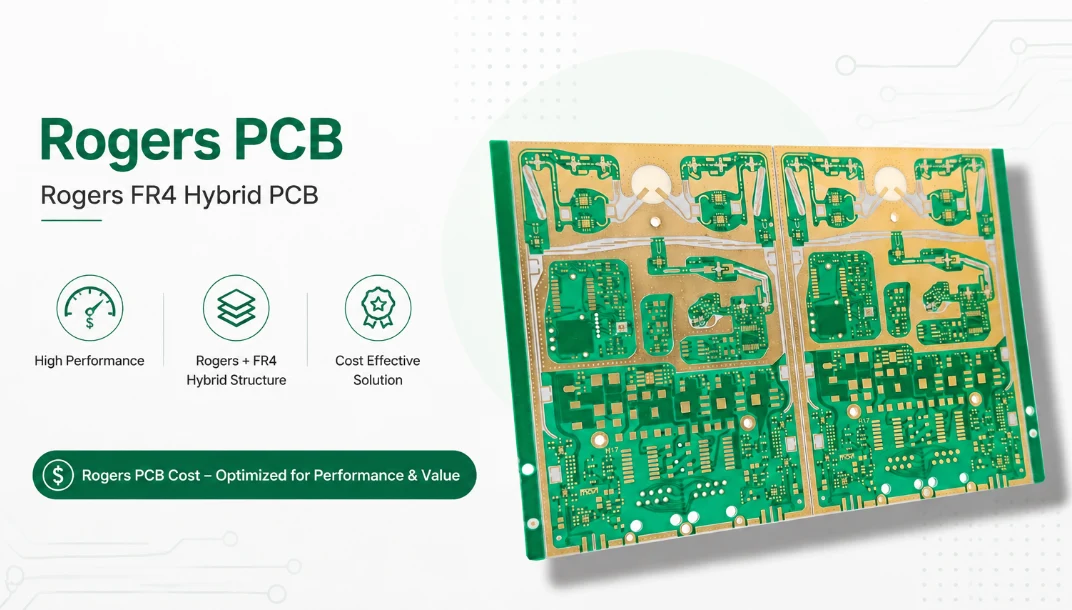
Figure 2. Rogers PCB Cost
Material scope: the Rogers product name is used to identify the laminate specified for the PCB build. Highleap Electronics provides PCB fabrication and assembly, while the laminate is sourced and verified separately.
4. How to Reduce Rogers PCB Cost: 7 practical cost controls
Strategy 1: Use a Rogers FR4 hybrid stackup. Place Rogers only on the RF signal layers and FR4 on power, ground, and digital layers. This is the one potential cost-control option — 30–50% material savings on a 6-layer board. See our Rogers FR4 hybrid PCB guide for stackup design details.
Strategy 2: Choose RO4000 over RO3000/RT/duroid when the frequency allows. If your operating frequency is below 15–20 GHz, RO4350B or RO4003C likely meets your loss budget at a fraction of the cost of PTFE-based alternatives. Run an insertion loss simulation comparing materials at your frequency before defaulting to the most expensive option.
Strategy 3: Optimize panel utilization. Work with your PCB manufacturer to panelize your board dimensions for maximum fit on the available Rogers panel size. Rotating the board layout 90° or adjusting board margins by 1–2 mm can sometimes fit an additional column or row on the panel, reducing per-board material cost by 10–20%.
Strategy 4: Select standard Rogers thicknesses. Rogers stocks certain core thicknesses in higher volume (10, 20, 30, 60 mil for RO4350B). Non-standard thicknesses require custom laminate orders with longer lead times and higher minimum quantities. Design your stackup around standard available thicknesses to avoid custom material surcharges.
Strategy 5: Reduce layer count. Fewer layers means less Rogers material. Evaluate whether a 4-layer hybrid can replace a 6-layer all-Rogers design by combining ground and power planes and tightening the digital routing on FR4 layers.
Strategy 6: Consolidate orders. Rogers PCB fabrication has significant fixed costs (material procurement, lamination setup, impedance test fixture). Larger order quantities amortize these costs. If your annual demand supports it, negotiate quarterly blanket orders rather than frequent small-lot purchases.
Strategy 7: Partner with a factory that stocks Rogers material. Factories that maintain Rogers inventory avoid the 4–8 week material lead time and the associated rush surcharges. Volume purchasing may improve material pricing, but the actual quote depends on the approved grade, construction, quantity, and current supply route.
5. Rogers PCB Pricing Examples by Application
| Application | Board Spec | Rogers Material | Approx. Unit Cost (100 pcs) | Approx. Unit Cost (1,000 pcs) |
|---|---|---|---|---|
| Wi-Fi 6 access point | 4L hybrid, 80 × 60 mm | RO4003C + FR4 | $12–20 | $6–10 |
| 5G small-cell radio | 6L hybrid, 100 × 80 mm | RO4350B + FR4 | $25–45 | $12–22 |
| 77 GHz automotive radar | 4L all-Rogers, 50 × 40 mm | RO3003 | $30–55 | $15–28 |
| Satellite LNB | 2L, 60 × 40 mm | RT/duroid 5880 | $20–35 | $10–18 |
| Microwave backhaul | 6L hybrid, 120 × 100 mm | RO4835 + FR4 | $45–80 | $22–40 |
These are indicative ranges — actual pricing depends on copper weight, surface finish, impedance requirements, hole count, and manufacturer. The key takeaway: hybrid stackups consistently deliver the lowest cost per unit at every volume tier except for very small, simple boards where all-Rogers 2-layer construction is already cost-competitive. Highleap breaks the build into engineering, material, fabrication, inspection and assembly elements when reviewing a quote. Cost reduction works best when it protects the RF-critical layers and removes unnecessary complexity from non-critical areas. Exact material property values should be checked against the current supplier documentation for the specified grade and construction.
6. Get a Rogers PCB Quote from Highleap
Availability of RO4350B, RO4003C, RO4835, and common thicknesses is confirmed per RFQ; material lead time varies by grade, thickness, copper, and order quantity. Our Rogers PCB pricing advantages:
Material sourcing. Material sourcing through documented supply channels for the specified grade. Volume-based material pricing passed through to customers. Common cores and bondply in inventory for immediate production start. Authorised component sourcing ensures genuine Rogers material — no risk of counterfeit or off-spec laminate.
Hybrid stackup optimization. Our engineering team reviews your design and recommends the most cost-effective material combination — identifying layers where FR4 can replace Rogers without degrading RF performance. This review is provided at quoting stage, before you commit to a design.
Panel utilization optimization. We evaluate panelization options for your board dimensions against available Rogers panel sizes and recommend layout adjustments that maximize material yield.
Volume pricing tiers. Prototype (5–50 pcs), pre-production (50–500 pcs), and production (500+) pricing tiers with quantity-break discounts. Blanket order agreements available for recurring production. For an unvalidated design, Rogers prototyping before volume procurement may resolve construction risks before volume pricing assumptions are finalized.
Request a Rogers PCB quote — include Rogers material type, layer count, board dimensions, impedance requirements, quantity, and target delivery date. We return a detailed cost breakdown within 24 hours. For a comparable price check, hold the specification constant across suppliers. The RFQ should state dimensions, stackup, copper, finish, hole technology, impedance requirements, quantity and testing so that apparently lower prices do not hide a different construction.

Recommended Posts
TMM4 Filter PCB Manufacturing
TMM4 filter PCB manufacturing is controlled by the...
TMM3 PCB Manufacturing for RF Modules
TMM3 PCB manufacturing is most useful where the RF module...
TMM6 PCB Fabrication
TMM6 fabrication is the process-control page for a mid-Dk...
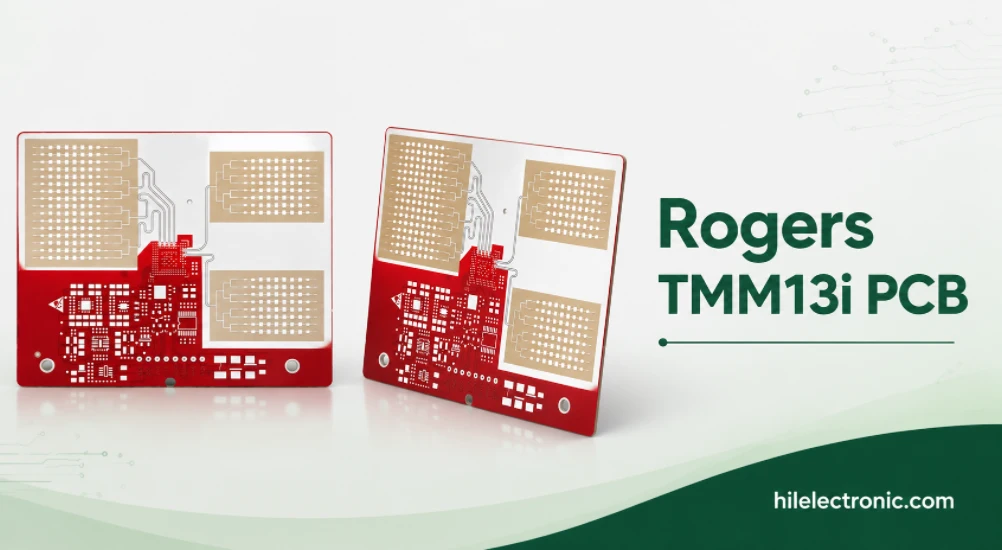
TMM13i PCB Manufacturing
TMM13i PCB manufacturing is aimed at ultra-compact RF...
How to get a quote for PCBs
Let’s run DFM/DFA analysis for you and get back to you with a report. You can upload your files securely through our website. We require the following information in order to give you a quote:
-
- Gerber, ODB++, or .pcb, spec.
- BOM list if you require assembly
- Quantity
- Turn time
For PCBA services, please provide your BOM (Bill of Materials) and any specific assembly instructions. We also offer DFM/DFA analysis to optimize your designs for manufacturability and assembly, ensuring a smooth production process.