
RO4533 PCB Manufacturing
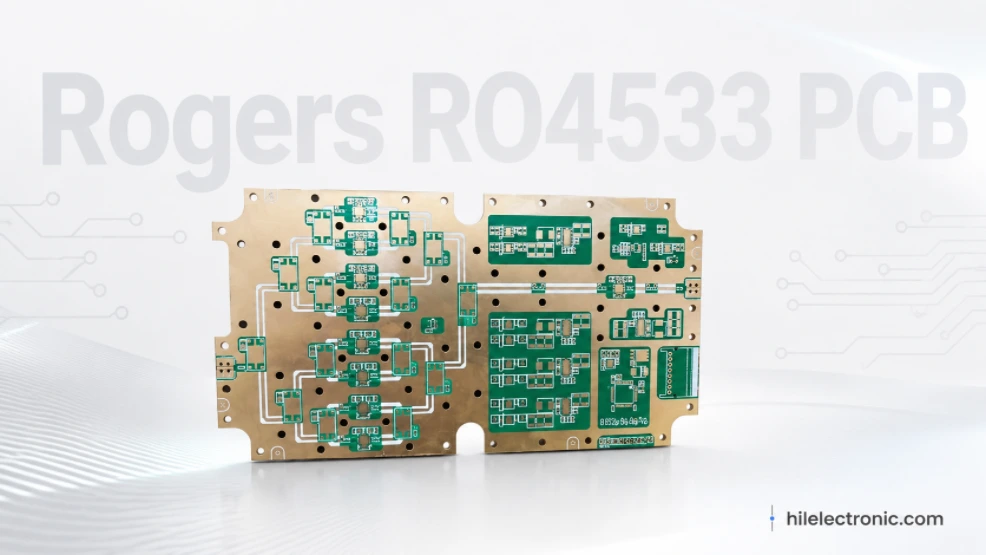
RO4533 PCB manufacturing is often a cost-performance decision rather than a search for the lowest-loss material available. The right grade is the one that satisfies the actual RF requirement without adding unnecessary fabrication or material cost. RO4533 should be handled as a grade-specific commercial RF request, not as a promise that one material will replace every FR-4 or PTFE construction. The purchasing value is created only when the board meets its RF target at a repeatable total cost—including material availability, panel yield, process controls, test scope and assembly.
Because RO4533 is not shown as a standalone product on Rogers’ current public RO4000 series page, Highleap should confirm the exact requested grade, controlled data sheet and supply route before issuing a production commitment. The customer’s approved construction remains the authority; any alternative should be presented as a requalification option, should not as an automatic substitution.
The cost-sensitive RO4533 route is evaluated from the complete PCB quotation rather than a laminate price alone. Material construction, board size, layer count, RF geometry, panel utilization, inspection and assembly scope are treated as the cost variables that can be controlled.
RO4533 Is a Cost-Performance Decision, Not a Universal RF Upgrade
Commercial antennas and RF modules often sit between two material extremes. Standard FR-4 may show too much loss or electrical variation for the required frequency and route. A specialised PTFE or ultra-low-loss construction may exceed the need and introduce cost, lead-time or processing complexity. RO4533 can be considered in this middle space when the complete design supports it.
| Material route | Typical reason to use it | Reason to move up or down |
|---|---|---|
| General or high-Tg FR-4 | Short, cost-driven RF-support circuits with comfortable margin. | Move up when loss, Dk stability or antenna efficiency becomes limiting. |
| RO4533-class commercial RF construction | Balanced high-frequency performance, processability and volume cost. | Move down if FR-4 meets measured requirements; move up for more demanding loss or stability. |
| Specialised low-loss or PTFE family | Longer paths, higher frequency, tighter phase or demanding environmental performance. | Reconsider if added cost and process complexity do not improve the product. |
The comparison should use actual frequency, circuit length, copper, construction and test method. A single Df value cannot determine product cost or performance. For a wider comparison, use the RF PCB material comparison approach and keep the operating conditions consistent.
Can RO4533 replace a PTFE laminate?
Sometimes a design can be re-qualified on RO4533, but it is not a drop-in statement. Dk, thickness, copper, loss, thermal behaviour and fabrication stackup may differ. Trace dimensions and RF response must be re-modelled. The system owner should approve the change after prototype testing. Highleap can propose a production construction but should not make an unauthorised substitution. Highleap reviews which layers genuinely need the specified RF construction and where normal manufacturing tolerances are sufficient. Yield, board size, copper and test scope are then considered alongside the material choice so the production economics remain visible. Exact material property values should be checked against the current supplier documentation for the specified grade and construction.
When is ordinary FR-4 still sufficient?
Short RF control lines, low-frequency support circuits and designs with comfortable margin may not need RO4533. If the product is cost-sensitive, proving that a lower-cost construction works can be the best engineering result. Material selection should protect function and yield, not maximise the price of the laminate.
Which RF Products Are Good Candidates for RO4533?
RO4533 may be evaluated for commercial antenna boards, base-station or small-cell subassemblies, industrial wireless modules, RF amplifiers, communication equipment and selected automotive or IoT circuits. The word “candidate” is important: operating frequency and geometry still decide suitability.
Antenna boards
Antenna designs need controlled dielectric thickness, copper geometry, ground clearance, mask keep-outs and mechanical interfaces. RO4533 can support cost-controlled antenna production when the efficiency and bandwidth targets are met. The fabricator should know which features control resonance and feed impedance. Review PCB antenna design requirements before treating the board outline as the only mechanical input.
RF amplifier and matching circuits
Power level, thermal path, component footprint and grounding are important. The PCB may combine RF transmission lines with dense bias and control circuitry. A hybrid multilayer can place RO4533 where the RF function needs it and another material on supporting layers, but the bonding and CTE route must be qualified.
Communication modules
Modules often require shielding, board-to-board connectors and assembly testing. Surface finish, mask clearance and connector launch can matter as much as the laminate. Highleap can provide fabrication and assembly, allowing the panel and test points to be planned together.
When RO4533 is not the right choice
It may be unnecessary for low-frequency or short routes, and it may be insufficient for a demanding microwave path with very low loss or tightly controlled phase. It may also be unsuitable when a customer qualification specifically requires another material family. The article should help the buyer reject the material as confidently as select it.
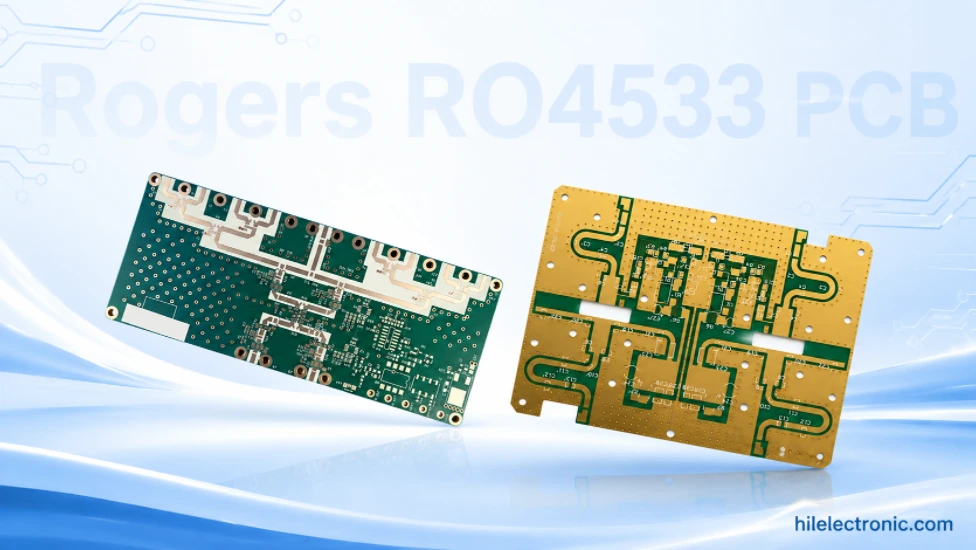
Material scope: Highleap Electronics is the PCB manufacturer and assembler for the build described here. Rogers and the referenced grade names identify the specified material and are not a description of Highleap material manufacturing.
How Highleap Controls Yield and RF Consistency
Volume RF PCB production depends on repeatable construction. Highleap reviews material thickness, copper, critical features, panel size, copper balance, tooling, surface finish and inspection before release. The aim is to avoid a prototype that works only because one panel happened to land near nominal.
Panel utilisation and cost
RO4533 material cost is influenced by sheet utilisation. Unusual board outlines, large coupons, tight edge requirements and mixed thicknesses can reduce yield. A panel proposal can show whether minor rail or array changes improve cost without changing the product. Buyers comparing suppliers should confirm whether quotations use the same panel quantity and test scope.
Hybrid multilayer production
Hybrid construction can reduce material use or integrate digital layers, but it requires compatible bonding, pressure, cure, copper balance and drilling. Highleap reviews the hybrid PCB manufacturing route before confirming a stackup. A low-cost hybrid design that warps or delaminates is not a cost saving.
Precision imaging and etching
Critical RF lines and gaps should be identified. CAM compensation is based on copper and feature geometry. AOI and dimensional checks can focus on the structures that drive RF response. Applying the same extreme tolerance to every trace raises cost without improving function.
Surface finish and solder mask
The finish must support assembly and the RF model. Antenna or resonator regions may need mask keep-outs. Component pads may require ENIG, immersion silver, tin or another approved finish depending on design and shelf-life needs. The customer should specify the allowed finish rather than permit an open substitution.
Testing and traceability
Electrical test verifies opens and shorts. Controlled impedance, RF coupon or functional testing can be added where specified. Production records tie the lot to material, stackup and inspection. If a later issue is reported, Highleap can review the lot rather than relying on memory.
Building an RO4533 Quote Around Cost and Performance
The quotation should identify exact RO4533 construction, thickness, copper, layer count, finished board thickness, critical RF geometry, surface finish, mask keep-outs, impedance and test requirements. If PCBA is required, include BOM, placement, assembly drawing, programming, test and packaging.
- material thickness, copper and sheet utilisation;
- single-layer, multilayer or hybrid construction;
- minimum line/gap and critical RF tolerance;
- controlled impedance, coupons and RF testing;
- surface finish, edge plating, cavities or special routing;
- prototype versus production quantities;
- component sourcing, SMT/THT assembly and functional test.
Highleap can quote prototype, low-volume and high-volume PCB manufacturing. Special material stock is checked before lead time. Payment terms and shipping options are stated in the commercial offer, with international express commonly used for prototypes and agreed freight for larger orders.
For a broader material overview, the Rogers PCB materials guide can support early screening. The RO4533 page itself should remain focused on production: what the buyer supplies, what the factory controls, how cost is built and how the first article is approved.
Procurement should compare total qualified cost
Total cost includes laminate, panel utilisation, tooling, testing, assembly yield and qualification. A more expensive material can reduce rework; a cheaper material can increase tuning or field risk. RO4533 is valuable only when the complete qualified product cost is favourable. Highleap can show material and process assumptions so sourcing teams compare like with like.
Volume forecasts improve material and panel planning
Prototype orders may use available sheet formats with higher scrap. A forecast allows panel optimisation and material reservation. If several related RF boards use the same construction, they may share a controlled material plan while retaining separate artwork and inspection records.
Assembly should be included in the RF yield review
A bare board can pass inspection while the module fails because of component tolerance, solder volume, shield placement or connector launch. When Highleap supplies PCBA, first-article and functional-test results can be tied to the board lot. This helps identify whether yield loss belongs to fabrication, assembly or design.
After-sales support is based on traceability
Highleap retains approved construction and production records. If a customer reports an issue, containment begins with affected lot, symptom, test method and quantity. Samples and data are reviewed before corrective action. This process is more credible to professional buyers than an unlimited marketing promise.
Shipping options should fit the product stage
Engineering samples often use international express and protective individual packaging. Production can use courier or air freight according to value, schedule and destination. Assembled RF modules may need trays, connector protection or moisture controls. These requirements are confirmed before shipment so logistics does not damage qualified product.
Design-for-cost begins before panelisation
Board outline, coupon size, rail requirements and array spacing determine material utilisation. Highleap can propose a panel, but the designer can often improve cost by standardising board dimensions, avoiding unnecessary external slots and separating optional test coupons from every production lot after the process is qualified.
Controlled impedance should be applied where it creates value
Not every RF line needs a coupon. Identify transmission lines, antenna feeds and interfaces whose impedance affects function. Highleap can calculate trace geometry from the approved stackup and test representative coupons. Applying a tight impedance tolerance to short bias or control traces adds cost without benefit.
Automated and manual assembly need different planning
Most SMT components can use standard placement when panel support and fiducials are appropriate. Shields, coax connectors, press-fit parts or heavy RF devices may require manual or secondary operations. The BOM and assembly drawing should identify these items. Highleap can quote mixed-technology PCBA and functional test as separate, visible steps.
Functional test should mirror the product stage
A bare board may receive electrical or impedance testing. An assembled module can receive current, communication or RF checks if the fixture and limits are supplied. Final antenna radiation or system certification may remain with the customer. Stating this boundary prevents both under-testing and unsupported is intended to support.
Supplier performance should be measured over repeat lots
Professional buyers can track material consistency, dimensional yield, assembly yield, delivery and corrective-action response. One fast prototype is not proof of volume capability. Highleap can support repeat orders using the approved construction and provide lot-based records according to the purchase agreement.
Commercial flexibility without excessive promotion
Payment currency, order release, shipping and packaging can be adapted to the project and account terms. These options are confirmed in writing. The article should mention them once because they reduce purchasing friction, not repeat them as sales slogans throughout the technical content.
Material availability can be designed into the sourcing strategy
Commercial RF products often need stable delivery as much as low unit price. Buyers can provide forecasts and approve a fixed construction so Highleap can plan material. If several thicknesses are technically possible, selecting a more commonly available option may reduce lead time and minimum-order exposure.
Any availability-driven change still requires electrical review. The quotation can distinguish the preferred construction from approved alternatives and state when customer approval is required.
Prototype-to-volume transfer should freeze the process that matters
The approved prototype should establish material, copper, stackup, critical dimensions, surface finish, mask boundaries and test method. Volume production may use a different panel size, but it should not silently change the functional construction. Highleap documents the production panel and retains the product revision.
Quality assurance for antenna boards
Antenna products may require outline, feed geometry, ground clearance, mask registration and connector location. These items can be measured at first article and sampled in production. Final gain, pattern and efficiency usually require the assembled antenna and test chamber. The purchase specification should clearly separate factory measurements from customer system qualification.
Quality assurance for amplifier and communication modules
These boards may prioritise impedance, plated ground vias, thermal features and assembly. Highleap can include microsection, electrical test, AOI, X-ray and functional test as agreed. The evidence should match the module’s failure risks rather than copy an antenna inspection plan.
Convenient service should remain technically disciplined
Highleap can combine PCB fabrication, component sourcing, SMT and through-hole assembly, testing, export packing and shipment. This reduces the number of suppliers the customer manages. Every service remains tied to approved files and acceptance criteria, so convenience does not become uncontrolled substitution or vague responsibility.
RFQ information that shortens quotation time
Send exact material and thickness, copper, layer count, stackup, RF dimensions, impedance, finish, mask keep-outs, quantities and test needs. Add BOM, centroid, assembly drawing and functional-test data for PCBA. Highleap can then confirm the available construction and return technical questions before pricing is finalised, rather than building a quotation around assumptions.
What a credible quality promise looks like
The delivered board is inspected against the approved drawing, material and test requirements. If a concern is reported, Highleap reviews the lot and evidence, contains affected product and communicates corrective action where responsibility is confirmed. This limited, traceable commitment is more useful to professional buyers than a claim that every RF system result can be verify by the PCB factory.
Supporting future revisions
Commercial RF products often evolve after field testing or component changes. Highleap can review revised artwork against the previous stackup, identify whether the change affects panelisation, impedance or assembly, and quote the new revision separately. Keeping old and new production data distinct protects both traceability and delivery.
Material note: use the latest controlled Rogers RO4533 data and the exact quoted construction. Manufacturer typical values and website summaries do not replace customer qualification. For quotation, state the target frequency, loss budget, stackup, board dimensions, copper, finish and quantity. These inputs let the manufacturer distinguish a cost-sensitive RF build from a design that needs tighter controls.

Recommended Posts
TMM4 Filter PCB Manufacturing
TMM4 filter PCB manufacturing is controlled by the...
TMM3 PCB Manufacturing for RF Modules
TMM3 PCB manufacturing is most useful where the RF module...
TMM6 PCB Fabrication
TMM6 fabrication is the process-control page for a mid-Dk...

TMM10 PCB Manufacturing for Compact RF Designs
Table of contentsHow TMM10 Shrinks RF StructuresTMM10 vs...
How to get a quote for PCBs
Let’s run DFM/DFA analysis for you and get back to you with a report. You can upload your files securely through our website. We require the following information in order to give you a quote:
-
- Gerber, ODB++, or .pcb, spec.
- BOM list if you require assembly
- Quantity
- Turn time
For PCBA services, please provide your BOM (Bill of Materials) and any specific assembly instructions. We also offer DFM/DFA analysis to optimize your designs for manufacturability and assembly, ensuring a smooth production process.