
Ultra Long Flexible PCB Manufacturer (4m–15m Super Long FPC) | Highleap Electronics

Ultra-long flexible PCBs are where “normal flex experience” stops being enough. When your flex circuit stretches into meters, the real risks are not schematic mistakes—they’re full-length consistency problems: far-end voltage drop, noise pickup near motors/inverters, pad misalignment after lamination, or fatigue cracks near stiffeners after installation.
This guide is written for teams sourcing a reliable Ultra Long Flexible PCB manufacturer for 4 meters flex PCB builds and extended projects up to 15 meters (engineering-reviewed). Highleap Electronics provides both PCB fabrication services and turnkey PCB assembly (PCBA), so your electrical intent and assembly reality stay aligned.
Table of Contents
- What Is an Ultra Long Flexible PCB?
- Where Ultra-Long Flex Is Used
- Manufacturing Capabilities (Length, Layers, Materials)
- What Makes 4m–15m Flex PCB Hard
- DFM Rules That Make Ultra-Long Flex Reliable
- Manufacturing & Assembly for Ultra-Long Flex
- Inspection, Electrical Test & Reliability Validation
- Fast RFQ Checklist for 4m–15m Ultra Long Flex PCB
- FAQ
1. What Is an Ultra Long Flexible PCB?
Ultra long flexible PCBs (also called super long FPC or meter-scale flex circuits) are flex boards engineered for multi-meter routing—commonly in the 2–4m range, and for special systems extending longer. You use ultra-long flex when a rigid PCB or short flex cannot physically reach, or when you want to reduce harness bulk and connector count while keeping routing predictable. If your design includes mechanically stressed connector zones, a rigid-flex PCB solution can also be used to stabilize specific areas while keeping the long run flexible.
Common ultra-long constructions:
- Double-sided ultra-long FPC for long-span power + control distribution
- 4-layer super long flex PCB for stable return paths, shielding, or higher routing density
- Connector islands reinforced with stiffeners (PI/FR4/steel) to protect pads and joints
- Defined bend zones + strain relief so installation doesn’t create crack starters
- EMI-aware routing/stackup for noisy environments (motors, generators, inverters)
Why ultra-long flex is chosen over harnesses/cables:
- Fewer failure points: fewer intermediate connectors means fewer corrosion/vibration trouble spots
- Cleaner installation: flat ribbon-like routing through narrow channels and long frames
- More repeatable performance: controlled geometry reduces “routing randomness” common with wiring
2. Where Ultra-Long Flex Is Used
Ultra-long flex appears wherever the structure is physically large, routing paths are long, and reliability matters. These are common application patterns we see from US/EU projects:
- Aerospace / space / defense: distributed sensors, avionics interconnects, weight-sensitive routing, vibration + thermal cycling environments
- Marine electronics (ships, yachts, offshore platforms): long compartment runs for monitoring/controls/lighting, high EMI near generators and propulsion drives, fewer joints preferred for corrosion resistance
- Research labs & test facilities: experimental rigs, one-off geometry, large instruments needing long, precise sensor routing and fast iteration
- Large industrial automation: gantries, inspection lines, packaging/printing systems, long travel assemblies where flex routes cleaner than bulky cable chains
- Transportation & heavy platforms: rail systems, specialty vehicles, construction platforms with long routing and constant vibration
- Energy & power systems: cabinets/submodules near converters and high-current switching where EMI behavior and grounding intent matter
- Stage / architectural LED systems: long lighting runs where resistance consistency affects brightness uniformity
- Long-format musical instruments: large electronic keyboards/digital organs with long keybeds, distributed sensing, fewer connectors for serviceability
- Large medical & scientific equipment: big frames with long internal routing paths, stable sensor/timing lines, traceable production requirements

3. Manufacturing Capabilities (Length, Layers, Materials)
If you’re quoting an ultra-long build, these are the build decisions that change feasibility, lead time, cost, and yield:
- Length: typical ultra-long flex is in the 2–4m class, and extended builds can reach up to 15 meters for qualified projects by engineering review
- Layers: single / double / 4-layer flex PCB depending on routing density, return paths, and shielding intent
- Base materials: Polyimide (PI) systems with copper selected to match current load and bending fatigue requirements
- Surface finish: selected based on solderability, corrosion resistance, and contact needs
- Reinforcement: PI/FR4/steel stiffeners based on connector style, insertion load, and handling risk
If your overall system needs high-density routing in rigid sections (adapter boards, processor boards, mezzanines), HDI PCB manufacturing can be relevant there—while the long run stays as flex.
4. What Makes 4m–15m Flex PCB Hard
Ultra-long flex doesn’t fail for mysterious reasons—it fails in predictable ways. If you want a stable build, make sure these are addressed up front (in design + process), not after the first batch arrives.
- Full-length dimensional stability: long flex can shrink/stretch during processing. If this isn’t controlled, pads and openings can drift—especially painful around connectors.
- Multi-layer registration over distance: a small layer offset becomes a real problem when repeated across meters. This is why long 4-layer flex needs disciplined registration control.
- Return-path continuity: long runs magnify noise pickup. Stable reference planning matters even for “not-that-fast” signals when the environment includes motors/inverters.
- Long-run power delivery: voltage drop and heating aren’t theory on meter-scale rails. If your far end is sensitive, power planning must be intentional.
- Lamination integrity: ultra-long laminations require consistency end-to-end. Weak adhesion zones become field reliability risks after thermal cycling and vibration.
- Handling damage: creasing/twisting during SMT, connector installation, or shipping can create intermittent faults that are extremely hard to debug later.
If you’re unsure whether your project needs double-sided vs 4-layer super long flex PCB, or whether you need reinforcement/strain relief, send your files—an engineering review is the fastest way to avoid expensive re-spins on long builds.
5. DFM Rules That Make Ultra-Long Flex Reliable
If you want your first ultra-long build to succeed, these choices matter more than chasing extreme line/space specs. They protect yield, reduce surprises, and prevent field failures.
5.1 Define bend behavior (static vs dynamic) and lock bend zones
- Keep pads, fine traces, and stiffener edges away from primary bend areas
- Use smooth geometry transitions; avoid sharp internal corners that start tears
- For dynamic motion, design the bend zone like a “life-critical area” with conservative construction
5.2 Treat connectors + stiffeners as a mechanical system
- Reinforce connector islands so insertion/cable pull loads don’t peel pads
- Add strain relief where the flex exits a stiffened region
- Avoid putting the “first bend” right at the stiffener edge
5.3 Plan power rails for real current and real distance
- Share worst-case current, allowable far-end voltage, and temperature rise limits
- Avoid bottlenecks and neck-downs that create hot spots near connector areas
5.4 If you have high-speed or sensitive signals, plan the whole channel
- Controlled impedance requires a manufacturable geometry—targets must match stable process tolerances
- Include connectors/cables as part of the channel; transitions often decide whether the link is stable
6. Manufacturing & Assembly for Ultra-Long Flex
Ultra-long flex requires a production approach that prevents cumulative errors and handling damage. If you want consistent results, these are the execution details that matter:
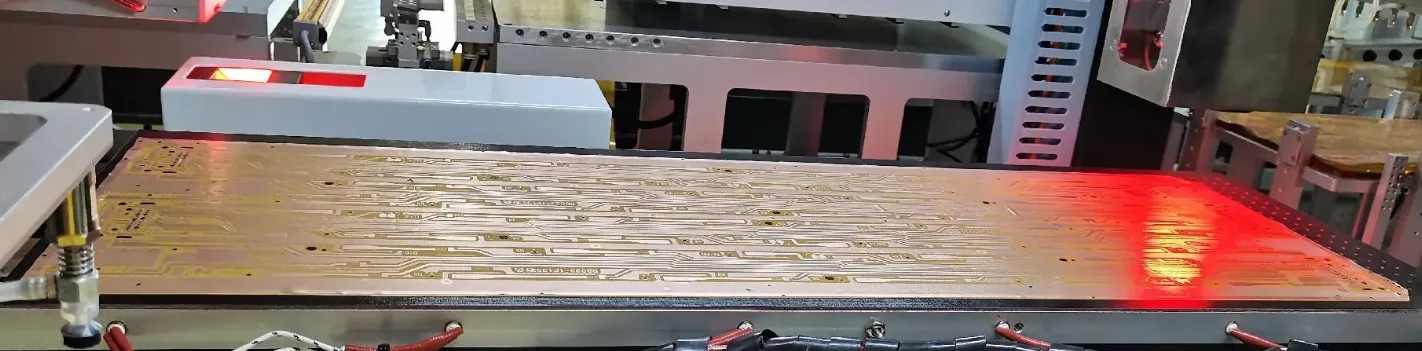
- Length-aware processing: long-format exposure/processing must maintain stability across the whole run, not only in the center.
- Registration control across multiple zones: checks should confirm alignment end-to-end, not just at one point.
- Clean edges and controlled cutting: poor edge quality becomes a tear initiation site during installation.
- Assembly fixtures for full-length support: without proper support, long flex can stretch, sag, or crease during SMT/connector installation.
- Thermal profile control: long thin substrates behave differently in heating processes—profile stability protects solder joint reliability.
- Packaging designed to prevent creasing: flat-supported packs or controlled-diameter rolling (depending on design) is not optional for long flex.
Highleap Electronics offers one-stop PCB fabrication + PCBA so the build plan, reinforcement strategy, fixture plan, and packaging method are coordinated—this is especially valuable for ultra-long flex where assembly handling is often the hidden failure source.
7. Inspection, Electrical Test & Reliability Validation
For long flex circuits, “passed continuity” isn’t enough. You want evidence that the full length is consistent and stable.
- Dimensional checks across multiple zones: verify stability along the full length, not one point
- Electrical continuity/short testing: full coverage as baseline for long interconnects
- Impedance verification (when required): confirm channel behavior for high-speed or sensitive signals
- Adhesion/peel validation: especially important for long lamination paths and harsh environments
- Bend-cycle testing plan: aligned to static install vs dynamic bending use cases
For demanding environments where you need documented validation methods, see PCB reliability validation for common screening and test approaches.
8. Fast RFQ Checklist for 4m–15m Ultra Long Flex PCB
Ultra-long flex quoting is fastest when your supplier understands both the electrical intent and the mechanical installation reality. Send the items below for accurate pricing + a build approach that protects yield.
- Gerbers + stackup intent (or request a stackup proposal)
- Total length/width + any “keep-flat” constraints (mounting points, channels, frames)
- Layer count (single/double/4-layer) and whether controlled impedance is required
- Current loads on power rails + allowable far-end voltage drop / max temperature rise
- Bend type (static installation vs dynamic repetitive bending) + minimum bend radius + where bends occur
- Connector types/locations + whether stiffeners/strain relief are needed
- Delivery format: bare flex / reinforced flex / with connectors / full PCBA module
9. FAQ
Q1: Can you manufacture a 4 meters flex PCB?
A: Yes. We support 4m-class ultra-long flex builds and can review your files to confirm the best construction for yield and reliability.
Q2: Can you build up to 15 meters ultra long flexible PCB?
A: Yes—up to 15 meters for qualified designs by engineering review. Feasibility depends on length + width + layer count + mechanical constraints + packaging method.
Q3: Do you support 4-layer super long flex PCB?
A: Yes. 4-layer ultra-long flex is commonly used for stable return paths, shielding intent, or denser routing. Stackup and registration strategy should be finalized early.
Q4: What is the #1 reason ultra-long flex fails after installation?
A: Handling and mechanical transitions—creases, stiffener-edge stress, and connector island fatigue are common causes if bend zones and reinforcement are not planned properly.
Q5: Can you provide fabrication + assembly (PCBA) for ultra-long flex?
A: Yes. One-stop fabrication + assembly reduces handling risk and keeps the build plan aligned with the assembly process.

Recommended Posts

PCB Panelization for Volume Production: Cost and Yield
A fabrication panel that holds more boards is not...

PCB SET Delivery and Panelization: Quantities and Acceptance
A purchase order for “500 SET” looks straightforward until...

Optical Transceiver PCB Cost: Compare Equivalent Quotes
Two suppliers may quote a nominally identical six-layer...
PCB Materials Database: Laminate Grades & Properties
How to get a quote for PCBs Let‘s run DFM/DFA analysis for...
How to get a quote for PCBs
Let us run DFM/DFA analysis for you and get back to you with a report.
You can upload your files securely through our website.
We require the following information in order to give you a quote:
-
- Gerber, ODB++, or .pcb, spec.
- BOM list if you require assembly
- Quantity
- Turn time
In addition to PCB manufacturing, we offer a comprehensive range of electronic services, including PCB design, PCBA (Printed Circuit Board Assembly), and turnkey solutions. Whether you need help with prototyping, design verification, component sourcing, or mass production, we provide end-to-end support to ensure your project’s success. For PCBA services, please provide your BOM (Bill of Materials) and any specific assembly instructions. We also offer DFM/DFA analysis to optimize your designs for manufacturability and assembly, ensuring a smooth production process.