
Solder Paste for SMT Assembly: Types, Storage, and Printing Defects
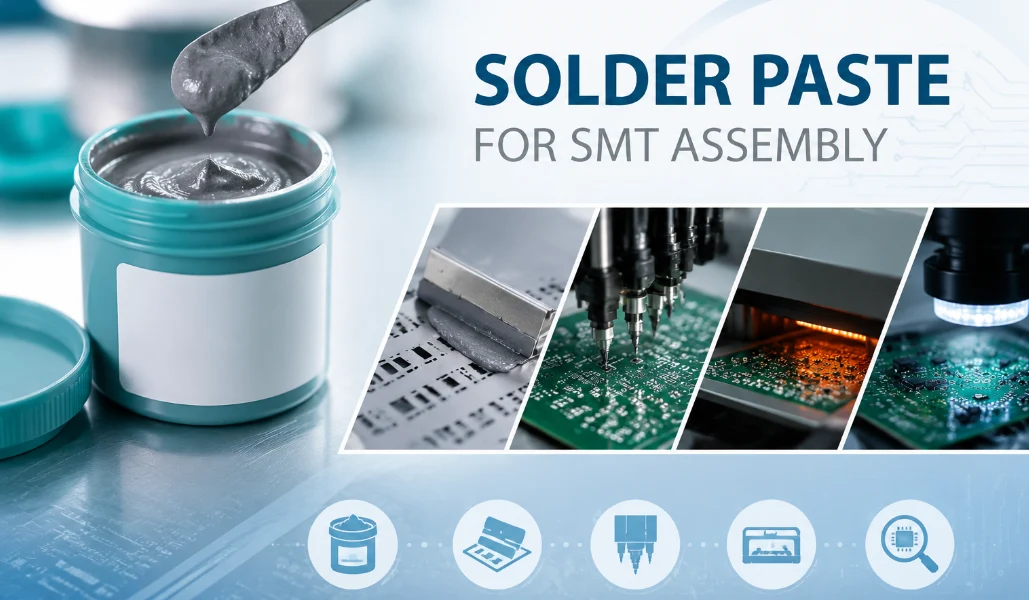
Figure 1. Solder paste selection affects SMT print quality, reflow yield, and long-term solder joint reliability.
Solder paste is the gray material that makes surface-mount assembly possible, but production results depend on the right alloy, flux chemistry, storage control, and stencil-printing discipline. This guide explains how solder paste affects SMT yield, what changes between lead-free and leaded options, how to store it correctly, and which defects operators should prevent before reflow.
1. What is solder paste made of?
Solder paste is made of two ingredients: microscopic solder-alloy powder and a flux medium that binds it into a paste. The powder forms the joints during reflow, while the flux strips oxide off the metal, helps the molten solder wet the pads, and temporarily holds parts in place before heating. By weight the paste is mostly powder; by volume the flux is a meaningful fraction, which is why a printed deposit visibly shrinks once the flux burns off in the oven.
The powder is graded by particle size, quoted as a “Type” number: Type 3 suits general assembly, while Type 4, Type 5 and finer are needed for tiny and tight-pitch parts where paste must squeeze through small stencil apertures. Finer powder costs more and is more sensitive to handling, so the grade is matched to the smallest feature on the board. If the difference between paste and plain flux is unclear, this comparison of solder paste versus solder flux clears it up.
2. Lead-free vs leaded solder paste (SAC305 vs Sn63/Pb37)
Lead-free solder paste (typically SAC305) melts at about 217-227°C, while leaded paste (Sn63/Pb37) melts lower at about 183°C and flows more easily. The choice is usually driven by compliance: products sold into RoHS markets need a lead-free solder process unless they qualify for an exemption, while leaded paste survives in some specialized and legacy applications.
| Leaded (Sn63/Pb37) | Lead-free (SAC305) | |
|---|---|---|
| Melting point | ~183°C | ~217-227°C |
| Wetting / ease of use | Flows easily, forgiving | Less forgiving, tighter profile |
| Compliance | Restricted under RoHS | RoHS compliant |
| Joint appearance | Shiny | Duller, grainier |
Lead-free’s higher melt point means more thermal stress on components and a tighter reflow profile, so process control matters more. For most commercial products today, lead-free is the default and the right starting assumption unless you have a specific reason otherwise.
3. No-clean, water-soluble, or rosin flux: which to choose
Choose no-clean flux for most assembly, water-soluble when you need maximum wetting and will wash the board, and rosin flux for hand-soldering and rework. No-clean leaves a small, benign residue that normally needs no washing and is the default for much modern production. Water-soluble flux gives excellent wetting but leaves a corrosive residue that must be washed off completely. Rosin-based flux (RMA) is the classic chemistry – available in leaded and lead-free variants – and its residue is usually cleaned for a tidy finish.
The right flux depends on how the board is cleaned, how residue-sensitive the circuit is, and the reliability class. When in doubt, no-clean is the safest general choice, with cleaning added where appearance or high reliability demands it.
4. How to use solder paste with a stencil and reflow
To use solder paste, print it onto the pads through a stencil, place components into the wet paste, then heat the whole board in a reflow oven so every joint forms at once – apply and place first, heat last. This is the opposite of wire soldering, where you heat each joint individually. In production the sequence runs on a coordinated SMT assembly line:
- Stencil printing. A laser-cut steel SMT stencil sits on the board and a squeegee forces paste through apertures onto each pad. Aperture size and stencil thickness set the solder volume – one of the most important variables – governed by careful stencil aperture design.
- Placement. A pick-and-place machine sets each part onto its paste-covered pads; the tacky paste holds them until reflow.
- Reflow. The board passes through a controlled profile – preheat, soak, a peak above the alloy’s melting point, then cooling. A correct reflow soldering profile lets the flux activate and surface tension pull each part into alignment.
- Inspection. AOI checks joints and placement after reflow, and X-ray inspects hidden joints under BGAs.
For prototypes, makers use a manual stencil with a hot plate or hot-air station; the principles are identical, scaled down. The most common beginner error is too much paste, which causes bridges, so aim for a thin, even deposit matching the pad.
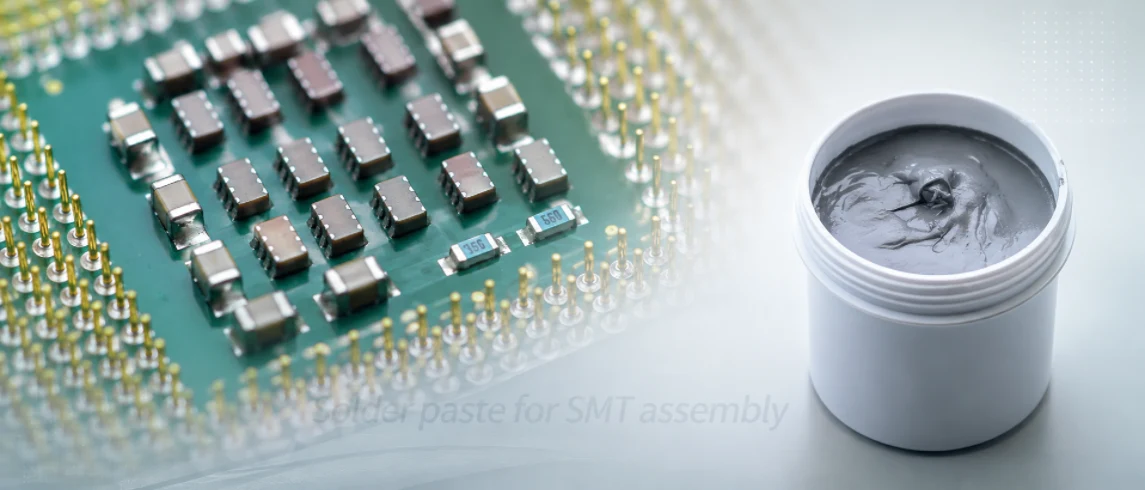
Stencil printing control is one of the first production checks in reliable SMT assembly.
5. How to store solder paste and its shelf life
Store solder paste sealed in a refrigerator at about 2-10°C, where shelf life is typically 6-12 months; at room temperature unopened paste lasts only weeks. Warm a sealed jar to room temperature (often 4-6 hours) before opening, so condensation does not contaminate the paste and cause spattering or voiding.
A few more rules keep it healthy: respect the open and idle time, since printed paste has a limited working life on the stencil before it dries; never refreeze it; never mix old with new; and discard expired paste rather than risk it. Solder paste is a perishable material, and poor handling is a hidden cause of defects, so treat it like the consumable it is.
6. Solder paste defects: bridging, tombstoning, and voids
Most solder-paste defects – bridging, tombstoning, voiding, insufficient solder, and solder balls – trace back to paste volume, alignment, or the reflow profile. Knowing the cause lets you prevent rework rather than chase it:
| Defect | Typical cause | Prevention |
|---|---|---|
| Bridging (shorts) | Too much paste or apertures too large | Reduce aperture size; verify stencil and print pressure |
| Tombstoning | Uneven paste or heating pulling a chip upright | Balance pad and paste on both ends; tune the profile |
| Voiding | Trapped flux gases, moisture, or a poor profile | Proper handling; optimized profile; X-ray to verify |
| Insufficient solder | Too little paste, clogged apertures, dried paste | Check stencil cleanliness and paste freshness |
| Solder balls / spatter | Moisture in paste or too-fast preheat | Warm paste sealed before use; slow the ramp rate |
The common thread is process control. Understanding the broader pattern of common SMT assembly faults helps you design boards that print well, and tombstoning in particular has a well-known set of root causes and fixes worth studying.
7. Solder paste in production SMT assembly
Beyond a handful of prototypes – and certainly for fine-pitch or BGA work – solder paste is best managed as a controlled process. On a professional line the stencil is designed around your board’s pad geometry and finest pitch, the paste is chosen for your RoHS and reliability needs, and the profile is set for the chosen alloy, backed by paste inspection, AOI, and X-ray for hidden joints.
Many paste-related defects are actually design issues – pad sizes, spacing, and orientation that make good printing hard – so a manufacturability check beforehand gives the stencil and profile the best chance of clean joints first time. Highleap runs that full path through SMT PCB assembly and, where boards need them, specialized BGA assembly with X-ray verification. When you request an assembly quote, tell us whether the product must be lead-free, any cleaning requirement, and the smallest component or pitch on the board.
8. Solder paste FAQ
What is solder paste made of?
A suspension of fine solder-alloy powder in a flux medium. The powder forms the joints during reflow; the flux cleans the metal, aids wetting, and holds parts in place.
What is the difference between lead-free and leaded solder paste?
Lead-free paste (SAC305) melts at about 217-227°C and is RoHS compliant; leaded paste (Sn63/Pb37) melts lower at about 183°C, flows more easily, but is restricted under RoHS.
How do you use solder paste?
Print it onto the pads (through a stencil for best results), place components into the wet paste, then heat the whole board in a reflow oven so every joint forms at once. Apply and place first, heat last.
Does solder paste need refrigeration, and what is its shelf life?
Yes – store it sealed at about 2-10°C, where shelf life is typically 6-12 months. Warm it to room temperature while sealed before opening to avoid condensation.
Why are my surface-mount joints bridging?
Usually too much paste or stencil apertures that are too large, sometimes with misalignment. Reducing aperture size, verifying the stencil, and checking print pressure typically solves it.
Can Highleap handle fine-pitch and BGA assembly?
Yes. Highleap uses fine-grade pastes, stencils designed for tight pitch, controlled reflow profiles, and X-ray inspection for hidden joints, with a manufacturability review beforehand.

Recommended Posts

Isola Astra MT77 PCB Manufacturing
Figure 1. Isola Astra MT77 PCB ManufacturingIsola Astra...

Nelco N4000-13 PCB Material and Manufacturing Guide | Highleap Electronics
Figure 1. Nelco N4000-13 PCBNelco N4000-13 PCB is a...

Copper Clad Laminate: Complete Material Selection Guide for PCB Engineers
Every electrical property that matters in a printed...

Inside a China Ceramic PCB Factory: Process Control Across Power/LED/RF/Medical
Table of Contents Inside a China Ceramic PCB Factory: How...
How to get a quote for PCBs
Let’s run DFM/DFA analysis for you and get back to you with a report. You can upload your files securely through our website. We require the following information in order to give you a quote:
-
- Gerber, ODB++, or .pcb, spec.
- BOM list if you require assembly
- Quantity
- Turn time
For PCBA services, please provide your BOM (Bill of Materials) and any specific assembly instructions. We also offer DFM/DFA analysis to optimize your designs for manufacturability and assembly, ensuring a smooth production process.