
Rogers RO4450T Bondply PCB for RO4000 Multilayer RF Stackups
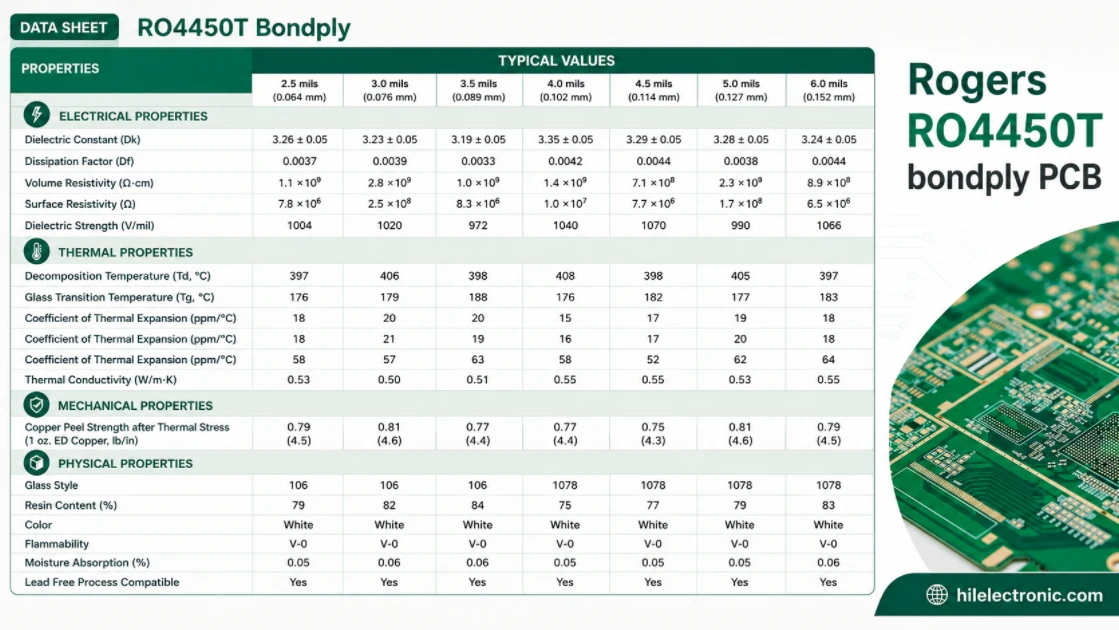
RO4450T bondply PCB manufacturing is a controlled multilayer lamination process for high-frequency Rogers PCB stackups. RO4450T is not used as a standalone core laminate. It works as a bonding layer in RO4000 multilayer constructions, especially with RO4003C, RO4350B, and selected hybrid Rogers/FR4 stackups.
For RF PCB production, the key requirement is not only material availability. The complete stackup must be reviewed for dielectric thickness, copper weight, impedance target, lamination stability, registration, drilling, plating, and inspection repeatability. Highleap reviews these details before quotation so the finished PCB can meet both mechanical and RF performance requirements.
RO4450T Bondply for Rogers Multilayer PCB Stackups
RO4450T is part of the electrical stackup.
RO4450T is commonly used as a bonding material in high-frequency multilayer PCB constructions. In RO4003C, RO4350B, or hybrid Rogers stackups, the bondply layer can affect stripline structures, broadside coupling, RF transitions, layer-to-layer spacing, and impedance repeatability.
Highleap reviews the complete PCB construction before production, including core material, bondply callout, copper thickness, finished board thickness, lamination sequence, and impedance requirements. This helps confirm whether the design can be manufactured consistently from prototype to repeat production.
- RO4003C and RO4350B multilayer RF PCBs
- Hybrid FR4/Rogers high-frequency PCB stackups
- RF modules with controlled dielectric bonding layers
- Controlled-impedance multilayer PCB prototypes
- Production builds requiring stable RF performance
For best results, the RO4450T layer should be clearly shown in the stackup drawing. The drawing should identify each core, bondply, copper layer, reference plane, impedance layer, and finished thickness requirement.
Related manufacturing topics include PCB lamination, hybrid PCB lamination, and Rogers PCB stackup.
RO4450T Thickness and Impedance Control
The bondply layer must be included in the impedance model.
In a high-frequency multilayer PCB, RO4450T thickness and dielectric behavior should be included in the stackup calculation. If the impedance model only considers copper geometry but ignores the bonding layer, the finished board may miss the target impedance even when the circuit pattern is etched correctly.
Before CAM tooling, Highleap checks whether controlled traces reference a Rogers core, a RO4450T bondply layer, or a combined dielectric structure. Finished copper thickness, plating allowance, reference plane continuity, and impedance coupon design are also reviewed.
- Bondply thickness and material callout
- Layer-by-layer dielectric structure
- Controlled impedance value and tolerance
- Finished copper thickness and plating impact
- Impedance coupon position and test requirement
Small changes in dielectric height, copper weight, resin flow, or reference plane design can affect the electrical result. For this reason, the stackup and impedance table should be approved before production files are released.
RO4450T Lamination Control
Lamination consistency determines RF repeatability.
RO4450T lamination requires control of pressure, temperature, resin flow, registration, void risk, and final dielectric thickness. These are manufacturing factors that directly influence finished board quality, especially in multilayer RF PCB production.
For hybrid Rogers/FR4 stackups, Highleap reviews material compatibility, CTE mismatch, copper balance, drill quality, and allowed material substitutions before quotation. This prevents the stackup from becoming an uncontrolled hybrid construction during production.
- Press cycle and lamination process window
- Registration control for multilayer RF boards
- Void, delamination, and resin-flow risk
- Copper balance and panel layout review
- Sequential lamination feasibility when required
- Hybrid Rogers/FR4 material compatibility
If the design requires sequential lamination, special cavity areas, asymmetric copper distribution, or strict finished thickness control, these requirements should be listed in the fabrication drawing. Clear documentation helps reduce engineering holds, material substitution risk, and production delays.
RO4450T PCB Quote Requirements
A complete RFQ package improves quote accuracy.
To quote a RO4450T bondply PCB, Highleap needs complete manufacturing data. A Gerber file alone is usually not enough for accurate stackup review, impedance confirmation, lamination planning, or cost evaluation.
- Gerber, ODB++, or IPC-2581 files
- Fabrication drawing
- Layer stackup drawing
- RO4003C, RO4350B, RO4450T, or hybrid material callout
- Copper weight and finished copper requirement
- Controlled impedance table and tolerance
- Surface finish requirement
- Finished board thickness requirement
- Impedance report, test coupon, or special inspection requirement
- Assembly files if PCBA service is required
Submit the production package through the Highleap PCB quote form. Highleap can then review material availability, stackup feasibility, lamination risk, impedance control, inspection level, and lead time before confirming the quotation.

Recommended Posts

Taconic RF-35 PCB Manufacturing Service — Prototype Through Volume Production
Figure 1. Taconic RF-35 PCBTaconic RF-35 is the workhorse...

Isola Astra MT77 PCB Manufacturing
Figure 1. Isola Astra MT77 PCB ManufacturingIsola Astra...

Custom Rogers RO4835 PCB Fabrication & Assembly Services
Figure 1. Rogers RO4835 PCBRogers RO4835 PCB is a...

Nelco N4000-13 PCB Material and Manufacturing Guide | Highleap Electronics
Figure 1. Nelco N4000-13 PCBNelco N4000-13 PCB is a...
How to get a quote for PCBs
Let’s run DFM/DFA analysis for you and get back to you with a report. You can upload your files securely through our website. We require the following information in order to give you a quote:
-
- Gerber, ODB++, or .pcb, spec.
- BOM list if you require assembly
- Quantity
- Turn time
For PCBA services, please provide your BOM (Bill of Materials) and any specific assembly instructions. We also offer DFM/DFA analysis to optimize your designs for manufacturability and assembly, ensuring a smooth production process.