
DBC Ceramic Substrate Materials and Selection Guide

Choosing the appropriate ceramic material for DBC substrates affects heat dissipation, electrical insulation, and long-term reliability. This page compares alumina Al2O3 aluminum nitride AlN and silicon nitride Si3N4 using practical engineering data to support material selection for power electronics and ceramic PCB designs.
Table of Contents
DBC ceramic substrates use different base materials to balance thermal conductivity, mechanical strength, and cost. Alumina offers economical performance for general applications, aluminum nitride provides high thermal conductivity for heat-intensive designs, and silicon nitride improves mechanical durability under thermal cycling. Understanding these differences helps engineers choose the most suitable option based on system requirements and compatibility with downstream ceramic PCB fabrication processes and broader PCB manufacturing and assembly workflows.
For projects that require prototype or volume production support, you can request a quotation directly below.
What Is a DBC Ceramic Substrate?
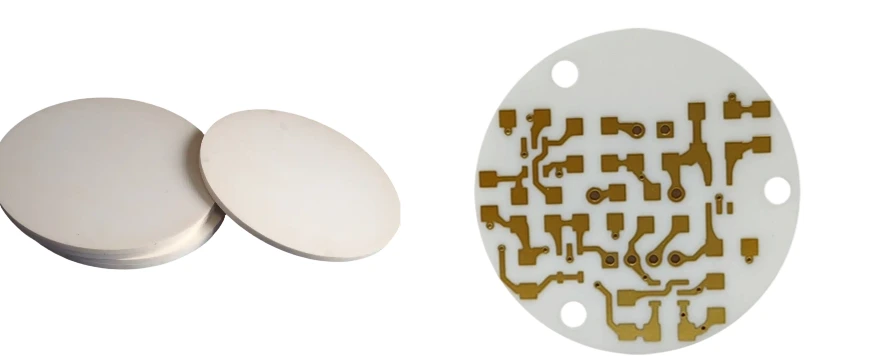
A DBC ceramic substrate combines a ceramic insulating core with directly bonded copper conductors. The ceramic layer provides electrical isolation, mechanical support, and thermal conduction between power devices and the cooling system. Understanding ceramic material options is essential for optimizing DBC substrate performance in any application.
The ceramic material’s physical properties fundamentally determine the substrate’s capabilities:
- Thermal conductivity: Governs how efficiently heat transfers from power devices to the heatsink
- Coefficient of thermal expansion (CTE): Affects reliability under thermal cycling when mismatched with other materials
- Mechanical strength: Determines resistance to cracking under thermal and mechanical stress
- Dielectric strength: Defines maximum operating voltage capability
The DBC process parameters vary depending on the ceramic material, with each requiring specific bonding temperatures and atmospheres for optimal results.
2) Common Ceramic Materials Used in DBC
Three ceramic materials dominate DBC substrate manufacturing, each offering distinct performance characteristics:
2.1 Alumina (Al₂O₃)
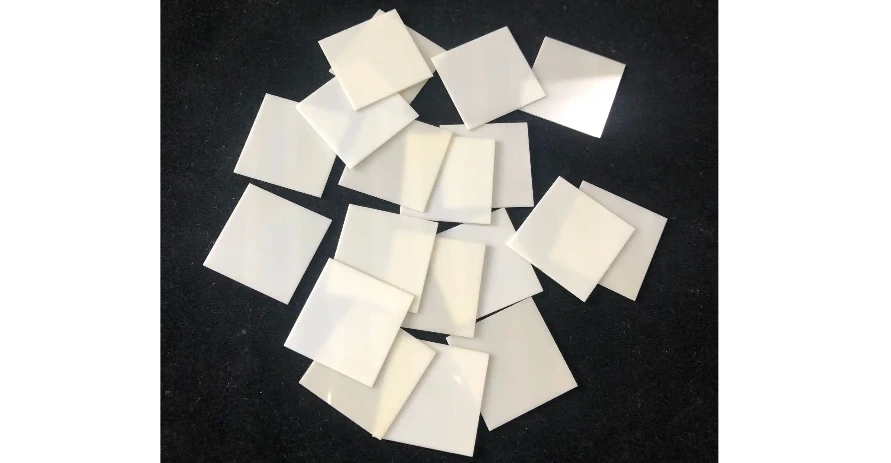
Alumina ceramics have served as the workhorse material for DBC substrates since the technology’s inception. Available in purity grades from 92% to 99.6%, alumina offers a mature supply chain, predictable processing, and competitive pricing. The 96% purity grade represents the most common choice for standard power electronics applications.
Key properties of 96% alumina:
- Thermal conductivity: 24-28 W/m·K
- CTE: 7.1 ppm/°C
- Flexural strength: 350-400 MPa
- Dielectric strength: 15-20 kV/mm
2.2 Aluminum Nitride (AlN)
Aluminum nitride delivers thermal conductivity 7-10 times higher than alumina, making it the preferred choice for thermally demanding applications. High-quality AlN ceramics achieve thermal conductivities of 170-230 W/m·K depending on purity and processing. This exceptional thermal performance justifies the higher material cost in applications where heat dissipation limits power density.
Key properties of AlN:
- Thermal conductivity: 170-230 W/m·K
- CTE: 4.5 ppm/°C (excellent match to silicon’s 2.6 ppm/°C)
- Flexural strength: 300-350 MPa
- Dielectric strength: 15-17 kV/mm
2.3 Silicon Nitride (Si₃N₄)
Silicon nitride offers the highest mechanical strength and fracture toughness among common DBC ceramics. While its thermal conductivity falls between alumina and AlN, its exceptional resistance to thermal shock and mechanical stress makes it increasingly popular for demanding automotive and railway applications where long-term reliability under harsh conditions is paramount.
Key properties of Si₃N₄:
- Thermal conductivity: 70-90 W/m·K
- CTE: 2.6 ppm/°C (closely matches silicon)
- Flexural strength: 700-900 MPa
- Fracture toughness: 6-7 MPa·m^½
3) AlN vs Al₂O₃ vs Si₃N₄ DBC Substrates
Choosing between ceramic materials requires balancing multiple performance factors against cost and availability. The following comparison highlights the key differences relevant to substrate selection.
3.1 Thermal Performance Ranking
AlN > Si₃N₄ > Al₂O₃
AlN substrates reduce junction-to-case thermal resistance by 60-70% compared to alumina in identical geometries. This thermal advantage translates directly to higher power handling capability or lower operating temperatures.
3.2 Mechanical Reliability Ranking
Si₃N₄ > Al₂O₃ > AlN
Silicon nitride’s superior fracture toughness makes it far more resistant to cracking from thermal shock or mechanical stress. Si₃N₄ DBC substrates routinely survive 5,000+ thermal cycles where AlN substrates of identical design might fail after 3,000 cycles.
3.3 Cost Ranking (Low to High)
Al₂O₃ < AlN < Si₃N₄
Alumina DBC substrates typically cost 30-50% less than AlN equivalents, while Si₃N₄ commands premium pricing due to more complex ceramic processing requirements. Volume and specification complexity significantly influence actual pricing.
3.4 CTE Match to Silicon
Si₃N₄ (2.6 ppm/°C) ≈ Silicon (2.6 ppm/°C) < AlN (4.5 ppm/°C) < Al₂O₃ (7.1 ppm/°C)
Close CTE matching between substrate and semiconductor die reduces thermal stress on solder joints and die attach interfaces, improving reliability under thermal cycling.
4) Thermal and Electrical Performance Comparison
Understanding quantitative performance differences helps engineers make material selection decisions based on application requirements. Explore the broader landscape of ceramic circuit technologies at our ceramic PCB overview page.
4.1 Thermal Resistance Comparison
For a 1mm thick ceramic substrate at 10mm × 10mm size:
- Al₂O₃: ~0.42°C/W thermal resistance
- AlN: ~0.05°C/W thermal resistance
- Si₃N₄: ~0.13°C/W thermal resistance
These differences compound when designing for specific junction temperatures, directly affecting achievable power density.
4.2 Dielectric Performance
All three ceramics provide excellent electrical isolation for power electronics applications. Key considerations:
- Partial discharge inception voltage: AlN typically exhibits lower partial discharge inception voltage than alumina at equivalent thickness, requiring consideration in high-voltage designs.
- Volume resistivity: All three materials maintain resistivities >10^14 Ω·cm at room temperature, dropping significantly at elevated temperatures.
- Loss tangent: Critical for RF applications; AlN offers the lowest dielectric loss among these ceramics.
5) Application-Driven Material Selection
The optimal ceramic choice depends heavily on application requirements. The following guidelines help match materials to common use cases.
5.1 Choose Alumina (Al₂O₃) When:
- Cost optimization is a primary concern
- Thermal requirements are moderate (power density <50 W/cm²)
- Operating temperatures remain below 150°C
- Design can accommodate larger substrate area for heat spreading
- Standard industrial motor drives, UPS systems, and general power supplies
5.2 Choose Aluminum Nitride (AlN) When:
- Maximum thermal performance is required
- Power density exceeds 100 W/cm²
- Size constraints prevent heat spreading with alumina
- SiC or GaN wide-bandgap devices require enhanced cooling
- EV traction inverters, aerospace power electronics, and high-frequency RF amplifiers
5.3 Choose Silicon Nitride (Si₃N₄) When:
- Extreme thermal cycling reliability is required (>5,000 cycles)
- Application involves severe thermal transients
- Mechanical shock and vibration are significant concerns
- Long warranty periods demand exceptional reliability
- Automotive traction systems, railway inverters, and high-reliability industrial equipment
6) Choosing the Right DBC Ceramic Substrate
Material selection requires evaluating technical requirements against practical constraints. Working with an experienced DBC substrate manufacturer provides access to application expertise and material guidance.
6.1 Key Questions to Address During Material Selection
- What is the maximum allowable junction temperature? This determines the required thermal performance.
- What thermal cycling profile will the substrate experience? Severe cycling may necessitate Si₃N₄ regardless of thermal requirements.
- What operating voltage is required? This determines minimum ceramic thickness.
- What is the target unit cost? Volume production may justify higher-performance materials through yield improvements.
- What are the size constraints? Limited footprint may require AlN to achieve target thermal performance.
Highleap Electronics provides technical guidance on ceramic material selection, helping engineers balance performance, reliability, and cost. Our capabilities span PCB fabrication through advanced DBC substrate manufacturing, supporting projects from concept through volume production.
For terminology clarification and foundational understanding, visit our direct bonded copper substrate definition page.

Recommended Posts
PCB Panelization for Volume Production: Cost and Yield
A fabrication panel that holds more boards is not...
PCB SET Delivery and Panelization: Quantities and Acceptance
A purchase order for “500 SET” looks straightforward until...

Optical Transceiver PCB Cost: Compare Equivalent Quotes
Two suppliers may quote a nominally identical six-layer...
PCB Materials Database: Laminate Grades & Properties
How to get a quote for PCBs Let‘s run DFM/DFA analysis for...
How to get a quote for PCBs
Let us run DFM/DFA analysis for you and get back to you with a report.
You can upload your files securely through our website.
We require the following information in order to give you a quote:
-
- Gerber, ODB++, or .pcb, spec.
- BOM list if you require assembly
- Quantity
- Turn time
In addition to PCB manufacturing, we offer a comprehensive range of electronic services, including PCB design, PCBA (Printed Circuit Board Assembly), and turnkey solutions. Whether you need help with prototyping, design verification, component sourcing, or mass production, we provide end-to-end support to ensure your project’s success. For PCBA services, please provide your BOM (Bill of Materials) and any specific assembly instructions. We also offer DFM/DFA analysis to optimize your designs for manufacturability and assembly, ensuring a smooth production process.