
How to Design Fast Turnaround Blind Buried Via PCBs

Table of Contents
- Fast Turnaround Blind Buried Via PCB: What’s Actually Achievable
- The Lamination Time Floor: What Expediting Can and Cannot Compress
- Design Strategies That Enable Fast Turnaround Without Expedite Fees
- Specification Choices That Compress Processing Time
- Expedite Cost vs. Schedule Value: The ROI Calculation
- When Fast Turnaround Blind Buried Via PCB Is and Is Not Worth It
- Highleap Fast Turnaround Capabilities and Process
Fast Turnaround Blind Buried Via PCB — Lead Time Reality Check
- Type I HDI (1+N+1): 10–12 days standard · 7 days expedited · 5 days super rush (Type I only)
- Type II HDI (2+N+2): 14–16 days standard · 10 days expedited · below 10 days not achievable
- Type III HDI (buried + blind): 18–22 days standard · 14 days expedited · below 14 days not achievable
- The physical floor: Each lamination cure cycle takes 8–12 hours minimum — no expedite fee changes chemistry
- Design optimization: Staggered vias + Type I where possible = up to 12 days saved with zero expedite cost
Achieving fast turnaround blind buried via PCB fabrication requires understanding precisely which process steps have physical time floors versus which can be compressed through priority scheduling, and then making the design and specification choices that eliminate every compressible delay. The confirmed minimum lead times: Type I HDI 7 business days, Type II 10 business days, Type III 14 business days — with full expedite service and stocked materials. These floors are set by lamination cure chemistry, not factory scheduling. Below these numbers, boards either aren’t fabricated correctly or aren’t classified as described. Within these constraints, intelligent design choices can reduce lead time by 6–10 days relative to a maximally specified design — often eliminating the need for expedite fees entirely. See expedited PCB manufacturing options
Get Fast Turnaround Quote with Delivery Guarantee
1) Fast Turnaround Blind Buried Via PCB: What’s Actually Achievable
1.1 Confirmed Minimum Lead Times by Configuration
| HDI Type | Standard Lead Time | Expedited | Super Rush (Max Effort) | Conditions Required for Minimum |
|---|---|---|---|---|
| Type I (1+N+1) | 10–12 days | 7 days | 5 days | Stocked FR-4, staggered vias, Class 2, clean files |
| Type II (2+N+2) | 14–16 days | 10 days | Not achievable | Stocked materials, staggered vias, Class 2 |
| Type III (buried + blind) | 18–22 days | 14 days | Not achievable | Stocked materials, Class 2, simple buried via structure |
| Type III (complex, multiple buried) | 22–28 days | 16–18 days | Not achievable | N/A — minimum constrained by cycle count |
1.2 Industry Benchmarks and Red Flags
If a supplier quotes blind buried via PCB lead times significantly below these benchmarks, ask specifically: what lamination cycle count does this design require? A valid answer demonstrates they understand your HDI type. A vague answer like “we have fast equipment” should prompt further questioning.
Legitimate reasons a supplier might be faster than average:
- 24/7 operation (3-shift factory) — adds 50–80% throughput vs. single-shift, can compress lead time by 1–3 days for Type I
- Dedicated prototype lines with permanently configured press programs for common stackups — reduces setup time, not cure time
- Pre-stocked panels with standard HDI stackups partially processed — rare but exists at high-volume specialized factories
None of these eliminate the lamination cure time. They reduce queue time and setup time. The cure time floor remains.
1.3 Geographic Proximity and Shipping Time
Factory-to-destination shipping time is not part of fabrication lead time but is part of total delivery time. For urgent programs:
- DHL/FedEx from Shenzhen to US: 2–3 business days
- DHL/FedEx from Shenzhen to Europe: 3–4 business days
- Air freight vs. express courier: Air freight is cheaper for larger quantities but requires customs clearance time (1–3 days)
For a 7-day fabrication window with US delivery: total time from file submission to boards in hand = 7 days fabrication + 3 days shipping = 10 calendar days minimum. Plan accordingly.
2) The Lamination Time Floor: What Expediting Can and Cannot Compress
2.1 The Non-Compressible Process Steps
These steps cannot be shortened regardless of expedite priority or fee:
Lamination cure dwell (90–180 minutes per cycle at 170–190°C)
The epoxy resin cross-linking reaction in prepreg requires sustained temperature for complete cure. Insufficient cure time produces boards with marginal peel strength, inadequate Tg, and latent delamination risk under thermal cycling in service. This is a chemical reaction time, not a scheduling matter.
Cool-down (3–5 hours per cycle)
After press opening, the panel must cool at a controlled rate to prevent warpage from differential thermal contraction between copper layers and laminate. FR-4 CTE: 14–18 ppm/°C (in-plane), 50–70 ppm/°C (z-axis). Copper CTE: 17 ppm/°C. Rapid cooling from 180°C introduces CTE-mismatch stresses that cause both immediate warpage and longer-term delamination. The cool-down cannot be accelerated.
Electroplating bath time (6–12 hours per cycle for copper fill)
Electroplating is a current-density-determined process. The copper deposition rate is limited by Faraday’s law and mass transport constraints. Running higher current density causes non-uniform plating, low ductility deposits, and burning on exposed surfaces. IPC-6012 Class 2 requires minimum 20µm barrel copper — meeting this specification at accelerated current density is possible but requires tight bath chemistry control.
2.2 Compressible Time Elements (Where Priority Helps)
| Process Step | Standard Time | Compressed (Priority) | How It’s Compressed |
|---|---|---|---|
| CAM review and job release | 4–8 hrs | 1–2 hrs | Dedicated engineer, priority queue |
| Inner layer imaging | 8–14 hrs | 4–6 hrs | Night shift processing |
| Laser drill queue | 6–14 hrs | 2–4 hrs | Priority machine access |
| Desmear and electroless copper | 6–8 hrs | 3–4 hrs | Dedicated bath line |
| Outer layer imaging | 6–10 hrs | 3–5 hrs | Night shift processing |
| Solder mask and cure | 8–12 hrs | 5–7 hrs | UV LED solder mask (faster cure) |
| ENIG finish | 6–10 hrs | 4–6 hrs | Priority bath access |
| Electrical test | 4–8 hrs | 2–4 hrs | Dedicated tester, night shift |
Total compressible time: 25–45 hours for a Type I HDI job. This is how expediting achieves 3–4 day reduction from standard lead time — not by eliminating process steps but by moving the job through compressible steps faster with priority queue access.
2.3 Why No Factory Can Produce Type II HDI in 5 Days
Type II HDI (3 lamination cycles) minimum time accounting:
- Inner layer fabrication (minimum compressed): 8 hours
- Cycle 1 (core): 8–12 hours cure + 3–5 hours cool-down = 11–17 hours
- Buried via processing (if Type III) or first blind via laser+plate: 12–18 hours
- Cycle 2 (first buildup): 11–17 hours
- Second laser drill + plate: 10–15 hours
- Cycle 3 (second buildup): 11–17 hours
- Outer processing + test: 18–24 hours
- Minimum total: 71–108 hours = 9–14 working days at 8 hrs/shift
At 24-hour continuous production (3 shifts): 71–108 hours = 3–5 calendar days. This is why 24-hour factory operation is a genuine differentiator for fast turnaround Type II/III HDI — it converts working-day lead time to calendar-day lead time.
💡 Speed without stability is a liability. True fast turnaround blind buried via PCB manufacturing requires rigorous process control. As shown in our structural analyses, accelerating the production schedule must never compromise internal layer registration or copper integrity.
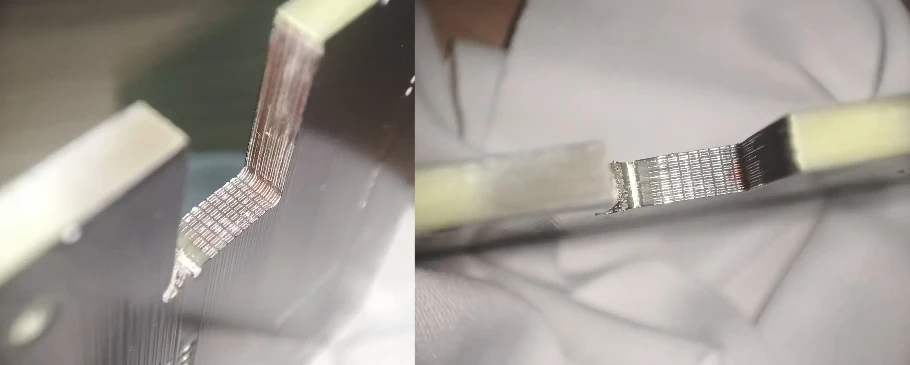
✓ Design choices that reduce lead time
- Type I instead of Type III: saves 8–12 days
- Staggered vias (no fill): saves 1–2 days/cycle
- Eliminate via-in-pad where pitch allows: saves 5–8 hours
- Standard stocked FR-4 materials: eliminates 5–15 day procurement
- IPC Class 2 instead of Class 3: saves 1–2 days
✗ Choices that add lead time
- Type III when Type I is sufficient: +8–12 days
- Stacked via fill and planarization: +6–10 hours/cycle
- Specialty materials (Megtron 6, specialty low-loss laminate): +5–15 day procurement
- Via-in-pad on all BGAs regardless of pitch: +5–8 hours
- IPC Class 3 with full microsection on prototype: +1–2 days
3) Design Strategies That Enable Fast Turnaround Without Expedite Fees
3.1 Strategy 1: Confirm HDI Type Before Committing
The most powerful fast turnaround strategy is not being in Type III when Type I is sufficient. Lead time saved by type reduction:
- Type III (18–22 days standard) → Type II (14–16 days): 4–6 days saved
- Type II (14–16 days) → Type I (10–12 days): 4 days saved
- Type III → Type I: 8–12 days saved with zero additional cost
The question to answer for each BGA component: what is the minimum blind via depth required for fanout? If L1→L2 blind vias (Type I territory) are sufficient for fanout, specify Type I. If L1→L2 and L2→L3 are needed (Type II), specify Type II. Only specify Type III when inner-layer connections between non-adjacent layers (e.g., L4→L6 or L5→L7) are functionally required.
3.2 Strategy 2: Staggered Via Architecture
Converting stacked microvias to staggered removes via fill and planarization from the process sequence. Impact on each lamination cycle:
- Resin fill injection: 2–3 hours per panel → eliminated
- Planarization (mechanical or chemical): 3–5 hours per panel → eliminated
- Planarization verification inspection: 1–2 hours → eliminated
Total time saved per lamination cycle requiring fill: 6–10 hours. For a Type II board with 2 blind-via buildup cycles, converting both to staggered saves 12–20 hours = 1–2 business days.
The routing trade-off: staggered vias require each microvia to land on an intermediate capture pad offset 0.25mm from the next layer’s via. This consumes 5–8% additional routing area in the BGA fanout zone. On boards not at absolute density limits, this trade-off is worth taking for every design that is schedule-sensitive.
3.3 Strategy 3: Board Dimension Optimization for Panel Efficiency
Panel utilization directly affects processing time. A panel with 16 boards takes approximately the same press time, laser time, and test time as a panel with 24 boards. If your board dimensions allow 24 boards/panel instead of 16, the per-board processing time drops by 33% — and the factory can run the same number of panels to deliver your quantity in fewer production days.
Worked example: Board at 82×110mm = 16 boards/panel (600×500mm usable panel). Board resized to 79×107mm = 20 boards/panel — a 25% improvement. At 100-board order: 5 panels needed vs. 6.25 panels. One fewer panel run saves 0.5–1 production day on tight schedules.
Ask your factory what the optimal board dimensions are for their standard panel size before finalizing the board outline, especially if schedule is a constraint.
3.4 Strategy 4: Eliminating Via-in-Pad Requirements
Via-in-pad requires copper fill and cap plating, adding:
- Fill injection: 2–3 hours per panel
- Cap plating and inspection: 3–5 hours per panel
For BGA components where dog-bone routing (via offset 0.20–0.30mm outside the pad edge) is feasible, eliminating via-in-pad saves 5–8 hours and $0.30–$0.70/via in cost. Dog-bone routing is feasible at 0.5mm BGA pitch with standard trace and space rules. At 0.4mm pitch, it becomes constrained. At 0.35mm pitch, via-in-pad is typically unavoidable.
Evaluate each BGA on your board individually. A design with 4 BGA components at 0.5mm pitch and one at 0.4mm pitch should use dog-bone for the 0.5mm components and accept via-in-pad only for the 0.4mm component — not apply via-in-pad to the entire board.
3.5 Strategy 5: Through-Hole Via on Non-Critical Signals
Not every via needs to be a blind via. Signals that connect L1 to L4 through L6 on a 10-layer HDI board can use through-hole vias if stub resonance is not a concern at the operating frequency. Through-hole vias:
- Are mechanical drilled (faster than laser for large diameters)
- Don’t require additional lamination cycles
- Cost 3–5× less than blind vias
Reserving blind vias for BGA fanout and high-speed escape routing, and routing power and general-purpose signals through through-hole vias, minimizes the blind via count — which directly reduces laser drill time and fill requirements.
4) Specification Choices That Compress Processing Time
4.1 Surface Finish Selection for Fast Turnaround
ENIG (Electroless Nickel Immersion Gold) is the standard finish for HDI because of its flat surface compatibility with fine-pitch BGA. ENIG process time: 6–10 hours. Alternative finishes for faster processing:
- OSP (Organic Solderability Preservative): 2–3 hours process time — saves 4–7 hours. See PCB surface finish comparison for quick turn Limitation: 6–12 month shelf life, no second reflow compatibility. Suitable for same-month assembly without second reflow.
- Immersion Silver: 3–4 hours process time — saves 3–6 hours. Excellent for RF applications; tarnish-sensitive, requires immediate assembly or moisture-barrier packaging.
- HASL lead-free: 2–3 hours. Not suitable for fine-pitch BGA (surface flatness inadequate). Viable for designs without BGA components.
For fast turnaround prototypes where assembly will occur within days of receipt, OSP can shave 4–7 hours off the total lead time while reducing cost by $0.80–$2.00/board.
4.2 Controlled Impedance Tolerance Relaxation
Standard controlled impedance specification: ±10% of target (e.g., 50Ω ±5Ω). Tight specification: ±5% (50Ω ±2.5Ω). The difference in manufacturing impact:
- ±10% tolerance: factory uses standard stackup verification TDR coupon. Pass/fail is clear. No re-work or re-verification loop.
- ±5% tolerance: requires tighter stackup control, possible dielectric thickness measurement on each lot, and TDR re-verification if first coupon falls outside the window. This adds 0.5–1 day on lots that require re-verification.
For fast turnaround on designs where ±10% impedance tolerance is electrically sufficient (most PCIe Gen3 and below, most RF designs with 2Ω margin in the link budget), specify ±10%. The electrical impact is negligible; the schedule impact can be meaningful.
4.3 IPC Class 2 vs. Class 3 Processing Time
Class 3 inspection adds 1–2 business days:
- Destructive cross-section analysis on representative samples: 4–8 hours
- Extended electrical test coverage: 1–2 hours additional
- Stricter AOI thresholds requiring more manual inspection re-checks: 2–4 hours
- Micro-section documentation and review: 2–3 hours
For prototype boards where the primary goal is functional bring-up and design validation, Class 2 inspection is appropriate. Upgrading to Class 3 for production adds the necessary reliability verification without the schedule constraint of prototype schedules.
4.4 File Submission Best Practices for Fast Turnaround
Engineering queries and back-and-forth DFM issues are the most common cause of prototype schedules slipping. See DFM review for HDI designs Submitting complete, verified files reduces job release to production to 1–2 hours vs. 1–3 days for files with issues.
The checklist for fast turnaround file submission:
- Gerber files reviewed in an independent viewer (Gerbv, KiCad) to confirm layer assignments and completeness
- Drill file verified: via types classified (blind, buried, through-hole), diameters confirmed against design rules, coordinate origin matches Gerber origin
- Blind via depth specified: “blind L1–L2” and “blind L9–L10” explicitly stated, not inferred from stackup
- Controlled impedance: trace width, layer, target impedance, and acceptable tolerance stated explicitly
- Lamination stackup: complete layer stackup document with dielectric thickness and copper weight per layer
- Surface finish, copper weight, board thickness, and IPC class all specified on the fabrication notes document
A job submitted with this checklist complete has a near-zero probability of generating a DFM query that delays production release. A job missing any of these items will typically generate at least one engineering query, adding 4–24 hours before the clock starts on fabrication.
5) Expedite Cost vs. Schedule Value: The ROI Calculation
5.1 Expedite Fee Structure
| Lead Time Target | HDI Type Eligible | Surcharge | Example (25 boards, $1,800 base) |
|---|---|---|---|
| 7 days (from 10–12 standard) | Type I only | +25–40% | +$450–$720 |
| 5 days (super rush) | Type I only | +50–70% | +$900–$1,260 |
| 10 days (from 14–16 standard) | Type II | +30–45% | +$540–$810 |
| 14 days (from 18–22 standard) | Type III | +35–55% | +$630–$990 |
5.2 ROI Scenarios Where Expediting Makes Sense
Scenario 1: Pre-scheduled assembly shop time
Assembly shop has allocated a build slot starting in 10 days. Standard HDI lead time is 12 days. Expediting to 7 days: $630 cost. Value of maintaining the assembly slot vs. rescheduling (average 2–3 week delay, assembly shop re-booking cost, downstream schedule impact): $2,000–$5,000+ depending on product and program. Expedite ROI: clearly positive.
Scenario 2: Product launch deadline
Product launch scheduled for Q1. One additional board respin is needed. Standard lead time is 12 days, leaving 2 days of margin for firmware bring-up. Expediting to 7 days adds 5 days of margin for debugging. If the launch slips one quarter due to insufficient bring-up time, the revenue impact is far larger than $630.
Scenario 3: Customer-committed delivery with penalty clause
Contract commits delivery of prototype units in 14 days from design freeze. Current HDI fabrication quote is 12 days standard + 3 days assembly. Expediting fabrication to 7 days allows 7 days for assembly and test — within the commitment. The expedite cost ($630) is less than the contractual penalty.
5.3 When Expediting Blind Buried Via PCBs Is NOT Worth It
- When the downstream use (assembly, testing) isn’t scheduled until after the standard lead time anyway — you’re paying to sit on boards
- When the design hasn’t been fully verified and a second respin is likely — expediting a design that will need re-work doesn’t compress the overall program timeline
- When cost pressure on the program is severe and the schedule buffer is adequate — standard lead time with disciplined scheduling is always the best choice when schedule allows
- When the expedite premium would be better spent on design reviews that reduce respin risk
6) When Fast Turnaround Blind Buried Via PCB Is and Is Not Worth It
6.1 The Total Schedule Analysis
Evaluating whether to expedite requires looking at the critical path of the entire development schedule, not just the PCB fabrication step. Common findings:
- Expediting PCB fabrication by 5 days, but firmware development takes 8 more days: fabrication is not the critical path — expediting adds cost with no schedule benefit
- Expediting PCB fabrication by 5 days, removing it from the critical path, allowing concurrent assembly start: saves 5 days on overall schedule
Fast turnaround is worth the premium only when PCB fabrication is the critical path constraint. Identify the critical path first; expedite second.
6.2 Prototype vs. Production Expediting
Expedite fees are proportionally most impactful at prototype quantities (5–25 boards) where the base order cost is lowest. At prototype, the expedite surcharge (25–70%) may add $400–$1,000 to a $1,200–$2,000 order. At production (500+ boards), the same percentage surcharge adds $5,000–$15,000 to a $15,000–$30,000 order — a much more significant commitment.
The implication: expediting prototype runs is often easily justifiable based on program schedule value. Expediting production runs requires a more careful ROI analysis because the absolute cost is higher and production runs are typically on more predictable schedules than prototype runs.
7) Highleap Fast Turnaround Capabilities and Process
7.1 Confirmed Fast Turnaround Lead Times
| Configuration | Stocked Materials | Expedited | Super Rush |
|---|---|---|---|
| Type I HDI, staggered vias, Class 2 | 10–12 days | 7 days | 5 days |
| Type I HDI, stacked vias, Class 2 | 11–13 days | 8 days | 6 days |
| Type II HDI, staggered vias, Class 2 | 14–16 days | 10 days | Not available |
| Type III HDI, staggered outer vias, Class 2 | 18–22 days | 14 days | Not available |
7.2 Material Stock and Availability Transparency
Before confirming lead time, Highleap verifies material availability for your specified stackup. If the required material is not stocked, we provide three options: quoted lead time with material procurement included, alternate stocked material recommendation with electrical equivalence assessment, and customer-consigned material option if you have the material available. You receive this information within 4 hours of file submission — before committing to the lead time.
7.3 Fast Turnaround File Review Process
For expedite orders, Highleap completes DFM review within 2 hours of file submission (standard: 24 hours). The review is focused on the three items most likely to cause job holds: via depth specification, impedance target documentation, and drill file completeness. Jobs that clear this review are released to production immediately. The 2-hour review window starts the fast turnaround clock as early as possible.
7.4 Expedite Pricing Transparency
Highleap quotes expedite surcharges as a specific dollar amount, not a percentage, on every fast turnaround quote. You see exactly what the faster delivery costs, and can compare it against the schedule value before committing. For programs where standard and expedited quotes are both obtained, the difference is transparent. For understanding standard HDI lead time planning for recurring programs, see our lead time guide. For the cost implications of HDI type selection, see blind buried via PCB cost analysis.
7.5 Design Support for Fast Turnaround Optimization
For programs where lead time is a primary design constraint, Highleap’s engineering team provides a pre-submission review focused on fast turnaround optimization: HDI type reduction feasibility, via staggering opportunities, and stackup material availability check — before you finalize the design. This review identifies lead time reduction opportunities at the design stage, where changes are free, rather than during production where changes are impossible.

Recommended Posts
TMM3 PCB Manufacturing for RF Modules
TMM3 PCB manufacturing is most useful where the RF module...
TMM6 PCB Fabrication
TMM6 fabrication is the process-control page for a mid-Dk...

TMM10 PCB Manufacturing for Compact RF Designs
Table of contentsHow TMM10 Shrinks RF StructuresTMM10 vs...

TMM10i PCB Fabrication and DFM
TMM10i PCB fabrication has a stronger DFM emphasis because...
How to get a quote for PCBs
Let us run DFM/DFA analysis for you and get back to you with a report.
You can upload your files securely through our website.
We require the following information in order to give you a quote:
-
- Gerber, ODB++, or .pcb, spec.
- BOM list if you require assembly
- Quantity
- Turn time