
8 Common High Frequency PCB Design Mistakes and Solutions

High frequency PCB design mistakes can cause severe performance degradation, including signal distortion, unwanted EMI, and reliability issues in high-speed or RF systems. Even well-trained designers may overlook subtle factors such as impedance stability, return path integrity, and via parasitics.
Understanding these common pitfalls—and knowing how to correct them—is crucial for maintaining design precision and manufacturability. This article outlines the most frequent errors engineers face in high frequency PCB design and provides actionable, technically grounded solutions for each.
1. Improper Impedance Control
Maintaining precise impedance is a cornerstone of high frequency PCB design. Mismatched impedance leads to signal reflection, increased insertion loss, and degraded timing accuracy, especially in GHz-level circuits. The problem often arises from unbalanced trace widths, incorrect dielectric thickness, or inconsistent material properties.
To prevent this, designers should perform pre-layout impedance simulations using tools such as Polar Si8000 or ADS, define target impedance for every controlled layer, and verify with time-domain reflectometry (TDR) during prototyping. Selecting materials with stable dielectric constants (low Dk) and low dissipation factors (Df) ensures consistent transmission characteristics across temperature and frequency variations.
2. Inadequate Ground and Power Plane Design
A poorly structured ground system is one of the most common high frequency PCB design mistakes. Split or discontinuous ground planes introduce unpredictable return paths and create EMI hotspots. This occurs when designers isolate analog, digital, and RF grounds without considering return current continuity.
The solution lies in maintaining large, unbroken ground planes and carefully defining layer stackups that minimize loop area. Route high-speed traces directly above solid ground references, use multiple ground vias around high-frequency components, and apply stitching vias near layer transitions to reduce return path impedance. Proper plane design not only reduces EMI but also improves overall signal integrity.
3. Poor Trace Routing and Length Matching
Routing errors frequently degrade high frequency signal performance. Sharp 90° turns, inconsistent differential pair spacing, and unbalanced trace lengths all contribute to signal skew and phase distortion. Instead of sharp bends, use 45° angles or smooth arcs to maintain uniform impedance along the trace.
Differential signals, such as LVDS or USB 3.0, require equal-length matching to avoid timing mismatch. Keep these pairs routed symmetrically and avoid crossing plane gaps. Additionally, minimize coupling with noisy power or digital lines to protect high frequency signals from interference. A disciplined routing strategy ensures cleaner waveforms and more predictable transmission behavior.
4. Excessive Use of Vias
Vias are essential for interlayer connections, but their excessive or improper use is a frequent high frequency PCB design mistake. Each via introduces parasitic capacitance and inductance, which distort signal phase and increase insertion loss. Problems worsen when long via stubs act as unwanted resonant elements at high frequencies.
Designers should reduce via transitions in high-speed paths and use microvias or buried vias to minimize parasitics. When through vias are unavoidable, apply back-drilling to eliminate unused stubs. Placing ground vias near signal vias can also help maintain impedance balance and suppress EMI radiation.

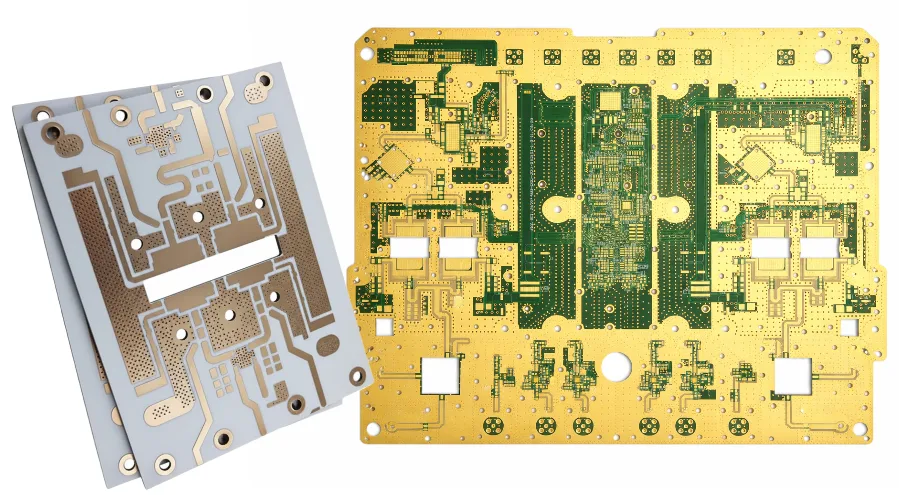
High Frequency PCB
5. Inappropriate Material Selection
Material choice plays a decisive role in high frequency PCB design. Using standard FR-4 for microwave or RF applications is one of the most critical mistakes engineers make. FR-4’s high and unstable dielectric loss at elevated frequencies results in significant signal attenuation and phase shift.
Instead, select substrates like a specialty low-loss laminate, Taconic RF-35, or Panasonic Megtron 6, which offer low dielectric loss and consistent Dk over a wide frequency range. Moreover, matching prepreg and core materials within multilayer stackups avoids dielectric discontinuities. Always verify material properties with your PCB manufacturer to ensure both electrical performance and manufacturability align with design intent.
6. Insufficient EMI and Crosstalk Control
Electromagnetic interference (EMI) and crosstalk issues often arise when high-frequency traces are routed too closely or when signal layers overlap without proper isolation. Inadequate spacing causes coupling between adjacent lines, degrading signal quality and compliance performance.
To prevent these issues, maintain adequate spacing between parallel traces, insert grounded guard traces where necessary, and implement via fences around sensitive analog or RF circuits. Ensure that critical high-speed routes are shielded by continuous ground planes to reduce radiation and susceptibility. Simulation tools such as HFSS or SIwave can help visualize field coupling and optimize PCB geometry before fabrication.
7. Ignoring Manufacturing Constraints
A design that looks perfect on-screen can still fail in production if manufacturing limits are overlooked. Many high frequency PCB design mistakes stem from ignoring factory tolerances, minimum drill sizes, or achievable impedance margins. Overly fine traces, narrow gaps, or exotic materials may increase cost and reduce yield.
The solution is early collaboration with your PCB fabricator to confirm realistic design rules. Discuss layer stackups, copper thickness, dielectric spacing, and material alternatives that support both electrical performance and mass production efficiency. Integrating manufacturability at the design stage saves costly rework and ensures consistent high-frequency performance in final products.
8. Lack of Simulation and Testing
Skipping pre-layout simulation and post-fabrication testing is a critical oversight in high frequency PCB design. Without simulation, designers cannot predict how parasitics, trace geometry, or material variation will affect real-world signal integrity.
Use 3D EM simulation tools to validate impedance, crosstalk, and reflection behavior before fabrication. After assembly, apply S-parameter testing and TDR measurements to verify actual performance. Flying-probe or network analyzer testing provides valuable insight into signal consistency across production batches. Regular validation not only prevents costly redesigns but also ensures long-term reliability in high-speed systems.
Conclusion
High frequency PCB design mistakes often stem from small oversights that lead to major performance issues—improper impedance, weak grounding, poor routing, unsuitable materials, and lack of manufacturability awareness. Addressing these challenges requires a combination of engineering discipline, simulation, and collaboration between design and production teams.
Highleap Electronics Engineering Advantages
-
Material Expertise – Proficiency in handling advanced substrates such as specialty low-loss laminate, Taconic, and Megtron for stable high-frequency performance.
-
Precision Manufacturing – Controlled impedance fabrication, laser-drilled microvias, and low-loss multilayer stackups.
-
DFM Collaboration – Early engineering support to align your layout with optimal manufacturability and yield.
-
Comprehensive Testing – In-house impedance verification, flying-probe testing, and signal integrity validation for critical designs.
At Highleap Electronics, we support engineers in transforming high frequency PCB concepts into production-ready solutions. Our team ensures that every design—whether for 5G, radar, or high-speed computing—meets the strictest signal integrity and reliability standards. Contact us today to discuss your next high frequency PCB project and achieve superior performance from design to mass production.

Recommended Posts
PCB Materials Database: Laminate Grades & Properties
How to get a quote for PCBs Let‘s run DFM/DFA analysis for...
Optical Transceiver PCB Manufacturer for Custom Pluggable Modules
Highleap Electronics manufactures and assembles custom...
Optical Module PCB Manufacturer for 400G, 800G and 1.6T Programs
Highleap Electronics provides optical module PCB...
Optical Communication PCB Manufacturer for Fiber Network Equipment
Highleap Electronics manufactures and assembles optical...
How to get a quote for PCBs
Let‘s run DFM/DFA analysis for you and get back to you with a report. You can upload your files securely through our website. We require the following information in order to give you a quote:
-
- Gerber, ODB++, or .pcb, spec.
- BOM list if you require assembly
- Quantity
- Turn time
In addition to PCB manufacturing, we offer a comprehensive range of electronic services, including PCB design, PCBA, and turnkey solutions. Whether you need help with prototyping, design verification, component sourcing, or mass production, we provide end-to-end support to ensure your project’s success.
For PCBA services, please provide your BOM (Bill of Materials) and any specific assembly instructions. We also offer DFM/DFA analysis to optimize your designs for manufacturability and assembly, ensuring a smooth production process.