
Reduce Your 10-Layer Blind Buried Via PCB Cost
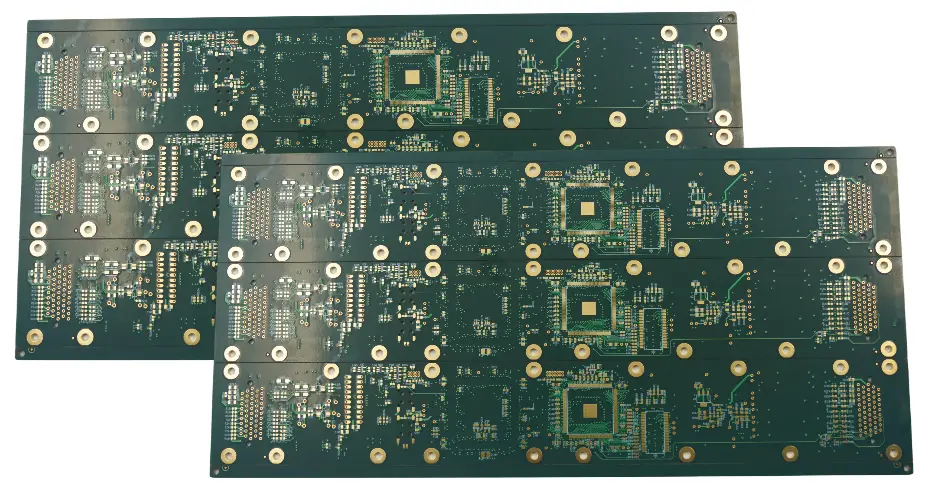
Table of Contents
- What Actually Drives 10-Layer HDI Cost Beyond Layer Count
- Back-Drilling: The Signal Integrity Cost Decision Unique to High-Layer HDI
- Power Plane Architecture and Its Hidden Cost Impact
- Material Selection: Hybrid Stackup Strategy for 10-Layer
- 10-Layer HDI vs. 12-Layer Standard: When Each Wins on Cost
- Reference Price Ranges and What Makes Them Move
- Getting an Accurate 10-Layer HDI Quote from Highleap
The 10-layer blind buried via PCB cost is frequently misunderstood — most pricing discussions stop at “10-layer costs more than 8-layer” without explaining which specific design decisions actually drive that difference. In practice, the buried via type, back-drilling for SerDes signal integrity, power plane routing architecture, and inner core material grade are independent choices that each add or remove significant cost. A design that defaults to maximum specification across all four areas can cost 2–3× more than a design that makes the same routing decisions with targeted optimization. This guide breaks down each cost driver, explains the engineering tradeoffs, and identifies where the largest savings are available — without compromising electrical performance.
1) What Actually Drives 10-Layer HDI Cost Beyond Layer Count
1.1 The Four Decisions That Move Price
Layer count is a cost factor, but not the dominant one. The four design decisions that most dramatically affect 10-layer HDI price — roughly in order of impact:
- Buried via decision (Type I vs. Type III): Adding buried vias to the inner core adds 1–3 lamination cycles and can increase prototype pricing by 40–100%+ over a Type I equivalent (reference figure — actual impact varies). Most 10-layer HDI designs do not need buried vias. Confirming this before fabrication is the single highest-ROI cost optimization available.
- Back-drilling for high-speed signals: Back-drilling is only electrically meaningful for SerDes interfaces above approximately 10 Gbps. Specifying it for PCIe Gen3 or DDR4 designs adds fabrication cost with no measurable signal benefit. The correct decision requires modeling via stub resonance for your specific stackup thickness — not applying back-drilling as a default precaution.
- Material grade on inner core layers: Specifying premium low-loss laminate (Megtron 6, I-Tera MT40) on all 10 layers when only the outer signal layers carry high-frequency traces is the most common over-specification in 10-layer HDI. A hybrid stackup — premium outer buildup layers, standard high-Tg FR-4 inner core — achieves 88–92% of full-premium electrical performance at substantially lower material cost (reference).
- Power plane routing architecture: Using buried vias between power planes rather than through-hole vias forces a transition from Type I to Type III processing — even when all signal routing could be achieved in Type I. Symmetric power plane placement eliminates this cost driver entirely.
1.2 Why 10-Layer Costs Less Than the Layer Count Increase Suggests
Adding 2 inner layers to an 8-layer HDI design typically increases cost by 25–40% at prototype quantities — less than a linear cost-per-layer model would suggest. The reason: the dominant cost drivers in HDI are lamination cycle count and laser drilling setup, neither of which changes when you add standard inner layers at the same HDI type. The marginal cost is material and imaging time only.
The direct implication: if your routing density genuinely requires more capacity, going from 8-layer Type I to 10-layer Type I is frequently more cost-effective than going from 8-layer Type I to 8-layer Type II. More layers at the same HDI type costs less than the same layer count at a higher HDI type. For a side-by-side comparison of 8-layer HDI pricing by stackup type, see the 8-layer blind buried via PCB price breakdown.
1.3 Type I vs. Type III: The Buried Via Decision in 10-Layer HDI
The most consequential single cost decision for a 10-layer HDI design is whether inner-layer buried vias are actually required. This is a routing architecture decision, not a quality decision — it should be driven by whether your signal paths genuinely require inner-layer via transitions between non-adjacent layers that cannot be achieved with through-hole vias.
| Configuration | Lamination Cycles | Buried Via Capability | Cost vs. Type I (reference) | When Justified |
|---|---|---|---|---|
| Type I (1+8+1) | 2 | Blind L1–L2 and L9–L10 only | Baseline | BGA pitch ≥0.5mm; inner core routable via through-hole |
| Type II (2+6+2) | 3 | Two blind via levels per side | +40–55% (reference) | BGA pitch 0.40–0.45mm; high I/O count |
| Type III (1 buried pair) | 4 | One buried via layer pair in core | +60–90% (reference) | Inner-layer transitions unavoidable with through-hole routing |
| Type III (2+ buried pairs) | 5–6 | Multiple buried via layers in core | +90–130% (reference) | High-density inner routing equivalent to 14–16 layer standard |
Reference basis: cost multiples are approximate and vary by factory, board size, and design specifications. All figures are for relative comparison only — submit your Gerber for actual pricing.
In Highleap’s DFM experience, roughly 60–70% of designs submitted as Type III can achieve their routing objectives in Type I or Type II after stackup review — eliminating 1–3 lamination cycles before fabrication begins.
2) Back-Drilling: The Signal Integrity Cost Decision Unique to High-Layer HDI
2.1 Why Via Stubs Matter More at 10 Layers
When a through-hole via connects L1 to L5 on a 10-layer board, the barrel continues through L6–L10 as an unused stub. This stub acts as a transmission line resonator, reflecting energy at the frequency where stub length equals quarter-wavelength. A 0.8mm stub in FR-4 (εr ≈ 4.3) has its first resonant null at approximately 28 GHz.
The problem becomes more significant at 10 layers because the board is physically thicker, stubs are longer, and resonant frequencies fall lower — closer to the operating range of modern high-speed interfaces:
| Interface | Data Rate | Fundamental Frequency | 3rd Harmonic | Back-Drilling Decision |
|---|---|---|---|---|
| PCIe Gen3 | 8 GT/s | 4 GHz | 12 GHz | Not required — stub resonance above signal bandwidth |
| PCIe Gen4 | 16 GT/s | 8 GHz | 24 GHz | Evaluate — depends on stub length; model before committing |
| PCIe Gen5 / DDR5 | 32–38 GT/s | 16–19 GHz | — | Back-drill or use blind vias on critical signal paths |
| 28 Gbps PAM4 SerDes | 28 Gbps | 14 GHz | 42 GHz | Back-drilling required for stubs >0.4mm |
| 56 Gbps PAM4 (400G Ethernet) | 56 Gbps | 28 GHz | — | Back-drill all vias >0.3mm stub, or use blind vias throughout |
2.2 Back-Drilling vs. Blind Via: Choosing the Right Approach
There are two ways to eliminate via stub resonance on a 10-layer HDI board. The right choice depends on the signal path geometry:
- Blind via approach: No stub is created because the via terminates at the target layer. Works for transitions from an outer layer inward (L1→L2, L1→L3, L9→L8, etc.). Cannot reach inner-to-inner layer transitions. Best when designing from scratch — no added process step, and routing redesign may reduce total via count. See blind and buried via design rules for depth limits and annular ring requirements.
- Back-drilling approach: Works for inner-to-inner transitions where blind vias cannot reach. Adds a secondary depth-controlled mechanical drill operation after main fabrication. Adds per-board cost (reference: roughly $8–$22 at 50-piece quantity — varies significantly by via count, tolerance, and factory). Requires depth calibration and X-ray verification. Necessary for legacy-constrained designs with fixed via placement.
On 400G Ethernet boards, routing high-speed signals using blind vias wherever the transition is from outer-to-inner — and reserving back-drilling only for genuinely inner-to-inner transitions — typically reduces back-drilled via count by 40–60% compared to all-through-hole routing. See PCB back-drilling technology guide for depth control specifications and residual stub tolerances.
2.3 Back-Drilling Cost Components
Back-drilling cost has a strong volume dependency due to fixed setup costs (reference figures — actual costs vary by factory and design):
- Panel setup (depth calibration, test coupon drilling): roughly $35–$80/panel — the fixed component that makes back-drilling expensive at low quantities
- Per-via drilling: roughly $0.012–$0.028/via for depth-controlled mechanical drill
- X-ray depth verification: roughly $4–$9/panel added inspection
- Tighter residual stub tolerance: +/−0.05mm vs. +/−0.1mm increases setup and calibration cost
At 5 boards, panel setup amortization dominates per-board back-drilling cost. At 500 boards, the per-via cost drives the total. For high-speed designs that genuinely require stub elimination, the cost is justified — but signal simulation before committing to back-drilling is always worth the modeling time.
3) Power Plane Architecture and Its Hidden Cost Impact
3.1 How Power Routing Can Force Type III Processing
A frequently overlooked 10-layer HDI cost driver: how power and ground planes are connected between layers. When designers route power between non-adjacent inner layers using buried vias (e.g., a buried via connecting L4 to L7 to distribute a power rail), they require Type III processing — even when all signal routing could be achieved in Type I.
The alternative is symmetric power plane architecture with through-hole vias, which achieves equivalent power delivery without the Type III processing penalty:
| Layer | Cost-Optimal Allocation (Type I) | Function | Via Type for Power |
|---|---|---|---|
| L1 (top) | Signal (BGA fanout) | High-speed routing | Blind via L1–L2 |
| L2 | Signal (escape routing) | BGA breakout continuation | — |
| L3 | GND plane | Reference for L1, L2, L4 | Through-hole via |
| L4 | Signal | Inner routing | Through-hole via |
| L5 | Power plane | VCC distribution | Through-hole via — no buried via needed |
| L6 | Power plane | Secondary rail distribution | Through-hole via — no buried via needed |
| L7 | Signal | Inner routing | Through-hole via |
| L8 | GND plane | Reference for L7, L9, L10 | Through-hole via |
| L9 | Signal (escape routing) | Bottom BGA breakout | — |
| L10 (bottom) | Signal (BGA fanout) | High-speed routing | Blind via L9–L10 |
3.2 Why Through-Hole Power Routing Is Adequate in Most 10-Layer HDI Designs
Through-hole vias are 3–5× cheaper per via than buried vias and require no additional lamination cycle. For power distribution, they are electrically equivalent to buried vias in most 10-layer HDI designs for three reasons:
- Power plane impedance is dominated by plane capacitance and decoupling capacitor placement — not via type
- Through-hole vias connecting power planes to decoupling capacitors have adequate current-carrying capacity for standard 10-layer HDI designs
- Via stub resonance (which drives back-drilling decisions for high-speed signals) is not a concern for power planes — power delivery is a low-frequency problem
The exception is high-current power delivery in very dense boards where through-hole vias consume too much routing space on signal layers. This constraint typically appears at layer counts above 16, not at 10 layers with symmetric plane allocation.

4) Material Selection: Hybrid Stackup Strategy for 10-Layer
4.1 Why Inner Core Material Grade Matters Less Than Engineers Assume
In a 10-layer HDI board with the symmetric stackup described in Section 3, the outer buildup layers (L1–L2 and L9–L10) carry the most critical high-frequency traces. L3–L8 are reference planes or inner signal layers operating at lower frequencies. Dielectric loss tangent (Df) matters most on the layers where high-frequency signals travel the longest distances — which is the outer buildup, not the core.
Specifying Megtron 6 (Df ~0.002 at 10 GHz) on all 10 layers when only L1–L2 carry signals above 5 GHz is paying a material premium for no measurable electrical benefit on 8 of the 10 layers. The cost-optimized approach:
| Application Type | Max Signal Frequency | Outer Layers (L1–L2, L9–L10) | Inner Core (L3–L8) | Estimated Cost vs. All FR-4 |
|---|---|---|---|---|
| Industrial control, IoT gateway | <1 GHz | High-Tg FR-4 | High-Tg FR-4 | Baseline — no premium needed |
| Server NIC, PCIe Gen5 FPGA | 16–32 GHz | Isola I-Tera MT40 or Megtron 6 | High-Tg FR-4 | +40–65% (reference, hybrid) |
| Automotive ADAS, radar front-end | 10–77 GHz | Megtron 6 or a specialty low-loss laminate | IATF-qualified High-Tg FR-4 | +55–80% (reference, hybrid) |
| 5G mmWave radio, 400G optical | >28 GHz | Megtron 6 or specialty low-loss laminate (may be needed throughout) | Megtron 6 if inner signals are also high-frequency | +80–130% (reference, all-premium) |
All cost estimates are reference figures for relative comparison. Actual pricing depends on your specific Gerber, dimensions, and current material availability. Submit your design for an accurate quote.
4.2 Copper Foil Roughness: A Targeted Optimization for 5–25 GHz Designs
For designs in the 5–25 GHz range where upgrading to premium laminate is borderline, specifying low-profile (LP) copper foil on outer signal layers is a more cost-targeted option than upgrading all layers. Standard electrodeposited copper has surface roughness Rz ~3.5–5µm; LP copper reduces this to ~1.5–2.5µm, cutting insertion loss 8–15% at 10 GHz on the signal layers that matter.
LP copper on outer layers adds roughly 12–18% to outer-layer material cost — a fraction of the board price — compared to upgrading the entire laminate stack which affects all 10 layers. For designs with marginal link budget at 10–15 GHz, LP copper on outer buildup layers plus standard FR-4 on the core is frequently the optimal cost/performance combination. See high-speed PCB material selection for Df and copper roughness comparison data across grades.
5) 10-Layer HDI vs. 12-Layer Standard: When Each Wins on Cost
5.1 The Routing Density Crossover Point
The common framing — “10-layer HDI costs more than 12-layer standard” — is only accurate for a specific range of BGA pitches. The more useful framing: 10-layer HDI costs more per board but enables routing density and board size reduction that 12-layer standard cannot achieve without adding layers.
The crossover happens when the 12-layer standard board needs 14 or 16 layers to achieve the routing density that 10-layer Type I HDI provides — at which point the standard board cost exceeds the HDI board cost. BGA pitch determines where that crossover falls:
- BGA pitch ≥0.8mm: 12-layer standard through-hole is typically more cost-effective. Dog-bone via routing provides adequate fanout without laser drilling.
- BGA pitch 0.5–0.65mm: Borderline — depends on I/O count and board size. Run both designs through DFM to determine which achieves targets in fewer total layers.
- BGA pitch 0.4–0.5mm: 10-layer Type I HDI is typically more cost-effective than the 14-layer standard board needed for equivalent fanout density.
- BGA pitch <0.4mm: HDI is required. Through-hole via dogbone routing is not feasible at this pitch; the standard PCB comparison is no longer relevant.
5.2 Total System Cost vs. Per-Board Price
For products where board area reduction has value — mobile devices, wearables, automotive modules where packaging space is constrained — the per-board price comparison understates the HDI advantage. A 10-layer HDI board that is 20% smaller than the 12-layer standard equivalent enables a smaller enclosure, reduced assembly volume, and potentially a product form factor that the standard board simply cannot fit.
The per-board price premium for the HDI option may be fully recovered in enclosure tooling savings, shipping weight reduction, or a product differentiation that supports a higher selling price. Total system cost — not the PCB line item — is the correct comparison.
5.3 When 12-Layer Standard Is the Clear Choice
12-layer standard beats 10-layer HDI on cost when all of the following apply:
- All components have ≥0.8mm pitch and standard dogbone fanout is feasible
- Board size is not constrained by the product enclosure
- Signal frequencies are below 5 GHz (no signal advantage from HDI’s reduced stub length)
- No BGA components requiring fine-pitch laser-drilled via accommodation
When these conditions are met, specifying 10-layer Type I HDI adds fabrication cost with no routing, signal integrity, or size benefit. Multilayer PCB manufacturing at standard through-hole specification is the cost-optimal path.
6) Reference Price Ranges and What Makes Them Move
6.1 How to Read These Reference Ranges
The figures below are illustrative reference ranges for a standard 100×100mm board under typical market conditions. They exist to help engineers understand the relative cost impact of design decisions — not to substitute for a factory quote. PCB pricing is determined by your specific Gerber, not by category descriptions. A 10-layer HDI board with unusual dimensions, specialty finishes, or very fine trace/space requirements may be priced very differently from these ranges in either direction.
| Configuration | Lamination Cycles | ~10 pcs (reference) | ~50 pcs (reference) | ~500 pcs (reference) | Key factors that move price higher |
|---|---|---|---|---|---|
| Type I (1+8+1), FR-4, ENIG | 2 | ~$82–$118 | ~$65–$92 | ~$38–$56 | Board size, via count, impedance tolerance, IPC Class 3 |
| Type II (2+6+2), FR-4, ENIG | 3 | ~$118–$175 | ~$92–$138 | ~$56–$86 | Stacked vias, tight line spacing, large board area |
| Type III (buried core), FR-4, ENIG | 4–6 | ~$165–$290 | ~$128–$225 | ~$78–$140 | Multiple buried via pairs, asymmetric via placement |
| Add: back-drilling | — | +$15–$40 | +$8–$22 | +$4–$12 | Via count, residual stub tolerance, X-ray sampling rate |
| Add: hybrid Megtron 6 outer layers | — | +40–65% | +40–65% | +35–55% | Specific laminate grade, prepreg availability, panel size |
Illustrative figures for standard 100×100mm boards, staggered vias, IPC Class 2. Your actual pricing will depend on your design files and specifications. Submit your Gerber for an accurate quote.
6.2 The Five Most Common Ways Engineers Overpay on 10-Layer HDI
Based on DFM reviews of 10-layer HDI designs, these over-specifications appear most frequently and have the largest cost impact:
- Specifying Type III when routing can be achieved in Type I: The most frequent and most expensive mistake. Cannot be confirmed without a DFM review that checks actual buried via necessity — not assumed from component density alone.
- Back-drilling for PCIe Gen3 or DDR4: Unnecessary for these interface speeds on a 10-layer board where stub resonance falls above the signal frequency range. Adds fabrication cost with no measurable signal improvement.
- Megtron 6 on all 10 layers when only 2 outer layers carry high-frequency signals: Hybrid stackup achieves nearly identical electrical performance at 35–55% lower material cost (reference).
- Stacked via structures when staggered vias would route the design: Stacked vias require resin fill and planarization between lamination cycles. Converting to staggered via placement eliminates that process step and cost entirely.
- IPC Class 3 for prototype bring-up boards: Class 3 adds documentation, cross-section, and inspection requirements appropriate for production qualification — not first-spin prototype validation.
7) Getting an Accurate 10-Layer HDI Quote from Highleap
7.1 What Drives Quote Accuracy — and What the Reference Ranges Miss
The reference ranges in this article help with relative cost comparison and planning — they are not substitutes for a quote against your actual design. The variables that most affect accurate 10-layer HDI pricing are not captured by category descriptions:
- Board dimensions and panel utilization: A 120×100mm board that fits 16 boards per panel costs less per board than an 82×115mm board that fits 20 boards per panel in the same panel area. Panel efficiency, not board area alone, drives material cost.
- Via count and type breakdown: Blind via count, through-hole via count, and whether any stacked via configurations require resin fill between lamination cycles.
- Back-drilling specification: Via locations requiring back-drilling, target residual stub length, and depth tolerance class.
- Controlled impedance requirements: Target impedance values, tolerance (±10% vs. ±5%), and which specific layers carry controlled-impedance traces.
- Quantity schedule: First-order quantity and anticipated annual volume — annual volume determines whether production-level material pricing applies to the first order.
7.2 DFM Review at No Charge
Every Highleap 10-layer HDI quote submission includes a DFM review that specifically checks the five over-specification patterns in Section 6.2. If your design can be achieved in Type I instead of Type III, or if back-drilling is unnecessary for your signal frequencies, the DFM review identifies that before fabrication — not after. The review is completed within 24–48 hours. Where a design change would reduce cost, the savings are quantified as a specific dollar figure so you can evaluate the tradeoff before committing.
7.3 Production Metrics
Highleap’s production metrics for 10-layer HDI: Type I yield 95–97%; Type II yield 92–95%; Type III yield 88–93%. All 10-layer HDI boards receive 100% electrical test (flying probe for prototypes, fixture test for production), X-ray inspection at sampling rate for Type I/II and 100% for Type III, and TDR coupon data with every controlled-impedance shipment.
For lead time planning on 10-layer HDI programs, see blind buried via PCB lead time guide. For the complete HDI cost framework covering NRE amortization, yield loss modeling, and total program cost, see blind buried via PCB cost analysis.

Recommended Posts
TMM3 PCB Manufacturing for RF Modules
TMM3 PCB manufacturing is most useful where the RF module...
TMM6 PCB Fabrication
TMM6 fabrication is the process-control page for a mid-Dk...
TMM10 PCB Manufacturing for Compact RF Designs
Table of contentsHow TMM10 Shrinks RF StructuresTMM10 vs...

TMM10i PCB Fabrication and DFM
TMM10i PCB fabrication has a stronger DFM emphasis because...
How to get a quote for PCBs
Let us run DFM/DFA analysis for you and get back to you with a report.
You can upload your files securely through our website.
We require the following information in order to give you a quote:
-
- Gerber, ODB++, or .pcb, spec.
- BOM list if you require assembly
- Quantity
- Turn time