
AMR and AGV Robot PCB for Navigation, Battery Power, Safety and Fleet Reliability
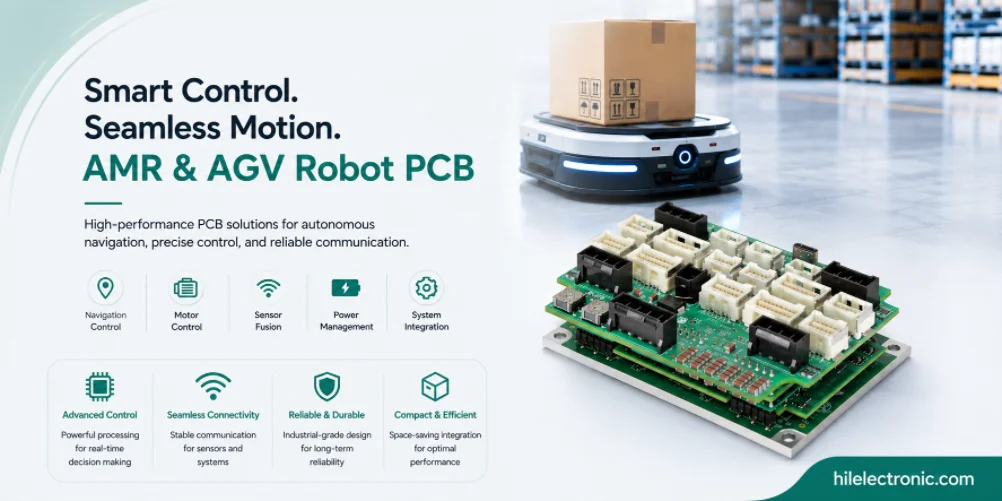
AMR and AGV robot PCBs support mobile platforms that move materials through warehouses, factories, hospitals, logistics centers, and commercial facilities. Their boards must combine battery-powered operation, navigation sensors, safety scanners, motor control, wireless communication, charging interfaces, and rugged construction for vibration and shock.
This guide explains the electronics and manufacturing requirements behind AMR and AGV platforms. It covers navigation architecture, motion configuration, payload handling, safety in shared human spaces, battery and charging design, fleet serviceability, and production testing. FAQ content has been rewritten as industry guidance rather than supplier-centered sales answers.
What Makes AMR and AGV Electronics Distinct
Role in the Robot System
Autonomous Mobile Robots (AMR) and Automated Guided Vehicles (AGV) are battery-powered mobile platforms that move payloads around warehouses, factories, and other facilities. Their electronics differ from fixed industrial robots because they run on batteries, navigate autonomously (AMR) or along defined paths (AGV), operate in shared human spaces, and must survive rough handling. What makes AMR/AGV electronics distinct:
- Battery-powered operation: battery management and power efficiency directly determine runtime. Every watt matters.
- Autonomous navigation: LIDAR, cameras, and sensor fusion for AMR. Magnetic tape, QR codes, or reflectors for AGV.
- Payload handling: lifters, rollers, arms, or specialty payload interfaces. Application-specific electronics.
- Safety in shared spaces: safety scanners, e-stops, and dynamic behaviour meeting ISO 3691-4 for AGV or ANSI R15.08 for AMR.
- Wireless communication: Wi-Fi standard; some platforms use 5G or private LTE. Cellular for outdoor delivery.
- Ruggedised construction: shock and vibration from rough floors and payload handling.
Design Risks to Control
For AMR and AGV PCBs, manufacturability input should happen before connector placement, enclosure fit, fixture access, thermal paths, and harness routing are frozen. Late changes to these details usually trigger mechanical rework, test-fixture redesign, or reliability compromises that could have been avoided with early DFM review.
Component selection should include lifecycle status, approved alternates, package availability, temperature rating, and safety or isolation ratings where relevant. Amr and agv pcbs often stay in production or service longer than consumer electronics, so unresolved sourcing risk becomes a field-support issue, not only a purchasing issue.
At the system level, the board should be specified by function, environment, lifetime, and test coverage rather than by schematic alone. This prevents the common error of building a technically correct PCB that is difficult to fixture, hard to service, or insufficiently robust once installed in the robot.
Navigation electronics often share timing and power constraints with the robot camera board and the sensor interface assembly.
Navigation Architecture: SLAM, Fixed Path, Fiducials, GPS
Architecture Choices for Navigation Architecture
Navigation architecture varies substantially between AMR and AGV. The main navigation approaches are:
- LIDAR SLAM: simultaneous localisation and mapping. Standard for AMR; no fixed infrastructure required.
- Camera SLAM: vision-based navigation. Cheaper than LIDAR; less robust in featureless environments.
- Fixed path following: magnetic tape, painted lines, or embedded wire. Standard AGV; no on-board mapping needed.
- Fiducial-based: QR codes or reflective markers at known positions. Common hybrid AGV/AMR approach.
- GPS: outdoor mobile robots. Requires clear sky view; supplemented with IMU during signal loss.
- UWB: ultra-wideband positioning. Precision indoor positioning where required.
Validation Requirements for Navigation Architecture
Reliability depends on preserving the margins designed into the board: copper width, isolation spacing, thermal relief, connector retention, component derating, and inspection coverage. Manufacturing should verify these characteristics instead of treating the PCB as a generic assembly with a generic pass/fail test.
Serviceability should be considered through labelled connectors, accessible test points, clear board variants, and serial-number tracking. When a robot fails in the field, good board-level diagnostics let the service team isolate the problem quickly instead of replacing large assemblies or returning the whole robot.
The practical rule is to choose the simplest construction that still meets the signal, safety, thermal, and mechanical requirement. Over-specification raises cost, while under-specification creates rework during test or field deployment.
Motion Configuration: Differential, Skid Steer, Ackermann, Omnidirectional
Selection Criteria for Motion Configuration
Motion control on AMR/AGV drives typically uses differential or omnidirectional configurations. The main configurations are:
- Differential drive: two independent drive wheels plus casters. Simple, cheap, common on warehouse AMR.
- Skid steer: four drive wheels, each independent. Better traction; higher power.
- Ackermann steering: car-like steering. Common on outdoor and delivery platforms.
- Omnidirectional: mecanum or Swedish wheels enabling lateral motion. Common where lateral positioning needed.
- Tracked: tracks instead of wheels. Rugged; common on outdoor and construction platforms.
How Motion Configuration Affects Cost and Reliability
Test coverage discipline scales with reliability requirement. Consumer applications need less coverage than industrial; industrial less than medical; medical less than safety-critical. Matching test coverage to actual requirement preserves cost budget while providing the assurance the application needs.
Manufacturing documentation is often under-invested during design phase and expensive to construct retroactively. Per-unit test records captured during production support field investigation years later; component lot traceability supports post-mortem analysis of field returns. Programs that plan documentation early have the records they need; programs that add documentation later often lose the data they would have wanted.
Payload Handling: Conveyor, Lift, Manipulator, Delivery
Key Design Choices for Payload Handling
Payload handling electronics depend on the specific application. Common payload interfaces are:
- Conveyor top: powered rollers or belt on top of robot. Motor control plus sensors for payload presence.
- Lift plate: elevating plate for pallet or cart pickup. Actuator control plus position sensing.
- Arm or manipulator: mounted manipulator for pick-and-place. Often uses separate joint drive electronics.
- Cart connector: automated coupling to towed carts. Sensor and actuator interface for connection state.
- Vending: delivery robot compartment access control. Actuators, locks, and user interfaces.
- Sortation: automated sortation interface. Sensor plus actuator for sortation logic.
Manufacturing and Reliability Considerations
Supply chain visibility during production affects both cost and reliability. Manufacturers with active sourcing capability absorb allocation cycles that would otherwise cause production stoppages; manufacturers without active sourcing pass through supply issues to customers. The value of active sourcing is highest during industry-wide shortages and lowest during stable supply conditions.
Design iteration cycles benefit from tight design-manufacturing feedback. A manufacturing partner who provides prompt DFM feedback enables rapid iteration; a partner who provides slow or superficial feedback slows iteration proportionally. Programs that select manufacturing partners partly on feedback quality typically move through prototype phase faster than programs that select on lowest-cost quote alone.
Safety Architecture for Shared Human Spaces
Architecture Choices for Safety Architecture for Shared Human Spaces
Safety architecture on AMR/AGV meets standards for mobile robotics in shared human spaces. The main safety features are:
- Safety scanner: laser scanner detecting people in the robot path. Speed reduction or stop based on detected proximity.
- Emergency stop: physical stop buttons on robot chassis. Redundant hardware paths.
- Bumper sensors: physical contact detection. Backup to scanner-based avoidance.
- Speed monitoring: safe speed control; monitored speed limits. Meets Performance Level d or higher on safety-critical applications.
- Warning devices: audible and visual warnings during motion. Local behaviour matched to environment.
- Zone monitoring: operation restricted to defined zones. Prevents robot excursion into unauthorised areas.
Validation Requirements for Safety Architecture for Shared Human Spaces
Volume-band economics affect the right process choices differently at different production scales. Practices that pay back at 100,000 units per year rarely pay back at 500 units; practices that make sense at prototype rarely make sense at high volume. Matching manufacturing approach to actual production volume is what makes each volume band economically viable.
Regulatory certification obligations vary substantially by application and market. Manufacturing evidence supporting customer submissions can range from minimal (consumer products in unregulated markets) to extensive (medical devices with tight retention periods). Programs that specify certification requirements at quote get manufacturing set up correctly; programs that add certification requirements later sometimes need process changes.
Runtime targets depend on the battery-management PCB, the power-distribution electronics, and a sourcing plan that can support fleet maintenance.
Battery and Power Management for Runtime
Electrical and Thermal Requirements
Battery and power management on AMR/AGV directly affects runtime economics. The main considerations are:
- Battery chemistry: LFP standard for its cycle life; NMC where energy density matters more than cycle life.
- Charge management: opportunity charging during idle; scheduled charging at docks. Charge behaviour affects fleet operations.
- State-of-charge accuracy: affects when robots return to charge. Poor accuracy strands robots or wastes runtime.
- Regenerative braking: recovers energy during deceleration. Modest efficiency benefit; useful on high-cycle applications.
- Power modes: standby, active, and rapid-startup modes. Affects total energy consumption over fleet lifetime.
Production Test and Failure Modes
Consolidated production at one manufacturing partner preserves institutional knowledge that accumulates across product generations. A partner who has built multiple generations of similar products knows the specific issues that arise, the process tweaks that improve yield, the design patterns that manufacture well. This knowledge does not transfer to new partners without cost.
Continuing engineering-manufacturing dialogue improves both the products and the supplier relationship over time. Yield data flowing back to engineering informs design refinement; field return data flowing back informs both design and manufacturing improvements. Programs where this dialogue is active improve across product generations.
For adjacent design decisions, see the robot BMS PCB for mobile battery packs and the robot power distribution PCB for mobile platforms.
For pilot and fleet builds, component availability should be checked through electronics component sourcing support before the robot enters repeat production.
Manufacturing AMR and AGV PCBs at Highleap
DFM Review Before Production
Highleap manufactures AMR/AGV electronics with the specific discipline mobile robots need. The specific capabilities include:
- Vibration and shock tolerance: component selection and mounting supporting mobile-platform stress.
- Battery and power distribution: integrated manufacturing of BMS and power distribution boards.
- Navigation sensor integration: LIDAR interface boards, camera boards, and sensor fusion boards.
- Motion control: differential, skid steer, and omnidirectional drive boards.
- Wireless communication: Wi-Fi, LTE, and specialty wireless integration.
- Safety-rated manufacturing: support for ISO 3691-4 and ANSI R15.08 certification submissions.
Test, Traceability, and Build Handoff
The manufacturing process discipline for robotics blends practices from several traditional electronics categories. From consumer electronics — cost discipline and volume manufacturing. From industrial electronics — reliability engineering and long service life. From automotive electronics — vibration and environmental tolerance. From medical electronics — documentation and traceability. Robotics benefits from combining these.
Programs that treat manufacturing as strategic — investing in supplier relationships, sharing forecast information, coordinating on capacity — typically outperform programs that treat manufacturing transactionally. The transactional approach saves negotiation time but forfeits the compounding benefits of long-term supplier partnership.
AMR and AGV Robot PCB FAQs
What is the difference between AMR and AGV electronics?
AGVs usually follow predefined paths using magnetic tape, reflectors, QR codes, or embedded guidance. AMRs use onboard perception and navigation to plan routes dynamically. Both need motor control, safety, battery management, communication, and charging electronics, but AMRs generally require more compute, sensors, and synchronization for navigation.
Which PCBs are common in AMR and AGV robots?
Common boards include a main controller, motor driver boards, battery management system, power distribution board, sensor interface board, safety I/O board, communication board, charging interface board, and payload-specific electronics. The exact mix depends on payload, navigation method, battery voltage, fleet communication, and required safety standard.
What navigation sensors affect AMR PCB design?
AMRs may use LIDAR, cameras, depth sensors, IMUs, wheel encoders, ultrasonic sensors, UWB, or GPS for outdoor use. Each sensor affects interface selection, power budget, connector placement, synchronization, EMI control, and mechanical mounting. Sensor boards should be designed together with the navigation algorithm and mechanical layout.
How do safety scanners connect to AMR and AGV electronics?
Safety scanners usually connect through safety-rated digital outputs, industrial Ethernet, or dedicated safety protocols, depending on the scanner and system architecture. The PCB must support reliable power, isolated inputs, diagnostic monitoring, emergency-stop integration, and a defined safe stop when the scanner detects a person or obstacle.
How does battery design affect AMR and AGV PCB requirements?
Battery voltage, capacity, discharge current, charging method, docking strategy, and runtime target all affect PCB design. High-current paths may need heavy copper, large connectors, thermal management, inrush control, and fault protection. Battery data should also be integrated into fleet software so robots charge before operational failure.
What PCB design issues are caused by vibration and shock?
Mobile robots experience floor impacts, payload shifts, docking impacts, and continuous vibration. PCBs need secure connectors, proper component orientation, strain relief, mounting support, conformal coating when needed, and test points that remain reliable after vibration. Large components and batteries require special mechanical retention rather than solder joints alone.
What production tests are important for AMR and AGV PCBs?
Tests should verify power rails, motor-drive outputs, communication links, sensor interfaces, charging path, safety inputs, firmware programming, current draw, and fault reporting. For fleet deployment, serial-number records, firmware version tracking, and functional test logs help diagnose recurring field issues across many robots.
What should be considered when designing charging-interface PCBs?
Charging-interface boards must handle alignment tolerance, contact wear, inrush current, over-current protection, temperature monitoring, communication with the charger, and safe behaviour during partial connection. Docking robots also need protection against arcing, contamination, and repeated mechanical cycles over the fleet's service life.

Recommended Posts

Isola Astra MT77 PCB Manufacturing
Figure 1. Isola Astra MT77 PCB ManufacturingIsola Astra...

Nelco N4000-13 PCB Material and Manufacturing Guide | Highleap Electronics
Figure 1. Nelco N4000-13 PCBNelco N4000-13 PCB is a...

Copper Clad Laminate: Complete Material Selection Guide for PCB Engineers
Every electrical property that matters in a printed...

Inside a China Ceramic PCB Factory: Process Control Across Power/LED/RF/Medical
Table of Contents Inside a China Ceramic PCB Factory: How...
How to get a quote for PCBs
Let’s run DFM/DFA analysis for you and get back to you with a report. You can upload your files securely through our website. We require the following information in order to give you a quote:
-
- Gerber, ODB++, or .pcb, spec.
- BOM list if you require assembly
- Quantity
- Turn time
For PCBA services, please provide your BOM (Bill of Materials) and any specific assembly instructions. We also offer DFM/DFA analysis to optimize your designs for manufacturability and assembly, ensuring a smooth production process.