
Medical Robot PCB for IEC 60601, Traceability, Sterilization and Long-Term Support
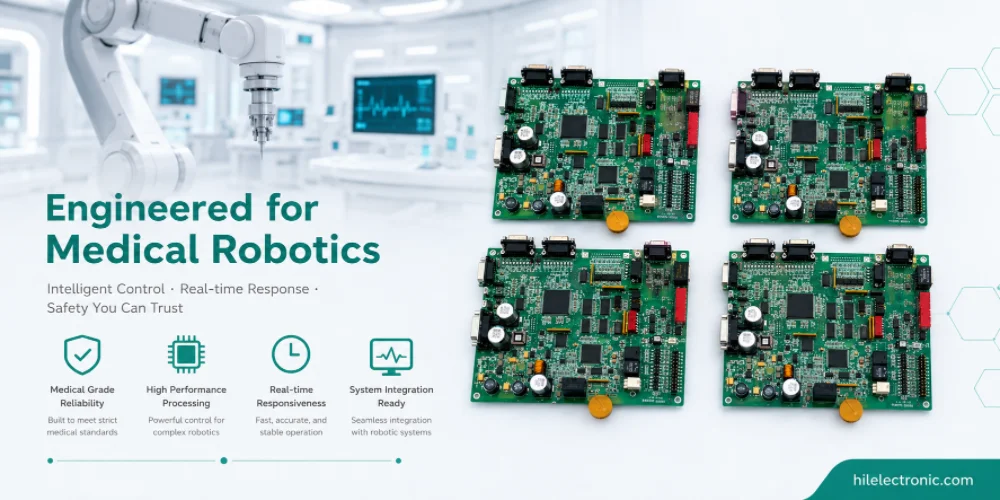
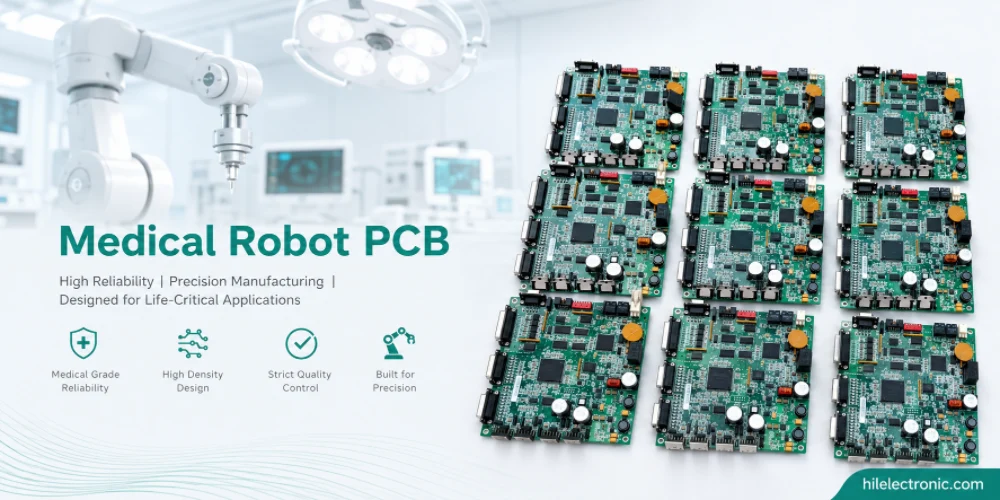
Medical robot PCBs support surgical robots, rehabilitation systems, imaging robots, laboratory automation, pharmacy automation, and other medical device platforms. These boards must meet stricter expectations for safety, documentation, traceability, manufacturing control, change management, and long-term service than ordinary robotics electronics.
This guide explains medical robot PCBs at the industry level: IEC 60601 safety implications, ISO 13485-style quality management, sterilization compatibility, regulatory documentation, long-term product support, production test, and controlled change. The FAQ has been shortened and reframed as industry questions rather than supplier-only qualification answers.
What Makes Medical Robot Electronics Distinct
Role in the Robot System
Medical robots — surgical robots, imaging robots, rehabilitation robots, laboratory automation — have the most demanding regulatory and reliability requirements in the robot category. Their electronics must meet medical device standards, support extensive documentation, tolerate sterilization procedures, and deliver quality expected in medical environments. What makes medical robot electronics distinct:
- Regulatory certification: FDA (US), CE MDR (Europe), and market-specific medical device approvals. Design and manufacturing evidence required.
- IEC 60601: medical electrical equipment safety standard. Determines isolation, leakage current, and safety architecture.
- IEC 62304: medical device software lifecycle. Manufacturing evidence for embedded software.
- Sterilisation compatibility: some medical robots undergo sterilisation between procedures. Materials, coatings, and construction affect compatibility.
- Per-unit traceability: component lot records, test data, and manufacturing history retained per unit for entire product lifetime.
- Quality management system: manufacturing operating under ISO 13485. Documentation and process control matching QMS requirements.
Design Risks to Control
For medical robot PCBs, manufacturability input should happen before connector placement, enclosure fit, fixture access, thermal paths, and harness routing are frozen. Late changes to these details usually trigger mechanical rework, test-fixture redesign, or reliability compromises that could have been avoided with early DFM review.
Component selection should include lifecycle status, approved alternates, package availability, temperature rating, and safety or isolation ratings where relevant. Medical robot pcbs often stay in production or service longer than consumer electronics, so unresolved sourcing risk becomes a field-support issue, not only a purchasing issue.
At the system level, the board should be specified by function, environment, lifetime, and test coverage rather than by schematic alone. This prevents the common error of building a technically correct PCB that is difficult to fixture, hard to service, or insufficiently robust once installed in the robot.
Safety planning for medical robotics should be aligned with broader medical device PCB requirements and the robot safety-interface electronics.
Safety Architecture per IEC 60601
Architecture Choices for Safety Architecture per IEC 60601
Safety architecture on medical robots meets IEC 60601 requirements. The main safety considerations are:
- Patient isolation: galvanic isolation between patient-contact circuits and other electronics. Reinforced isolation on patient-connected parts.
- Leakage current: patient auxiliary current and patient leakage current limited per IEC 60601. Design and test verify.
- Redundant safety: safety-critical functions implemented through redundant hardware paths.
- Fail-safe defaults: all failure modes result in safe outcomes for the patient. Analysed and verified through FMEA.
- Emergency stop: clinician-accessible stop with defined response time. Redundant activation paths.
- Fault detection: continuous monitoring of safety-critical parameters. Fault triggers immediate safe state.
Validation Requirements for Safety Architecture per IEC 60601
Reliability depends on preserving the margins designed into the board: copper width, isolation spacing, thermal relief, connector retention, component derating, and inspection coverage. Manufacturing should verify these characteristics instead of treating the PCB as a generic assembly with a generic pass/fail test.
Serviceability should be considered through labelled connectors, accessible test points, clear board variants, and serial-number tracking. When a robot fails in the field, good board-level diagnostics let the service team isolate the problem quickly instead of replacing large assemblies or returning the whole robot.
The practical rule is to choose the simplest construction that still meets the signal, safety, thermal, and mechanical requirement. Over-specification raises cost, while under-specification creates rework during test or field deployment.
Manufacturing Under Quality Management System
Key Design Choices for Manufacturing Under Quality Management System
Manufacturing under a quality management system introduces specific process requirements. The main QMS-related manufacturing practices are:
- Documented processes: every manufacturing step follows documented procedures. Procedures versioned and controlled.
- Change control: process changes go through formal change control. Impact analysis and re-verification required.
- Component traceability: component lots traced from receiving through assembly to specific board serial numbers.
- Test data retention: per-unit test data retained for product lifetime plus regulatory retention period.
- Non-conformance handling: manufacturing defects tracked, analysed, and dispositioned through formal process.
- CAPA: corrective and preventive action for quality issues. Documented investigation and closure.
Manufacturing and Reliability Considerations
Test coverage discipline scales with reliability requirement. Consumer applications need less coverage than industrial; industrial less than medical; medical less than safety-critical. Matching test coverage to actual requirement preserves cost budget while providing the assurance the application needs.
Manufacturing documentation is often under-invested during design phase and expensive to construct retroactively. Per-unit test records captured during production support field investigation years later; component lot traceability supports post-mortem analysis of field returns. Programs that plan documentation early have the records they need; programs that add documentation later often lose the data they would have wanted.
Sterilisation Compatibility Considerations
Key Design Choices for Sterilisation Compatibility Considerations
Sterilisation compatibility affects component selection and construction. The main sterilisation methods and their impacts are:
- Steam autoclave: high temperature steam. Standard for reusable equipment. Component and material selection must tolerate 121-134 °C moist heat.
- Ethylene oxide: chemical sterilisation. Compatible with most electronics; requires aeration.
- Gamma radiation: high-energy radiation. Damages many electronic components; used mostly on packaged single-use devices.
- Hydrogen peroxide: low-temperature chemical sterilisation. Common on modern equipment.
- Manual disinfection: wipedown between uses. Housing and connector design must permit thorough disinfection.
- Non-sterilisable: some medical electronics are protected from patient contact and do not require sterilisation.
Manufacturing and Reliability Considerations
Supply chain visibility during production affects both cost and reliability. Manufacturers with active sourcing capability absorb allocation cycles that would otherwise cause production stoppages; manufacturers without active sourcing pass through supply issues to customers. The value of active sourcing is highest during industry-wide shortages and lowest during stable supply conditions.
Design iteration cycles benefit from tight design-manufacturing feedback. A manufacturing partner who provides prompt DFM feedback enables rapid iteration; a partner who provides slow or superficial feedback slows iteration proportionally. Programs that select manufacturing partners partly on feedback quality typically move through prototype phase faster than programs that select on lowest-cost quote alone.
Regulatory documentation becomes stronger when traceability records connect to the production test workflow and to the precision sensor PCB assembly used for feedback control.
Documentation for Regulatory Submissions
Safety Function Requirements
Documentation supporting medical device submissions requires specific manufacturing evidence. The main documentation categories are:
- Design History File: contribution from manufacturing to the customer DHF. Manufacturing process documentation.
- Device Master Record: manufacturing procedures and specifications for the device. Version-controlled.
- Device History Record: per-unit manufacturing records. Retained for regulatory period.
- First-article inspection: initial production units verified against design specification. Formal report.
- Process validation: manufacturing process validated to produce conforming output. IQ/OQ/PQ documentation.
- Component certificates: material certificates and component qualification records. Traceable to specific production lots.
Evidence, Diagnostics, and Traceability
Volume-band economics affect the right process choices differently at different production scales. Practices that pay back at 100,000 units per year rarely pay back at 500 units; practices that make sense at prototype rarely make sense at high volume. Matching manufacturing approach to actual production volume is what makes each volume band economically viable.
Regulatory certification obligations vary substantially by application and market. Manufacturing evidence supporting customer submissions can range from minimal (consumer products in unregulated markets) to extensive (medical devices with tight retention periods). Programs that specify certification requirements at quote get manufacturing set up correctly; programs that add certification requirements later sometimes need process changes.
Lifecycle planning should also include controlled component alternates through electronic component sourcing, especially for medical programs that need repeat builds over many years.
Long-Term Product Support Obligations
Key Design Choices for Long-Term Product Support Obligations
Long-term product support obligations differ for medical devices. Programs typically must support production, service, and last-time-buy planning across regulatory-defined periods. The main considerations are:
- Component obsolescence management: specific components going out of production during product lifetime. Managed through last-time-buy, alternate qualification, or design change.
- Manufacturing continuity: ability to produce the same device to the same specification for years. Requires stable process and supply chain.
- Field service support: parts availability, repair capability, and field failure investigation across product lifetime.
- Regulatory record retention: manufacturing records retained per regulatory requirement. Typically 10+ years post product discontinuation.
- Product change management: formal change control including regulatory notification where changes affect approved device design.
Manufacturing and Reliability Considerations
Consolidated production at one manufacturing partner preserves institutional knowledge that accumulates across product generations. A partner who has built multiple generations of similar products knows the specific issues that arise, the process tweaks that improve yield, the design patterns that manufacture well. This knowledge does not transfer to new partners without cost.
Continuing engineering-manufacturing dialogue improves both the products and the supplier relationship over time. Yield data flowing back to engineering informs design refinement; field return data flowing back informs both design and manufacturing improvements. Programs where this dialogue is active improve across product generations.
For adjacent design decisions, see the robot sensor PCB assembly for medical measurements and the robot I/O and safety interface PCB documentation guide.
Manufacturing Medical Robot PCBs at Highleap
DFM Review Before Production
Highleap manufactures medical robot electronics with the specific discipline medical devices need. The specific capabilities include:
- ISO 13485 QMS: manufacturing operating under medical device quality management system.
- Isolation manufacturing: reinforced isolation construction meeting IEC 60601 requirements.
- Per-unit traceability: component lot records and test data retained per unit for regulatory period.
- Process validation: IQ/OQ/PQ documentation for manufacturing processes.
- First-article inspection: formal FAI report for regulatory submissions.
- Long-term support: component obsolescence management and manufacturing continuity across product lifetime.
Test, Traceability, and Build Handoff
The manufacturing process discipline for robotics blends practices from several traditional electronics categories. From consumer electronics — cost discipline and volume manufacturing. From industrial electronics — reliability engineering and long service life. From automotive electronics — vibration and environmental tolerance. From medical electronics — documentation and traceability. Robotics benefits from combining these.
Programs that treat manufacturing as strategic — investing in supplier relationships, sharing forecast information, coordinating on capacity — typically outperform programs that treat manufacturing transactionally. The transactional approach saves negotiation time but forfeits the compounding benefits of long-term supplier partnership.
Medical Robot PCB FAQs
What is a medical robot PCB?
A medical robot PCB is an electronic assembly used in a robotic medical device such as a surgical robot, rehabilitation robot, imaging robot, laboratory automation system, or pharmacy automation platform. It may handle control, sensing, motion, power, communication, or safety functions under medical-device quality and documentation requirements.
How does IEC 60601 affect medical robot PCB design?
IEC 60601 influences isolation, leakage current, creepage and clearance, protective earth, patient-applied parts, risk management, and safety testing. The PCB is only one part of compliance, but board layout, component selection, power architecture, and documentation must support the complete medical electrical equipment safety case.
Why is ISO 13485 relevant to medical robot PCBs?
ISO 13485 defines quality management expectations for medical device manufacturing. For PCBs, this affects documented processes, supplier control, traceability, change management, nonconformance handling, validation, and record retention. Even when the PCB manufacturer is not the legal device manufacturer, its records may support the customer's regulatory file.
What does sterilization compatibility mean for PCBs?
Sterilization compatibility means the board, coating, connectors, labels, adhesives, and enclosure interfaces can tolerate the intended sterilization or cleaning method. Autoclave, hydrogen peroxide plasma, ethylene oxide, alcohol wipe-down, and other methods impose different material stresses. Not every medical robot board is sterilized, but reusable patient-adjacent assemblies may be.
What traceability is needed for medical robot electronics?
Traceability typically includes component lot data, board serial numbers, production route, inspection results, test records, firmware version, rework history, and change records. The required depth depends on the device risk class and customer quality plan. Traceability should be designed into production before the first regulated build.
How long should medical robot PCB records be retained?
Record retention depends on market, device class, customer requirements, and quality agreement. Medical robot programs often need records retained for many years, sometimes through the device lifetime plus an additional regulatory period. Retention expectations should be agreed before production because rebuilding missing manufacturing evidence later is difficult.
How are medical robot PCBs tested during production?
Testing can include AOI, X-ray, electrical test, firmware programming, functional test, isolation or hipot testing where applicable, leakage-related checks at system level, calibration, and final inspection. Test limits should be documented and tied to serial numbers. Any rework should follow controlled procedures and be recorded.
What should be checked before choosing a medical robot PCB manufacturer?
Check experience with controlled documentation, traceability, change control, regulated customer audits, IPC workmanship expectations, functional test, long-term sourcing, and quality agreements. The supplier should understand that medical robot manufacturing evidence is part of the product's compliance and lifecycle support, not only a shipment record.
Send medical robot PCB files for DFM, traceability, and test review

Recommended Posts

Isola Astra MT77 PCB Manufacturing
Figure 1. Isola Astra MT77 PCB ManufacturingIsola Astra...

Nelco N4000-13 PCB Material and Manufacturing Guide | Highleap Electronics
Figure 1. Nelco N4000-13 PCBNelco N4000-13 PCB is a...

Copper Clad Laminate: Complete Material Selection Guide for PCB Engineers
Every electrical property that matters in a printed...

Inside a China Ceramic PCB Factory: Process Control Across Power/LED/RF/Medical
Table of Contents Inside a China Ceramic PCB Factory: How...
How to get a quote for PCBs
Let’s run DFM/DFA analysis for you and get back to you with a report. You can upload your files securely through our website. We require the following information in order to give you a quote:
-
- Gerber, ODB++, or .pcb, spec.
- BOM list if you require assembly
- Quantity
- Turn time
For PCBA services, please provide your BOM (Bill of Materials) and any specific assembly instructions. We also offer DFM/DFA analysis to optimize your designs for manufacturability and assembly, ensuring a smooth production process.