
Halogen Free PCB Material Manufacturer for Compliant PCB Fabrication and Assembly
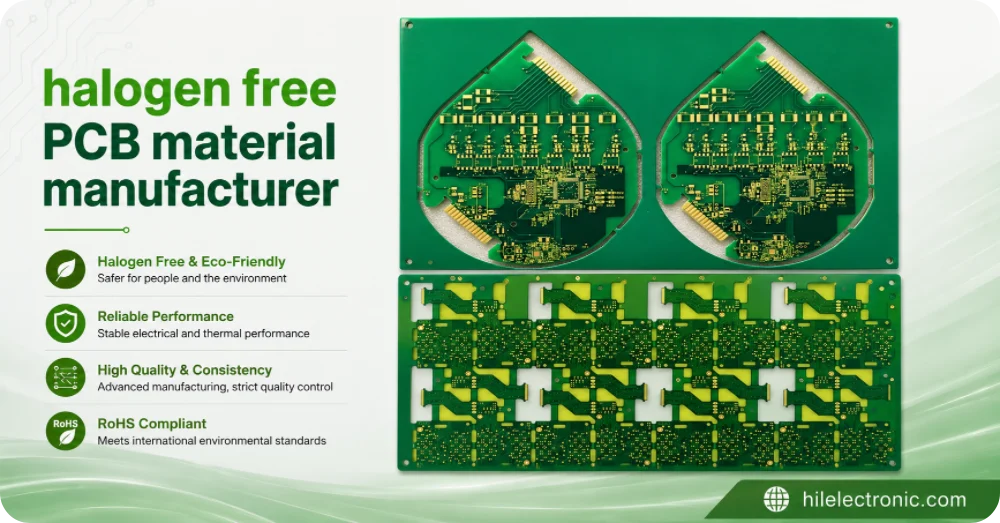
Halogen free PCB material manufacturing should be written as a compliance and production page, not an environmental essay. Buyers usually want to know whether the bare board or full PCBA can meet the required material scope, documentation, traceability, assembly process, and export requirements.
Highleap supports halogen-free PCB manufacturing, halogen-free materials, lead-free assembly, and documentation review. This guide focuses on how to specify and quote halogen-free PCB fabrication and assembly correctly.
Halogen Free PCB Material Manufacturing for Export and OEM Electronics
The search intent is compliance plus manufacturability
Halogen-free requirements appear in consumer electronics, automotive modules, industrial controllers, communication equipment, and OEM export programs. The manufacturing question is whether the selected laminate, prepreg, solder mask, ink, surface finish, and assembly materials match the customer requirement.
The manufacturing review should not simply explain what halogens are. It should help buyers prepare the documentation and production package needed to manufacture compliant boards repeatedly.
- Export electronics PCB
- OEM environmental compliance programs
- Halogen-free bare PCB fabrication
- Halogen-free PCBA with documentation
For a production halogen-free PCB or PCBA build RFQ, requirement should be converted into drawing notes and supplier checks rather than left as background explanation. Highleap uses it to decide whether the project needs material confirmation, stackup adjustment, DFM feedback, special inspection, or assembly process review before the quote is finalized.
The same requirement also affects cost and lead time because compliance scope, material availability, document control, and assembly compatibility can change tooling effort, process control, test coverage, or material purchasing. Providing halogen-free scope, material declaration request, solder mask requirement, BOM scope, and shipment documentation before quotation reduces back-and-forth and makes the first engineering response more useful.
In practical builds such as export electronics, OEM control boards, consumer electronics, automotive modules, and communication equipment, this requirement normally appears during the first DFM or sourcing discussion. The reason is simple: halogen-free scope, material approval, compliance records, and assembly documentation can change the recommended stackup, inspection plan, or assembly sequence before a purchase order is placed.
For repeat production, Highleap also checks whether the requirement can be held from pilot build to batch production. That means the production package should give Highleap complete manufacturing inputs, not only a material name or a partial drawing set.
Halogen-free RFQs should stay close to procurement reality. Many RFQs fail because the customer does not state whether the rule applies only to laminate, or also to solder mask, legend ink, adhesives, coating, components, and process materials. Highleap should clarify that boundary before quoting.
For a manufacturing order, the useful commercial details are document scope, substitute approval, lot traceability, assembly compatibility, and the exact files needed before a halogen-free bare PCB or full PCBA order can be accepted.
The RFQ should also distinguish halogen-free from lead-free and RoHS. These requirements often appear together in an OEM specification, but they are not identical. Treating them as separate manufacturing and documentation items helps the buyer understand what Highleap can verify, quote, assemble, and ship with records.
Bare PCB vs PCBA: Confirming the Halogen-Free Compliance Scope
The customer must define what needs to be halogen-free
Some customers require only the laminate and prepreg to be halogen-free. Others require solder mask, legend ink, adhesives, coating, and full assembly materials to be included. Highleap reviews the compliance boundary before quotation because the scope changes material selection and documentation.
If the RFQ only says “halogen free” without specifying bare board or PCBA scope, the quote may be incomplete. A better RFQ states the required standard, documents, and whether substitutions are allowed.
- Bare PCB material scope
- Solder mask and legend ink scope
- Assembly material and BOM scope
- Customer-specific declaration requirements
Assembly planning for a halogen-free PCB or PCBA build should be considered before bare-board release. Pad design, surface finish, solder mask, component thermal mass, fixture access, and inspection requirements can change the fabrication notes even when the schematic is already complete.
For purchasing teams, assembly scope changes the quote substantially. A bare PCB price does not cover BOM sourcing, stencil, programming, AOI, X-ray, functional testing, packaging, or documentation unless those requirements are stated clearly.
In practical builds such as export electronics, OEM control boards, consumer electronics, automotive modules, and communication equipment, this requirement normally appears during the first DFM or sourcing discussion. The reason is simple: halogen-free scope, material approval, compliance records, and assembly documentation can change the recommended stackup, inspection plan, or assembly sequence before a purchase order is placed.
For repeat production, Highleap also checks whether the requirement can be held from pilot build to batch production. That means the production package should give Highleap complete manufacturing inputs, not only a material name or a partial drawing set.
Halogen-free RFQs should stay close to procurement reality. Many RFQs fail because the customer does not state whether the rule applies only to laminate, or also to solder mask, legend ink, adhesives, coating, components, and process materials. Highleap should clarify that boundary before quoting.
For a manufacturing order, the useful commercial details are document scope, substitute approval, lot traceability, assembly compatibility, and the exact files needed before a halogen-free bare PCB or full PCBA order can be accepted.
The RFQ should also distinguish halogen-free from lead-free and RoHS. These requirements often appear together in an OEM specification, but they are not identical. Treating them as separate manufacturing and documentation items helps the buyer understand what Highleap can verify, quote, assemble, and ship with records.
Halogen-Free Laminate, Prepreg, Solder Mask, and Ink Selection
Material availability affects cost and lead time
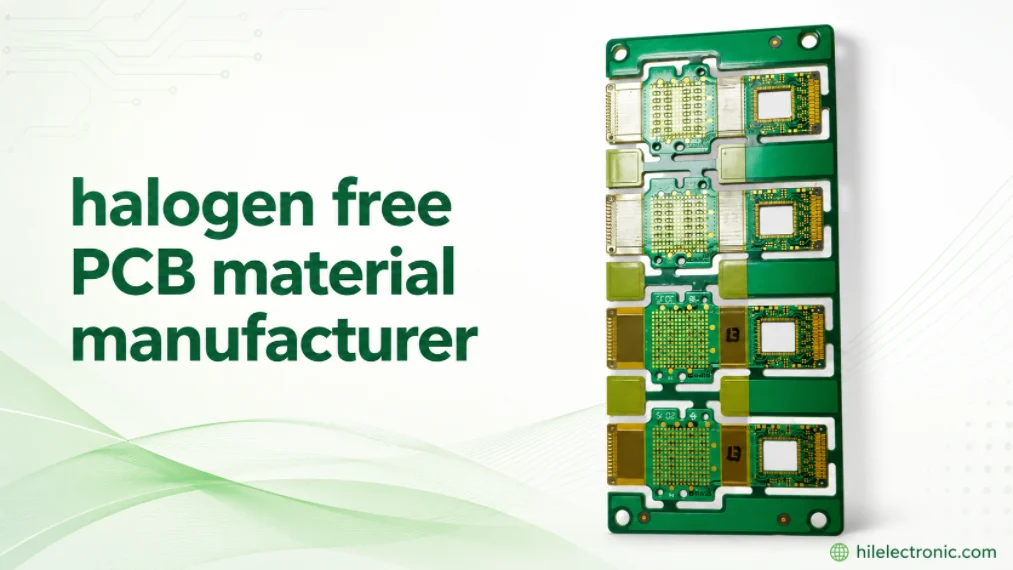
A halogen-free build may require approved laminate and prepreg, compatible solder mask, marking ink, and process documentation. Availability should be checked early, especially when the customer specifies a brand or export documentation package.
Highleap checks whether the requested halogen-free material can meet the board thickness, layer count, copper weight, solder mask color, surface finish, and assembly temperature requirements.
- Laminate and prepreg selection
- Solder mask and marking ink compatibility
- Material substitution approval
- Lead time and inventory review
For a production halogen-free PCB or PCBA build RFQ, requirement should be converted into drawing notes and supplier checks rather than left as background explanation. Highleap uses it to decide whether the project needs material confirmation, stackup adjustment, DFM feedback, special inspection, or assembly process review before the quote is finalized.
The same requirement also affects cost and lead time because compliance scope, material availability, document control, and assembly compatibility can change tooling effort, process control, test coverage, or material purchasing. Providing halogen-free scope, material declaration request, solder mask requirement, BOM scope, and shipment documentation before quotation reduces back-and-forth and makes the first engineering response more useful.
In practical builds such as export electronics, OEM control boards, consumer electronics, automotive modules, and communication equipment, this requirement normally appears during the first DFM or sourcing discussion. The reason is simple: halogen-free scope, material approval, compliance records, and assembly documentation can change the recommended stackup, inspection plan, or assembly sequence before a purchase order is placed.
For repeat production, Highleap also checks whether the requirement can be held from pilot build to batch production. That means the production package should give Highleap complete manufacturing inputs, not only a material name or a partial drawing set.
Halogen-free RFQs should stay close to procurement reality. Many RFQs fail because the customer does not state whether the rule applies only to laminate, or also to solder mask, legend ink, adhesives, coating, components, and process materials. Highleap should clarify that boundary before quoting.
For a manufacturing order, the useful commercial details are document scope, substitute approval, lot traceability, assembly compatibility, and the exact files needed before a halogen-free bare PCB or full PCBA order can be accepted.
The RFQ should also distinguish halogen-free from lead-free and RoHS. These requirements often appear together in an OEM specification, but they are not identical. Treating them as separate manufacturing and documentation items helps the buyer understand what Highleap can verify, quote, assemble, and ship with records.
Fabrication and Lead-Free Assembly Controls for Halogen-Free PCB
Compliance does not remove normal process risk
Halogen-free boards still need ordinary manufacturing discipline: stackup control, drilling, plating, solder mask registration, electrical test, and surface finish review. Many projects also combine halogen-free requirements with lead-free PCB requirements, so assembly temperature compatibility should be checked.
For turnkey builds, Highleap connects bare-board manufacturing with PCB assembly services, BOM compliance review, soldering, inspection, and test coverage.
- Lead-free reflow compatibility
- Surface finish and solderability
- PCB assembly BOM compliance
- Inspection and electrical test requirements
Assembly planning for a halogen-free PCB or PCBA build should be considered before bare-board release. Pad design, surface finish, solder mask, component thermal mass, fixture access, and inspection requirements can change the fabrication notes even when the schematic is already complete.
For purchasing teams, assembly scope changes the quote substantially. A bare PCB price does not cover BOM sourcing, stencil, programming, AOI, X-ray, functional testing, packaging, or documentation unless those requirements are stated clearly.
In practical builds such as export electronics, OEM control boards, consumer electronics, automotive modules, and communication equipment, this requirement normally appears during the first DFM or sourcing discussion. The reason is simple: halogen-free scope, material approval, compliance records, and assembly documentation can change the recommended stackup, inspection plan, or assembly sequence before a purchase order is placed.
For repeat production, Highleap also checks whether the requirement can be held from pilot build to batch production. That means the production package should give Highleap complete manufacturing inputs, not only a material name or a partial drawing set.
Halogen-free RFQs should stay close to procurement reality. Many RFQs fail because the customer does not state whether the rule applies only to laminate, or also to solder mask, legend ink, adhesives, coating, components, and process materials. Highleap should clarify that boundary before quoting.
For a manufacturing order, the useful commercial details are document scope, substitute approval, lot traceability, assembly compatibility, and the exact files needed before a halogen-free bare PCB or full PCBA order can be accepted.
The RFQ should also distinguish halogen-free from lead-free and RoHS. These requirements often appear together in an OEM specification, but they are not identical. Treating them as separate manufacturing and documentation items helps the buyer understand what Highleap can verify, quote, assemble, and ship with records.
Halogen Free PCB Quote Requirements
The RFQ should request documents before purchase order
A halogen-free PCB quote should include Gerber files, stackup, material requirement, solder mask requirement, surface finish, compliance standard, document needs, BOM if PCBA is required, and annual volume. Use the Highleap quick quote form to provide the package.
Common requested documents include certificate of conformity, material declaration, RoHS or REACH-related files, supplier data, and lot traceability where required. These should be quoted explicitly rather than requested after shipment.
- Gerber or ODB++ and fabrication drawing
- Halogen-free standard and material scope
- RoHS/REACH, CoC, or material declaration needs
- BOM and assembly data for full PCBA compliance
Quote readiness is a manufacturing quality issue for a halogen-free PCB or PCBA build. When files are complete, Highleap can review material availability, stackup feasibility, assembly risk, inspection level, and volume pricing without guessing from incomplete Gerber data.
The most useful RFQs identify halogen-free scope, material declaration request, solder mask requirement, BOM scope, and shipment documentation. When those details are missing, the quote may look simple but can hide later engineering questions, material substitution risk, or assembly delays.
For export electronics, OEM control boards, consumer electronics, automotive modules, and communication equipment, quote speed depends on how complete the technical package is. Highleap can usually respond more accurately when the RFQ includes stackup, drawings, assembly files, required reports, and expected volume rather than only a ZIP of Gerber files.
This is especially important when halogen-free scope, material approval, compliance records, and assembly documentation affects yield. If the requirement is unclear at quotation, it often returns later as an engineering hold, material substitution question, or assembly exception.
Halogen-free RFQs should stay close to procurement reality. Many RFQs fail because the customer does not state whether the rule applies only to laminate, or also to solder mask, legend ink, adhesives, coating, components, and process materials. Highleap should clarify that boundary before quoting.
For a manufacturing order, the useful commercial details are document scope, substitute approval, lot traceability, assembly compatibility, and the exact files needed before a halogen-free bare PCB or full PCBA order can be accepted.
The RFQ should also distinguish halogen-free from lead-free and RoHS. These requirements often appear together in an OEM specification, but they are not identical. Treating them as separate manufacturing and documentation items helps the buyer understand what Highleap can verify, quote, assemble, and ship with records.
Need a halogen-free PCB or PCBA quote?
Send the material scope, required documents, Gerber files, BOM, assembly data, and compliance requirements so Highleap can review the build before pricing.
Request a halogen-free PCB quote
FAQs
Does halogen-free PCB mean the full PCBA is halogen-free?
Not automatically. The customer must define whether the requirement applies only to the bare PCB or also to solder mask, ink, components, adhesives, coating, and assembly materials.
What documents are usually needed for halogen-free PCB?
Common requests include CoC, material declaration, RoHS or REACH-related documents, supplier data, and lot traceability if required by the customer.
Can halogen-free and lead-free requirements be combined?
Yes. Many export electronics specify both, but material selection, surface finish, soldering process, and documentation should be reviewed together.

Recommended Posts

Taconic RF-35 PCB Manufacturing Service — Prototype Through Volume Production
Figure 1. Taconic RF-35 PCBTaconic RF-35 is the workhorse...

Isola Astra MT77 PCB Manufacturing
Figure 1. Isola Astra MT77 PCB ManufacturingIsola Astra...

Custom Rogers RO4835 PCB Fabrication & Assembly Services
Figure 1. Rogers RO4835 PCBRogers RO4835 PCB is a...

Nelco N4000-13 PCB Material and Manufacturing Guide | Highleap Electronics
Figure 1. Nelco N4000-13 PCBNelco N4000-13 PCB is a...
How to get a quote for PCBs
Let’s run DFM/DFA analysis for you and get back to you with a report. You can upload your files securely through our website. We require the following information in order to give you a quote:
-
- Gerber, ODB++, or .pcb, spec.
- BOM list if you require assembly
- Quantity
- Turn time
For PCBA services, please provide your BOM (Bill of Materials) and any specific assembly instructions. We also offer DFM/DFA analysis to optimize your designs for manufacturability and assembly, ensuring a smooth production process.