
Aluminum LED PCB Factory Process Guide

Most engineers receive an aluminum LED PCB as a finished panel and never see what happened to it between Gerber file submission and delivery. That gap matters, because decisions made during production — dielectric pressing temperature, drilling speed, solder mask chemistry, panel utilization — show up in the board’s thermal performance, isolation reliability, and assembly yield. This article walks through an aluminum LED PCB factory’s production sequence and explains where each step introduces risk or quality margin.
How an Aluminum LED PCB Factory Differs from a Standard PCB Shop
Article Navigation
- How an Aluminum LED PCB Factory Differs from a Standard PCB Shop
- Step-by-Step: The Aluminum LED PCB Production Flow
- Panel Utilization and Its Effect on Unit Cost
- AOI and Electrical Testing Standards for Metal Core Boards
- Output Capacity at Highleap Electronics
- How Factory Decisions Show Up in Your Assembly Line
- FAQ
The differences are not cosmetic. Three fundamental process variables separate a metal core facility from a standard FR-4 operation:
Drilling: Aluminum alloy is abrasive to carbide tooling. Factories that run aluminum on the same drill program as FR-4 see accelerated bit wear, oversized holes, and burring at the entry and exit faces. Dedicated aluminum LED PCB lines use PCD (polycrystalline diamond) tooling or modified carbide geometries with reduced feed rates.
Lamination: The dielectric layer between copper foil and the aluminum base is a thermally conductive polymer composite, not standard prepreg. It requires a specific cure profile — temperature, pressure, and hold time matched to the dielectric’s Tg and resin flow behavior. A mismatch produces voids, incomplete bonding, or thickness variation, each of which degrades both thermal conductivity and breakdown voltage.
Solder mask: Standard LPSM (liquid photoimageable solder mask) adhesion to aluminum is unreliable without surface preparation. Factories that do not run a mechanical or chemical surface treatment step before mask application produce boards where the solder mask delaminates during reflow or thermal aging. Review common MCPCB manufacturing challenges to understand how often this failure mode appears in field returns.
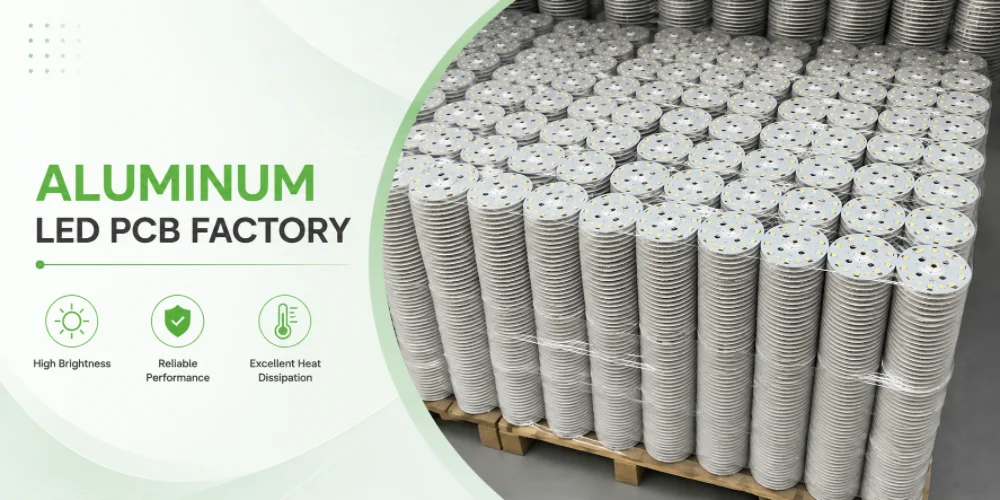
Step-by-Step: The Aluminum LED PCB Production Flow
Step 1 — Material incoming inspection Aluminum base stock is checked for alloy grade (typically 1050 or 5052), thickness tolerance, and surface condition. Dielectric rolls are verified against the purchase specification — thermal conductivity grade, dielectric constant, and breakdown voltage per lot.
Step 2 — Copper-clad laminate preparation For single-layer boards, the aluminum base arrives pre-bonded to the dielectric and copper foil as a metal core PCB laminate. For custom thermal conductivity requirements or non-standard aluminum gauges, the factory bonds the stack in-house using the lamination press.
Step 3 — Imaging and etching The copper layer is coated with photoresist, exposed through a photomask corresponding to the circuit pattern, and chemically etched. The aluminum base must be fully protected during etching — any electrolyte contact with the aluminum causes corrosion. Panel masking and rack design are critical at this step.
Step 4 — Drilling Through-holes for connectors or mounting hardware are drilled with aluminum-rated tooling. Most single-layer aluminum LED PCBs are not drilled for signal vias — only mechanical holes. Panel entry and backup materials are selected to minimize aluminum burring at hole exit.
Step 5 — V-scoring and routing Panels are scored or routed into individual board outlines. V-scoring blade angle and depth are calibrated for the aluminum gauge. Insufficient score depth causes panel breakout failures; excessive depth weakens the aluminum base at the score line and introduces warpage risk.
Step 6 — Surface finish application ENIG, LF-HASL, or OSP is applied to copper pads only, not the aluminum base. Maskant and fixture design prevent surface finish chemistry from contacting the aluminum. Explore the surface finish options for aluminum LED PCBs and how each affects solderability, shelf life, and SMT assembly compatibility.
Step 7 — Solder mask Following surface preparation (mechanical scrub or microetch), liquid photoimageable solder mask is applied, exposed, and developed. Cure temperature must stay below the dielectric’s maximum process temperature — typically 150–160°C — to avoid dielectric property degradation.
Step 8 — Electrical test and hi-pot Every board is tested for continuity and isolation. Hi-pot testing applies 1500–3000 V AC or DC between the copper circuit and the aluminum base to verify dielectric integrity. Boards that fail hi-pot are scrapped — there is no rework path for a dielectric breakdown failure.
Step 9 — Final inspection and packaging AOI verifies solder mask coverage and pad geometry. Visual inspection checks for surface defects, edge quality, and marking legibility. Boards are packaged in antistatic bags with desiccant, layered in foam or bubble wrap to prevent the aluminum edge from damaging adjacent boards.
Panel Utilization and Its Effect on Unit Cost
How a factory panelizes your board directly determines material efficiency and per-unit cost. A square LED module fits a rectangular aluminum panel with minimal waste; a circular LED array can produce 30–40% scrap if the panelization is not optimized through rotation and nesting.
Highleap Electronics runs panelization optimization on all orders, and the PCB panelization strategy is shared with customers as part of the quote documentation so the material cost component is transparent.
AOI and Electrical Testing Standards for Metal Core Boards
Automated optical inspection on aluminum LED PCBs covers:
- Solder mask coverage over copper traces and around pad openings
- Pad geometry conformance against Gerber data
- Silkscreen registration
- Board edge and slot quality
X-ray inspection is available but rarely required for single-layer aluminum LED PCBs unless components with hidden terminations (QFN LED drivers) are assembled. The primary quality gate for bare aluminum LED PCBs is the hi-pot test, which cannot be replaced by optical inspection.
Output Capacity at Highleap Electronics
Highleap operates dedicated MCPCB production capacity alongside FR-4 and flexible PCB lines. Monthly aluminum LED PCB output exceeds 50,000 panels at standard specifications. Expedited production for NPI and engineering runs is available on most aluminum LED PCB specifications with 5–7 working day lead time.
How Factory Decisions Show Up in Your Assembly Line
Four production variables that directly affect your SMT assembly yield on aluminum LED PCBs:
- Dielectric thickness variation: boards with thickness outside ±10% warp during reflow, causing pad opens
- Surface finish uniformity: HASL inconsistency causes bridging on small LED pads; ENIG from uncontrolled immersion baths shows nickel corrosion that inhibits wetting
- Solder mask registration: misregistered mask exposes copper outside the intended pad area, causing solder shorts
- Burring at drill holes: aluminum burrs that are not cleaned create short-circuit paths when boards are mounted to aluminum heatsink housings with conductive fasteners
Discussing these variables with your factory before production — not after the first assembly run — is the function of a DFM review specific to MCPCB design.
FAQ
What aluminum alloys are used in aluminum LED PCB bases? 1050 (99.5% purity) and 5052 (Al-Mg alloy) are most common. 1050 offers slightly better thermal conductivity (~220 W/m·K). 5052 has higher tensile strength and better corrosion resistance, making it preferred for outdoor lighting applications. 6061 is used for structural heatsink-PCB hybrid designs.
Why is hi-pot testing required for aluminum LED PCBs? The aluminum base carries chassis potential in most LED fixtures. Dielectric breakdown between the copper circuit and the aluminum base causes an electrical short to chassis — a safety hazard and an immediate product failure. Hi-pot testing at 1500–3000 V verifies that the dielectric layer provides reliable isolation at operating voltage plus margin.
What is the typical lead time for aluminum LED PCB production? Standard specifications (1-layer, 1.0–1.6 mm aluminum, ENIG or HASL surface finish): 7–10 working days for production quantities. Expedited NPI runs: 5–7 working days. Custom dielectric grades or non-standard aluminum thickness may add 3–5 working days for material procurement.
Can aluminum LED PCBs be assembled in the same SMT line as FR-4 boards? Yes, with adjustments. The aluminum base has higher thermal mass than FR-4, so reflow oven conveyor speed and zone temperature settings need to be recalibrated to achieve equivalent peak pad temperature. Factories with experience in aluminum PCB assembly maintain separate thermal profiles for metal core boards.

Recommended Posts
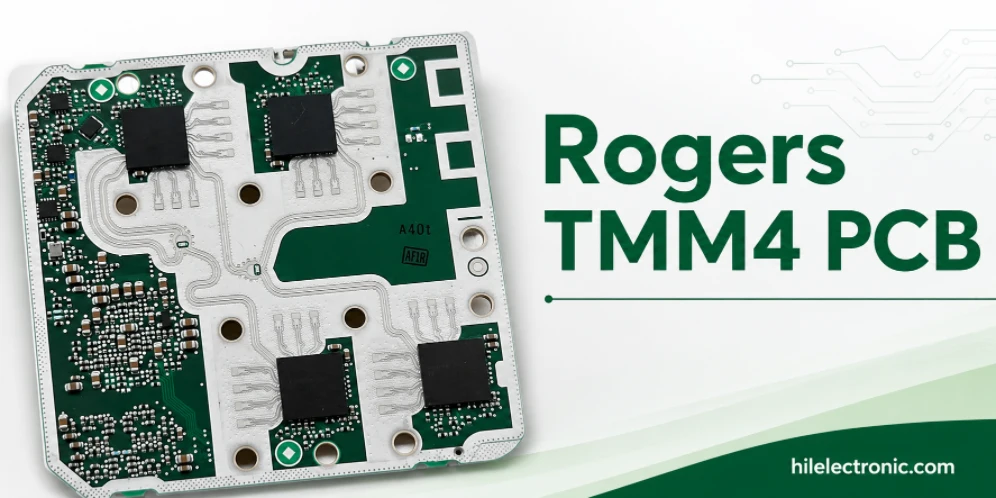
TMM4 Filter PCB Manufacturing
TMM4 filter PCB manufacturing is controlled by the...
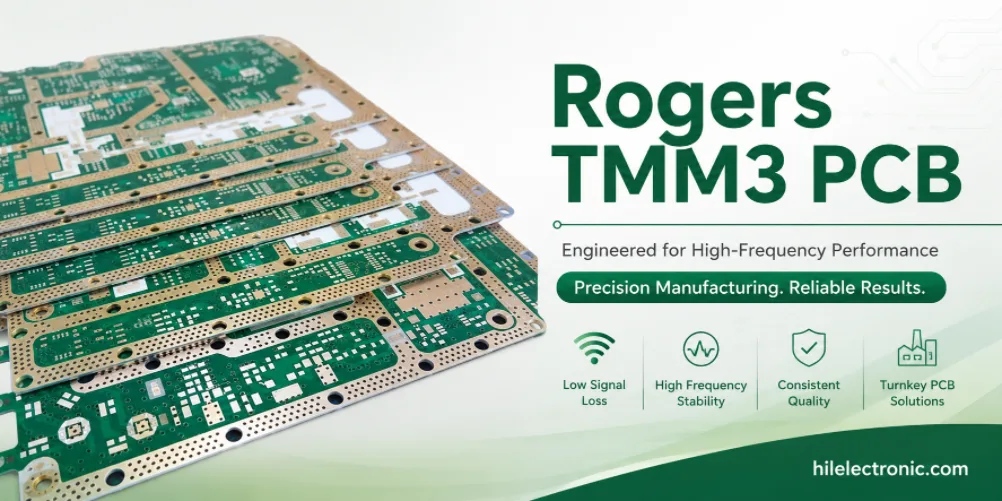
TMM3 PCB Manufacturing for RF Modules
TMM3 PCB manufacturing is most useful where the RF module...
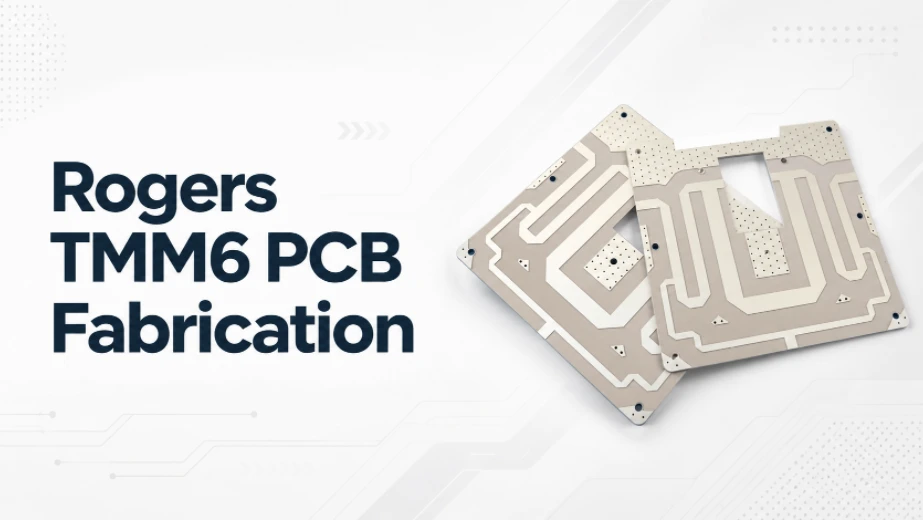
TMM6 PCB Fabrication
TMM6 fabrication is the process-control page for a mid-Dk...
TMM10 PCB Manufacturing for Compact RF Designs
Table of contentsHow TMM10 Shrinks RF StructuresTMM10 vs...
How to get a quote for PCBs
Let‘s run DFM/DFA analysis for you and get back to you with a report. You can upload your files securely through our website. We require the following information in order to give you a quote:
-
- Gerber, ODB++, or .pcb, spec.
- BOM list if you require assembly
- Quantity
- Turn time
For PCBA services, please provide your BOM (Bill of Materials) and any specific assembly instructions. We also offer DFM/DFA analysis to optimize your designs for manufacturability and assembly, ensuring a smooth production process.