
Blind Via PCB Lamination Defect Prevention
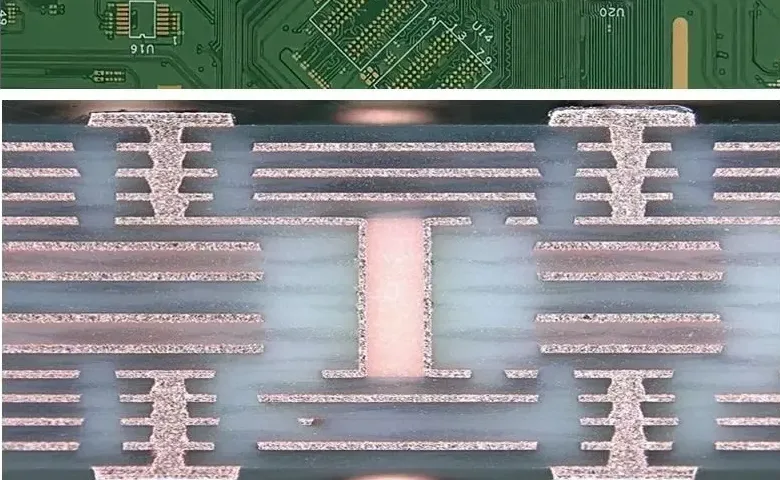
Table of Contents
- Blind Via PCB Lamination: Sequential Build vs. Single-Cycle Process
- Lamination Cycle Requirements by HDI Type
- Pre-Lamination Preparation: Inner Layer and Material Requirements
- Lamination Press Cycle: Parameters, Phases, and Process Control
- Inter-Cycle Processing: Inspection, Drilling, and Plating Between Cycles
- Common Lamination Defects, Root Causes, and Prevention
- Highleap’s Controlled Lamination Process for HDI PCBs
Blind Via PCB Sequential Lamination — Key Process Facts
- Standard PCB: 1 lamination cycle (all layers pressed simultaneously)
- Type I HDI: 2 lamination cycles — core first, then outer buildup layers
- Type II HDI: 3 lamination cycles — adds one buildup layer per side
- Type III HDI: 4–6 cycles — buried via core processing before outer buildups
- Minimum per cycle: 8–12 hours (cure dwell + cool-down) — physically non-compressible
- Registration requirement: ±0.075mm layer-to-layer (vs. ±0.15mm standard PCB)
The blind via PCB lamination process is the fundamental differentiator between HDI fabrication and standard PCB manufacturing. Where standard boards use a single lamination cycle — all layers pressed simultaneously, then drilled mechanically — blind via HDI boards require sequential lamination: each buildup layer is laminated, inspected, laser-drilled, and plated before the next layer can be added. Type I HDI requires 2 lamination cycles; Type II requires 3; Type III with buried vias requires 4–6. Each cycle contributes 8–12 hours of non-compressible process time, which is why HDI lead times are 2–3× longer than standard PCBs and why blind buried via PCB fabrication cost scales non-linearly with complexity. This guide covers every step of the sequential lamination process with the process parameters and defect prevention practices that determine yield and reliability outcomes.
Request HDI Fabrication with Controlled Lamination
1. Blind Via PCB Lamination: Sequential Build vs. Single-Cycle Process
1.1 Why Standard Lamination Cannot Produce Blind Vias
In standard multilayer PCB fabrication, all layers are pressed together in a single lamination cycle. After lamination, through-hole vias are drilled mechanically from top to bottom, passing through all layers. This works because through-hole vias are accessible from both board surfaces.
Blind vias, by definition, terminate at a specific inner layer and don’t penetrate the full board thickness. They cannot be formed after all layers are laminated because:
- Mechanical drilling cannot reliably stop at the exact dielectric thickness corresponding to a specific inner layer without over-drilling risk
- Laser drilling (which can achieve controlled depth) has insufficient energy to penetrate more than 1–2 layers of FR-4 prepreg in a single pass
- The inner layer copper pad that the blind via must land on is only accessible before the layers above it are laminated
Sequential lamination solves this by building the board layer by layer: laminate the inner core, then drill and plate blind vias into the first buildup layer before adding the next.
1.2 Sequential Build vs. Single Lamination: Process Comparison
| Attribute | Standard PCB (Single Cycle) | Type I HDI (Sequential, 2 Cycles) | Type III HDI (Sequential, 4–6 Cycles) |
|---|---|---|---|
| Via type achievable | Through-hole only | Blind L1–L2, L(n-1)–Ln | Blind outer + buried inner |
| Minimum via diameter | 0.20mm (mechanical) | 0.10mm (laser) | 0.10mm (laser) |
| Lamination cycles | 1 | 2 | 4–6 |
| Lead time vs. standard | Baseline | 1.4–1.8× | 2.0–3.0× |
| Cost vs. standard | Baseline | 2.3–3.2× | 5.8–9.5× |
| Registration requirement | ±0.15mm | ±0.075mm | ±0.050mm |
1.3 Why Each Additional Lamination Cycle Compounds Cost and Risk
Each lamination cycle adds:
- Direct cost: Press time, prepreg material, plating bath time — approximately $18–$45/board at prototype quantities
- Registration error accumulation: Each cycle introduces ±0.025–0.075mm of registration uncertainty. After 4 cycles, cumulative uncertainty can reach ±0.10–0.15mm — approaching the annular ring specification for high-density HDI
- Yield risk: Each cycle has a 1–3% probability of a process failure (delamination, void, registration error) requiring scrapping that panel. Across 4 cycles, probability of at least one cycle failure reaches 4–12%
- Thermal exposure: Each lamination cycle subjects previously completed layers to another 170–190°C excursion. Tg-sensitive materials may see Dk shift. PTFE-based materials require especially careful temperature management
This compounding effect is why Type III HDI costs 5.8–9.5× standard PCB price despite containing only 1.5–2× the material — the process complexity, not the material, drives the cost.
2. Lamination Cycle Requirements by HDI Type
2.1 Type I HDI Lamination Sequence
Type I (1+N+1): One buildup layer on each side of the core, blind vias connecting L1–L2 and L(n-1)–Ln.
Cycle 1 — Core lamination:
- Input: Imaged and etched inner layer cores (L2 through L(n-1)), prepreg between cores, thin copper foil on outer surfaces
- Output: Fully laminated inner core with solid copper outer surfaces (these will become L2 and L(n-1) after outer processing)
- Inspection: Thickness measurement, X-ray fiducial registration, visual delamination check
Cycle 2 — Outer buildup lamination:
- Input: Core from Cycle 1 (with blind via drilling, desmear, and electroless copper between cycles), laser-drillable prepreg, thin outer copper foil (typically 12–18µm foil)
- Output: Complete multilayer stack with all layers bonded
- After Cycle 2: Outer layer imaging, etching, solder mask, surface finish, test
2.2 Type II HDI Lamination Sequence
Type II (2+N+2): Two buildup layers per side, enabling two-level blind via stacking (L1–L2 and L2–L3).
Cycle 1 — Core lamination: Same as Type I Cycle 1.
Cycle 2 — First outer buildup:
- Laser-drillable prepreg laminated onto the core
- After this cycle: First laser drill pass (blind vias from L2 into core), desmear, electroless copper, electroplating
- If stacked vias: resin fill + planarization before Cycle 3
- If staggered vias: direct to Cycle 3 without fill
Cycle 3 — Second outer buildup:
- Second laser-drillable prepreg laminated on top of Cycle 2 structure
- After this cycle: Second laser drill pass (blind vias from L1 into L2 pad), desmear, electroless, plating
- Then outer layer processing begins
2.3 Type III HDI: Core Buried Via Processing
Type III adds buried via processing before outer buildup layers are applied. For a 10-layer Type III with L4–L5 buried vias:
Core sub-cycle 1 — L4–L5 buried via formation:
- Core laminate (L4–L5 layers only) is mechanical-drilled and plated for buried via barrels
- L4 and L5 are imaged with buried via pads and interconnecting traces
- Core sub-assembly inspected and oxidized
Core sub-cycle 2 — Full core lamination:
- L4–L5 sub-assembly, remaining inner layer cores, and prepreg are laminated together
- The buried vias are now permanently enclosed inside the core
Outer buildup cycles (same as Type I or II): Applied on top of the complete core.
Each additional buried via layer pair in the core adds one complete mechanical-drill-plate-laminate cycle before outer buildups begin.
3. Pre-Lamination Preparation: Inner Layer and Material Requirements
3.1 Inner Layer Quality Requirements
Every lamination cycle outcome depends on the quality of the preceding inner layer fabrication:
Copper surface cleanliness: Any organic contamination (oil, fingerprints, photoresist residue) on inner copper prevents resin adhesion. Copper surfaces are cleaned through a multistep process: alkaline cleaner, micro-etch (1–2µm copper removal), acid rinse, deionized water rinse. Cleanliness is verified by water break test — a properly cleaned surface shows even wetting; contamination causes beading.
Oxide treatment: Bare copper has low surface energy and poor adhesion to epoxy resin. Brown oxide or black oxide treatment roughens the copper surface from 0.3–0.5µm (as-etched) to 1.5–3.0µm, dramatically improving peel strength. Modern “micro-etch” or “organic adhesion promotion” systems (e.g., MacDermid MultiBond, Atotech Universal Etch) can replace oxide at certain resin systems, but must be qualified for the specific prepreg chemistry.
Registration accuracy: Inner layer targets (typically cross-shaped copper features) must fall within ±0.075mm of their nominal positions for the subsequent drill programs to maintain annular ring. Layers outside this tolerance are scrapped before lamination — not after.
3.2 Prepreg Preparation and Staging
Prepreg (fiberglass cloth pre-impregnated with partially-cured B-stage epoxy resin) is the bonding material between copper layers. Pre-lamination requirements:
Moisture control: Prepreg absorbs moisture from ambient air. Moisture above 0.2% content causes:
- Steam generation during lamination, creating voids and blisters
- Reduced Tg of the cured laminate
- Delamination at the copper-resin interface during subsequent thermal processing
Prepreg must be stored below 21°C and 50% relative humidity. Panels stored in non-controlled environments for more than 24 hours should be baked at 120°C for 2 hours before use.
Prepreg selection for laser-drillable buildup layers: Outer buildup prepregs for blind via formation must be laser-drillable without carbonization that would contaminate via walls. Standard woven fiberglass cloth prepreg is difficult to laser-drill cleanly; non-woven or modified glass-cloth prepregs with reduced fiberglass content (e.g., Panasonic R-1661W, Isola I-Tera MT40 prepreg, specialty low-loss laminate a specialty low-loss laminate bondply) are specified for buildup layers where blind via laser drilling is planned (see laser drilling for microvia formation)
3.3 Copper Foil Selection for Buildup Layers
Outer buildup layers typically use thinner copper foil (9–18µm) than inner cores (17–35µm). Thinner foil:
- Enables finer imaging resolution (2/2 mil trace/space vs. 3/3 mil minimum for thick foil)
- Reduces the amount of copper the laser must ablate before reaching the prepreg, improving via wall quality
- Requires more careful handling to prevent wrinkling during lamination
For designs using LP (Low Profile) or VLP (Very Low Profile) copper to reduce high-frequency insertion loss, these foils are exclusively used on outer signal layers where the signal frequency justifies the cost premium. Inner core layers can use standard ED copper.
4. Lamination Press Cycle: Parameters, Phases, and Process Control
Inner layers, prepreg, and copper foil loaded into press book. Contact pressure (50–100 PSI) applied before heating to prevent layer shift during ramp.
Press temperature rises at 2–4°C/min to 175–185°C. Slow ramp allows moisture evaporation and uniform resin flow before gelation begins.
Full lamination pressure (300–400 PSI) applied. Resin flows, fills voids, and cross-links. Duration is set by resin chemistry — cannot be shortened.
Temperature reduced at 2–4°C/min. Rapid cooling causes CTE-mismatch warpage and latent delamination. This phase cannot be accelerated.
Thickness measurement, visual inspection, X-ray layer registration check (inner fiducials must be within ±0.075mm of drill targets).
4.1 Press Cycle Phases in Detail
Phase 1 — Loading and initial pressure:
The stack is loaded into the press book between release films and mirror plates. Initial contact pressure (50–100 PSI) is applied before heating begins to prevent layer shift during the initial temperature ramp.
Phase 2 — Temperature ramp (60–90 minutes):
Temperature increases from ambient to the cure temperature setpoint (typically 175–185°C for standard FR-4, up to 195°C for high-Tg grades). Ramp rate is controlled at 2–4°C/minute. The purpose of the slow ramp:
- Evaporates any residual moisture before the resin flows
- Allows resin to reach its flow temperature (130–150°C) uniformly across the panel before full gelation begins
- Minimizes thermal gradient across the panel — especially important for large panels where edge-to-center temperature differential can cause non-uniform cure if ramped too quickly
Phase 3 — Full pressure and cure dwell (90–180 minutes):
Full lamination pressure (300–400 PSI for standard FR-4) is applied when the resin reaches flow temperature. The resin flows, fills gaps and voids, and begins cross-linking (gelation). Cure dwell continues until the resin reaches full Tg — as measured by DSC (Differential Scanning Calorimetry) on process coupons. Insufficient cure dwell produces boards with substandard Tg, reduced peel strength, and elevated z-axis CTE — all of which cause reliability problems in service.
Phase 4 — Controlled cool-down (3–5 hours):
After cure dwell, the press temperature is reduced at a controlled rate of 2–4°C/minute. This rate is determined by the CTE differential between copper layers (17 ppm/°C in-plane) and the laminate (14–18 ppm/°C in-plane, 50–70 ppm/°C z-axis). Faster cooling introduces residual stresses that cause:
- Immediate warpage (visible bow and twist exceeding IPC-6012 ±0.75% limits)
- Internal stresses that manifest as latent delamination under subsequent thermal cycling
- Microcracking at via drill entry points during subsequent drilling operations
The cool-down phase is the most commonly shortened process step in low-cost HDI fabrication — and the most common cause of warpage and reliability failures in boards produced under cost pressure.
4.2 Multi-Opening vs. Single-Opening Press
Multi-opening presses process multiple panel stacks simultaneously (typically 8–12 openings), with each opening holding one or more panels separated by mirror plates. This increases throughput without changing per-cycle time.
Single-opening vacuum presses are used for:
- High-complexity HDI with asymmetric stackups where uniform pressure distribution is critical
- Thin buildup prepregs (below 60µm) where vacuum is needed to prevent void formation
- PTFE-based materials where temperature and pressure profiles differ from FR-4 and cross-contamination between press loads is a concern
For any PTFE or ceramic-filled high-frequency laminate, press lines must be dedicated or thoroughly cleaned between FR-4 and HF material runs. Cross-contamination of PTFE materials with FR-4 resin changes the dielectric constant and is difficult to detect without destructive analysis.
4.3 Process Control and Monitoring
Production lamination at quality HDI factories includes:
Thermocouple monitoring: Multiple thermocouples placed in the press book at panel corners and center. Temperature traces are logged for every cycle and reviewed against the validated press profile window. Any panel where a thermocouple fell outside the profile window is flagged for dimensional and cross-section verification.
Resin flow coupons: Small test coupons placed at panel edges collect resin flow during lamination. Resin flow outside the acceptable window (too little = voids, too much = edge delamination) triggers investigation of prepreg lot moisture content and press temperature calibration.
Panel thickness measurement: Post-lamination thickness is measured at 9+ points per panel. Variation exceeding ±10% of nominal triggers review for non-uniform pressure distribution or prepreg lot variation.

5. Inter-Cycle Processing: Inspection, Drilling, and Plating Between Cycles
5.1 Post-Lamination Inspection Before Next Cycle
Every cycle must pass inspection before the job proceeds to the next cycle. Releasing a defective panel into the next cycle is the most expensive quality failure in HDI manufacturing — the defect is buried, additional process steps are applied to a fundamentally flawed substrate, and the panel is eventually scrapped at final inspection.
Inspection checklist between cycles:
- X-ray layer registration: inner layer fiducials must align within ±0.075mm of drill targets
- Panel dimensional check: length, width, and thickness within specification
- Visual inspection for delamination blisters, edge delamination, and surface voids
- Cross-section sample (destructive, on process coupon): resin void check, copper-resin interface integrity, peel strength estimation
5.2 Laser Drilling After Each Buildup Cycle
Laser drilling follows each outer buildup lamination. Key process parameters:
CO₂ laser for standard FR-4 buildup:
- Wavelength: 10.6µm — absorbed well by organic resin, poorly by copper
- Copper ablation step: a brief first pulse ablates a “window” in the outer copper foil
- Dielectric ablation: subsequent pulses remove the prepreg material down to the capture pad on the inner layer
- Minimum via diameter: 0.10mm finished (0.12mm drilled before plating)
- Maximum aspect ratio: 1:1 (depth equal to or less than diameter)
UV (Nd:YAG) laser for thin films and PTFE:
- Wavelength: 355nm — cold ablation without charring
- Used for: prepreg below 40µm, polyimide flexible materials, PTFE-based buildup films
- Higher cost per via ($0.015–0.040) vs. CO₂ (~$0.008–$0.025/via, reference)
- Better via wall quality — less residue, cleaner ablation
Conformal mask technique: A common method for CO₂ laser where the outer copper foil is etched with windows at blind via locations before laser drilling. The CO₂ laser then drills through the dielectric in the pre-opened window without needing to penetrate copper. This reduces the number of laser pulses per via and improves via wall consistency.
5.3 Desmear and Electroless Copper: Via Wall Preparation
After laser drilling, via walls contain residue from the ablation process:
- Carbonized resin (drill smear) from CO₂ laser ablation
- Glass fiber residue from the prepreg substrate
- Oxidized copper on the capture pad
Permanganate desmear process:
- Swelling agent: swells the drill smear to improve chemical access
- Permanganate etch: oxidizes and removes carbonized resin and smear
- Reducer: neutralizes residual permanganate and removes any oxidation from the capture pad copper
For PTFE laminates, CF₄/O₂ plasma replaces permanganate. The plasma removes carbonized residue without attacking the PTFE matrix. Dedicated plasma chambers are required — PTFE contamination in standard permanganate lines causes adhesion failures.
Following desmear, palladium catalyst is applied to all surfaces including via walls, and electroless copper (0.5–1.5µm) is deposited to create a conductive seed layer for electroplating.
ℹ Staggered vs. Stacked: The Design Choice That Determines Fill Cost
Stacked microvias (directly above each other across layers) require resin fill + planarization between lamination cycles — adding $0.05–$0.15/via for fill and $1.50–$5.00/panel for planarization. Staggered microvias (offset ≥0.25mm) eliminate both steps entirely. For a 600-via design, the difference is roughly $68/board (stacked) vs. $10.80/board (staggered) in via processing cost alone — these are illustrative figures for a 600-via design; actual costs vary.
5.4 Via Fill and Planarization for Stacked Designs
For designs using stacked vias (where L1–L2 via is directly above L2–L3 via), the L2–L3 via must be filled and planarized before lamination of the L1–L2 buildup layer proceeds:
Resin fill:
- Epoxy or polymer resin ink is injected into the via barrel under vacuum or squeegee application
- Fill must be 95%+ complete with no voids — voids cause outgassing during subsequent assembly reflow
- Cure at 150–175°C for 60–90 minutes
Planarization:
- The filled via surface may be slightly domed (overfill) or recessed (underfill)
- Mechanical planarization (belt sanding or rotary grinding) removes material until the via surface is level with the surrounding copper within ±15µm
- This flatness is critical for the subsequent buildup lamination to achieve uniform pressure and bondline thickness
Cost impact: Fill adds $0.05–$0.15/via, planarization adds $1.50–$5.00/panel. For a 600-via design, fill and planarization together may add roughly $31.50–$95.00/board (reference range — actual cost depends on via count, material, and supplier). This is why staggered via design — which eliminates both steps — has such substantial cost impact. See the blind buried via PCB cost guide for the complete via architecture cost comparison.
6. Common Lamination Defects, Root Causes, and Prevention
⚠ The Most Common HDI Lamination Failure Mode
Insufficient inner layer oxide treatment causes 40–60% of delamination failures. Copper surface roughness below 1.5µm (as-etched copper is 0.3–0.5µm) provides inadequate peel strength for epoxy adhesion. Brown oxide or modern organic adhesion promotion treatment is a required process step — not an optional quality upgrade.
6.1 Delamination
Definition: Separation between a copper layer and the adjacent resin/glass laminate. May be visible as a blister or bubble on the board surface, or hidden and only detectable by cross-section.
Root causes:
- Insufficient oxide treatment: copper-resin peel strength below 4 N/cm minimum
- Prepreg moisture above 0.2%: steam generation during cure creates voids that grow into delamination zones
- Cure dwell insufficient: partially cross-linked resin has reduced cohesive strength
- Contamination on copper surface before lamination
Prevention: Copper surface treatment qualification (monthly peel strength testing on production coupons), prepreg moisture monitoring with mandatory bake-out for non-compliant material, process coupon cross-section sampling after every lamination lot.
6.2 Registration Errors
Definition: Drill targets and inner layer pads are misaligned, resulting in reduced or zero annular ring at blind via capture pads.
Root causes:
- Panel dimensional change during lamination: FR-4 undergoes slight X-Y expansion during cure (typically 0.02–0.05%). Drill programs must be compensated for this predictable expansion.
- Inner layer dimensional instability: inner layers that weren’t etched symmetrically (different copper density top vs. bottom) bow during lamination, shifting features from their nominal positions
- Press stack misalignment: registration pins must seat correctly; mis-seated pins allow layer shift
Prevention: X-ray drill registration measurement on every panel before drilling (not on a sampling basis). Artwork scaling compensation applied to each layer based on measured material expansion characteristics. Copper distribution analysis during inner layer DFM to flag asymmetric designs before production.
6.3 Voids and Air Entrapment
Definition: Air or gas pockets in the cured resin, appearing as delamination-like inclusions or pinpoint voids in cross-section.
Root causes:
- Prepreg with insufficient resin content for the given panel design (high copper-to-dielectric area ratio requires higher resin flow)
- Insufficient vacuum in vacuum-assist press cycles
- Too-rapid initial ramp preventing proper resin flow and outgassing before gelation
Prevention: Resin content specification matched to panel copper density. Vacuum lamination for designs with dense inner copper patterns. Validated ramp rate protocols that ensure complete gas evacuation before resin gels.
6.4 Warpage and Bow
Definition: Panel shape deviation exceeding IPC-6012 limits (bow and twist ≤0.75% of panel diagonal for HDI Class 3, ≤1.5% for Class 2).
Root causes:
- Asymmetric copper distribution: if top half of the stackup has significantly more copper than the bottom half, differential CTE during cool-down causes bow toward the copper-heavy side
- Rapid cool-down: thermal gradient from surface to core of thick panels during fast cooling generates bending moments
- Mismatched prepreg and core CTE: different materials in the stackup with different CTEs create internal stresses
Prevention: Copper balance analysis during DFM — copper density on top and bottom halves of the stackup should be within ±10% of each other for symmetric designs. Controlled cool-down rate monitoring. For asymmetric designs (unavoidable in some applications), reverse-side copper copper features may be added to balance the stackup.
6.5 Thickness Variation
Definition: Post-lamination dielectric thickness outside the ±10% specification, causing controlled impedance trace dimensions to miss their targets.
Root causes:
- Non-uniform resin flow: too much flow at panel edges (thin center), too little (thick edges) — caused by prepreg with resin content mismatch
- Press pressure non-uniformity across large panels
- Prepreg lot variation in resin content
Prevention: 9-point thickness mapping after each lamination cycle. Resin content measurement on incoming prepreg (not just Dk and Df). Mirror plate flatness verification (mirror plates that bow after wear introduce pressure non-uniformity).
7. Highleap’s Controlled Lamination Process for HDI PCBs
7.1 Equipment and Process Infrastructure
Highleap’s HDI lamination capability includes:
- Vacuum-assist multi-opening hydraulic presses with ±1°C temperature uniformity across the press platen
- Dedicated PTFE/specialty low-loss laminate families press lines — no cross-contamination with FR-4 press lines
- Climate-controlled prepreg storage at ≤21°C, ≤45% RH with moisture monitoring per-lot
- In-line thermocouple logging for every production lamination cycle
- X-ray layer registration measurement on 100% of panels (not sampling) before and after laser drilling
7.2 Inter-Cycle Inspection Protocol
Between every lamination cycle, Highleap conducts:
- 100% X-ray registration check: all inner layer fiducials measured, not sampled
- Panel thickness mapping at 9 points: any panel outside ±10% is removed from production
- Visual inspection for delamination blisters and edge separation
- Process coupon cross-section (one coupon per production lot): peel strength measurement, resin void check, copper-resin interface quality assessment
This inter-cycle gate catches 85–90% of lamination defects before additional process investment is applied to a compromised panel. The cost of catching a defect at inter-cycle inspection versus at final electrical test: roughly $15 vs. $85 in wasted process cost (illustrative figures). For the cost implications of yield and lamination cycle count, see blind buried via PCB cost analysis. For the lead time implications of each lamination cycle, see HDI PCB lead time guide.
7.3 Material Handling and Lot Traceability
Every production lot includes full material traceability: prepreg lot number, copper foil lot, and laminate core lot — all linked to the production traveler and inspection records. For controlled-impedance programs, prepreg Dk is measured on incoming lot coupons and the measured value is used for final impedance calculation (not the nominal datasheet value), ensuring TDR coupon results are reproducible from lot to lot (see controlled impedance PCB requirements)
7.4 Quality Metrics for HDI Lamination at Highleap
- Type I HDI lamination yield (panel passing all inter-cycle inspections): 97.8% average
- Type II HDI lamination yield: 95.2% average
- Type III HDI lamination yield: 91.6% average
- Delamination rate at final inspection: below 0.3% of shipped panels
- Controlled impedance first-pass yield (within ±10%): 98.1% of lots
- Warpage compliance (bow and twist within spec): 99.2% of HDI panels
These metrics are available on request for vendor qualification purposes.

Recommended Posts
TMM3 PCB Manufacturing for RF Modules
TMM3 PCB manufacturing is most useful where the RF module...
TMM6 PCB Fabrication
TMM6 fabrication is the process-control page for a mid-Dk...

TMM10 PCB Manufacturing for Compact RF Designs
Table of contentsHow TMM10 Shrinks RF StructuresTMM10 vs...

TMM10i PCB Fabrication and DFM
TMM10i PCB fabrication has a stronger DFM emphasis because...
How to get a quote for PCBs
Let us run DFM/DFA analysis for you and get back to you with a report.
You can upload your files securely through our website.
We require the following information in order to give you a quote:
-
- Gerber, ODB++, or .pcb, spec.
- BOM list if you require assembly
- Quantity
- Turn time