
FFC vs FPC: Cable, Circuit, Connector Guide

Figure 1. FFC vs FPC
FFC and FPC are both thin, flat, flexible interconnects, but they are not the same thing. An FFC (flat flexible cable) is a simple cable, a set of parallel conductors laminated in plastic film, used as a flexible jumper. An FPC (flexible printed circuit) is an actual circuit, etched copper on a polyimide film, that can carry components and complex routing. Confusing the two leads to the wrong part and the wrong connector. This guide explains FFC vs FPC, when to choose each, how to select the matching connector, and what goes into designing and manufacturing flexible circuits.
Key takeaways
- FFC is a simple flat cable of parallel conductors; FPC is a printed flexible circuit that can include components and custom routing.
- Use FFC for a plain board-to-board or board-to-display jumper; use FPC when you need a real circuit that bends.
- Connectors must match pitch, contact count, contact side (same or opposite), and stiffener; ZIF connectors clamp the cable, non-ZIF rely on friction.
- Flex manufacturing uses polyimide (FCCL) and a coverlay instead of soldermask, with bend radius, stiffeners, and finish all design decisions.
- Dynamic (repeatedly flexing) and static (flex-to-install) applications have very different reliability requirements.
Table of Contents
What Is an FFC?
A flat flexible cable is exactly what the name says: a row of flat metal conductors held in parallel and laminated between thin plastic films, usually PET. It is a cable, not a circuit, a flexible jumper that carries the same signals from one connector to another with no components and no branching.
Key characteristics
- Construction: parallel conductors in a flat plastic laminate, a simple 1:1 connection.
- Pitch: common spacings include 0.5, 1.0, and 1.25 mm.
- Contacts: exposed at each end, on the same side or opposite sides, with the rest insulated.
- Stiffeners: small reinforcing tabs at the ends help the cable seat in its connector.
FFCs are everywhere short, flat, flexible links are needed, connecting a display to a mainboard, or two boards in a slim device. They are inexpensive and ideal when all you need is to move a set of signals from A to B.
What Is an FPC?
A flexible printed circuit is a true printed circuit board built on a flexible substrate. Copper is etched into custom traces on a polyimide film, so an FPC can do everything a rigid board’s copper does, route complex patterns, branch, and even carry mounted components, while bending and folding.
Key characteristics
- Construction: etched copper on polyimide, single-sided, double-sided, or multilayer.
- Capability: custom routing and, unlike an FFC, the ability to mount components.
- Form: very thin and bendable, able to fit folded or three-dimensional spaces.
- Integration: can be combined with rigid sections to form a rigid-flex board.
Because an FPC is a circuit, it solves layout and packaging problems a cable cannot, replacing wiring harnesses, fitting curved enclosures, and reducing connectors. When you need flexibility and circuitry in one part, the FPC is the answer, and it is the foundation of a flexible PCB.
FFC vs FPC Side by Side
The clearest way to see the difference is a direct comparison.
| Aspect | FFC (flat flexible cable) | FPC (flexible printed circuit) |
|---|---|---|
| What it is | A cable | A printed circuit |
| Conductors | Parallel, fixed, 1:1 | Etched into any custom pattern |
| Substrate | PET plastic film | Polyimide |
| Components | None | Can be mounted |
| Layers | Single flat layer | Single, double, or multilayer |
| Cost | Lower | Higher, for greater capability |
| Best role | Simple flexible jumper | A circuit that must bend |
In short: if you only need to carry a set of signals across a flexible link, an FFC does it cheaply. If you need actual circuitry, routing, components, multiple layers, in a flexible form, you need an FPC.
When to Choose Which
Choose an FFC when
- You need a plain, flat, flexible connection between two connectors.
- The signals are a straightforward 1:1 set with no processing in the cable.
- Cost and simplicity matter, as in a display-to-board link.
Choose an FPC when
- You need custom routing, branches, or multiple layers in a flexible part.
- Components must mount on the flexible circuit itself.
- You are replacing a wiring harness or fitting a curved or folded space.
- The design calls for combining rigid and flexible sections.
The decision usually comes down to one question: do you need a cable or a circuit? When the answer is “a circuit that also has rigid mounting areas,” the natural step beyond a plain FPC is a rigid-flex construction, which integrates both in a single assembly and eliminates connectors between them.
Choosing the Right Connector
An FFC or FPC is only as reliable as its connector, and the connector must match the cable exactly.
ZIF vs non-ZIF
Connectors come in two broad styles. A ZIF (zero insertion force) connector lets you insert the cable freely, then clamp it with a flip or slide lock, giving a secure, low-stress connection that is ideal for finer pitches and repeated mating. A non-ZIF connector holds the cable by friction as it is pushed in, which is simpler but less forgiving. For most flex applications, especially fine-pitch ones, a ZIF connector is the safer choice.
Matching the connector to the cable
Whichever style you use, four things must match:
- Pitch, the conductor spacing, must be identical.
- Contact count, the number of conductors, must agree.
- Contact side, whether the exposed contacts are on the top or bottom at the end, must suit the connector.
- Stiffener, the end reinforcement, must match what the connector expects.
Most flex connection failures come from a mismatch in one of these four, a cable whose contacts face the wrong way for its connector, for instance. Specify the cable and connector together and confirm all four, ideally as part of a manufacturer’s DFM review of the assembly.
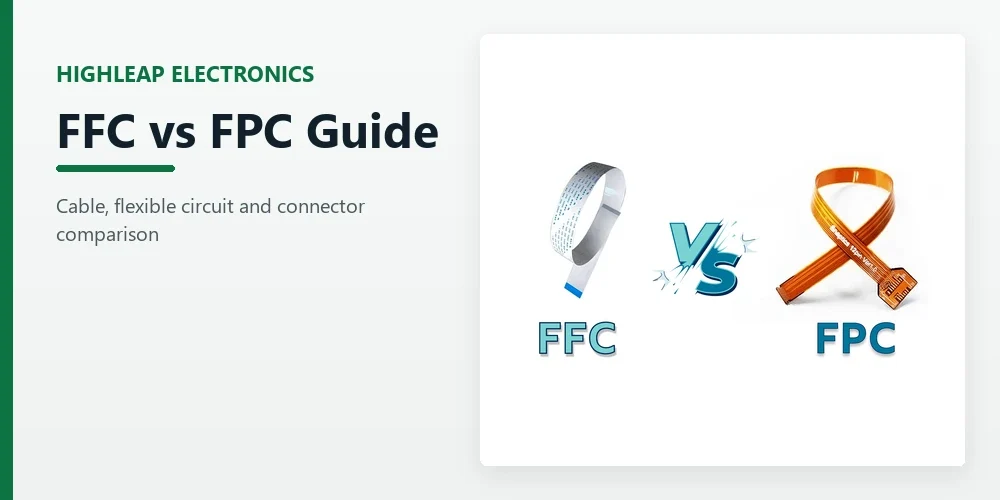
Figure 2. FFC vs FPC details
FPC Construction Types
Flexible printed circuits come in several constructions, from the simplest single layer to combinations with rigid sections. The right one depends on routing density and how the circuit has to bend.
| Construction | Description | Typical use |
|---|---|---|
| Single-sided | Copper on one side of the polyimide | Simple routing and dynamic bending |
| Double-sided | Copper both sides, plated through-holes | More routing at moderate complexity |
| Multilayer | Several copper layers laminated together | Dense routing in a flexible form |
| Rigid-flex | Flexible and rigid layers combined | Eliminating connectors between boards |
Single- and double-sided flex suit most jumper and routing tasks, while multilayer and rigid-flex solve dense or three-dimensional packaging. The more layers and rigid-flex transitions involved, the more specialized the fabrication and the more it benefits from a partner experienced through high-volume PCB assembly of flexible builds.
Designing and Manufacturing Flexible Circuits
Flexible circuits are built differently from rigid boards, and a few terms and decisions are worth understanding.
Materials and layers
An FPC starts from flexible copper-clad laminate (FCCL), copper bonded to polyimide. Instead of the rigid soldermask used on hard boards, a coverlay, a polyimide film, protects the flexible circuit while keeping it bendable. Adhesiveless constructions improve bend performance, and an immersion finish such as ENIG suits the flexible surface and resists corrosion. For circuits that combine flexible and rigid layers, the manufacturing becomes more involved, the realm of multilayer flex-rigid fabrication.
Bend radius and stiffeners
The most important mechanical rule in flex design is the bend radius: bend too tightly and the copper cracks. A generous bend radius, with traces routed perpendicular to the bend and copper relief where needed, keeps the circuit reliable. Stiffeners are added under areas that must stay rigid, where components mount or connectors attach, so flexing happens only where intended. These choices are central to good rigid-flex PCB design.
Dynamic vs static flexing
How the circuit flexes changes everything. A static flex is bent once to fit during assembly and then stays put; a dynamic flex bends repeatedly in use, as in a hinge or a moving head. Dynamic applications demand thinner copper, careful routing, and a larger bend radius to survive many cycles. Decide which case you are designing for early, because it drives the stack-up and the layout.
Reliability and Handling
Flexible parts reward careful handling and manufacturing. A few practical points keep them reliable.
- Respect the bend radius in both design and assembly; over-bending during installation is a common failure cause.
- Support the transitions with stiffeners so stress does not concentrate at the rigid-to-flex boundary.
- Mount components only on stiffened regions, never across a bend.
- Choose a finish and coverlay suited to the environment and the flex type.
Because flex and rigid-flex manufacturing is more specialized than standard rigid-board work, it pays to use a fabricator experienced in it, who can control the lamination, the rigid-to-flex transitions, and the handling. The components themselves are still placed during PCB assembly, with modified handling for the flexible substrate, and the bare flex is produced through specialized PCB manufacturing.
Decide first whether you need a cable (FFC) or a circuit (FPC), match the connector by pitch, contact count, contact side, and stiffener, and design the flex with bend radius and stiffeners in mind. Get those right and a flexible interconnect is reliable and elegant. You can read more about Highleap Electronics and our flexible and rigid-flex capabilities.
Frequently Asked Questions
What is the difference between FFC and FPC?
An FFC is a flat flexible cable, parallel conductors in a plastic film, a simple jumper with no components. An FPC is a flexible printed circuit, etched copper on polyimide, that can carry custom routing and mounted components. Put simply, FFC is a cable and FPC is a circuit.
Can an FFC carry components like an FPC can?
No. An FFC is just a set of parallel conductors and cannot mount components or route custom patterns. If you need circuitry, branching, multiple layers, or mounted parts in a flexible form, you need an FPC.
What is a ZIF connector?
A zero-insertion-force connector lets you insert the cable without resistance, then clamp it with a flip or slide lock for a secure connection. It suits fine pitches and repeated mating. Non-ZIF connectors hold the cable by friction instead, which is simpler but less forgiving.
How do I make sure a connector matches my cable?
Match four things: pitch (conductor spacing), contact count, contact side (whether the end contacts are top or bottom), and stiffener. Most flex connection failures come from a mismatch in one of these, so specify the cable and connector together and verify all four.
Why does flex use coverlay instead of soldermask?
Rigid soldermask would crack when the circuit bends. A coverlay, a flexible polyimide film, protects the circuit while keeping it bendable. Combined with a generous bend radius and stiffeners where rigidity is needed, it keeps the flex reliable.
What is the difference between dynamic and static flex?
A static flex is bent once to fit during assembly and then stays in place. A dynamic flex bends repeatedly in use, like a hinge. Dynamic designs need thinner copper, careful routing, and a larger bend radius to survive many cycles, so the use case drives the stack-up and layout.
What are the different types of FPC construction?
Single-sided (copper on one side), double-sided (copper on both with plated through-holes), multilayer (several laminated copper layers), and rigid-flex (flexible and rigid layers combined). Simpler constructions suit jumpers and basic routing, while multilayer and rigid-flex handle dense or three-dimensional packaging.

Recommended Posts
Taconic RF 35 vs RO4350B PCB
Table of contentsRF-35 vs RO4350B Procurement and...
TMM4 Filter PCB Manufacturing
TMM4 filter PCB manufacturing is controlled by the...
TMM6 PCB Fabrication
TMM6 fabrication is the process-control page for a mid-Dk...
TMM3 PCB Manufacturing for RF Modules
TMM3 PCB manufacturing is most useful where the RF module...
How to get a quote for PCBs
Let‘s run DFM/DFA analysis for you and get back to you with a report. You can upload your files securely through our website. We require the following information in order to give you a quote:
-
- Gerber, ODB++, or .pcb, spec.
- BOM list if you require assembly
- Quantity
- Turn time
For PCBA services, please provide your BOM (Bill of Materials) and any specific assembly instructions. We also offer DFM/DFA analysis to optimize your designs for manufacturability and assembly, ensuring a smooth production process.