
IC vs PCB: What’s the Difference and How They Work Together
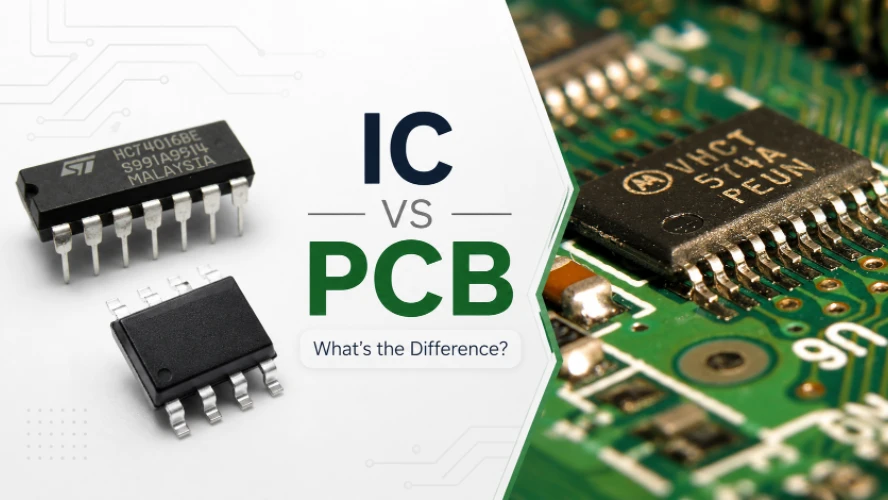
Figure 1. IC vs PCB comparison showing the chip and the board as different design levels.
An IC (integrated circuit) is a tiny semiconductor chip that contains thousands to billions of electronic components in one package, while a PCB (printed circuit board) is the rigid or flexible board that physically holds components and connects them with copper traces. In short, the IC does the computing or signal processing; the PCB is the platform that powers, connects, and supports the IC and everything around it.
Key takeaways
- An IC is a component; a PCB is the board that components are mounted on.
- The phrase “integrated circuit board” usually means a PCB populated with ICs — they are not the same thing.
- A working product almost always needs both: ICs for function, a PCB for interconnection and support.
- The IC package you choose directly determines the PCB footprint, assembly method, and inspection needs.
Table of Contents
IC vs PCB: What Is the Difference?
The confusion between an IC and a PCB is understandable, because you rarely see one without the other. But they sit at different levels of the electronics hierarchy. An integrated circuit is a single packaged component. A printed circuit board is the structure that holds many such components and wires them together into a functioning circuit.
A useful analogy is a building. The ICs are the appliances and machinery — they do the actual work. The PCB is the building’s wiring, plumbing, and framework that delivers power to each machine and lets them communicate. Remove the appliances and the building is empty; remove the building and the appliances have nothing to plug into.
| Aspect | Integrated Circuit (IC) | Printed Circuit Board (PCB) |
|---|---|---|
| What it is | A single semiconductor component | A board that holds and connects components |
| Scale | Microscopic transistors inside one chip | Millimetres to hundreds of millimetres |
| Main job | Processing, switching, amplification, memory | Power distribution, interconnection, mechanical support |
| Made by | Semiconductor fabs (wafer fabrication) | PCB fabricators and assemblers |
| Replaceable? | Sometimes (if socketed); usually soldered | The board is the base; ICs mount onto it |
What Is an Integrated Circuit?
An integrated circuit, often called a chip or microchip, packs an entire electronic circuit onto a small piece of semiconductor material, almost always silicon. Inside the package, microscopic transistors, resistors, and capacitors are fabricated and interconnected to perform a specific function. The “ic chip meaning” people search for comes down to this: a self-contained circuit miniaturized into one component.
ICs range from simple logic gates to system-on-chip processors with billions of transistors. What they share is that the internal circuitry is sealed inside a package, and the only access points are the external pins or pads. Those pins are what the PCB connects to.
Common Categories of ICs
- Digital ICs: microcontrollers, microprocessors, memory, and logic devices that work with binary signals.
- Analog ICs: amplifiers, voltage regulators, and sensors that handle continuous signals.
- Mixed-signal ICs: devices such as data converters that bridge the analog and digital worlds.
- Power ICs: regulators and drivers that manage current and voltage for the rest of the system.
What Is a PCB and What Does It Do?
A printed circuit board is a laminate of insulating material, usually fiberglass-reinforced epoxy (FR-4), with one or more layers of copper etched into conductive paths. Those paths replace the bundles of hand-wired connections that early electronics relied on, giving every product a compact, repeatable, and mechanically stable interconnection system.
Beyond connecting parts, a PCB delivers regulated power to each device, manages heat, controls signal integrity through its stackup, and provides the rigid or flexible structure that the whole assembly is built around. The number of copper layers can run from one to sixty or more, which is what allows complex products to route thousands of connections in a small footprint.
What a PCB Provides
- Electrical interconnection: copper traces, planes, and vias link every component.
- Power and ground distribution: dedicated planes feed clean power to ICs.
- Mechanical support: components are anchored and protected.
- Signal and thermal management: controlled impedance and copper for heat spreading.
How ICs and PCBs Work Together
In a real product, the IC and PCB are partners. The PCB receives power from a connector or battery, regulates it, and routes it to each IC. Signals generated or processed by one IC travel across the board’s copper traces to other ICs, connectors, and components. Decoupling capacitors placed next to each chip stabilize its supply, and the board’s ground plane gives every device a common reference.
This is why the searched phrase “integrated circuit board” is best understood as a populated PCB: a board that has been assembled with its ICs and supporting parts. The board without chips is a bare PCB; the chips without a board cannot function. The assembly step is what turns the two into a working system, and it is the heart of what a turnkey PCB assembly service delivers.
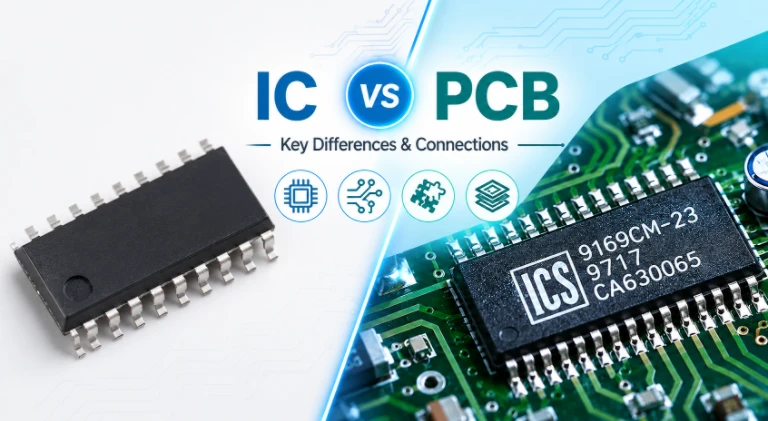
Figure 2. IC vs PCBA example showing how chips become part of an assembled board.
IC Package Types and Their PCB Footprints
An IC’s package is the bridge between the silicon and the board, and it dictates how the chip is mounted, routed, and inspected. Choosing a package is therefore as much a PCB decision as a circuit decision. Smaller, denser packages save board space but demand finer traces, tighter tolerances, and more advanced assembly and inspection.
| Package | Mounting | PCB impact | Inspection |
|---|---|---|---|
| DIP (through-hole) | Leads through drilled holes | Easy to route and hand-solder | Visual |
| SOIC / SOP | Surface-mount gull-wing leads | Compact, leads visible | AOI |
| QFP | Fine-pitch leads on four sides | Needs accurate paste and placement | AOI |
| QFN | Bottom-terminated, no leads | Thermal pad, tight tolerances | AOI + X-ray |
| BGA | Solder balls under the package | Hidden joints, may need microvias | X-ray required |
Because the joints under a QFN or BGA cannot be seen, boards using them often rely on a thorough manufacturability check and X-ray inspection during build. Dense fine-pitch devices frequently push a design toward an HDI fabrication approach with microvias to fan out the signals.
Designing and Building a PCB for ICs
Turning a schematic full of ICs into a reliable product depends on getting three things right: the footprint, the sourcing, and the assembly. A footprint that does not match the datasheet leads to shorts, opens, or reversed parts. An IC that is hard to source or end-of-life can stall the whole build. And a package that the assembly line cannot place or inspect accurately undermines yield.
This is where a manufacturing partner adds value before any board is built. For prototypes and short runs, a low-volume assembly service can validate footprints and sourcing cheaply, while complex multilayer designs benefit from a high-layer-count board capability. Products with demanding thermal or power ICs may move to a metal-core assembly, and embedded control systems such as those in robotics and automation boards often combine several IC types on one assembly.
Checklist Before You Build
- Verify footprints against the IC datasheet, including pin one, polarity, and thermal pads.
- Confirm sourcing with exact part numbers, lifecycle status, and approved alternates.
- Match the assembly method to the package — reflow for fine-pitch SMT, selective or wave for through-hole.
- Plan inspection so hidden joints under BGAs and QFNs are covered by X-ray.
Handling fabrication and assembly together — the model behind a single EMS provider — keeps the board and its ICs in sync from design data through final test, which is the most dependable way to ship a working integrated circuit board.
Examples of ICs and PCBs in Everyday Devices
The clearest way to understand the IC versus PCB relationship is to look at products people use every day. In each one, the integrated circuits do the computing or signal work, while the printed circuit board holds them, connects them, and feeds them power. Neither part is the whole device on its own.
Key everyday examples
- Smartphone: a processor and memory ICs sit on a compact multilayer board.
- Laptop motherboard: a large PCB carries the CPU, chipset, and power ICs.
- Microcontroller board: one MCU chip runs on a small, low-cost board.
- USB power adapter: a controller IC and passive parts share a tiny board.
- LED driver: a driver IC on an aluminum board sets the current.
- Automotive ECU: rugged boards host control ICs in a sealed module.
Producing any of these means turning a verified design into a built board, which is the day-to-day work of our China-based factory, from the bare PCB through full component placement.
Everyday devices make the relationship concrete. A smartphone mainboard is a dense multilayer PCB carrying dozens of ICs — processor, memory, power management, and radio chips — all interconnected by its copper layers. A simple LED driver board is a small PCB with one driver IC and a few passives. Even a hobby microcontroller board is an IC mounted on a PCB that breaks its pins out to headers. In every case the IC supplies the intelligence while the PCB supplies the connections, power, and mechanical support.
Frequently Asked Questions
Is an IC the same as a PCB?
No. An IC is a single packaged semiconductor component that performs a function, while a PCB is the board that holds and electrically connects many components. A PCB can carry dozens of ICs along with resistors, capacitors, and connectors.
What does “integrated circuit board” mean?
It generally refers to a printed circuit board that has been populated with integrated circuits and other components — in other words, an assembled PCB. The term blends the two concepts, but technically the IC and the board are separate items.
Can a PCB work without any ICs?
Yes, simple boards can work with only passive components such as resistors, capacitors, connectors, and LEDs. However, most modern electronics rely on at least one IC to provide control, processing, or power management.
Why does the IC package matter for the PCB?
The package sets the footprint dimensions, the mounting method, the routing density, and the inspection requirements. A fine-pitch BGA, for example, may require microvias, controlled fabrication tolerances, and X-ray inspection that a simple through-hole chip does not.
Are ICs and PCBs made in the same factory?
Usually not. ICs are produced in semiconductor wafer fabs through a completely different process, while PCBs are fabricated and assembled by board manufacturers. A PCB factory sources finished ICs and mounts them onto the board.
How do I make sure my ICs are placed correctly on the board?
Start with verified footprints and clear assembly drawings that mark pin one and polarity, use accurate pick-and-place data, and inspect with AOI and X-ray where joints are hidden. A pre-build manufacturability review catches most footprint and orientation problems early.
Can one supplier handle both the board and the IC assembly?
Yes. A turnkey provider fabricates the bare board, sources the ICs and other parts, assembles them, and tests the finished product, which keeps the design data consistent across every step.
Can a PCB work without any ICs?
Yes. Many simple boards carry only passive parts such as resistors, capacitors, connectors, and LEDs, with no integrated circuits at all. ICs add processing or control, but a PCB’s core job of interconnecting components does not require them.

Recommended Posts
TMM4 Filter PCB Manufacturing
TMM4 filter PCB manufacturing is controlled by the...
TMM3 PCB Manufacturing for RF Modules
TMM3 PCB manufacturing is most useful where the RF module...
TMM6 PCB Fabrication
TMM6 fabrication is the process-control page for a mid-Dk...
TMM10 PCB Manufacturing for Compact RF Designs
Table of contentsHow TMM10 Shrinks RF StructuresTMM10 vs...
How to get a quote for PCBs
Let‘s run DFM/DFA analysis for you and get back to you with a report. You can upload your files securely through our website. We require the following information in order to give you a quote:
-
- Gerber, ODB++, or .pcb, spec.
- BOM list if you require assembly
- Quantity
- Turn time
For PCBA services, please provide your BOM (Bill of Materials) and any specific assembly instructions. We also offer DFM/DFA analysis to optimize your designs for manufacturability and assembly, ensuring a smooth production process.