
IPC-A-610 Standard for PCB Assembly Acceptance

Figure 1. IPC-A-610 PCB assembly acceptance standard
IPC-A-610, titled Acceptability of Electronic Assemblies, is the most widely used standard for judging whether a finished, populated circuit board is acceptable. It provides illustrated visual criteria for solder joints, component placement, hole fill, lead protrusion, cleanliness, and marking, sorted into three performance classes. Unlike a process standard, it focuses on the finished result, giving engineers, operators, and inspectors a common language for what a good assembly looks like. The current revision is IPC-A-610J, published in 2024.
Key takeaways
- IPC-A-610 sets visual acceptance criteria for the assembled board, not the manufacturing process.
- It defines three classes; a condition that is a defect in a lower class is a defect in higher classes too.
- Conditions are judged as Acceptable, Process Indicator, and Defect Conditions; the former Target condition was removed in recent revisions.
- It pairs with J-STD-001 (how to build), IPC-A-600 (bare board), and IPC/WHMA-A-620 (cable and wire harness).
- State the revision and class on your order, for example “IPC-A-610J Class 2”, since criteria differ between revisions.
Table of Contents
- What Is IPC-A-610?
- IPC-A-610 Companion Standards (J-STD-001 and IPC-A-600)
- IPC-A-610 Acceptance Classes (1, 2, and 3)
- Acceptable, Process Indicator, and Defect Conditions
- What IPC-A-610 Inspects on an Assembly
- IPC-A-610 Solder-Joint Acceptance Criteria
- IPC-A-610 Certification: CIS and CIT
- What IPC-A-610 Does Not Cover
- How to Specify IPC-A-610 on an Order
- Frequently Asked Questions
What Is IPC-A-610?
IPC-A-610 is an acceptance standard for the assembled product. It answers a single practical question: looking at this finished board, is the workmanship acceptable? It does this with clear photographs and written criteria for acceptable, non-conforming, and defective conditions.
Outcome, not process
The crucial distinction is that IPC-A-610 judges the outcome, not how the board was built. The process, how the soldering is actually performed, is governed by a different document. This is why the two are used together: one tells the line how to build, the other tells the inspector how to judge the result. Treating IPC-A-610 as a build instruction is a common mistake; it is an inspection standard.
Why it is so widely used
Because it gives a shared, illustrated vocabulary, IPC-A-610 lets a buyer in one country and a factory in another agree on what “good” means without long arguments. That common standard is fundamental to dependable PCB assembly, and it scales from a single prototype up to large production runs.
IPC-A-610 Companion Standards (J-STD-001 and IPC-A-600)
IPC-A-610 is part of a family, and knowing which document does what prevents citing the wrong one.
| Standard | Role |
|---|---|
| IPC-A-610 | Acceptability of the assembled board (the subject here) |
| IPC J-STD-001 | Soldering process requirements, how to build the assembly |
| IPC-A-600 | Acceptability of the bare board, before assembly |
| IPC/WHMA-A-620 | Acceptability of cable and wire-harness assemblies |
A complete quality specification often references several of these, IPC-A-600 for the bare board from PCB manufacturing, J-STD-001 for the soldering process, and IPC-A-610 for the finished assembly. Each owns a different stage, so naming the right one for the right stage keeps the requirement meaningful.
IPC-A-610 Acceptance Classes (1, 2, and 3)
As with other IPC standards, the performance class sets how strict the criteria are, based on the consequences of failure.
| Class | Typical products | Emphasis |
|---|---|---|
| Class 1 | General consumer items, short-life products | Function; cosmetics secondary |
| Class 2 | Most commercial and industrial electronics | Reliable performance and extended life |
| Class 3 | Medical, aerospace, automotive safety, high-reliability | Continued performance where failure is unacceptable |
The same escalation rule applies: a defect at a lower class remains a defect at a higher class. Pick the class from the application. A consumer gadget built to Class 3 wastes money, while a life-supporting device built to Class 1 is a serious risk. Most commercial products are Class 2, and high-reliability work, often paired with rugged constructions such as metal-core assemblies, uses Class 3.
Acceptable, Process Indicator, and Defect Conditions
IPC-A-610 sorts every observed condition into categories that tell you what to do about it.
- Acceptable. The condition meets the requirements for the class; no action needed.
- Process indicator. The condition does not affect form, fit, or function, but suggests the process could be improved. It is not a defect and does not require rework.
- Defect. The condition fails to meet requirements for the class and must be addressed.
Recent revisions of the standard removed the former “Target” condition, which described an ideal rather than a requirement, leaving these three working categories. Understanding the difference between a process indicator and a defect prevents two opposite errors: reworking boards that are actually fine, and shipping boards that are actually defective. The category, judged against the specified class, is what decides the outcome.
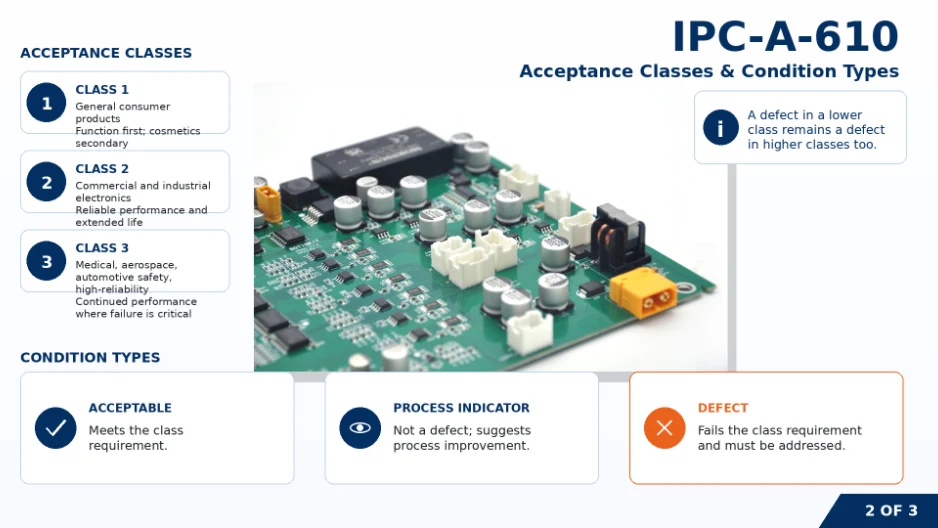
Figure 2. IPC-A-610 acceptance classes and condition types
What IPC-A-610 Inspects on an Assembly
IPC-A-610 covers the full range of what can be seen on an assembled board.
| Area | Examples of what is judged |
|---|---|
| Solder joints | Fillet shape, wetting, bridging, excess or insufficient solder, voids |
| Component placement | Orientation, alignment, and spacing on the board |
| Through-hole | Hole fill and lead protrusion |
| Cleanliness | Residues and contamination on the finished board |
| Marking and damage | Legible marking, mechanical and laminate damage |
The standard also addresses anomalies such as dewetting, excess solder, and bridging, and it has expanded over revisions to cover newer surface-mount component types. It does not, however, authorize rework or repair or include cross-section evaluation, those belong to other documents. Its scope is judging the visible quality of the assembly.
IPC-A-610 Solder-Joint Acceptance Criteria
Solder joints are the heart of the standard, and a few principles capture most of what it requires.
Wetting and fillet
An acceptable joint shows good wetting, the solder has flowed onto and bonded to the metal, forming a smooth fillet rather than a ball sitting on the surface. Poor wetting, dewetting, or a non-wetting condition are flagged because they indicate a weak or unreliable joint.
Hole fill for through-hole
For plated through-hole joints, the standard sets a minimum vertical fill of the hole with solder, with the exact figure depending on the class. Higher classes demand more complete fill because a partially filled barrel is a weaker, less reliable connection. The criteria balance reliability against what is realistically achievable in production.
Hidden joints
Some modern joints cannot be judged by eye at all, BGA balls and bottom-terminated parts sit under the component. For these, visual inspection is supplemented by X-ray, the same approach a production line uses for fine-pitch and ball-grid parts, especially on the dense boards associated with high-speed manufacturing.
IPC-A-610 Certification: CIS and CIT
IPC-A-610 is also a training and certification program, which is part of why it is so consistent across the industry.
- CIS (Certified IPC Specialist). Operators and inspectors trained and certified to apply the standard’s criteria.
- CIT (Certified IPC Trainer). Trainers certified to teach the standard and certify specialists.
When a supplier’s staff are certified to the current revision, a buyer can trust that “Class 2 acceptable” means the same thing on the line as it does in the specification. Asking which revision a partner is certified to is a reasonable question, because criteria can change between revisions. Consistent application of the standard is what keeps quality steady from prototypes through high-volume assembly.
What IPC-A-610 Does Not Cover
Knowing the standard’s limits is as useful as knowing its scope, because several common misunderstandings come from expecting it to do things it does not.
- It does not authorize rework or repair. Whether a defect is reworked or repaired is a separate decision between supplier and customer.
- It does not include cross-section evaluation. Microsection is covered by test methods and bare-board standards, not by IPC-A-610.
- It is not a design standard. Design rules live in documents such as IPC-2221.
- It is not a soldering process standard. How the assembly is built is governed by J-STD-001.
- It does not replace electrical test. A board can be visually acceptable and still need in-circuit or functional testing.
Seen this way, IPC-A-610 is one piece of a larger quality system: it judges visible workmanship, while other documents and tests cover the process, the bare board, the design, and electrical function. A capable partner applies it alongside the right companions during board assembly and bare-board fabrication.
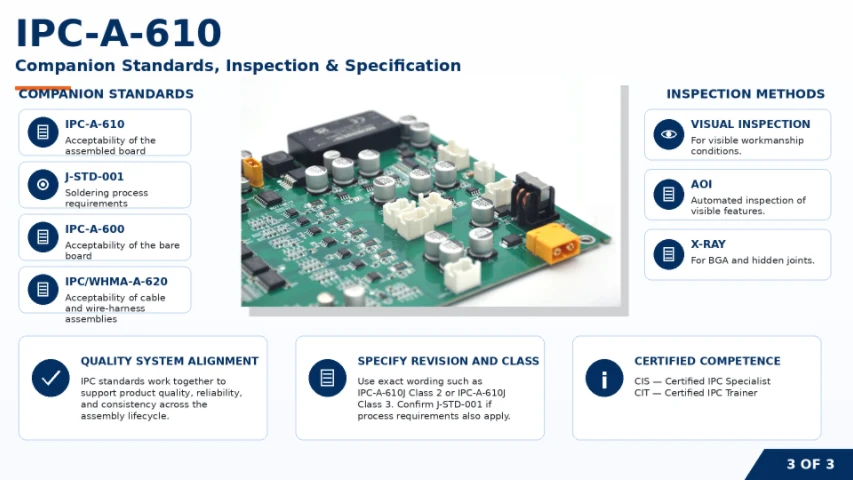
Figure 3. IPC-A-610 companion standards inspection and specification
How to Specify IPC-A-610 on an Order
To get the result you expect, invoke the standard precisely.
- State the revision and class. Write it out, for example “IPC-A-610J Class 3”, since acceptance criteria differ between revisions.
- Confirm the soldering standard. If the process matters to you, also reference J-STD-001 to the same class.
- Agree on inspection methods. Decide where AOI and X-ray apply, especially for BGA and fine-pitch parts.
- Define documentation. Specify whether you need inspection records, photos, or reports.
- Resolve conflicts early. A design review before the build catches features that would be hard to inspect or assemble to your class.
That early review is where a design-for-manufacturing check pays off, confirming the assembly can actually be built and inspected to the class you specified before the order is committed. If you are unsure which class fits, that conversation is the right place to decide.
Get an IPC-Class Assembly Quote
IPC-A-610 gives the industry a shared, illustrated definition of an acceptable assembly, judged by class and condition. Name the revision and class, pair it with the right companion standards, and confirm your partner is certified to apply it. You can read more about Highleap Electronics and how we build and inspect assemblies to IPC criteria.
Frequently Asked Questions
What is IPC-A-610 used for?
It is the standard for judging the acceptability of a finished, assembled circuit board, covering solder joints, component placement, hole fill, lead protrusion, cleanliness, and marking. It gives inspectors and manufacturers a shared, illustrated definition of acceptable workmanship across three performance classes.
What is the current revision of IPC-A-610?
IPC-A-610J, published in 2024, is current; it supersedes Revision H from 2020. There is no Revision I, the letter was skipped to avoid confusion with the number one. Because criteria can change between revisions, state the revision you require on your order.
How is IPC-A-610 different from J-STD-001?
IPC-A-610 judges the finished assembly (the outcome), while J-STD-001 specifies the soldering process requirements (how to build it). They are companion standards, so a thorough specification may reference both to the same class, one for the process and one for the acceptance of the result.
What do Acceptable, Process Indicator, and Defect mean?
Acceptable meets the class requirements. A process indicator does not affect form, fit, or function but suggests the process could improve, and is not a defect. A defect fails the requirements and must be addressed. Recent revisions removed the former Target condition.
How do I choose between Class 1, 2, and 3?
Choose by the consequences of failure. Class 1 suits general consumer products, Class 2 most commercial and industrial electronics, and Class 3 high-reliability products like medical and aerospace. Over-specifying adds cost; under-specifying adds risk. Most commercial work is Class 2.
Does IPC-A-610 cover hidden joints like BGA?
It sets criteria for assemblies including ball-grid and bottom-terminated parts, but those joints sit under the component and cannot be judged by eye. Visual inspection is therefore supplemented by X-ray, just as a production line does for fine-pitch and BGA devices.
How should I reference IPC-A-610 on my drawing?
State the document, revision, and class together, for example “IPC-A-610J Class 2”, reference J-STD-001 if the process matters, agree where AOI and X-ray apply, and define the documentation you need. Confirm your supplier’s staff are certified to the revision you require.
Does a board passing IPC-A-610 mean it works electrically?
No. IPC-A-610 judges visible workmanship, solder joints, placement, and cleanliness, not electrical function. A board can be visually acceptable and still fail an in-circuit or functional test. Acceptance to IPC-A-610 and electrical testing are complementary, and high-reliability builds use both.

Recommended Posts
TMM6 Filter PCB Manufacturing
Table of contentsWhy Microwave Filter Designers Use...
TMM4 Filter PCB Manufacturing
TMM4 filter PCB manufacturing is controlled by the...
TMM3 PCB Manufacturing for RF Modules
TMM3 PCB manufacturing is most useful where the RF module...
TMM6 PCB Fabrication
TMM6 fabrication is the process-control page for a mid-Dk...
How to get a quote for PCBs
Let‘s run DFM/DFA analysis for you and get back to you with a report. You can upload your files securely through our website. We require the following information in order to give you a quote:
-
- Gerber, ODB++, or .pcb, spec.
- BOM list if you require assembly
- Quantity
- Turn time
For PCBA services, please provide your BOM (Bill of Materials) and any specific assembly instructions. We also offer DFM/DFA analysis to optimize your designs for manufacturability and assembly, ensuring a smooth production process.