
NAS Server PCB Fabrication Services

Figure 1. NAS server PCB Fabrication
Highleap Electronics fabricates NAS server PCBs across the full NAS appliance market — from consumer and prosumer 2/4/6/8-bay NAS controllers (ARM SoC mainboards with fanless thermal design and SATA/M.2 NVMe backplanes), through SMB and office NAS appliances (8/10/12-bay x86 mainboards with 2.5GbE and 10GbE network integration), to enterprise filer-class NAS systems (dual-controller 12/16-bay mainboards with PCIe Gen5, 25/100GbE network interfaces, NVMe cache backplanes, and hot-swap controller pairs). We build for NAS appliance OEMs and ODM partners serving Synology-class, QNAP-class, ASUSTOR-class, TerraMaster-class, ReadyNAS-class, and enterprise filer markets, with cost-optimized fabrication appropriate to the high-volume consumer end of the market and full quality-system support for enterprise NAS programs.
Table of Contents
- How NAS Appliance PCB Fabrication Differs from General Storage Servers
- Consumer & Prosumer NAS Controller Mainboard Builds
- SMB & Office NAS Appliance PCB Fabrication
- Enterprise Filer-Class NAS PCB Fabrication
- Drive Backplane Fabrication — SATA, M.2 NVMe, U.2, EDSFF
- Network Interface Integration — 2.5GbE, 10GbE, 25GbE, 100GbE
- Volume Production, Cost-Down & Supply Chain Discipline for NAS OEMs
- Engaging Highleap on Your NAS Appliance Program
1. How NAS Appliance PCB Fabrication Differs from General Storage Servers
NAS appliances are not just smaller versions of enterprise storage servers. The NAS market has its own volume, cost structure, environmental requirements, and engineering priorities — and the PCBs inside NAS appliances reflect those differences. A PCB fabricator serving NAS OEMs needs to understand the market segmentation to make appropriate fabrication and cost decisions. Our broader server PCB manufacturing capability covers the full server-class portfolio; NAS programs draw on the same fabrication line but with cost structures matched to the consumer/SMB volume profile.
Volume and cost structure differences
- Consumer NAS volume: top consumer NAS OEMs ship hundreds of thousands of units per year per model; PCB cost-down pressure is intense.
- SMB NAS volume: tens of thousands of units per model per year; less aggressive cost-down but high quality bar for office environments.
- Enterprise NAS volume: thousands of units per model per year; quality and reliability dominate cost.
- BOM cost share: PCB is a meaningful percentage of consumer NAS BOM cost; near-negligible percentage of enterprise NAS BOM.
Environmental and reliability differences
- Consumer NAS environment: home or small office, 0–35°C ambient, intermittent operation patterns, 5-7 year service life expectation.
- SMB NAS environment: office closet or server room, 0–40°C, 24/7 operation, 5-7 year service life with field replacement.
- Enterprise NAS environment: data center, controlled 18-27°C, 24/7 operation under heavy load, 7-10 year service life with maintenance contracts.
- Implication for PCB: consumer NAS uses standard FR4 with cost-optimized stackups; enterprise NAS uses higher-Tg materials with IPC Class 2-3 acceptance.
Form factor and thermal differences
- Consumer NAS: compact desktop chassis with limited airflow; fanless thermal design preferred at low end; quiet single-fan designs typical.
- SMB NAS: small rack-mount (1U/2U) or compact tower; multiple fans for higher drive count.
- Enterprise NAS: standard 19″ rack-mount chassis (2U-4U); full server-class cooling.
- PCB thermal design impact: fanless consumer NAS PCBs need thermal vias under CPU and heat-spreader copper layers; rack-mount NAS PCBs follow standard server thermal practice.
Software/firmware ecosystem considerations
Consumer and SMB NAS OEMs typically ship their own custom Linux distribution with a polished web GUI — Synology DSM, QNAP QTS, ASUSTOR ADM, TerraMaster TOS, ReadyNAS OS. Enterprise NAS systems run more diverse stacks: NetApp ONTAP, Dell PowerStore, custom OEM software, or pure-software NAS on top of generic hardware. The software ecosystem affects PCB hardware support requirements — BMC features, sensor exposure, GPIO connections, and so on — but the PCB fabrication problem doesn’t change much based on software stack.
2. Consumer & Prosumer NAS Controller Mainboard Builds
Consumer and prosumer NAS controllers dominate the unit-volume side of the NAS market. The dominant architecture is an ARM SoC mainboard with 2-8 drive bays, fanless or single-fan thermal design, 1GbE or 2.5GbE network interface, and aggressive cost optimization.
ARM SoC mainboard fabrication
- Common SoCs: Marvell Armada, Realtek RTD, Annapurna Labs AL314/AL514, Rockchip RK3588, custom SoCs from major NAS OEMs.
- Layer count: 4-6 layers typical for consumer NAS controllers; 6-8 layers for prosumer with 10GbE or NVMe cache.
- Memory: typically 1-8 GB DDR4 soldered on the mainboard.
- Form factor: custom sized to NAS chassis — typically 100-200 mm × 120-180 mm depending on bay count.
- Material: standard FR4 PCB material (IS410 or equivalent) — cost-optimized for high volume.
- Surface finish: immersion silver or OSP for cost; ENIG only where required by component placement.
2-bay and 4-bay consumer NAS mainboards
- Drive interface: SATA III (6 Gb/s) per bay; chipset SATA or discrete SATA controller.
- Network: 1GbE standard; 2.5GbE on newer mid-range models.
- USB ports: 2-4 USB 3.x ports for external drive and peripheral support.
- HDMI output: some consumer NAS support direct video output for media server use cases.
- PCB area: small (typically 150 × 130 mm); high panel utilization for cost.
- Annual volume: 100,000+ units per model on top sellers — consumer NAS controllers ship under cost-down rhythms similar to other consumer electronics PCB programs.
6-bay and 8-bay prosumer NAS mainboards
- Higher-performance SoC: typically 6-8 core ARM or low-end x86 (Intel Atom, Intel Celeron J-series).
- Memory: 4-16 GB DDR4; some support DIMM expansion.
- Drive interface: SATA III + optional M.2 NVMe cache slots.
- Network: 2.5GbE standard, 10GbE on high-end prosumer.
- Expansion: some prosumer NAS include PCIe Gen3 slot for NIC, M.2, or other expansion.
- Material: 370HR or IS410 for thermal reliability under sustained workload.
Fanless prosumer NAS construction
- Thermal design: heat-spreader baseplate; PCB must support thermal via array under CPU and chipset.
- Conformal coating: not typical for indoor consumer/prosumer NAS but offered on some marine or recreational-vehicle NAS variants.
- Wide-temperature operation: not typical; consumer NAS targets standard indoor temperature ranges.
- Quiet operation: PCB design avoids switching noise paths that could couple into audio output (for NAS used as media servers).
NAS-specific I/O
- Front-panel LED control: drive status, network activity, power state — driven by SoC GPIO or dedicated controller.
- LCD displays: some prosumer NAS include small LCD for system status; SPI or I2C interface.
- Power management: sleep/wake support with low-quiescent power rails for residential use.
- UPS communication: USB or RS-232 port for UPS integration; standard on most NAS appliances.
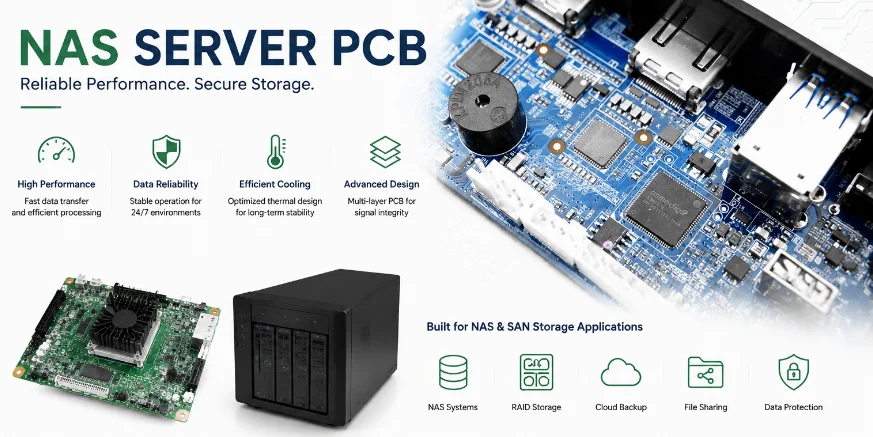
Figure 2. NAS server PCB
3. SMB & Office NAS Appliance PCB Fabrication
SMB NAS appliances bridge consumer pricing and enterprise capability. They serve workgroups of 10-100 users in office environments, often with hybrid cloud integration, backup appliance integration, and surveillance NVR functionality alongside primary file service.
x86 SMB NAS controller fabrication
- CPU options: Intel Atom C-series, Intel Xeon-D, AMD Ryzen Embedded.
- Memory: DDR4 DIMM slots; typically 16-64 GB capacity.
- Drive interface: 8-12 SATA ports via PCH or SAS HBA; some support SAS dual-port enterprise drives.
- Network: 2× 2.5GbE or 1× 10GbE standard; 10GbE+25GbE on higher-end SMB.
- Layer count: 8-12 layers.
- Material: 370HR or FR408HR; the choice depends on PCIe Gen4 vs Gen3 design.
1U and 2U rack-mount SMB NAS
- 1U NAS: 4-bay 3.5″ or 8-bay 2.5″ drive configurations with shallow-depth options for office wiring closets.
- 2U NAS: 8/12-bay 3.5″ configurations; standard depth for IT rack deployment.
- Mainboard layout: constrained by drive backplane mounting position and PSU placement.
- Cooling: redundant or N+1 fans; PCB hosts fan controller and tachometer monitoring.
Office tower SMB NAS
- Form factor: larger desktop chassis with 8-16 bay capacity.
- Operating environment: office floor or under desk; lower noise requirement than rack-mount.
- Volume: moderate; total SMB tower NAS unit volumes lower than rack-mount.
Surveillance NVR-integrated NAS
- Use case: file storage plus integrated video recording from IP cameras (often 16-64 channels).
- PCB additions: PoE PSE for camera power (if cameras connected directly), hardware video decode acceleration support, dedicated video storage scheduling.
- Network: separate camera network port from main data network on some designs.
Backup appliance NAS fabrication
- Dedupe/compression acceleration: some backup-focused NAS include FPGA or ASIC acceleration for inline dedupe.
- Cloud integration: typically nothing special on PCB; software-driven.
- Tape library connection: some larger backup appliances integrate with LTO tape libraries via SAS HBA expansion.
4. Enterprise Filer-Class NAS PCB Fabrication
Enterprise filer-class NAS — NetApp FAS series, Dell PowerStore (NAS configurations), HPE Nimble (NAS variants), Pure Storage FlashArray with NAS protocols, custom OEM filers — is a different product category. Built for 7-10 year service life under continuous heavy load, supporting petabytes of data, with dual-controller active/active architectures and enterprise-class network interfaces.
Dual-controller filer mainboard fabrication
- Architecture: two complete controllers in the same chassis with shared backplane access; failover and load-balancing within the array.
- Per-controller layer count: 14-20 layers.
- Inter-controller link: PCIe Gen4/Gen5 NTB (non-transparent bridge) or proprietary fabric for cache mirroring and failover state.
- Shared backplane: both controllers reach all drives via redundant SAS or NVMe paths.
- Cache backup: NVDIMM, BBU, or supercapacitor-backed DRAM for cache preservation on power failure.
- IPC Class 3: acceptance standard for enterprise filer controllers.
Enterprise CPU and memory subsystem
- CPU: dual-socket Xeon Scalable or EPYC; typically mid-range SKUs balancing core count and memory channels.
- Memory: 256 GB-2 TB per controller; ECC DDR5; some products use NVDIMM-N for protected cache.
- PCIe Gen5 slots: for high-bandwidth NIC, NVMe drive expansion, and SAS HBA.
- Per-controller layer count: 14-20 layers on dual-socket enterprise NAS mainboards built on our multilayer PCB line.
Hot-swap controller pair design
- Service-friendly architecture: failed controller can be pulled and replaced while partner controller continues serving data.
- Hot-swap connector: precision blind-mate connector mating controller PCB to backplane.
- Connector launch impedance: controlled-impedance launches for high-speed signals crossing the hot-swap interface.
- Power sequencing: hot-swap controller IC manages power-up and power-down sequencing for safe insertion/removal.
Enterprise NAS-specific PCB features
- Battery-backed cache (BBU) integration: lithium-ion battery pack mating connector and charge controller circuit.
- NVDIMM-N support: backed by supercapacitor and SLC NAND for protected cache; specific power-loss-protection signal routing.
- Out-of-band management: dedicated Ethernet for service processor; isolated from data network.
- Cluster interconnect: for scale-out filer architectures (NetApp Cluster Mode, etc.), high-bandwidth cluster network ports.
Hyperscaler cold-storage NAS appliance
A growing PCB application is custom NAS appliances built by hyperscaler ODM partners for internal cold-storage tiers — software-defined NAS running on commodity hardware with very high drive density (60-90 bays per chassis), low CPU footprint, and 100GbE network interfaces. These designs typically have moderate complexity PCBs (12-16 layers on mainboard, 8-12 layers on backplane) but ship at hyperscaler volume with aggressive cost-down pressure. AVL qualification for these programs follows hyperscaler-specific flows rather than enterprise OEM flows.
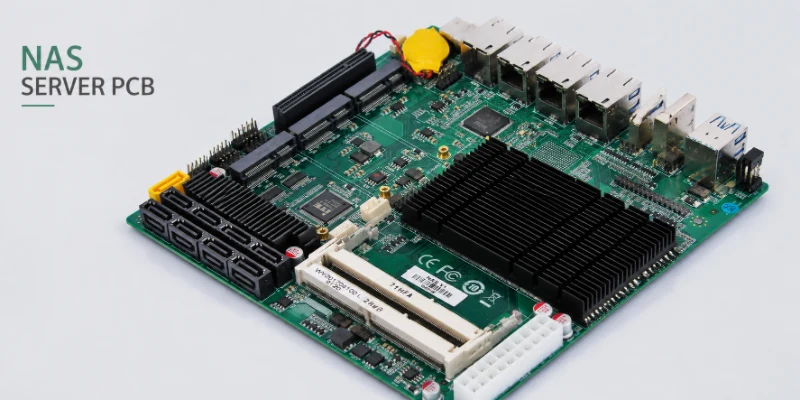
Figure 3. NAS Server PCBA
5. Drive Backplane Fabrication — SATA, M.2 NVMe, U.2, EDSFF
NAS appliances span the full range of drive interfaces from cost-optimized SATA to performance-optimized NVMe. Backplane PCB fabrication varies significantly by drive interface and bay count.
SATA backplane fabrication (consumer/SMB NAS)
- Drive interface: SATA III (6 Gb/s) per bay.
- Routing: standard FR4 acceptable; controlled impedance ±10% on differential pairs.
- Layer count: 4-6 layers depending on bay count and power routing.
- Hot-swap connector: standard SATA hot-swap connector (SAS/SATA universal in many designs).
- Power: 5V and 12V rails; current capacity sized for full bay population at startup.
- LED control: activity and fault LEDs per bay; multiplexed or dedicated GPIO control.
SAS backplane for SMB and enterprise NAS
- SAS-12 (12 Gb/s): dominant on enterprise NAS using SAS HDDs and SAS SSDs.
- SAS dual-port: for redundant controller access; backplane routes dual SAS lanes per bay.
- Layer count: 8-12 layers depending on bay count and routing complexity.
- SAS expander integration: for backplanes with more bays than direct controller SAS lanes; expander chip on backplane aggregates.
U.2/U.3 NVMe backplane fabrication
- PCIe Gen4 NVMe: 16 GT/s per lane; 4-lane drives standard.
- PCIe Gen5 NVMe: 32 GT/s per lane; emerging on enterprise NAS in 2024-2025.
- Layer count: 10-16 layers depending on bay count and Gen5 routing requirements.
- Material: I-Tera MT40 for Gen5; FR408HR for Gen4; 370HR for short channels.
- Back drilling: mandatory on Gen5 signal vias.
M.2 NVMe cache backplane (consumer/prosumer NAS)
- Use case: 1-4 M.2 NVMe drives acting as cache acceleration for SATA storage pool.
- Form factor: small daughter board or integrated into main controller PCB.
- PCIe routing: Gen3 or Gen4 depending on platform CPU; impedance ±10%.
- Thermal: M.2 NVMe drives generate heat; backplane often includes mounting features for heat-spreader.
E1.S / E3.S EDSFF backplane (high-density enterprise NAS)
- Emerging form factor: increasingly adopted in hyperscaler and enterprise NAS for higher drive density.
- E1.S thickness options: 5.9 mm, 9.5 mm, 15 mm, 25 mm.
- Routing density: higher than U.2 due to closer drive pitch.
- Layer count: 12-18 layers depending on density.
24-bay and 36-bay backplane fabrication
- Mainstream enterprise NAS chassis: 24-bay 4U and 36-bay 4U configurations dominate enterprise NAS.
- Backplane size: approximately 280 × 340 mm for 24-bay 3.5″ backplane.
- Power distribution: 12V and 5V rails sized for full population; heavy copper power planes.
- Expander placement: SAS expander chips placed for balanced routing across bays.
6. Network Interface Integration — 2.5GbE, 10GbE, 25GbE, 100GbE
NAS performance is increasingly bound by network bandwidth. PCB design for network interface integration spans 1GbE chip-on-board through 100GbE OSFP host boards on enterprise filers.
1GbE and 2.5GbE chip-on-board integration
- Common PHYs: Intel I210/I225/I226 (2.5GbE), Realtek RTL8125/RTL8126, Marvell AQR/AQC.
- Layout: integrated on consumer and SMB NAS mainboards directly.
- Magnetics: discrete magnetics modules or integrated-magnetics RJ45 connectors.
- Layer count impact: minimal; standard 2-layer differential pair routing.
10GbE integration
- 10GBASE-T: common on SMB and prosumer NAS; PHYs from Marvell (AQrate), Broadcom, Intel; significant power and thermal footprint.
- 10GBASE-SR/LR: SFP+ cage interface; common on enterprise NAS for fiber connectivity.
- Layout consideration: 10GBASE-T PHY generates significant heat; thermal vias and heat-spreader required.
- Material: 370HR acceptable for typical 10GbE routing distances.
25GbE integration
- SFP28 form factor: 25GBASE-SR or 25GBASE-CR (DAC) connectivity.
- PHY ICs: integrated in NIC chips (Mellanox/NVIDIA ConnectX-4 Lx, Intel E810, Broadcom).
- Signaling: 25.78 Gbps NRZ; FR408HR or I-Tera MT40 depending on trace length.
- Use case: enterprise NAS where 10GbE no longer sufficient.
100GbE integration on enterprise NAS
- QSFP28 form factor: 4×25G electrical interface to module.
- NIC carriers: typically via PCIe carrier card (Mellanox/NVIDIA ConnectX-5/6, Intel E810).
- OCP NIC 3.0: increasingly the form factor for hyperscaler NAS designs.
- PCB material: I-Tera MT40 or Tachyon 100G depending on channel length.
Multi-port NIC carrier fabrication
- Dual-port 10/25GbE NICs: standard PCIe Gen4 carriers.
- Dual-port 100GbE NICs: PCIe Gen4 ×16 cards.
- Quad-port 25GbE NICs: common on enterprise NAS for client and storage network combined.
- Front-bezel I/O: some NAS bring network ports to chassis front panel; cable assemblies and bezel boards required.
7. Volume Production, Cost-Down & Supply Chain Discipline for NAS OEMs
NAS appliance OEMs operate on different procurement rhythms than enterprise server or storage OEMs. Consumer products especially are subject to seasonal demand, retail channel inventory cycles, and aggressive year-over-year cost reduction expectations.
Consumer NAS production scheduling
- Seasonal patterns: Q4 retail-heavy buying; demand visibility 3-6 months out.
- Forecast variability: consumer demand harder to forecast than enterprise; supplier flexibility valuable.
- Lot size economics: larger lot sizes drive lower unit cost; OEMs balance inventory carrying cost vs unit cost.
- Annual cost-down expectations: 3-7% year-over-year cost reduction is typical; supplier engagement on cost initiatives is expected.
SMB NAS production patterns
- Steadier demand: less seasonal than consumer; channel distribution patterns drive production scheduling.
- Mid-range volumes: 10,000-50,000 units per year per model on top SMB products.
- Buffer stock value: SMB NAS OEMs benefit from buffer-stock programs at the PCB factory to manage demand variability without full inventory commitment.
Enterprise NAS production patterns
- Project-based demand: large enterprise NAS deals drive specific build campaigns.
- Long forecast horizon: 12-18 months visibility typical; enables forecast-based capacity reservation.
- Higher quality investment: environmental qualification, accelerated life testing, formal customer acceptance all justified by unit value.
Cost-down opportunities in NAS PCB fabrication
- Layer count reduction: consolidating routing through better stackup planning can drop a layer pair; PCB cost drops 15-20%.
- Material substitution: moving from 370HR to IS410 where thermal requirements allow saves 5-10%.
- Surface finish optimization: OSP over ENIG saves 10-15% where compatible with assembly process.
- Panel utilization improvement: design changes accommodating better array nesting improve panel yield.
- Tooling consolidation: sharing tooling across product family members reduces NRE amortization per unit.
Long-life NAS sustainment
NAS products often remain in production 3-5 years and remain in service much longer. Spare parts production typically continues 5-7 years beyond end-of-production. We support this with documented material substitutability paths, archived tooling and process records, and 7+ year retention of all design and quality data. For enterprise NAS programs with formal service-life commitments, dedicated spare-parts inventory programs are available.
8. Engaging Highleap on Your NAS Appliance Program
For NAS appliance OEMs and ODM partners evaluating PCB factory partners, our engagement model varies significantly by NAS product tier:
Consumer/prosumer NAS engagement
- Cost-driven proposal: aggressive panel utilization, optimized stackup, cost-appropriate surface finish.
- Prototype turnaround: 5-7 working days for 4-6 layer consumer NAS controller mainboards.
- Volume production: scheduled monthly deliveries with adjustable forecasts.
- Cost-down collaboration: annual cost-down workshops to identify fabrication efficiency improvements.
SMB NAS engagement
- Quality-cost balance: 370HR material baseline; IPC Class 2 acceptance standard.
- Prototype turnaround: 7-10 working days for 8-12 layer SMB NAS mainboards.
- Buffer stock support: finished-inventory buffer programs valuable for SMB OEMs with variable demand.
- Multi-board family: mainboard + backplane + NIC carrier coordinated under unified change control.
Enterprise NAS engagement
- Full AVL qualification flow: site audit, sample build, environmental qualification, customer acceptance.
- IPC Class 3 acceptance: standard for enterprise filer controller boards.
- Full quality documentation: CoC, mill cert, electrical test, impedance, microsection, AOI per delivery.
- Long-life sustainment: 7-10 year spare-parts production commitment with documented EOL management.
- Capacity reservation: firm capacity allocation against rolling forecast for production builds.
Highleap is ISO 9001 and IATF 16949 certified. We manufacture NAS PCBs from 2 layers (simple backplanes) to 20 layers (enterprise filer dual-controller mainboards), with HDI capability for compact prosumer NAS controllers, controlled impedance for high-speed NVMe and network interfaces, and the full range of PCB surface finish options (ENIG, immersion silver, OSP, lead-free HASL) matched to product cost and reliability requirements.
Submit Gerber files, drill data, stackup specification, target quantities, and program timeline through our online quote portal for a 24-hour response covering DFM feedback, material recommendation, and pricing. For complex NAS programs — multi-board family supply, hyperscaler ODM cold-storage NAS, enterprise filer dual-controller builds — our NAS appliance team can engage directly. For custom NAS board work outside standard appliance form factors, see our custom PCB manufacturing capability covering tailored mainboards across consumer, SMB, and enterprise NAS programs.

Recommended Posts
TMM4 Filter PCB Manufacturing
TMM4 filter PCB manufacturing is controlled by the...
TMM3 PCB Manufacturing for RF Modules
TMM3 PCB manufacturing is most useful where the RF module...
TMM6 PCB Fabrication
TMM6 fabrication is the process-control page for a mid-Dk...

TMM10 PCB Manufacturing for Compact RF Designs
Table of contentsHow TMM10 Shrinks RF StructuresTMM10 vs...
How to get a quote for PCBs
Let‘s run DFM/DFA analysis for you and get back to you with a report. You can upload your files securely through our website. We require the following information in order to give you a quote:
-
- Gerber, ODB++, or .pcb, spec.
- BOM list if you require assembly
- Quantity
- Turn time
For PCBA services, please provide your BOM (Bill of Materials) and any specific assembly instructions. We also offer DFM/DFA analysis to optimize your designs for manufacturability and assembly, ensuring a smooth production process.