
RO4450F Prepreg for Multilayer PCB Manufacturing
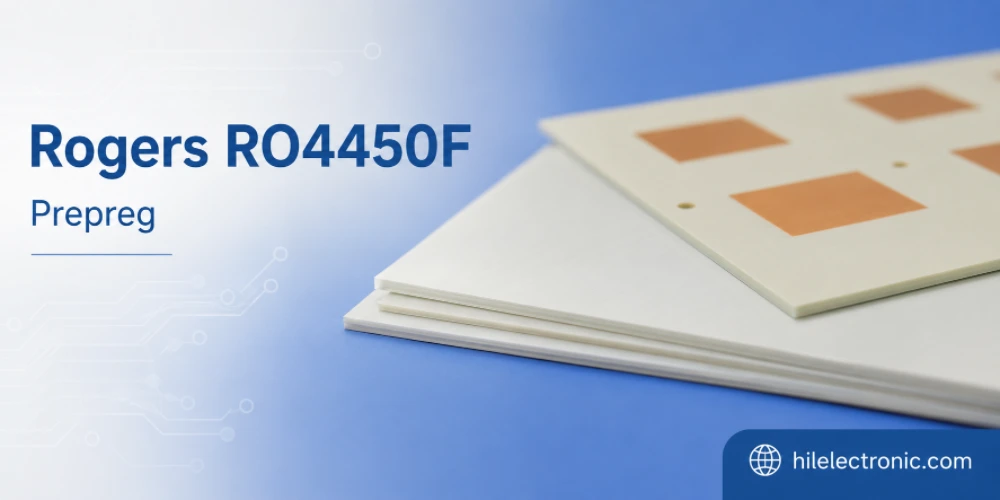
RO4450F is used as part of a multilayer bonding construction, so the fabrication target is the finished dielectric system rather than the bondply sheet alone. Its role should be defined by the released stackup and the adjacent core materials. “RO4450F prepreg” is not enough information to manufacture a multilayer RF board. The bonding result depends on the exact grade or approved successor, glass style, resin content, ply count, copper topography, press cycle and target cured spacing. Rogers’ current public bonding-material portfolio groups products under the RO4400/RO4400T family rather than presenting a standalone RO4450F entry, so the requested designation and current availability should be verified before quotation.
Highleap treats the bonding material as part of a complete construction. The stackup review must identify the cores being joined, the electrical spacing to protect, the resin volume needed to fill copper and the evidence that will release the press result. No grade replacement should be made without written customer approval and an updated model where the dielectric spacing is electrically significant.
RO4450F is handled here as part of a multilayer bonding construction. The prepreg cannot be specified independently from adjacent cores, copper and finished dielectric thickness; the lamination review therefore starts from the complete stackup and the target pressed construction.
RO4450F Is Part of the Bonding System, Not a Stand-Alone Laminate
In a multilayer RF board, copper-clad laminate provides the core circuit layers and a bondply or prepreg creates adhesion and dielectric spacing between subassemblies. RO4450F is selected as part of that system. The design must identify which cores are being bonded, whether the construction is all-Rogers or hybrid, and what electrical spacing the cured bond line must achieve.
Why the exact construction matters
Different glass styles and resin contents can press to different thicknesses and fill different copper patterns. One ply may be sufficient over light copper but starve around heavy or uneven topography. Multiple plies can increase thickness and change impedance. The correct construction is determined from copper area, copper thickness, cavity or cut-out features, pressure and material guidance.
Does nominal prepreg thickness equal cured thickness?
No universal equality should be assumed. The cured result depends on resin flow, copper distribution, pressure, temperature and the glass carrier. Use supplier construction data and fabricator experience to propose the stackup, then verify by microsection where the spacing is critical. The purchase drawing should state the approved construction or finished dielectric target and change-control rule.
Can RO4450F bond Rogers laminate to FR-4?
A hybrid build may be possible, but it must be qualified for material compatibility, cure, CTE, registration, drill process and warpage. It is not enough that the materials can physically adhere. The finished board must survive assembly and service. Highleap reviews the hybrid PCB lamination route before confirming a production stackup.
| Stackup item | Why it must be specified | Typical release evidence |
|---|---|---|
| Matching laminate | Defines Dk, thickness, copper and cure compatibility. | Exact grade and core thickness. |
| RO4450F construction | Glass style and resin determine flow and cured spacing. | Supplier construction code or approved ply definition. |
| Ply count | Controls resin volume and bond-line thickness. | Approved stackup and press calculation. |
| Copper distribution | Creates local resin demand and thickness variation. | CAM copper-density review. |
| Acceptance method | Turns “good lamination” into measurable criteria. | Microsection, impedance, thermal or void requirement. |
Design the Bond Line From Copper Geometry and Dielectric Spacing
The bond line must satisfy both mechanical and electrical requirements. It must wet the surfaces and encapsulate copper without voids or starvation. It must also create the dielectric spacing used in the RF and impedance models. Those goals can conflict: more resin can improve fill but change thickness; high pressure can reduce voids but move resin and alter registration.
Copper topography drives resin demand
Plane layers, sparse signal layers, thick copper and large clearances do not consume resin equally. A stackup that presses well on a uniform coupon may behave differently on a product panel with large copper-free areas. Highleap reviews copper percentage and local topography. Fill issues may be addressed by changing ply count, copper balancing, local design or press construction, subject to customer approval.
Cavities, cut-outs and local keep-outs
Openings can create flow paths or unsupported areas. If the product has a cavity, embedded metal, recessed component or exposed RF surface, the drawing must show the boundary and acceptable resin condition. RO4450F is not a “no-flow” material; normal resin movement must be considered. Tooling or stop-flow features may be required for special structures.
Impedance spacing
The field solver should use the approved cured construction. When the bond line is part of a stripline or broadside-coupled structure, tolerance can affect impedance and coupling. Highleap can propose trace dimensions from the manufacturable stackup, but the design owner should approve the electrical result. Review the Rogers PCB stackup process before freezing artwork around an unconfirmed prepreg thickness.
Glass style should appear in the release
If a specific glass style is required for thickness, fill or electrical performance, it should be controlled in the drawing or approved stackup. A broad note permitting any RO4450F construction can change the bond line and effective dielectric behaviour. If supply requires an alternative, the factory should return the revised construction for approval.
Material scope: This page concerns PCB fabrication using the specified Rogers material. Highleap Electronics manufactures the finished board and PCBA; laminate manufacturing and material sales are outside our service scope.
What Can Go Wrong During RO4450F Lamination
Defects should be discussed by mechanism. Voids can result from trapped gas, surface contamination or insufficient flow. Starvation can result from inadequate resin volume or excessive movement. Glass exposure can indicate insufficient resin at the interface. Delamination can involve contamination, incompatible cure, moisture or poor adhesion. Registration error can result from material movement or tooling.
| Defect | Likely contributors | Useful verification |
|---|---|---|
| Voids | Air entrapment, contamination, inadequate wetting or press profile. | Microsection, X-ray where suitable and process-record review. |
| Resin starvation | Insufficient resin, heavy copper, excessive flow or local topography. | Bond-line section and copper-encapsulation check. |
| Excessive bond-line variation | Copper-density imbalance, press distribution or construction mismatch. | Multiple-location thickness measurements. |
| Delamination | Surface condition, moisture, cure compatibility or thermal stress. | Microsection and defined thermal test. |
| Warpage | Asymmetric materials, copper imbalance or uneven shrinkage. | Finished bow/twist measurement after assembly-relevant exposure. |
Voids and resin starvation are different problems
A void is an unfilled space; starvation is inadequate resin volume or coverage at an interface. The corrective actions may differ. Increasing pressure may not solve a construction that lacks resin, and adding resin may not solve contamination. First-article sections should be reviewed against the actual mechanism rather than a generic “no voids” note.
Delamination can appear after assembly
A board can look acceptable after fabrication and separate during reflow or thermal cycling. Moisture, incomplete cure, material mismatch and local stress can contribute. The order should define any required preconditioning or thermal test. See the practical PCB delamination discussion when setting acceptance criteria.
Warpage affects both RF geometry and assembly
Hybrid material and asymmetric copper can bend the board. Warpage can change connector fit, BGA coplanarity and cavity dimensions. The design should balance materials and copper where possible, and the assembly team may need support fixtures. Review PCB warpage limits in relation to the final assembly, not only the bare board.
Qualifying a Hybrid Rogers Multilayer Before Production
A trial panel is justified when the stackup is new, the bond line is electrically critical, the copper is heavy or uneven, or the board combines materials with different movement. The trial should answer defined questions: cured thickness, voiding, adhesion, registration, impedance, thermal survival and warpage.
Microsection plan
Sections should pass through representative copper topography, plated holes and bond interfaces. One convenient location may not show the worst condition. The drawing or quality plan can identify sample locations and acceptance criteria for voids, glass exposure, resin fill, dielectric thickness and plating.
Thermal and reliability evidence
The required test depends on end use. It may include solder-float, reflow simulation, thermal stress, IST or customer-specific cycling. Highleap should not add an unrelated test only to make the report look comprehensive. The selected evidence should challenge the actual risk of the construction.
Impedance and RF correlation
If RO4450F forms a controlled dielectric, coupons should represent the same core, bond line and copper. Measured thickness from microsection can be correlated with impedance. For microwave structures, a dedicated resonator or S-parameter coupon may be more useful than TDR alone.
First-article assembly
When the board carries large BGA packages, connectors or shields, assembly can reveal warpage and thermal issues that the bare board does not. A PCBA first article can include solder inspection, X-ray, functional test and dimensional fit. Use a defined PCBA first-article inspection plan if the lamination and assembly risks interact.
RO4450F Procurement, Storage and RFQ Requirements
The buyer should provide exact material and construction, matching cores, stackup, copper, critical dielectric spacing, drill plan, finished thickness, surface finish, inspection and test requirements. Highleap confirms material availability and whether the project needs a trial lamination. A prototype date is offered only after stock and qualification steps are understood. Highleap’s lamination review focuses on resin distribution, layer registration and the final dielectric thickness after pressing. The process window needs to be set from the complete construction because a bondply choice cannot be separated from the neighboring cores and copper layers. Exact material property values should be checked against the current supplier documentation for the specified grade and construction.
- exact RO4450F construction or glass style and ply count;
- matching Rogers laminates and any FR-4 or other hybrid materials;
- finished stackup and target cured bond-line thickness;
- copper weights, copper distribution and cavity/cut-out details;
- impedance, RF coupon, microsection and thermal requirements;
- prototype and volume quantities, material certificate and traceability needs;
- BOM, centroid, assembly drawing and test data if PCBA is required.
Material storage and shelf-life requirements are handled according to supplier guidance and factory controls. The commercial quotation identifies material procurement, tooling, trial or inspection charges, fabrication, assembly, payment terms and shipping. International express can be used for many prototypes; volume shipments can use agreed courier or freight options.
After delivery, Highleap can review lamination or assembly concerns using material, press, inspection and lot records. Corrective action should be based on the observed defect and project specification. This provides more useful after-sales support than a broad promise that every hybrid board is verify without conditions.
The press traveler should be controlled as production data
For a qualified RO4450F stackup, material lot, layup orientation, ply count, press stages and inspection should be recorded under the factory process. The customer does not need proprietary machine settings, but repeat orders should use the same approved construction and controlled route. A change in glass style or ply count should trigger review.
Storage and preparation affect lamination consistency
Bonding materials should be stored and handled according to supplier guidance. Exposure history, packaging and preparation can affect processing. Highleap checks incoming identity and uses controlled handling for the quoted material. If customer-supplied material is used, its condition and traceability should be agreed before production.
Drilling begins after the hybrid stack is stable
Different materials can produce different drill wear and smear. Tool selection, hit count and desmear should match the final hybrid construction. Plated-hole microsection can verify interface condition and copper continuity. A good bond line alone does not is intended to support a reliable drilled interconnect.
Assembly qualification can expose hidden lamination stress
Reflow, selective soldering, press-fit and rework add thermal or mechanical strain. A trial panel may pass bare-board inspection and still warp or separate during assembly. Where risk is high, include an assembled first article or representative thermal exposure before volume release.
Commercial comparison needs the exact ply construction
Two RO4450F quotations can differ because they use different glass styles, ply counts, material yields or inspection. Ask suppliers to return the proposed stackup. A lower price based on less resin or a different bond line is not the same product. Highleap identifies these assumptions in the offer so procurement can evaluate technical and commercial differences together.
Bond-line thickness should be sampled at meaningful locations
A section through a uniform plane may not represent a dense signal area or large copper clearance. The quality plan can identify several locations that show worst-case resin demand. Highleap and the customer should agree whether acceptance is based on local minimum, average or a defined range.
Impedance compensation should follow the pressed result
If a trial lamination produces a stable bond line slightly different from the initial model, the preferred correction may be a controlled trace adjustment rather than forcing the press outside its stable window. The customer should approve the revised geometry. Manufacturing stability is usually more valuable than chasing a theoretical thickness through excessive pressure changes.
Hybrid material expansion needs registration margin
Different cores can move differently during lamination. Artwork scaling and tooling should account for the complete stack. Tight annular rings and cavity alignment may require a trial panel. Highleap reviews registration targets before accepting a design that leaves no allowance for material movement.
Repeat orders should reference the qualified stackup revision
The purchase order should reference the exact stackup and artwork approved during qualification. If a new laminate thickness, foil or RO4450F construction is proposed, the change is reviewed for thickness, fill, impedance and reliability. This prevents a repeat order from becoming an unplanned new build.
Assembly and box-level interfaces
Hybrid RF boards may mount into metal housings or carry connectors that load the board. Warpage and thickness affect fit. If Highleap provides assembly, housing drawings and connector specifications help plan fixtures and inspection. If the customer assembles elsewhere, these constraints should still be included in the bare-board RFQ.
Quality records and after-sales response
Highleap can retain material, press, microsection, electrical and assembly records within the agreed project scope. A reported delamination or dimensional issue is reviewed against those records and the returned sample. Corrective action is based on mechanism. This is the practical form of quality and after-sales assurance for a specialised bonding construction.
Material note: RO4450F is a Rogers bonding material. Always use the latest controlled product data and processing guidance for the exact construction; this article does not define a universal press cycle. For procurement, specify the bondply role, adjacent materials, target dielectric thickness, copper and layer count. This is enough to evaluate the lamination route and quote the finished multilayer PCB rather than a standalone bonding material.

Recommended Posts
TMM4 Filter PCB Manufacturing
TMM4 filter PCB manufacturing is controlled by the...
TMM3 PCB Manufacturing for RF Modules
TMM3 PCB manufacturing is most useful where the RF module...
TMM6 PCB Fabrication
TMM6 fabrication is the process-control page for a mid-Dk...

TMM10 PCB Manufacturing for Compact RF Designs
Table of contentsHow TMM10 Shrinks RF StructuresTMM10 vs...
How to get a quote for PCBs
Let’s run DFM/DFA analysis for you and get back to you with a report. You can upload your files securely through our website. We require the following information in order to give you a quote:
-
- Gerber, ODB++, or .pcb, spec.
- BOM list if you require assembly
- Quantity
- Turn time
For PCBA services, please provide your BOM (Bill of Materials) and any specific assembly instructions. We also offer DFM/DFA analysis to optimize your designs for manufacturability and assembly, ensuring a smooth production process.