
SMT PCB Assembly Process Explained
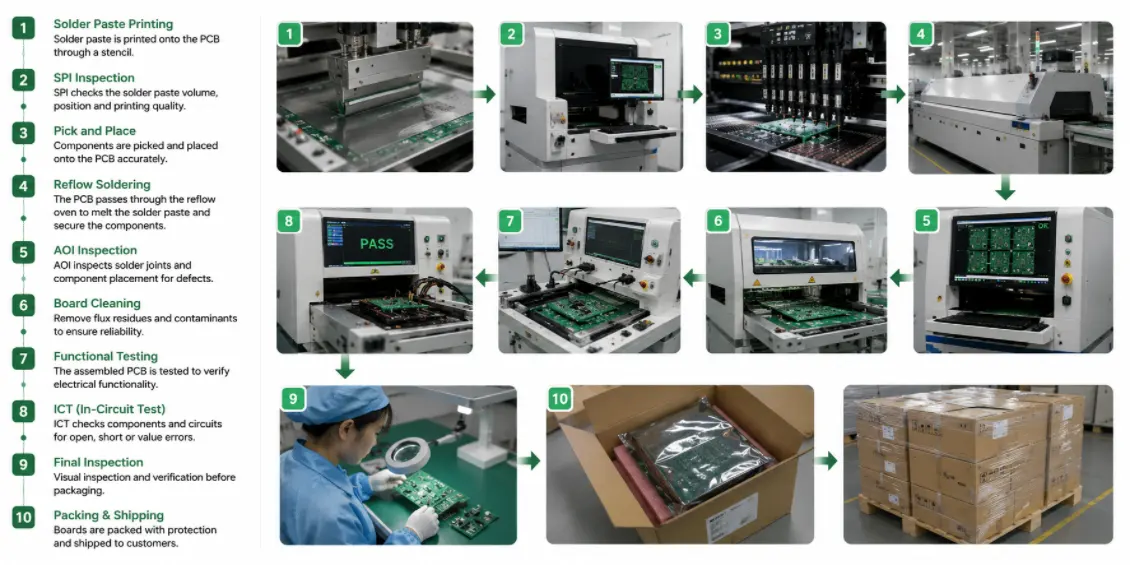
Figure 1. SMT PCB assembly process
SMT (surface-mount technology) is the dominant way modern circuit boards are assembled: components are placed directly onto pads on the board surface and soldered all at once in a reflow oven. It is what makes today’s small, dense, high-volume electronics possible. This guide explains what an SMT PCB is and how the assembly line works step by step, how surface-mount compares to through-hole, the common component packages, how to design a board that assembles cleanly, and how the finished boards are inspected and tested.
Key takeaways
- SMT places components on the board surface and solders them in a reflow oven, enabling small, dense, automated assembly.
- The line runs: solder-paste printing → paste inspection → pick-and-place → reflow → automated optical and X-ray inspection.
- SMT suits most modern parts; through-hole is still used for connectors and high-stress components, often on the same board (hybrid).
- Hidden-joint packages like QFN and BGA need X-ray inspection, since their connections sit underneath the part.
- Design-for-manufacturing details, footprints, paste apertures, fiducials, panelization, decide whether a board assembles cleanly.
Table of Contents
What SMT Means and Why It Dominates
In surface-mount technology, components have small terminals or leads that solder directly to pads on the surface of the board, rather than legs that pass through drilled holes. The board can carry parts on both sides, and the whole assembly is soldered in one pass through a reflow oven.
SMT dominates for concrete reasons. Surface-mount parts are far smaller than their through-hole equivalents, so boards are denser and more compact. The process is highly automated, which makes it fast, repeatable, and cost-effective at scale. And it supports the fine-pitch, high-pin-count packages that modern chips require. For almost all current electronics, SMT is the default, which is why an assembler’s core capability is its SMT line, the heart of PCB assembly.
The SMT Assembly Line, Step by Step
An SMT line is a sequence of machines, each doing one job and handing the board to the next. Understanding the flow makes the design rules later make sense.
1. Solder-paste printing
A stainless-steel stencil is aligned over the bare board, and solder paste, a mix of tiny solder particles and flux, is squeegeed through openings in the stencil onto the pads. The stencil apertures control exactly how much paste lands on each pad, and getting that amount right is the foundation of good joints.
2. Solder-paste inspection (SPI)
An automated system checks the printed paste, the volume, position, and shape on each pad, before any components go down. Catching a paste problem here is far cheaper than discovering a defect after reflow, so SPI is a key quality gate on fine-pitch work.
3. Pick-and-place
High-speed machines pick components from reels and trays and place them precisely onto the pasted pads, thousands of placements per hour. The paste’s tackiness holds each part in position until soldering. Placement accuracy is what allows tiny parts and fine-pitch chips to be assembled reliably.
4. Reflow soldering
The populated board travels through a reflow oven with a carefully controlled temperature profile, preheat, soak, a peak that melts the solder (for lead-free alloys, a peak around 245 °C), then cooling. The paste melts and forms the solder joints, then solidifies as the board cools. The thermal profile is tuned to the board and its parts, and demanding substrates need special attention, which is why thermally heavy boards are run with profiles suited to metal-core assembly.
5. Automated optical and X-ray inspection
After reflow, automated optical inspection (AOI) checks the visible joints and component placement with cameras. For packages whose connections sit underneath the body, such as QFN and BGA, X-ray inspection is used to see the hidden joints. Together they verify that the soldering came out right.
6. Double-sided boards
When parts go on both sides, the lighter side is usually assembled first, then the board is flipped and the second side is run, with the heaviest components placed on the final side so they are not disturbed. This sequencing keeps everything in place through the second reflow.
SMT vs Through-Hole
Surface-mount has not entirely replaced through-hole; each has its place, and many boards use both.
| Aspect | Surface-mount (SMT) | Through-hole (THT) |
|---|---|---|
| Size | Very small, high density | Larger components |
| Mechanical strength | Good for most parts | Very strong; leads anchor the part |
| Automation | Fully automated, fast at scale | More manual or selective processes |
| Best for | Most modern components | Connectors, high-power, high-stress parts |
Through-hole still earns its place for connectors that take mechanical load, large power components, and anything that benefits from leads anchored through the board. Most real products are hybrid: the surface-mount parts are reflowed first, then the through-hole parts are added by selective or wave soldering. A capable assembler runs both processes on one board, which matters as designs move toward high-volume PCB assembly.
Common SMT Package Types
SMT components come in a range of packages, and how each is inspected depends on whether its joints are visible.
| Package | What it is | Inspection |
|---|---|---|
| Chip passives (01005, 0201, 0402…) | Tiny resistors and capacitors | AOI; smallest sizes need careful process control |
| SOIC / QFP | Chips with visible leads on the edges | AOI; leads are visible and checkable |
| QFN | Bottom-terminated, no extended leads | X-ray, since terminations are underneath |
| BGA | Grid of solder balls under the package | X-ray, since the balls are hidden |
The pattern is simple: parts with visible leads (SOIC, QFP) and chip passives are checked optically, while bottom-terminated and ball-grid packages (QFN, BGA) hide their joints and require X-ray. Knowing this up front shapes both the inspection plan and the design, fine-pitch and hidden-joint parts demand tighter process control.
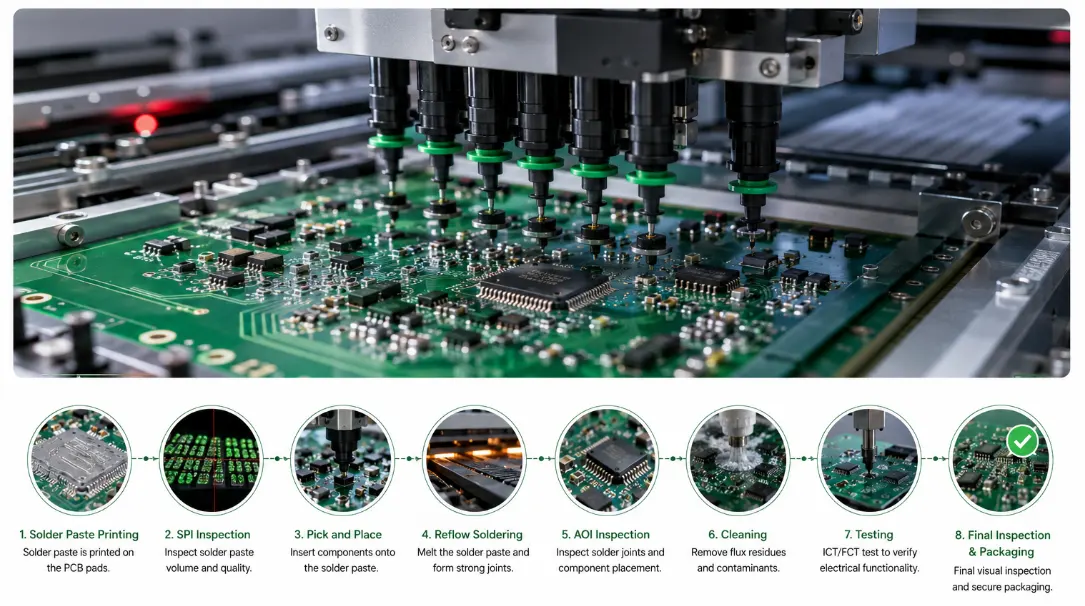
Figure 2. SMT PCB assembly process details
Designing an SMT-Ready Board
A board that assembles cleanly is designed for assembly, not just for function. The key design-for-manufacturing points are:
- Correct footprints and land patterns. Pads must match the part’s recommended pattern; wrong footprints cause placement and soldering defects.
- Sensible paste apertures and stencil design. The stencil openings must deposit the right paste volume, especially for fine-pitch and bottom-terminated parts.
- Fiducials. Reference marks let the machines align accurately, with local fiducials for fine-pitch devices.
- Adequate spacing. Leave room between parts for placement, reflow, and inspection.
- Panelization and tooling rails. Panelize sensibly with rails so the board runs smoothly through the line.
- The right laminate. Use a material with a glass-transition temperature (Tg) suited to lead-free reflow temperatures.
- Moisture-sensitive (MSL) handling. Some parts must be baked and handled carefully before reflow to avoid moisture damage.
Getting these right before fabrication prevents most assembly problems. A manufacturer’s free DFM review checks your footprints, spacing, fiducials, and panelization against a real SMT line and flags issues while they are still cheap to fix. The bare board’s quality matters too, since the assembly is only as good as the PCB manufacturing underneath it, and high-speed or RF designs add further requirements tied to high-speed PCB manufacturing and low-loss materials.
The Reflow Profile, Stage by Stage
The reflow oven is where the solder joints actually form, and its temperature profile is tuned to the board and its components. A typical profile moves through four stages.
| Stage | What happens | Purpose |
|---|---|---|
| Preheat | Temperature ramps up at a controlled rate | Bring the board up gently and avoid thermal shock |
| Soak | Temperature held on a plateau | Activate the flux and equalize temperature across the board |
| Reflow | Peak above the solder’s melting point (lead-free around 245 °C) | Melt the paste so the joints form |
| Cooling | Controlled ramp back down | Solidify the joints with sound structure |
Getting each stage right matters: too fast a ramp can damage parts or cause defects, too little soak leaves uneven heating, and the wrong peak gives weak or cold joints. The profile depends on the board’s mass and materials, which is why thermally heavy substrates need the tailored profiles used in metal-core assembly.
Solder alloys: lead-free and leaded
Most current production uses lead-free solder, commonly a tin-silver-copper (SAC) alloy, which melts hotter and so needs a higher reflow peak and a laminate rated for it. Leaded (tin-lead) solder melts at a lower temperature and is still used in some specialized applications. The alloy sets the peak temperature and influences the material choices, so it is decided alongside the board’s laminate during PCB manufacturing.
Inspection, Test, and Quality
Quality on an SMT line is built in through inspection at several stages and verified by testing at the end.
Inspection during the process
- SPI verifies the solder paste before placement.
- AOI checks placement and visible joints after reflow.
- X-ray inspects the hidden joints of QFN and BGA packages.
Testing the finished board
- Functional test powers the board and confirms it behaves as designed.
- In-circuit test (ICT) or flying-probe test checks individual nets and components electrically.
Layering inspection and test this way catches defects early and confirms the board works before it ships. As volume grows, statistical process control keeps the line consistent so every board behaves like the first, the difference between a one-off build and dependable production.
SMT assembly is a precise, automated sequence, paste, inspect, place, reflow, inspect, that turns a bare board and a reel of parts into a finished product. Design for that process from the start, and the result assembles cleanly and tests well. You can read more about Highleap Electronics and our SMT and hybrid assembly capabilities.
Frequently Asked Questions
What does SMT stand for?
Surface-mount technology. Components are placed onto pads on the board surface and soldered in a reflow oven, rather than having leads that pass through drilled holes. It enables small, dense, highly automated assembly and dominates modern electronics.
What are the steps of SMT assembly?
Solder-paste printing through a stencil, solder-paste inspection (SPI), pick-and-place of components, reflow soldering through a temperature-controlled oven, and automated optical and X-ray inspection. Double-sided boards run the lighter side first, then flip and run the second side.
Why do BGA and QFN parts need X-ray inspection?
Their solder connections sit underneath the package, BGAs on a grid of balls, QFNs on bottom terminations, so cameras cannot see the joints. X-ray inspection looks through the package to verify the hidden joints formed correctly.
Can SMT and through-hole parts be on the same board?
Yes, and most products are hybrid. The surface-mount parts are reflowed first, then the through-hole parts are added by selective or wave soldering. Through-hole is kept for connectors, high-power parts, and components that take mechanical stress.
What makes a board easy to assemble with SMT?
Correct footprints, well-designed paste apertures, fiducials for alignment, adequate spacing between parts, sensible panelization with rails, a laminate rated for reflow temperatures, and proper moisture-sensitive handling. A DFM review before fabrication confirms these are right.
How is an assembled SMT board tested?
Inspection during the process (SPI, AOI, and X-ray for hidden joints) catches soldering defects, and the finished board is verified by functional test and, where used, in-circuit or flying-probe testing. Statistical process control keeps results consistent at volume.

Recommended Posts
TMM4 Filter PCB Manufacturing
TMM4 filter PCB manufacturing is controlled by the...
TMM3 PCB Manufacturing for RF Modules
TMM3 PCB manufacturing is most useful where the RF module...
TMM6 PCB Fabrication
TMM6 fabrication is the process-control page for a mid-Dk...

TMM10 PCB Manufacturing for Compact RF Designs
Table of contentsHow TMM10 Shrinks RF StructuresTMM10 vs...
How to get a quote for PCBs
Let‘s run DFM/DFA analysis for you and get back to you with a report. You can upload your files securely through our website. We require the following information in order to give you a quote:
-
- Gerber, ODB++, or .pcb, spec.
- BOM list if you require assembly
- Quantity
- Turn time
For PCBA services, please provide your BOM (Bill of Materials) and any specific assembly instructions. We also offer DFM/DFA analysis to optimize your designs for manufacturability and assembly, ensuring a smooth production process.