
Custom Aluminum LED PCB Specification Guide

The term “custom aluminum LED PCB” covers a wide range of requests — from a non-standard board outline to a 3.0 W/m·K dielectric running on 3 oz copper. Not all of these requests are equally straightforward, and some advertised “options” are constrained in ways that affect both lead time and thermal performance. This article maps what is genuinely customizable in aluminum LED PCB design, where tradeoffs appear, and which parameters are physically or process-limited.
Aluminum Base: Alloy, Thickness, and Finish
Article Navigation
- Aluminum Base: Alloy, Thickness, and Finish
- Dielectric Layer: The Most Consequential Customization
- Copper Weight: Current-Carrying Capacity vs. Etch Resolution
- Board Outline and Shape
- Surface Finish Options for Aluminum LED PCBs
- Solder Mask Color: Functional Implications Beyond Aesthetics
- What Cannot Be Customized
- Ordering Custom Specifications: What to Include in Your RFQ
- FAQ
The aluminum base is the most frequently overlooked customization variable. Three properties matter:
Alloy grade:
- 1050 (99.5% Al): highest thermal conductivity (~220 W/m·K), softest, lowest strength — standard choice for thermally driven designs
- 5052 (Al-Mg): ~140 W/m·K, significantly higher tensile strength and corrosion resistance — preferred for vibration environments and outdoor products
- 6061 (Al-Mg-Si): ~170 W/m·K, highest mechanical stiffness — used when the PCB also functions as a structural heatsink element
Thickness: Standard range is 0.8 mm to 3.0 mm. Boards thinner than 1.0 mm require careful V-score or routing toolpath design to avoid base warpage. Boards thicker than 2.0 mm increase total assembly weight and may require fastener specification changes in the end product.
Base surface treatment: Anodized aluminum base is available for designs where the bare bottom of the board contacts a conductive heatsink and isolation is required. Anodizing adds 10–20 µm per side and acts as a secondary dielectric layer — useful for double-isolation designs but adds processing steps.
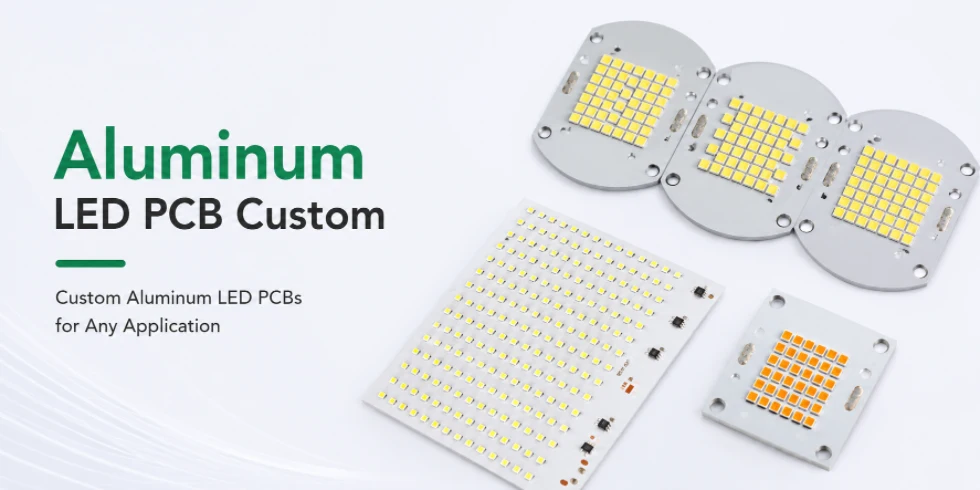
Dielectric Layer: The Most Consequential Customization
The dielectric layer defines thermal resistance, isolation voltage, and process behavior. This is where the most significant performance differentiation happens in aluminum substrate PCBs.
| Thermal Conductivity | Typical Application | Key Tradeoff |
|---|---|---|
| 1.0 W/m·K | General LED lighting, decorative | Low cost, adequate for <3 W/LED |
| 2.0 W/m·K | Commercial and industrial LED | Moderate cost, good for 3–8 W/LED |
| 3.0 W/m·K | High-power LED, automotive, horticulture | Higher cost, requires specific lamination process |
| 4.0–6.0 W/m·K | UV curing, high-density COB LED | Premium cost, limited supplier base |
Critical point: higher thermal conductivity dielectrics are thinner for equivalent breakdown voltage, because the high-conductivity fillers are ceramic-loaded and the dielectric strength per unit thickness is lower than standard polymer systems. Specifying 3.0 W/m·K at 100 µm thickness means lower isolation voltage than 1.0 W/m·K at 100 µm. Discuss the tradeoff with your manufacturer during metal core PCB design review.
Copper Weight: Current-Carrying Capacity vs. Etch Resolution
Standard aluminum LED PCBs use 1 oz (35 µm) copper. Three cases call for heavier copper:
2 oz copper (70 µm): LED strings carrying 2–5 A per trace. Appropriate for most industrial and commercial high-power LED modules.
3 oz copper (105 µm): LED arrays with 5–10 A current, or when resistive heating in traces would meaningfully add to the LED thermal load. Highleap Electronics processes aluminum LED PCBs in copper weights up to 3 oz.
The tradeoff: heavier copper reduces minimum trace and space specification. At 3 oz, minimum trace/space is typically 6/6 mil versus 4/4 mil at 1 oz. If your LED driver IC has fine-pitch pads adjacent to high-current traces, the copper weight choice constrains the layout.
Board Outline and Shape
Non-rectangular board outlines — circular, hexagonal, L-shaped, or custom contours — are fully supported but affect both material utilization and routing toolpath complexity. For large-area LED panels (>300 × 300 mm), verify the factory’s maximum aluminum panel dimensions. Some manufacturers cap at 400 × 500 mm for aluminum; others run up to 600 × 800 mm.
Cutouts, slots, and countersunk mounting holes are available. Slot tolerances on aluminum are typically ±0.15 mm vs. ±0.1 mm on FR-4 — relevant if the slot interfaces with a close-tolerance mechanical feature in the luminaire housing.
Surface Finish Options for Aluminum LED PCBs
Three surface finishes are routinely available on aluminum LED PCBs:
ENIG (Electroless Nickel Immersion Gold): 3–6 µin gold over 100–150 µin nickel. Flat, shelf-stable to 12 months, recommended for fine-pitch SMD LED and COB arrays. ENIG process adds 3–5 working days versus HASL.
LF-HASL (Lead-Free Hot Air Solder Leveling): Low cost, tolerant of handling. Surface unevenness of ±8–15 µm makes it unsuitable for 0402 and smaller LED pads or fine-pitch driver ICs. Good for through-hole connector pads.
OSP (Organic Solderability Preservative): Lowest cost, thinnest surface treatment. Sensitive to fingerprints and humidity — requires controlled handling from receipt through SMT. Shelf life typically 6 months. Suitable for single-reflow processes only.
Solder Mask Color: Functional Implications Beyond Aesthetics
White solder mask on aluminum LED PCBs is a functional choice, not just a cosmetic one. White mask reflects LED light back into the optical system, improving luminaire efficacy by 3–8% depending on cavity geometry. It is standard on outdoor aluminum LED PCBs and indoor grow lights where reflectance matters.
Black solder mask absorbs stray light and is used in display backlighting and optical sensor applications where secondary reflections degrade image quality.
Standard green is lower cost and available from more dielectric suppliers, but neither enhances nor degrades optical performance in typical LED fixtures.
What Cannot Be Customized
Some parameters look like variables but are actually constrained by physics or process:
- Dielectric thermal conductivity cannot exceed the base material’s Tc without defeating its own breakdown voltage margin — there is a physical tradeoff between thermal conductivity and dielectric strength in polymer-ceramic composite systems
- Through-vias connecting copper to the aluminum base are not available — the aluminum base is at a different electrical potential (chassis ground or floating) in most LED fixture designs; any via connecting copper to aluminum is a circuit fault
- Impedance control is not applicable to single-layer aluminum LED PCBs — all traces are above a solid metal ground plane and characteristic impedance control as used in high-frequency RF design does not apply in the same sense
Ordering Custom Specifications: What to Include in Your RFQ
A complete custom aluminum LED PCB RFQ includes:
- Gerber files + drill file + board outline DXF
- Aluminum alloy grade and thickness
- Dielectric thermal conductivity and brand preference (or “manufacturer’s recommended equivalent”)
- Copper weight (oz)
- Surface finish
- Solder mask color
- Hi-pot voltage requirement
- IPC class (Class 2 standard, Class 3 if required)
- Required certifications (UL 94V-0, REACH, RoHS)
Submit this to Highleap Electronics via the LED PCB quote form for a response within 24 hours on standard specifications.
FAQ
What is the minimum order quantity for custom aluminum LED PCB specifications? For fully custom specifications (non-standard dielectric Tc, non-standard aluminum gauge), minimum order quantities typically start at 50–100 panels depending on dielectric material minimum purchase requirements. Standard specifications (1.0 W/m·K, 1.6 mm aluminum, 1 oz copper) are available from prototype quantities of 5 panels.
Can I specify a custom board size larger than standard panels? Yes, within the factory’s maximum panel size. Highleap Electronics supports aluminum LED PCBs up to 600 × 800 mm. Very large panels (>500 × 500 mm) may require structural stiffening in the fixture design to compensate for reduced aluminum base rigidity at the edges.
How does white solder mask affect thermal performance? White solder mask has marginally higher thermal resistance than green due to added titanium dioxide filler. The difference is negligible in thermal terms (<<0.1°C/W). The optical reflectance benefit (3–8% higher luminaire efficacy) far outweighs the thermal effect in reflective cavity designs.
Can aluminum LED PCBs be made flexible? No. Aluminum is not a flexible substrate. For flexible LED applications — wearables, curved display backlighting — the appropriate product is a flexible LED PCB on polyimide substrate, which has different thermal management requirements.

Recommended Posts
TMM4 Filter PCB Manufacturing
TMM4 filter PCB manufacturing is controlled by the...
TMM3 PCB Manufacturing for RF Modules
TMM3 PCB manufacturing is most useful where the RF module...
TMM6 PCB Fabrication
TMM6 fabrication is the process-control page for a mid-Dk...
TMM10 PCB Manufacturing for Compact RF Designs
Table of contentsHow TMM10 Shrinks RF StructuresTMM10 vs...
How to get a quote for PCBs
Let‘s run DFM/DFA analysis for you and get back to you with a report. You can upload your files securely through our website. We require the following information in order to give you a quote:
-
- Gerber, ODB++, or .pcb, spec.
- BOM list if you require assembly
- Quantity
- Turn time
For PCBA services, please provide your BOM (Bill of Materials) and any specific assembly instructions. We also offer DFM/DFA analysis to optimize your designs for manufacturability and assembly, ensuring a smooth production process.