
Full Turnkey Isola 370HR PCB Service Expert

An Isola 370HR PCB service is defined by the engineering controls applied at each stage from Gerber submission through delivered, assembled hardware. 370HR’s thermal reliability — Tg 180°C, Td 340°C, Z-axis CTE 3.0% — reaches your application only when every stage includes material-specific process controls. A service that treats 370HR as interchangeable with standard FR-4 delivers a board with a genuine certificate and compromised performance. This guide maps the complete 370HR service lifecycle, documents what each stage should deliver, and identifies the three service failures most likely to compromise your program.
Service Stages Covered
Stage 1: DFM Review for 370HR Programs
A 370HR DFM review addresses material-specific design constraints that standard FR-4 DFM does not cover. The four items that must be reviewed before fabrication begins:
Prepreg style vs. impedance model alignment: Your impedance field solver model uses a specific dielectric thickness. That thickness is determined by the prepreg style — 1080, 2116, or 7628 — and the resin content percentage. A mismatch between the modeled prepreg and the fabricated prepreg is the most common cause of prototype-to-production impedance drift. The DFM review confirms that the specified prepreg style achieves your target dielectric thickness and locks that style for the entire program lifecycle. Learn more about how prepreg selection affects impedance in our PCB laminate construction guide.
Via aspect ratio verification: High-aspect-ratio vias (>8:1 for IPC Class 2, >10:1 for Class 3) are difficult to plate uniformly — the copper at the center of the via barrel receives less plating than the surface. In 370HR high-layer-count builds, via plating uniformity is the primary reliability factor because even 370HR’s low Z-axis CTE cannot prevent cracking through insufficient copper. DFM flags aspect ratio violations and recommends drill size or board thickness adjustments before tooling.
Back-drilling requirements: For high-speed SerDes applications on 370HR backplanes, unused via stubs create resonance artifacts at frequencies determined by the stub length. DFM confirms back-drill depth tolerance is achievable for the specified maximum stub length — typically 200µm (8 mil) residual for applications above 10 Gbps. See our 28-layer PCB design guide for back-drilling depth calculations in high-layer-count builds.
IPC class confirmation: The DFM review confirms IPC Class is explicitly stated in the fabrication drawing. Without explicit specification, acceptance criteria default to the factory’s lowest standard — a problem discovered only when boards fail incoming inspection at the assembly house.
Highleap returns DFM notes with every 370HR quote — no separate NRE charge for DFM review on standard programs.
Stage 2: Fabrication with Material-Specific Controls
Five fabrication process steps require 370HR-specific controls that differ from standard FR-4 processing:
| Process Step | 370HR-Specific Control Required | How to Verify |
|---|---|---|
| Lamination | 370HR-characterized temperature/pressure profile with phase-specific ramp rates | Request the factory’s press cycle parameter sheet — it must differ from their FR-4 cycle |
| Via plating | Minimum copper thickness per IPC class: ≥0.018mm avg (Class 2) or ≥0.025mm avg (Class 3) | Cross-section with IPC-A-600 plating measurements on first-article |
| Impedance control | Etch factor measured for 370HR with specified copper weight; artwork compensated accordingly | TDR coupon measurement on every production panel |
| Electrical test | 100% flying probe — continuity and isolation per IPC class acceptance criteria | Electrical test report per panel |
| Surface finish | ENIG standard; OSP/HASL/Immersion Silver per design requirement | XRF coating thickness measurement for ENIG gold and nickel layers |
Stage 3: The Verification Documentation Package
The documentation shipped with your 370HR boards is the evidence that each service stage was executed correctly. A complete Highleap Electronics 370HR documentation package includes five deliverables:
- TDR Impedance Data Report: Measured impedance values by coupon type — microstrip, stripline, differential pair — for every production panel. Not a pass/fail summary. Enables comparison against prototype TDR data to detect any process drift before boards reach assembly.
- Isola 370HR Material Lot Certificate: Lot number, Dk/Df values, and material identity traceable to the specific production order. Required for automotive PPAP, medical design history files, and defense supply chain qualification. See our Isola 370HR material specifications page for reference data.
- First-Article Cross-Section Report: Photographs with IPC-A-600 measurements — via plating thickness (minimum and average), etch geometry, and bond interface quality. Required on new programs and stackup revisions.
- Electrical Test Report: 100% flying probe results — pass for continuity and isolation per IPC class acceptance criteria, documented per panel.
- Certificate of Conformance: Manufacturer’s statement of compliance to specified IPC class and drawing requirements — the standard incoming inspection document for every shipment.
Stage 4: Assembly Integration for 370HR Boards
For turnkey 370HR programs, the assembly stage introduces thermal stresses that interact with the board’s lamination history. Two assembly-specific controls are critical:
Moisture management: 370HR bare boards absorb moisture during storage. At 260°C peak reflow temperature, absorbed moisture converts to steam, expanding at bond interfaces and via barrels. The risk is amplified in boards with marginal cure from an unvalidated press cycle — lower Tg means lower moisture resistance. Standard prevention: vacuum-sealed desiccant packaging from fabrication, pre-bake at 120–125°C for 2–4 hours before assembly for boards with any interim storage.
Reflow profile optimization: A generic FR-4 reflow profile applied to a 370HR board can produce excessive Z-axis dimensional change at peak temperature, stressing via structures that already have thermal history from the lamination press cycle. 370HR-validated reflow profiles account for the material’s specific CTE behavior through the Tg transition and above.
Highleap operates fabrication and SMT assembly within the same facility. 370HR boards transition directly from fabrication to the assembly line — no interim storage, no additional moisture exposure, no third-party logistics risk. The complete manufacturing and assembly process is documented with 370HR-specific controls at the assembly stage.
Three Service Failures and How to Prevent Them
Failure 1: Impedance Drift Between Prototype and Production
Root cause: Prepreg style changed from 2116 (prototype) to 7628 (production) for cost or availability reasons without notification. The dielectric thickness increase shifts all controlled-impedance traces 5–10% from prototype TDR values.
Prevention: Lock prepreg style at first article. Require written notification before any prepreg change. Compare prototype and production TDR data on the first production lot before committing volume. Highleap’s production traveler captures the first-article prepreg style and prohibits substitution without customer notification.
Failure 2: Via Cracking During Field Thermal Cycling
Root cause: Via barrel copper plating below IPC minimum thickness. The board passes incoming electrical inspection — the crack appears after thermal cycling in the field, producing intermittent open circuits. 370HR’s Z-axis CTE advantage cannot compensate for insufficient copper plating.
Prevention: First-article cross-section with plating thickness measurement on every new program. Production sampling cross-section at defined intervals. Specify IPC class explicitly in your fabrication drawing — unspecified acceptance criteria default to the factory’s lowest standard.
Failure 3: Delamination During Assembly Reflow
Root cause: Moisture absorbed in stored bare boards, released as steam at 260°C peak reflow. Accelerated in boards with marginal bond quality from an undercured press cycle.
Prevention: Vacuum-sealed desiccant packaging from fabrication. Pre-bake at 120–125°C for 2–4 hours before assembly. Highleap packages all 370HR boards in desiccant packaging and performs moisture baking as a standard turnkey assembly step.
Highleap Electronics: Full 370HR Service Lifecycle
Highleap Electronics provides complete Isola 370HR PCB service — from DFM engineering through delivered, assembled hardware:
|
Prototype Service 7–10 Days
8–16 layers. In-stock 370HR. DFM review, first-article cross-section, TDR data, material certificate. Rush available at 5–7 days. |
High-Layer-Count 10–15 Days
18–24+ layers with sequential lamination. IPC Class 2 or 3. Full documentation package. Confirm schedule at quote. |
Production Volume 15–25 Days
Lot-to-lot TDR tracking. Production sampling cross-section. IATF 16949 / PPAP documentation for automotive. |
Start your 370HR program with Highleap Electronics. Submit Gerbers, stackup, and IPC class — engineering DFM review and quote returned same business day.
Frequently Asked Questions
What is the total timeline from Gerber submission to assembled 370HR boards?
For standard builds at Highleap, the full timeline is typically 15–20 business days: 7–10 days fabrication + 5–8 days SMT assembly + 2–3 days express shipping. Rush fabrication (5–7 days) is available where in-stock material and queue priority are confirmed at quote submission.
Is first-article cross-section required on every production repeat order?
Full first-article cross-section is required on new programs and stackup revisions. For ongoing production with no changes, production sampling cross-section at defined intervals (typically every 5th or 10th lot) is the standard. The interval is agreed at program launch and documented in the quality plan.
How should 370HR boards be stored before assembly?
Store in vacuum-sealed desiccant packaging — the packaging Highleap ships with by default. Before assembly, pre-bake at 120–125°C for 2–4 hours depending on board thickness to drive out absorbed moisture before 260°C reflow. Highleap’s turnkey service performs pre-baking as a standard step for all 370HR builds.

Recommended Posts
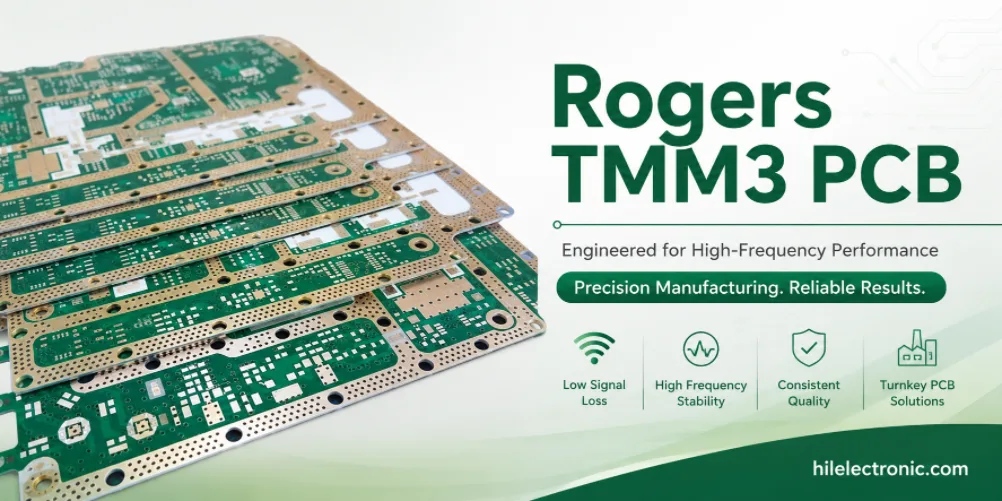
TMM3 PCB Manufacturing for RF Modules
TMM3 PCB manufacturing is most useful where the RF module...
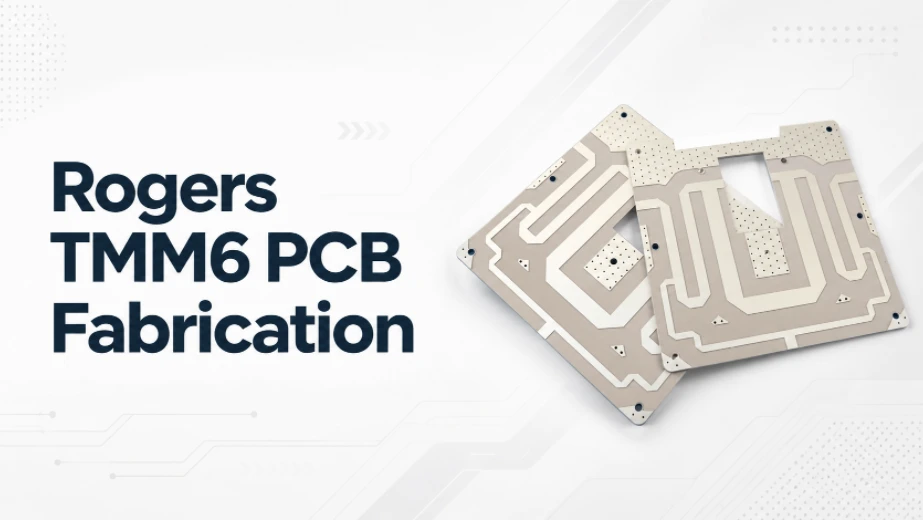
TMM6 PCB Fabrication
TMM6 fabrication is the process-control page for a mid-Dk...
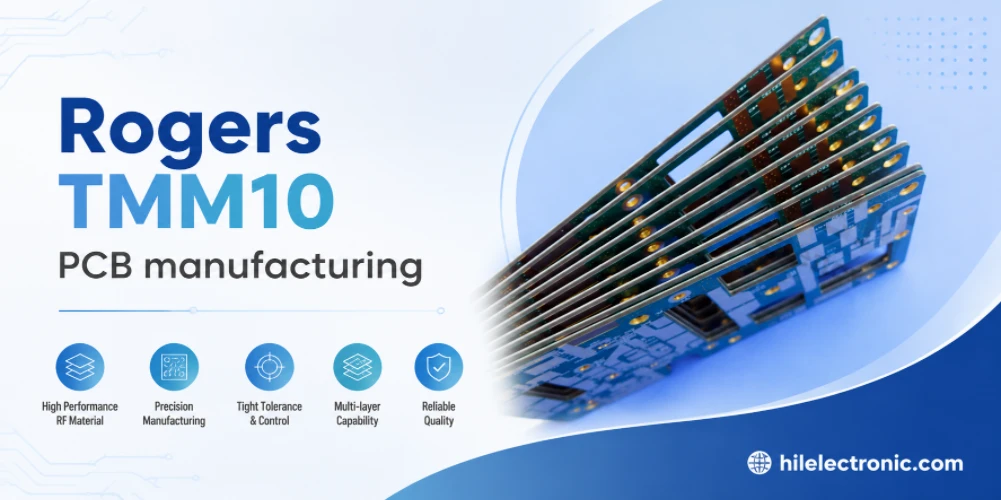
TMM10 PCB Manufacturing for Compact RF Designs
Table of contentsHow TMM10 Shrinks RF StructuresTMM10 vs...

TMM10i PCB Fabrication and DFM
TMM10i PCB fabrication has a stronger DFM emphasis because...
How to get a quote for PCBs
Let us run DFM/DFA analysis for you and get back to you with a report.
You can upload your files securely through our website.
We require the following information in order to give you a quote:
-
- Gerber, ODB++, or .pcb, spec.
- BOM list if you require assembly
- Quantity
- Turn time