
Panasonic MEGTRON 8 PCB Manufacturing for Low-Loss AI and Data Center Boards

Figure 1. Panasonic MEGTRON 8 PCB Manufacturing
Highleap Electronics provides Panasonic MEGTRON 8 PCB manufacturing and turnkey PCBA services for high-speed, low-loss electronic systems used in AI servers, GPU computing platforms, optical networking, switches, backplanes and advanced data center hardware. MEGTRON 8 materials such as R-5795(U) are commonly selected for multilayer PCB designs requiring excellent signal integrity, low transmission loss and stable high-frequency performance beyond conventional FR-4 capabilities.
For high-speed PCB projects, manufacturing capability is just as important as material selection. Highleap Electronics supports MEGTRON 8 PCB production with controlled impedance processing, precision lamination, back drilling, HDI fabrication, surface finish control, inspection and reliable PCB assembly services. Our engineering and manufacturing processes are designed to support demanding high-speed computing and networking applications from prototype through volume production.
MEGTRON 8 PCB Project Fit
MEGTRON 8 is not necessary for every high-speed PCB. It is usually considered when the longest critical channels, connector paths, via transitions or frequency targets leave little room in the loss budget. For short channels or less aggressive data rates, MEGTRON 6, MEGTRON 7, I-Tera MT40, Tachyon-class materials or another qualified laminate may be enough.
Projects that may justify a MEGTRON 8 review include:
- AI accelerator boards and GPU server platforms with long or dense high-speed routes
- 800G or 1.6T switch, line card and optical module host boards
- PCIe 6.0, CXL, SerDes and high-speed backplane designs with strict loss targets
- HBM, DDR5, management and power-dense compute boards where stackup space is limited
- Engineering builds where the customer needs material comparison before volume release
If the design is part of a broader compute platform, see our page on AI computing hardware PCB projects for related board-level manufacturing considerations.
Stackup and Material Review Before Quotation
A MEGTRON 8 quote should not be based only on board size and layer count. The quotation should confirm the stackup, layer assignment, impedance targets, copper type, drill strategy, surface finish and whether the entire PCB needs MEGTRON 8 or only selected signal layers.
| Review item | What to confirm | Why it affects the build |
|---|---|---|
| Material callout | Panasonic MEGTRON 8 part number, core thickness, prepreg type and any customer-approved substitute rules. | Prevents quoting a similar low-loss material when the design specifically requires R-5795(U) or another MEGTRON 8 construction. |
| Layer assignment | Which layers carry SerDes, PCIe, Ethernet, clock, DDR or other critical nets. | Determines whether full MEGTRON 8 or a hybrid stackup is practical. |
| Impedance targets | Single-ended and differential values, tolerance, coupon requirements and test method. | Connects the material choice to measurable production control rather than only a datasheet value. |
| Copper profile | VLP, HVLP or customer-specified copper foil on critical signal layers. | Copper roughness can become a major contributor to conductor loss at higher frequencies. |
| Build documentation | Stackup drawing, fabrication notes, drill chart, impedance table, material certificate requirement and inspection reports. | Helps keep prototype, pilot and production builds aligned. |
Manufacturing Controls for R-5795(U) Low-Loss Boards
MEGTRON 8 processing requires more discipline than a standard multilayer FR-4 build. The material choice affects lamination, drilling, plating, registration, surface finish and quality documentation. A good build plan should protect the signal integrity target while keeping the PCB manufacturable.
Lamination and registration
Low-loss multilayer materials should be pressed with a controlled lamination cycle and balanced stackup. Large high-layer-count boards are especially sensitive to resin flow, glass style, copper distribution and panel symmetry. The engineering review should confirm whether the stackup is mechanically balanced and whether sequential lamination is needed for buried vias, microvias or dense interconnect sections.
Drilling, back drilling and via quality
High-speed MEGTRON 8 boards often include dense via fields, connector breakouts and layer transitions close to critical routes. Drill quality, hole-wall condition, plating thickness, back-drill depth and residual stub length can all affect signal performance. Designs with strict high-speed requirements should review back-drill planning for high-speed vias before the first production release.
Controlled impedance and coupons
Controlled impedance should be tied to the approved stackup rather than treated as a generic PCB note. Coupon design, trace geometry, copper thickness, dielectric spacing and test method should be confirmed before the manufacturing package is frozen. Our controlled-impedance PCB process page explains how impedance targets are typically translated into production measurements.
HDI and via-in-pad decisions
Some MEGTRON 8 boards use HDI only where BGA escape routing or dense connector breakout requires it. Others can remain conventional multilayer designs with through vias and back drilling. The right decision depends on package pitch, routing escape, layer count, reliability expectations and cost target. For projects with microvias or via-in-pad, review the design against our HDI PCB fabrication review process before sending the board to production.
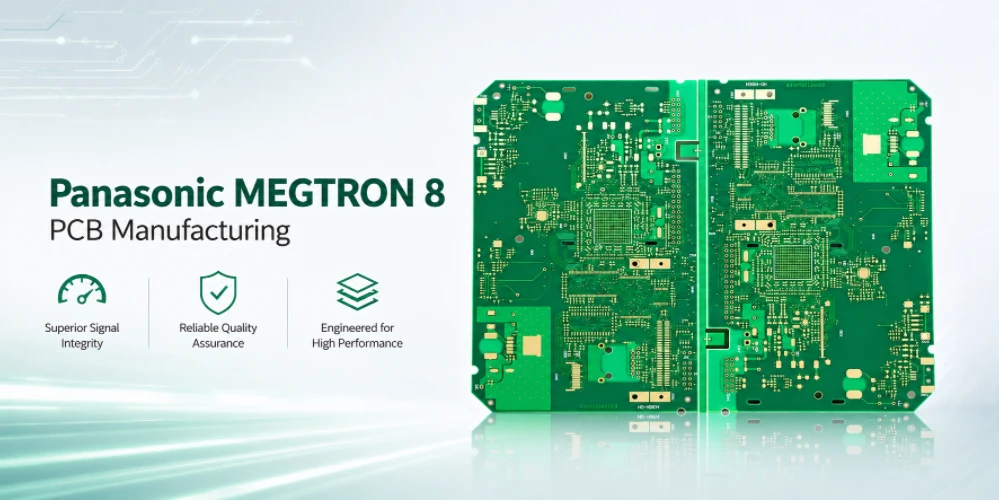
Figure 2. Panasonic MEGTRON 8 PCB
Channel Loss, Copper Foil and Surface Finish
When a customer specifies MEGTRON 8, the laminate is only one part of the loss equation. Conductor loss, copper roughness, via transitions, connector path, solder mask openings and surface finish can also influence high-speed behavior. The PCB fabricator should review these items before recommending a stackup or quoting a production build.
- Copper foil: critical signal layers may need VLP or HVLP copper, depending on the channel target and material availability.
- Back-drill strategy: via stubs should be reviewed where layer transitions occur on high-speed paths.
- Reference plane continuity: split planes, voids or unnecessary layer changes can reduce the benefit of a low-loss material.
- Surface finish: ENIG, ENEPIG, immersion silver or other finishes should be selected according to assembly, shelf life, connector and frequency-related requirements.
For more detail on conductor and finish choices, see our guide to copper foil and surface finish for high-frequency boards. If the project is also a fine-pitch assembly, the ENIG and ENEPIG finish comparison may help narrow the finish decision.
Hybrid MEGTRON Stackups for Cost and Availability
An all-MEGTRON 8 stackup is not always the best commercial or manufacturing choice. Many boards have only a few layers carrying the most loss-sensitive signals. Other layers may support power, ground, management signals or lower-speed routing. A hybrid stackup can reduce cost and improve material availability when the signal integrity team confirms that only selected layers require MEGTRON 8.
| Stackup option | Best use case | Engineering caution |
|---|---|---|
| Full MEGTRON 8 | Boards where most high-speed channels are loss-sensitive or where the customer requires one material system. | Higher material cost and longer procurement review may apply. |
| Selective MEGTRON 8 layers | Critical SerDes or Ethernet layers need the lowest loss, while other layers can use another approved material. | Stackup symmetry, CTE behavior and lamination compatibility must be reviewed. |
| MEGTRON 7 or MEGTRON 6 hybrid | Designs that need low loss but not on every signal layer. | The SI team should approve the layer assignment before quotation is finalized. |
| Alternative low-loss laminate | When MEGTRON 8 availability, lead time or customer AVL creates sourcing constraints. | Substitution should be approved by the customer because Dk, Df, copper foil and process behavior can differ. |
For broader manufacturing context around high-speed stackups, review our high-speed multilayer PCB manufacturing page.
Application Boards That Commonly Evaluate MEGTRON 8
MEGTRON 8 is most relevant when the channel budget is difficult to close. In practical RFQ discussions, customers usually evaluate it for a specific board family rather than as a general-purpose laminate.
- AI accelerator and GPU server boards: high-layer-count boards with dense routing, large packages and strict signal margin. Related manufacturing notes are covered in our GPU server PCB manufacturing resource.
- 800G and 1.6T switch or optical host boards: designs where insertion loss, via stubs and connector paths must be reviewed together.
- Backplanes and line cards: large boards where registration, warpage, back drilling and consistency across panels are important.
- High-speed test or evaluation boards: early engineering builds used to compare materials, copper profile or via structure before a production platform is released.
Inspection, Test and Build Documentation
For MEGTRON 8 builds, documentation is part of the value of the PCB. Engineering teams often need to compare the manufactured board against simulation, lab validation and customer qualification data. The required documents should be agreed before production.
- Material certificate or laminate traceability documentation when required by the customer
- Approved stackup with dielectric thickness, copper weight and material callout
- Impedance coupon measurement reports according to the agreed test method
- Microsection review for plating, dielectric thickness and registration
- Back-drill depth records when stub control is specified
- Electrical test, AOI and final inspection records based on the customer’s quality plan
If the board is assembled after fabrication, inspection planning should also cover solderability, assembly finish, BGA reliability and component-side process requirements.
RFQ Package for a MEGTRON 8 PCB Quote
A complete RFQ package helps avoid inaccurate pricing and repeated engineering questions. For MEGTRON 8 projects, send as much of the following as possible:
- Gerber X2, ODB++ or IPC-2581 fabrication files
- Stackup drawing with material callouts, copper weight and dielectric thickness
- Impedance table with single-ended and differential targets
- Drill file and back-drill requirements, including target layers and residual stub rules
- Fabrication notes with surface finish, solder mask, IPC class, via filling and coupon requirements
- Critical net list or SI notes for SerDes, PCIe, Ethernet, DDR, HBM or clock routes
- Required documentation such as material certificates, microsections or impedance reports
- Prototype quantity, pilot quantity and expected production release plan
Send your data package to Highleap Electronics for stackup review, material confirmation and a manufacturing quotation. You can submit a MEGTRON 8 PCB quote package or contact our engineering team if the material, copper foil, back-drill or impedance plan still needs review before release.

Recommended Posts
TMM4 Filter PCB Manufacturing
TMM4 filter PCB manufacturing is controlled by the...
TMM3 PCB Manufacturing for RF Modules
TMM3 PCB manufacturing is most useful where the RF module...
TMM6 PCB Fabrication
TMM6 fabrication is the process-control page for a mid-Dk...
TMM10 PCB Manufacturing for Compact RF Designs
Table of contentsHow TMM10 Shrinks RF StructuresTMM10 vs...
How to get a quote for PCBs
Let‘s run DFM/DFA analysis for you and get back to you with a report. You can upload your files securely through our website. We require the following information in order to give you a quote:
-
- Gerber, ODB++, or .pcb, spec.
- BOM list if you require assembly
- Quantity
- Turn time
For PCBA services, please provide your BOM (Bill of Materials) and any specific assembly instructions. We also offer DFM/DFA analysis to optimize your designs for manufacturability and assembly, ensuring a smooth production process.