
RO4003C vs RO4350B Datasheet and Stackup
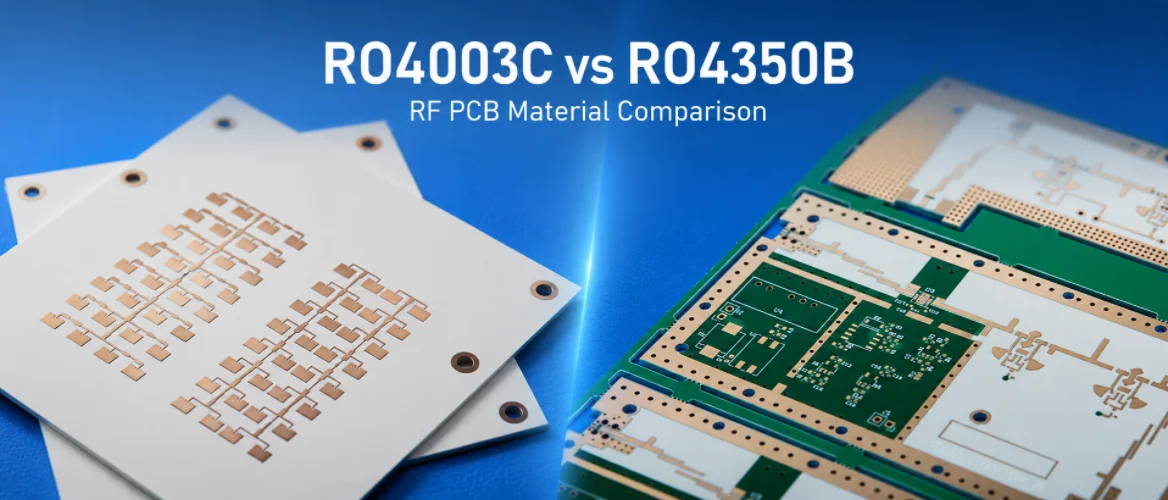
The useful distinction on this page is between supplier data-sheet values and the values actually used to release a PCB. Current grade, construction, copper foil and finished dielectric thickness should be fixed before impedance calculations are transferred into the fabrication drawing.
This page separates two questions that are often mixed together: what the current RO4003C and RO4350B data sheets specify, and what those values mean for a manufacturable PCB stackup. The correct design input is the supplier’s current grade and construction, while the manufacturing input is the finished thickness, copper and impedance target. Material scope: Highleap Electronics is the PCB manufacturer and assembler for the build described here. Rogers and the referenced grade names identify the specified material and are not a description of Highleap material manufacturing.
Figure 1. RO4003C vs RO4350B selection depends on dielectric data, loss target, stackup, and assembly requirements.
When a board carries RF, microwave, or fast digital signals, engineers often narrow the material choice to RO4003C vs RO4350B and then compare the Rogers datasheet details that affect impedance, loss, and manufacturability. This guide explains the Dk and Df values that matter, what RO4000 LoPro foil changes, and how Highleap Electronics builds these high-frequency laminates to spec.
1. Why use Rogers RO4000 instead of FR-4?
Use Rogers RO4000 instead of FR-4 when you need a stable, well-controlled dielectric constant and low signal loss at high frequency. FR-4 has two weaknesses that matter for RF: its dielectric constant is loosely controlled and shifts with frequency, and its loss climbs quickly as frequency rises – together producing unpredictable impedance and signals that arrive weak and distorted.
RO4000 is engineered to fix exactly that, offering a stable, specified dielectric constant and low loss while remaining processable with standard FR-4-style fabrication rather than more difficult PTFE materials. That combination is why RO4000 is so widely used for antennas, RF front ends, automotive radar, and high-speed digital links. The broader trade-offs are in this guide to Rogers PCB materials, and a direct FR-4 versus Rogers comparison helps decide when the upgrade is justified.
2. RO4003C Dk, Df and the datasheet specs that decide your design
The two RO4000 datasheet numbers that decide your design are the dielectric constant (Dk), which sets trace impedance and electrical length, and the dissipation factor (Df, or loss tangent), which sets signal loss. RO4003C is prized for a low, tightly held, frequency-stable Dk – design to the exact value and tolerance in the current datasheet at your operating frequency. Here are the RO4000 datasheet specs to read before you commit a stackup:
| Spec | What it tells you | Why it matters |
|---|---|---|
| Dielectric constant (Dk / εr) | How the material slows and concentrates the field | Sets trace impedance and electrical length |
| Dissipation factor (Df / loss tangent) | How much energy the dielectric absorbs | Low Df means low loss, critical at high frequency |
| Dk tolerance & frequency stability | How tightly Dk is held across frequency | Makes controlled impedance repeatable |
| Thermal coefficient of Dk | How Dk drifts with temperature | Keeps performance stable across the range |
| CTE (thermal expansion) | How the material expands with heat (z-axis) | Affects plated-through-hole reliability |
A low Dk that drifts is worse than a slightly higher Dk that holds steady, so the tolerance and stability rows separate a usable RF material from a frustrating one. If these terms are new, start with this primer on dielectric constant and loss tangent.
3. RO4350B vs RO4003C: what’s the difference?
RO4350B and RO4003C offer similar RF performance with stable Dk and low loss; the key difference is that RO4350B uses a flame-retardant formulation, making it the choice where a UL-recognized, lower-flammability material is required. Both are workhorses of the RO4000 family, and many designs could use either on electrical grounds alone.
RO4003C is a widely used general RF laminate where good performance and processability both matter, while RO4350B adds the flame-retardant property for applications with stricter safety requirements. This side-by-side of RO4350B versus RO4003C lays out the differences in detail so you can match the laminate to your compliance needs.
4. What is RO4000 LoPro foil and why does it lower loss?
RO4000 LoPro uses a reverse-treated, low-profile copper foil with a smoother copper-dielectric surface, which lowers conductor loss at high frequency. At high frequency, current crowds toward the conductor surface (the skin effect) and flows along the rough copper-dielectric interface; a rougher surface forces the current along a longer, more tortuous path and raises loss.
LoPro foil’s smoother profile reduces that surface roughness, lowering insertion loss – which is exactly why RO4000 LoPro exists for demanding, loss-sensitive designs. The trade-off is that smoother foil can require attention to adhesion and processing, which is a fabrication conversation to have with whoever builds the board.
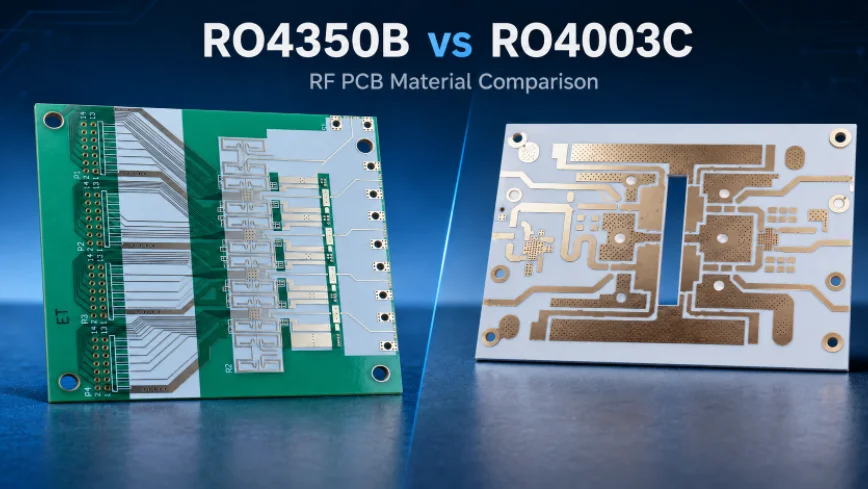
Rogers RO4000 LoPro foil can reduce conductor loss in RF and high-speed PCB applications.
5. How to design impedance and stackup with RO4000
To design controlled impedance with RO4000, use the datasheet Dk at your operating frequency and fix the stackup before finalizing trace geometry, because width, dielectric thickness, and copper weight together set impedance. Change one and the others must change, so the stackup is a decision that comes first:
- Use the real Dk for the frequency. Base impedance calculations on the datasheet value, not a generic FR-4 assumption.
- Fix the stackup early. Decide dielectric thickness and copper weight before trace geometry.
- Account for copper roughness in loss budgets. If loss is critical, the standard-versus-LoPro foil choice is part of the design.
- Coordinate the build with the fabricator, using proper impedance control processing, because results depend on the fab hitting the specified geometry.
6. RO4000 fabrication: impedance control and hybrid stackups
RO4000 is more FR-4-friendly than PTFE materials, but it still needs controlled-impedance processing, RF-appropriate drilling and plating, and is often combined with FR-4 in a hybrid stackup to balance cost and performance. Holding the specified line widths and dielectric thicknesses tightly is what delivers the target impedance, which requires a fab set up for impedance control and test.
Material composition affects drilling and through-hole plating, and reliable plated-through holes matter for RF grounds and vias. The right surface finish for high-frequency boards protects RF performance and solderability, especially with low-profile foils. Because so much of the final RF performance is set during fabrication, choosing a fabricator experienced with Rogers materials is as important as choosing the laminate – which is why dedicated high-frequency PCB fabrication exists as a distinct capability.
7. Building RO4000 boards that meet spec
Highleap builds the Rogers RO4000 family through Rogers PCB manufacturing with controlled-impedance processing, hybrid RO4000/FR-4 stackups where cost and performance need balancing, and appropriate drilling, plating, and surface-finish handling for RF materials. For loss-sensitive designs, the standard-versus-LoPro foil choice and the stackup can be confirmed up front so the built board matches the datasheet-based design. LoPro copper and stackup choices should be reviewed together because conductor loss and dielectric geometry are linked to the finished transmission line. Highleap uses the released stackup and drawing rather than a generic material model, and the final impedance validation is based on the finished panel and the agreed test method. Exact material property values should be checked against the current supplier documentation for the specified grade and construction.
A pre-production manufacturability review checks that your stackup, dielectric thicknesses, line widths, and via design are buildable and consistent with your impedance targets – the place where many RF boards either succeed or develop problems. When requesting a quote, specify the exact laminate (RO4003C or RO4350B), standard or LoPro foil, your operating frequency, your target impedance, and the stackup.
8. Rogers RO4000 FAQ
What is the dielectric constant of Rogers RO4003C?
RO4003C has a low, tightly specified, frequency-stable dielectric constant. Always design to the exact value and tolerance in the current datasheet at your operating frequency, since that stability is the reason for choosing it.
What is the difference between RO4003C and RO4350B?
Both offer similar RF performance with stable Dk and low loss. RO4350B uses a flame-retardant formulation, making it the usual choice where a UL-recognized, lower-flammability material is required.
What does LoPro mean in RO4000 LoPro?
LoPro refers to a low-profile, reverse-treated copper foil with a smoother copper-dielectric surface, which reduces conductor loss from the skin effect at high frequency.
Can RO4000 be processed like FR-4?
RO4000 is more FR-4-friendly than PTFE laminates and is often combined with FR-4 in hybrid stackups, but it still needs controlled-impedance processing and a fabricator experienced with Rogers materials.
Does Highleap build Rogers RO4000 RF boards?
Yes. Highleap supports the RO4000 family with controlled-impedance processing, hybrid RO4000/FR-4 stackups, RF-appropriate finishes, and a manufacturability review to confirm the stackup meets your impedance targets. For an RFQ, identify the exact material grade, core or bondply construction, copper weight, finished dielectric target and impedance tolerance. If the design was simulated with a specific supplier data set, include that reference so the fabrication stackup can be reconciled before tooling.

Recommended Posts
TMM4 Filter PCB Manufacturing
TMM4 filter PCB manufacturing is controlled by the...
TMM3 PCB Manufacturing for RF Modules
TMM3 PCB manufacturing is most useful where the RF module...
TMM6 PCB Fabrication
TMM6 fabrication is the process-control page for a mid-Dk...
TMM10 PCB Manufacturing for Compact RF Designs
Table of contentsHow TMM10 Shrinks RF StructuresTMM10 vs...
How to get a quote for PCBs
Let’s run DFM/DFA analysis for you and get back to you with a report. You can upload your files securely through our website. We require the following information in order to give you a quote:
-
- Gerber, ODB++, or .pcb, spec.
- BOM list if you require assembly
- Quantity
- Turn time
For PCBA services, please provide your BOM (Bill of Materials) and any specific assembly instructions. We also offer DFM/DFA analysis to optimize your designs for manufacturability and assembly, ensuring a smooth production process.