
AD300 PCB Fabrication
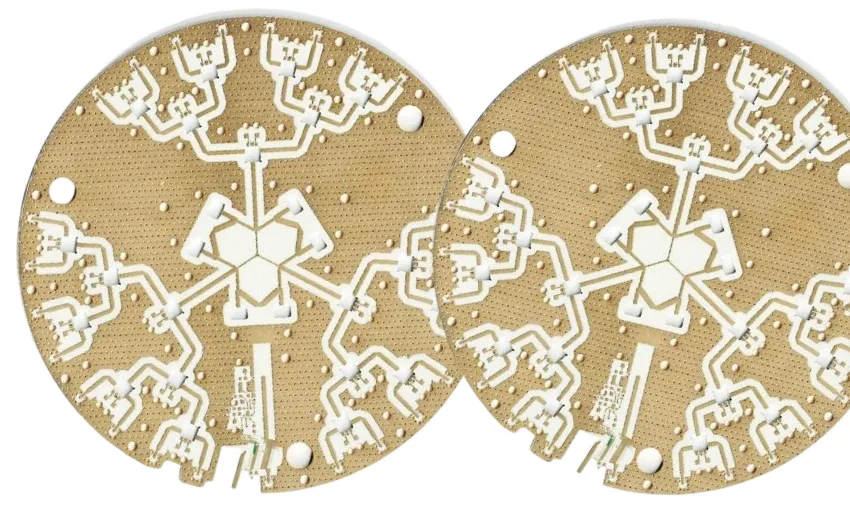
Table of Contents
- What Is Rogers AD300 PCB Material
- AD300 Series: AD300C, AD300D, and AD300A Explained
- Key Electrical and Mechanical Properties
- PIM Performance: Why It Defines AD300 Applications
- Where Rogers AD300 PCB Is Used
- How AD300 Compares to Other Rogers AD Series Materials
- Highleap’s Rogers AD300 PCB Capabilities
- Frequently Asked Questions
A Rogers AD300 PCB is a printed circuit board built on Rogers Corporation’s AD300-series laminate — a ceramic-filled, glass-reinforced PTFE-based substrate engineered for antenna applications where passive intermodulation (PIM) performance and low insertion loss are the governing design requirements. The current production variant is the AD300D, which has largely replaced the earlier AD300C in most commercial antenna programs.
This material sits within Rogers’ AD Series — a family of antenna-grade laminates spanning Dk values from 2.50 (AD250C) through 3.50 (AD350A), allowing antenna engineers to select a substrate Dk that optimizes element spacing, feed network dimensions, and beamwidth for their operating frequency and form factor.
1) What Is Rogers AD300 PCB Material
Rogers AD300 is a PTFE-based laminate using ceramic filler for dielectric constant control and woven glass reinforcement for dimensional stability. Unlike hydrocarbon-ceramic laminates (such as the RO4000 series), AD300 uses a fluoropolymer resin system, which gives it distinct processing characteristics — requiring plasma desmear or sodium etch for via metallization rather than standard alkaline desmear.
The material is designed around three performance priorities: controlled Dk for predictable antenna dimensions, low loss for high antenna efficiency, and suppressed passive intermodulation for multi-carrier infrastructure.
For engineers working on high-frequency PCB designs, AD300 occupies a specific niche: it is not the lowest-loss Rogers material available, but it delivers the combination of PIM suppression, dimensional stability, and PTFE processability that antenna infrastructure applications require.
2) AD300 Series: AD300C, AD300D, and AD300A Explained
The AD300 product designation covers three variants with different formulations:
AD300C was the original production variant. It established the series’ Dk target near 3.00 and the PTFE/ceramic/glass construction that defines the AD300 family.
AD300D is the current production standard and the variant specified in most new designs. Key improvements over AD300C include a refined dielectric constant tolerance and optimized PIM response. When engineers and manufacturers refer to “Rogers AD300 PCB” in active programs, they almost universally mean AD300D.
AD300A is a second-generation reformulation that differs from AD300C in dissipation factor (Df), coefficient of thermal expansion (CTE), and temperature coefficient of dielectric constant (TCDk). AD300A introduced process improvements that reduced variability across production lots.
For any new design, specify AD300D. For legacy programs on AD300C or AD300A, confirm with your fabricator whether the variants are interchangeable for your impedance targets before substituting.
3) Key Electrical and Mechanical Properties
All values below are for AD300D, the current production variant, measured per IPC-TM-650 methods at 10 GHz and 23°C unless noted.
| Property | Value | Test Condition |
|---|---|---|
| Dielectric Constant (Dk) | 2.94 ± 0.05 | 10 GHz / 23°C |
| Dissipation Factor (Df) | 0.0021 | 10 GHz / 23°C / 50% RH |
| CTE (X-axis) | 24 ppm/°C | — |
| CTE (Y-axis) | 23 ppm/°C | — |
| CTE (Z-axis) | 98 ppm/°C | — |
| Decomposition Temperature (Td) | >500°C | — |
| Moisture Absorption | 0.04% | ASTM D570 |
| Flammability Rating | UL 94 V-0 | — |
Three properties define AD300D’s position among high-frequency materials. The Dk of 2.94 is well-controlled to ±0.05 tolerance, enabling predictable impedance across production lots. The Df of 0.0021 is low enough for high-efficiency antenna designs but not as aggressive as materials like RT/duroid 5880 (Df 0.0009). The Z-axis CTE of 98 ppm/°C is characteristic of PTFE-based materials and must be accounted for in via reliability calculations on multilayer designs.
4) PIM Performance: Why It Defines AD300 Applications
Passive intermodulation (PIM) is a nonlinear distortion phenomenon in passive components that generates interference signals at intermodulation frequencies. In multi-carrier base station antennas carrying two or more transmit carriers, PIM products can fall directly on receive frequencies, degrading system sensitivity and carrier-to-interference ratios.
Rogers AD300D achieves PIM levels as low as -165 dBc when tested using Rogers’ internal method on 0.030″ thick substrates with S1 reverse-treated copper foil. This figure is not a guaranteed specification — PIM performance is heavily influenced by copper foil type, surface treatment, and circuit geometry — but it establishes the material’s capability class for base station antenna design.
Copper foil selection is the most significant PIM variable. AD300D is available with three foil options:
- Standard ED (electrodeposited) copper: General-purpose; adequate for moderate PIM requirements
- Reverse-treated ED copper (S1 foil): Recommended for antenna applications where PIM is a performance specification; provides the -165 dBc reference values
- IM Series copper foil: High peel strength option for applications with demanding mechanical requirements
For any antenna design with a published PIM specification, specify reverse-treated (S1) copper foil explicitly. Defaulting to standard ED copper without understanding the PIM impact is a common oversight that affects measured system performance.
5) Where Rogers AD300 PCB Is Used
AD300D is qualified for antenna applications across the cellular and commercial wireless frequency range. Documented use cases include:
- Base station antenna feed networks: The feed network distributes power from the transceiver to antenna elements. PIM performance in the feed network directly affects the interference floor of the entire antenna system.
- Distributed antenna systems (DAS): Indoor coverage systems where multiple antenna nodes share signal from a common source. Low insertion loss and PIM stability are critical for system link budget.
- Commercial cellular antennas: Sector antennas for 4G LTE and 5G sub-6 GHz infrastructure where regulatory PIM limits apply.
- Patch antennas for GNSS, GPS, and SDAR: Precision positioning and satellite radio receive antennas where substrate Dk consistency determines phase center stability.
- Digital Audio Broadcasting (DAB) antennas: VHF/UHF band broadcast receive antennas.
AD300D is not typically specified for millimeter-wave applications above 40 GHz, where materials like RT/duroid 5880 with lower Df provide necessary insertion loss margins. It is also not suited for high-power designs where thermal conductivity is the primary concern — that application is covered by higher-Dk laminate options in the AD Series, specifically AD350A.
6) How AD300 Compares to Other Rogers AD Series Materials
| Material | Dk (@ 10 GHz) | Df (@ 10 GHz) | Primary Design Driver |
|---|---|---|---|
| AD250C | 2.50 ± 0.05 | ~0.0015 | Lowest Dk, largest antenna elements, widest bandwidth |
| AD255C | 2.55 ± 0.05 | ~0.0015 | Cost-effective PIM performance for sub-6 GHz antenna |
| AD300D | 2.94 ± 0.05 | 0.0021 | PIM suppression + low loss for base station antennas |
| AD350A | 3.50 ± 0.05 | ~0.0030 | High thermal conductivity for higher-power designs |
Within the AD Series, AD300D and Rogers RO3035 (Dk 3.50, from the RO3000 series) address similar Dk ranges but from different construction philosophies. AD300D is optimized for PIM; RO3035 is optimized for stable dielectric behavior in broader microwave circuits. Neither replaces the other — the correct choice depends on whether PIM suppression or broader microwave performance is the governing requirement.
Isola I-Tera MT40 is a non-PTFE alternative for designers who need low-loss performance but want FR4-compatible processing. It does not offer the PIM characteristics of AD300D but eliminates PTFE-specific fabrication requirements.
7) Highleap’s Rogers AD300 PCB Capabilities
Highleap Electronics fabricates Rogers AD300 PCBs with PTFE-specific process controls: plasma desmear for via metallization, impedance-controlled etching verified by TDR coupon measurement, and copper foil selection matched to the design’s PIM requirements.
- Materials stocked: AD300D with standard ED, reverse-treated (S1), and IM Series copper foil
- Impedance control: ±5% controlled impedance with TDR verification on every production panel
- Layer range: 2-layer through multilayer hybrid (AD300D outer layers with compatible inner core materials)
- Assembly: Integrated SMT assembly with RF-specific reflow profiles and connectorization
For PCB fabrication projects on AD300D, submit Gerber files, stackup specification, impedance targets, and copper foil requirements. Our engineering team provides a DFM review before production release to confirm that trace geometry, via structure, and copper specification are consistent with the intended PIM and electrical performance.
For context on the broader range of RF and microwave PCB materials and processing, see our dedicated resource on PCB laminate material selection. Our high-frequency PCB fabrication services page covers the full material range and process capabilities.
Request a Rogers AD300 PCB Quote
Frequently Asked Questions
What is the difference between Rogers AD300C and AD300D?
AD300C and AD300D differ in dielectric constant value and nominal available thicknesses. AD300D is the current production standard with a Dk of 2.94 ± 0.05 at 10 GHz. AD300A is a second-generation formulation that differs from AD300C in Df, CTE, and TCDk values. For new designs, specify AD300D. AD300C is legacy and should only be specified when maintaining backward compatibility with an existing qualified design.
What Dk value should I use for impedance calculations on Rogers AD300D?
Use the design Dk of 2.94 at 10 GHz for impedance simulation. Note that Dk is not static — it shifts slightly with frequency and temperature. Rogers recommends validating impedance on prototype boards before committing to production. For microstrip designs, the effective Dk will be lower than the bulk material Dk due to the air region above the trace; use your EM simulator’s material model rather than applying the bulk Dk directly.
How does copper foil choice affect PIM performance on Rogers AD300 PCB?
Copper foil selection is the dominant variable in PIM performance. Reverse-treated ED copper (S1 foil) is the reference standard for Rogers’ published PIM figures of -165 dBc. Standard ED copper typically yields measurably higher PIM. IM Series foil provides higher peel strength but similar PIM performance to S1. If your design has a PIM specification, always specify S1 (reverse-treated) foil explicitly in your fabrication notes.
Can Rogers AD300D be used in multilayer stackups?
Yes. AD300D can be used in multilayer constructions, typically as outer layers in hybrid stackups. Because it is a PTFE-based material, bonding between AD300D and other laminates requires compatible bonding materials validated for PTFE-to-substrate adhesion. The Z-axis CTE of 98 ppm/°C must be accounted for in plated through-hole reliability calculations when AD300D is used in thick multilayer constructions with significant copper weight.
Is Rogers AD300D compatible with lead-free assembly?
Yes. AD300D has a decomposition temperature (Td) exceeding 500°C and is UL 94 V-0 rated, making it compatible with standard lead-free solder reflow profiles (typically peak temperatures of 260°C). The material’s PTFE base has a relatively low coefficient of friction and requires standard PTFE handling precautions during assembly (clean handling to avoid surface contamination that can affect solderability).

Recommended Posts
TMM4 Filter PCB Manufacturing
TMM4 filter PCB manufacturing is controlled by the...
TMM3 PCB Manufacturing for RF Modules
TMM3 PCB manufacturing is most useful where the RF module...
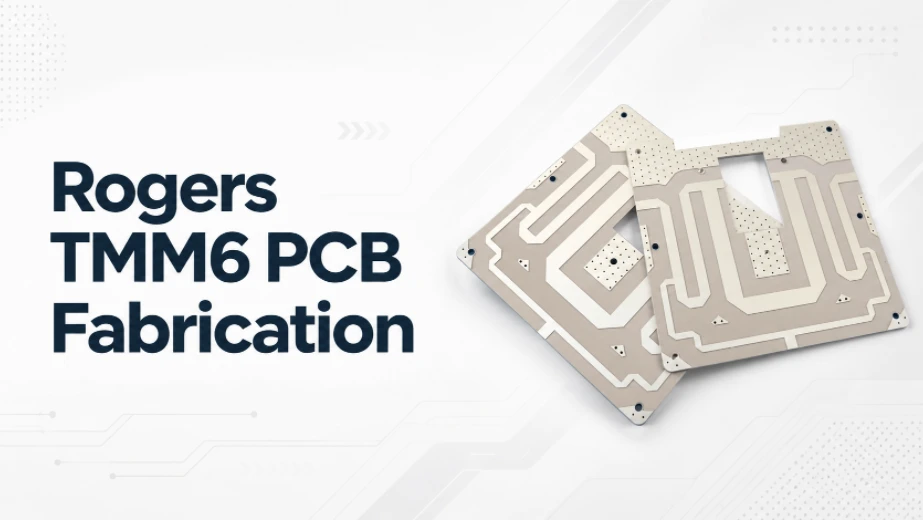
TMM6 PCB Fabrication
TMM6 fabrication is the process-control page for a mid-Dk...
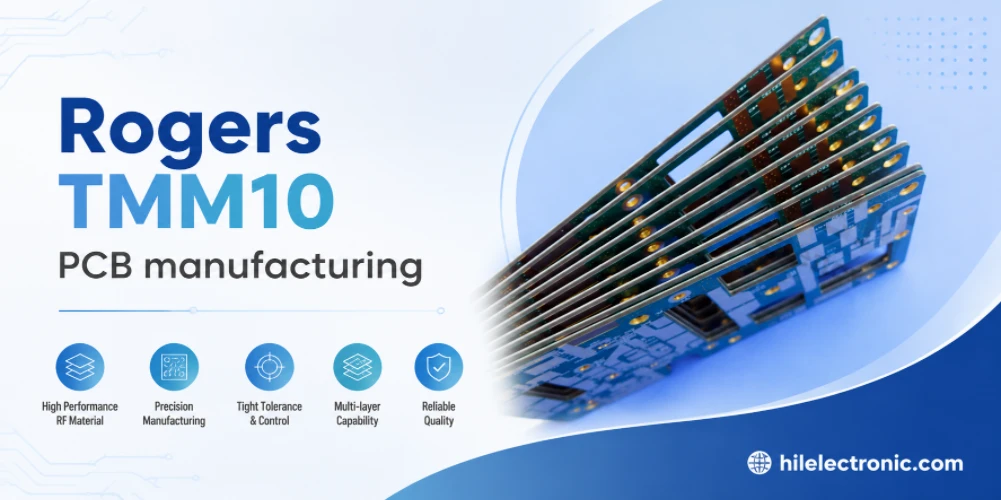
TMM10 PCB Manufacturing for Compact RF Designs
Table of contentsHow TMM10 Shrinks RF StructuresTMM10 vs...
How to get a quote for PCBs
Let’s run DFM/DFA analysis for you and get back to you with a report. You can upload your files securely through our website. We require the following information in order to give you a quote:
-
- Gerber, ODB++, or .pcb, spec.
- BOM list if you require assembly
- Quantity
- Turn time
For PCBA services, please provide your BOM (Bill of Materials) and any specific assembly instructions. We also offer DFM/DFA analysis to optimize your designs for manufacturability and assembly, ensuring a smooth production process.