
Enterprise Inference Server PCB Factory
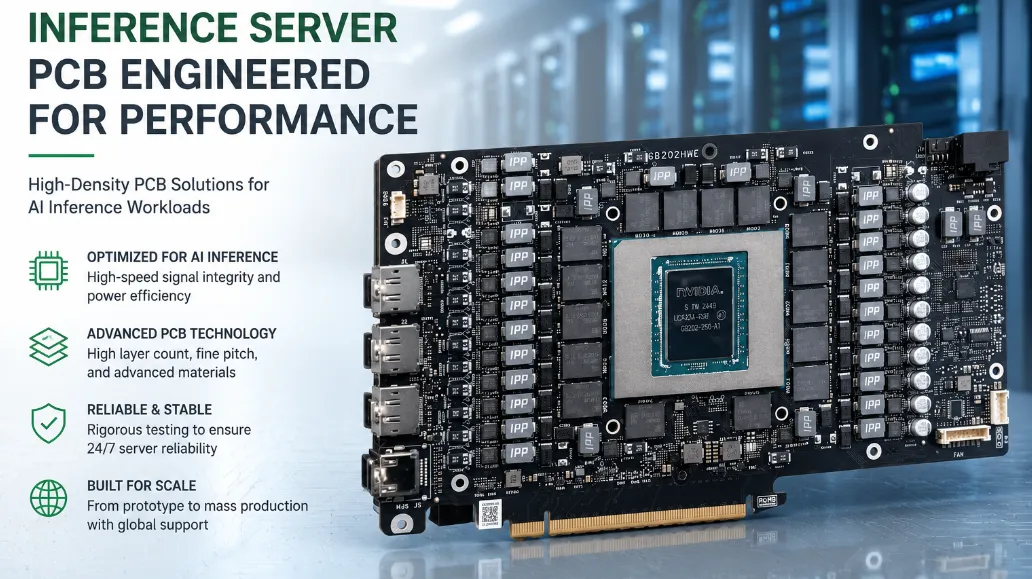
Figure 1. Inference Server PCB
Highleap Electronics is a PCB manufacturing and assembly factory with proven capability as an inference server PCB factory partner. We build accelerator carriers, server mainboards, OCP NIC mezzanines, Jetson carrier boards, and the supporting power, storage, and management PCBs that go into AI inference platforms — alongside our broader PCB and EMS portfolio.
Table of Contents
- What OEMs Look for in an Inference Server PCB Factory
- Inference Server PCB Factory Capability Matrix
- Board Types Built by Our Inference Server PCB Factory Line
- Quality Flow & AVL at the Inference Server PCB Factory
- Cost Engineering for High-Volume Inference Server PCB Programs
- Engaging Highleap as Your Inference Server PCB Factory
1. What OEMs Look for in an Inference Server PCB Factory
AI inference programs run at higher volume than training hardware, with tighter cost-down expectations and faster ramp from prototype to mass production. The inference server PCB factory must align with all three. The criteria below are what engineering and procurement teams at AI inference OEMs verify before placing a board program.
Engineering requirements for an inference server PCB factory
- PCIe Gen5/Gen6 routing discipline: An inference server PCB factory must hold 85Ω differential ±5–10% on Gen5 lanes and demonstrate back-drilling to ≤8 mil residual stub on production builds, not just prototypes.
- DDR5 fabrication discipline: 40Ω single-ended impedance, length matching to ±2 mil intra-byte, glass-weave management — verified panel by panel via our impedance control PCB flow.
- Layer count flexibility: 8 layers (Jetson edge carriers) up to 24 layers (data center inference mainboards) on the same line with consistent quality and lead time.
- Material range across cost points: Standard high-Tg FR4 (Isola 370HR, IS410) through mid-loss (FR408HR, I-Tera MT40) up to ultra-low-loss (Tachyon 100G) — a real inference server PCB factory carries every relevant material in active production stock.
- HDI sequential lamination: Compact edge inference carriers and dense BGA fanout under inference ASICs require 1+N+1 and 2+N+2 stackups, supported on our HDI PCB manufacturing line.
Procurement requirements for an inference server PCB factory
- Capacity ramp: Inference platforms can scale from prototype to 10,000+ units per month inside a single quarter; capacity reserved against rolling forecast, not just promised.
- AVL qualification flow: Tier-1 inference hardware customers operate formal AVL processes — documented site-audit history, process-validation records, and sample-build qualification packages ready.
- Change control discipline: Formal ECN management with cost and lead-time impact; supplier-initiated PCN with 90–180 day advance notice.
- Long-life supply: Inference hardware ships 3–5 years with another 5+ years of spare-parts support.
- Cost-down partnership: Annual cost-down reviews are standard; the inference server PCB factory must bring PCB-level proposals — material substitution, stackup consolidation, panelization improvement — not just hold price flat.
Quality system baseline
- IATF 16949 certified: baseline for any inference server PCB factory serving Tier-1 OEM AVLs.
- IPC-A-600 Class 2 standard, Class 3 on request: Class 2 typical for accelerator carriers and mainboards; Class 3 for safety-critical or long-life programs.
- UL recognition: standard for regulated enterprise markets.
- AS9100D-aligned process flow available: for inference programs serving defense, aerospace ground equipment, or government computing applications.
2. Inference Server PCB Factory Capability Matrix
What our inference server PCB factory confirms in writing during AVL qualification. Production-line numbers, not best-case prototype demonstrations.
| Parameter | Inference Server PCB Factory Spec |
|---|---|
| Layer count | 2 to 32 layers, production-qualified |
| Minimum trace / space | 0.060 / 0.060 mm production; 0.050 / 0.050 mm prototype |
| Minimum mechanical drill | 0.15 mm production; 0.10 mm prototype |
| Laser microvia | 0.075 mm minimum; 0.10 mm with 0.20 mm capture pad standard |
| Aspect ratio | 10:1 standard; 12:1 on request |
| Controlled impedance | ±10% standard; ±5% on critical Gen5 differential pairs |
| Back-drill residual stub | ≤8 mil with ±5 mil tolerance |
| Copper weight | 0.5 oz to 4 oz inner; 0.5 oz to 3 oz outer |
| Maximum board size | 600 × 500 mm |
| Imaging | LDI at 25 µm resolution |
| Surface finishes | ENIG, ENEPIG, immersion silver, OSP, lead-free HASL — see PCB surface finish |
| Electrical test | 100% flying probe or fixture; TDR coupon per panel; S-parameter to 40 GHz on request |
| Quality certifications | ISO 9001:2015, IATF 16949, UL recognition, AS9100D-aligned flow available |
| IPC acceptance class | IPC-A-600 Class 2 standard; Class 3 on request |
Material qualified at the inference server PCB factory
Every laminate listed is in active production qualification at our inference server PCB factory line — built at production yield, not just on prototype panels:
- Standard high-Tg FR4: Isola 370HR, IS410 — baseline for cost-optimized inference carrier and edge AI boards. See our FR4 PCB manufacturing capability.
- Mid-loss laminate: Isola FR408HR, Isola I-Tera MT40 — PCIe Gen4 to Gen5 routing on accelerator carriers with moderate channel length.
- Ultra-low-loss laminate: Isola Tachyon 100G, Panasonic Megtron 7 — high-end inference programs requiring premium signal integrity on long-channel Gen5/Gen6 routing or 112G PAM4 network host boards.
- RF / high-frequency: a specialty low-loss laminate, a specialty low-loss laminate — accelerator carriers integrated with wireless or mmWave front-ends. See specialty low-loss laminate PCB manufacturing.
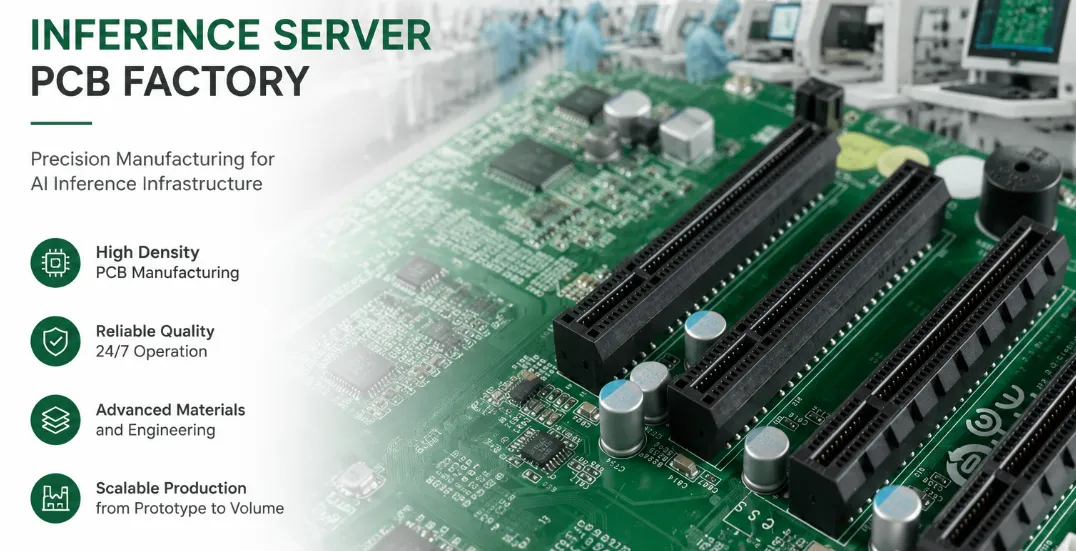
Figure 2. Inference Server PCBA
3. Board Types Built by Our Inference Server PCB Factory Line
An inference server PCB factory rarely builds just one board type per customer program. A typical inference platform involves a mainboard, multiple accelerator carriers, network interface carriers, storage backplanes, and a set of management and power boards — all coordinated under one fabrication agreement.
Inference accelerator carrier boards
- GPU carriers: PCIe slot-form-factor carriers for NVIDIA L40S (300W), L4 (72W), H100 NVL (400W per pair), A2 (60W); typically 10–14 layer construction on mid-loss laminate.
- Custom inference ASIC carriers: dedicated carriers for AWS Inferentia, Google TPU v4i/v5e, Sambanova, Groq, Cerebras inference, and hyperscaler proprietary chips. Typical 14–22 layers with dense power delivery and HBM-host support.
- FPGA inference carriers: AMD Alveo (U200/U250/U280/V70/V80), Intel Agilex, BittWare cards — 16–24 layers depending on memory subsystem.
- NVLink bridge boards (H100 NVL): small high-frequency boards built on Tachyon 100G; precision blind-mate connector integration.
Inference server mainboards
- 2U / 4U PCIe-slot inference servers: dual-socket Xeon or EPYC mainboards with 4–10 PCIe Gen5 slots; 12–18 layer construction; the highest-volume mainboard category at our inference server PCB factory.
- 1U compact inference servers: single-socket or low-profile dual-socket mainboards for hyperscaler inference farms; cost-optimized stackups.
- MGX modular platform mainboards: NVIDIA MGX-class modular building-block server mainboards supporting mixed CPU + GPU + DPU configurations; 14–18 layer typical.
- Edge box-PC inference mainboards: compact 100–250 mm form factors with integrated SoC, M.2 NVMe, multiple GbE ports; fanless thermal design support.
Network interface carriers
- OCP NIC 3.0 mezzanine carriers: SFF (76 × 115 mm) and TSFF/LFF (76 × 139 mm) hot-pluggable mezzanines for ConnectX-7 (400G), BlueField-3 DPU, Intel E810 (100G), Broadcom Thor (200G/400G).
- PCIe slot NIC carriers: low-profile and full-height carriers for 10/25/100/200/400 GbE inference traffic.
- SmartNIC and DPU carriers: NVIDIA BlueField-3, Pensando, Marvell Octeon — 14–16 layer carriers with onboard DRAM and management interfaces.
Storage backplanes and management boards
- NVMe backplanes: U.2/U.3 PCIe Gen4/Gen5 hot-swap backplanes for inference server local storage.
- E1.S / E3.S EDSFF backplanes: emerging high-density NVMe formats for hyperscaler inference platforms.
- M.2 expansion carriers: daughter cards hosting multiple M.2 NVMe drives.
- BMC management boards: ASPEED AST2600-based service processor boards.
- Front-panel and rear-I/O bezel boards: chassis-integration PCBs for status LEDs, service indicators, front-bezel network ports.
Compact and edge inference carrier boards
- Jetson Orin Nano / NX / AGX carriers: 8–12 layer carriers with CSI camera lanes, USB 3.x, GbE, GPIO, CAN bus, RS-232/485, M.2 sockets — built on Isola 370HR or FR408HR.
- Hailo, Ambarella, Qualcomm AI accelerator carriers: compact carriers for smart cameras, in-vehicle inference, retail AI.
- Multi-NPU edge boards: custom carriers hosting 2–8 NPU chips for distributed embedded inference.
4. Quality Flow & AVL at the Inference Server PCB Factory
Tier-1 inference hardware OEMs do not buy from an inference server PCB factory based on capability sheets alone. They run formal AVL qualification programs over 3–9 months. Our factory is structured to support that flow without slowing it down.
Inference server PCB factory inline quality control
- Inner-layer 100% AOI on every panel against Gerber
- X-ray registration verification on high-layer-count carriers at first article and agreed sampling frequency
- Microsection sampling: first article 100%; in-process per customer frequency. Plating thickness, via barrel integrity, layer alignment
- TDR coupon impedance verification on every panel
- 100% electrical test: flying probe (low-medium volume) or fixture (high-volume)
- S-parameter coupon test (on request): insertion loss, return loss, crosstalk to 40 GHz
- Final visual: IPC-A-600 Class 2 standard, Class 3 on request
Documentation per delivery
- Certificate of Conformance with material lot and process run traceability
- Material certificates (laminate, prepreg, copper foil)
- Electrical test report
- TDR impedance test report per panel
- Microsection report (first article + sampling)
- AOI inspection logs
- Visual inspection records to IPC-A-600 class
- RoHS, REACH, conflict-minerals declarations
- Process traceability log
AVL qualification flow at our inference server PCB factory
- Pre-qualification audit: customer quality team site visit; review of equipment, process, environmental controls, lab, operator certification.
- Process documentation: SPC data on critical parameters, control plans, FMEA, MSA.
- First article sample build: 25–200 piece sample of a representative inference server PCB with full documentation.
- Customer validation: environmental (thermal cycling, humidity, mechanical shock), system-level functional and stress test under customer protocols.
- Formal AVL approval: cross-functional engineering, quality, manufacturing, procurement sign-off — our team supports the documentation requirements at every step.
- AVL maintenance: PPM scorecards, on-time delivery, response-time metrics; periodic re-audits.
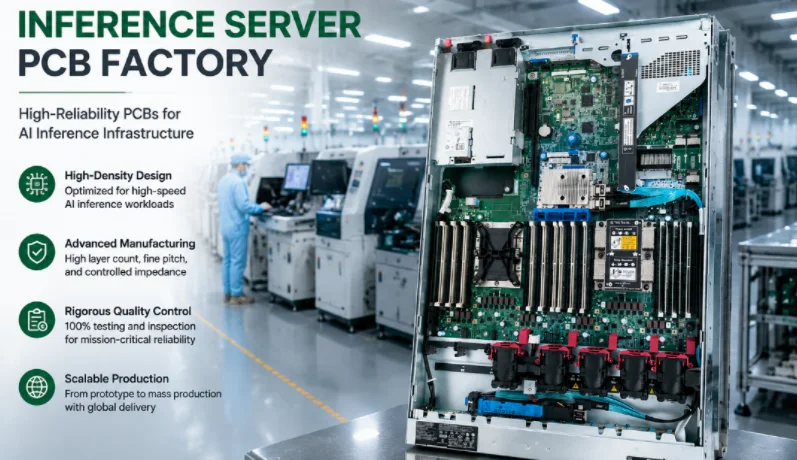
Figure 3. Inference Server PCB Factory
5. Cost Engineering for High-Volume Inference Server PCB Programs
Inference server PCB programs run at significantly higher volume than training hardware. The economic value an inference server PCB factory delivers is in disciplined cost engineering across that volume.
Layer count optimization
- Stackup consolidation: our engineering team reviews routing density to identify layer pairs that can be eliminated; each pair removed reduces unit cost 7–12% on typical inference mainboards.
- Symmetric stackup discipline: symmetric stackups improve panel yield by reducing warp; the trade-off documented for customer approval.
Material substitution at the inference server PCB factory
- FR408HR → 370HR on short channels: where signal-integrity simulation confirms acceptable loss budget, IS410-class material saves 15–20% over FR408HR.
- I-Tera MT40 → FR408HR on moderate-rate signals: where 25G SerDes runs are short, mid-grade material may suffice.
- Hybrid stackup: ultra-low-loss material only on critical signal layers; cost-grade material on power, ground, slower signals — fully qualified production process.
Surface finish and panelization
- OSP over ENIG where assembly process allows: 10–15% surface finish cost reduction.
- Selective ENIG: ENIG only on press-fit and edge-connector areas; OSP on standard pads.
- Multi-PCB panels for board family: mainboard + carrier + bezel board panelized together reduces total setup cost.
- Tooling amortization across volume: larger lot sizes spread NRE per piece.
Long-life sustainment
- Material lifecycle monitoring: our factory tracks laminate PCNs; relevant changes flagged to customer programs in advance.
- Documented substitutability: for each qualified material, documented near-equivalent alternatives.
- Strategic material reserve: for high-criticality inference programs, dedicated material lot reservation.
- EOL planning: 18–24 month advance planning on end-of-production; spare-parts production capacity reserved.
6. Engaging Highleap as Your Inference Server PCB Factory
Data center inference programs
- Prototype builds: 25–100 piece prototype at 7–12 working day turnaround for 14–18 layer accelerator carriers and mainboards.
- Qualification samples: 200–1,000 pieces for environmental qualification, system-level testing, customer AVL approval.
- Pilot production: first volume runs 2,000–10,000 units with capacity reserved against customer commit.
- Volume production: scheduled monthly or weekly deliveries against rolling forecast; programs run 3–5 years at steady demand.
Edge inference and embedded AI programs
- Prototype: 25–100 piece at 5–8 working day turnaround for typical 8–12 layer edge AI carrier boards.
- Qualification: wide-temperature operation, conformal coating compatibility, vibration testing per EN 50155 or customer-equivalent.
- Volume production: typically more variable than data center; buffer-stock and consigned-inventory programs valuable for edge AI OEMs with project-driven demand.
- Long-life support: 10+ year deployment lifecycles common; EOL planning and material substitutability supported throughout.
Custom inference ASIC programs
- Engineering partnership: early-stage stackup, impedance modeling, material recommendation — typically engaged 9–12 months before first silicon.
- First-silicon bring-up: rapid-turn prototype builds aligned with ASIC tape-out and bring-up schedule.
- Production ramp: capacity reservation matched to ASIC supply ramp; tight coordination across silicon supplier, PCB factory, OEM assembly partner.
- NDA and IP protection: dedicated engineering team and segregated information flow for confidential programs.
Highleap Electronics is a full-service PCB manufacturing and assembly factory; the inference server PCB factory capability described on this page is one of several specialized programs we run. We are ISO 9001 and IATF 16949 certified, with AS9100D-aligned process flow available. Our high-speed line for inference server PCB factory work is equipped with laser direct imaging at 25 µm resolution, controlled-depth back drilling at ±5 mil tolerance, 100% impedance test coverage with TDR, S-parameter characterization to 40 GHz on request, and microsection capability for first-article and in-process validation.
Submit Gerber files, drill data, stackup specification, target quantities, and program timeline through our online quote portal for a 24-hour response. For complex inference server PCB factory programs — custom ASIC carriers, edge AI platforms, hyperscaler qualification flows — our engineering team can engage directly. For related capability content, see our pages on AI server PCB manufacturing and AI computing hardware PCB manufacturing.

Recommended Posts
TMM4 Filter PCB Manufacturing
TMM4 filter PCB manufacturing is controlled by the...
TMM6 PCB Fabrication
TMM6 fabrication is the process-control page for a mid-Dk...
TMM3 PCB Manufacturing for RF Modules
TMM3 PCB manufacturing is most useful where the RF module...
TMM10 PCB Manufacturing for Compact RF Designs
Table of contentsHow TMM10 Shrinks RF StructuresTMM10 vs...
How to get a quote for PCBs
Let‘s run DFM/DFA analysis for you and get back to you with a report. You can upload your files securely through our website. We require the following information in order to give you a quote:
-
- Gerber, ODB++, or .pcb, spec.
- BOM list if you require assembly
- Quantity
- Turn time
For PCBA services, please provide your BOM (Bill of Materials) and any specific assembly instructions. We also offer DFM/DFA analysis to optimize your designs for manufacturability and assembly, ensuring a smooth production process.