
Advanced Rogers AD300 PCB Manufacturer Services

Table of Contents
Rogers AD300 PCB manufacturer in this context means a PCB fabrication company that can build circuit boards using Rogers Corporation’s AD300D laminate as the substrate. Rogers Corporation manufactures the AD300D laminate material itself; PCB fabricators like Highleap Electronics source that material from Rogers and process it into finished circuit boards.
Finding a qualified PCB fabricator for AD300D builds is not the same problem as finding a standard PCB supplier. AD300D is a PTFE-based laminate with fabrication requirements that most factories — even large, technically capable ones — have not invested in. A factory without validated PTFE process infrastructure will produce boards that look correct at incoming inspection but fail in the field.
This guide explains what to look for, what to ask, and what to avoid when selecting a PCB fabricator for AD300D builds — for both prototype development and volume production.
1) Why Most Factories Cannot Make Rogers AD300 Correctly
The primary barrier is via metallization. AD300D requires plasma activation — CF₄/O₂ plasma — before electroless copper will adhere to via walls. This requires a dedicated plasma chamber that most standard factories do not have.
Factories without plasma capability either decline the work or process the board using standard alkaline desmear. The boards they deliver pass electrical continuity test but have poor via wall adhesion that fails under thermal cycling.
The capability gap extends further:
- Impedance modeling: Accurate Dk/Df inputs calibrated to the specific AD300D thickness and copper weight being used — not a generic “PTFE Dk 2.9” entry
- Copper foil expertise: Understanding of when S1 reverse-treated foil is required versus standard ED copper based on the design’s PIM requirements
- Hybrid stackup validation: For AD300D outer layers with different inner core materials, the bonding film and CTE management must be validated for that specific material combination
For context on the RF PCB manufacturer China capability landscape, supplier tiers range from factories that hold ±5% impedance on Rogers hybrid stackups consistently to those that list “Rogers compatible” based on a single trial order from years ago.
2) Minimum Capability Requirements
Before shortlisting any Rogers AD300 PCB manufacturer, confirm these minimum requirements:
- ☐ In-house PTFE plasma treatment: CF₄/O₂ plasma system operated in-house — not outsourced. Outsourced plasma treatment is a process consistency risk.
- ☐ TDR impedance testing on every panel: Every production panel should include impedance coupons verified by TDR with data reports provided — not pass/fail certificates.
- ☐ Documented PTFE drill parameters: Specific spindle speeds, feed rates, and entry/backup materials for AD300D, verified by cross-section inspection. Ask for a cross-section photo from a recent AD300D build.
- ☐ AD300D-specific Dk inputs in impedance modeling: Field solver loaded with Dk values calibrated for AD300D at the specific thickness and copper weight being processed.
- ☐ Recent AD300D production history: PTFE processing skills degrade when a factory goes extended periods without running the material. Ask specifically when their last AD300D production lot shipped.
A qualified manufacturer for HF PCB solutions should also be able to process RT/duroid, RO3000, and other PTFE families — confirming that PTFE handling is a core competency, not a one-time capability.
3) Questions to Ask Before Placing an Order
These questions separate manufacturers with genuine AD300 capability from those who are guessing:
“What copper foil do you use by default for Rogers AD300D?”
Correct answer: Depends on specification — S1 reverse-treated for PIM-critical designs, standard ED for general RF. Red flag: “We use whatever is available.”
“How do you handle via preparation on PTFE-based materials?”
Correct answer: CF₄/O₂ plasma in-house with first-article cross-section inspection. Red flag: “Same as FR4” or “standard desmear.”
“What Dk value do you use in your impedance model for AD300D?”
Correct answer: Thickness-specific Dk from Rogers’ published data, calibrated against production measurements. Red flag: Generic “PTFE Dk 2.9.”
“Can you provide cross-section photos from a previous AD300D build?”
Any manufacturer with genuine AD300D production history has these. A factory that has never successfully processed the material does not.
“What impedance tolerance can you hold and how do you verify it?”
Correct answer: ±5% with TDR coupon on every panel, data reports included. Red flag: “Verified by calculation.”
These same questions apply when evaluating suppliers against the full range of high-frequency substrate options — the underlying capability requirements are consistent across the PTFE laminate family.
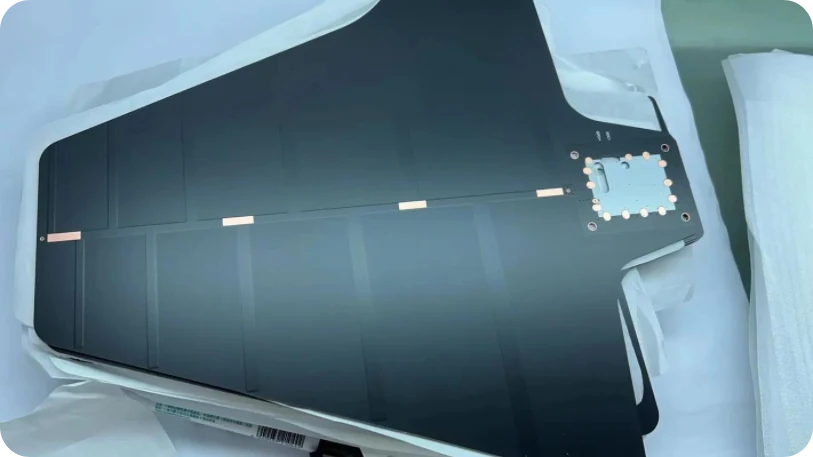
4) Prototype vs. Production Requirements
Prototype requirements center on speed and design validation. An AD300D prototype needs correct impedance, functioning vias, and the correct copper foil for PIM validation. A qualified Rogers AD300 PCB manufacturer can deliver simple 2-layer first articles in 5–7 business days when AD300D is in stock.
Production requirements add consistency, yield, and traceability:
- Lot-to-lot Dk consistency verified by incoming material inspection records
- Process capability data showing impedance distribution across multiple production lots — not just first articles
- Panel yield data for AD300D builds (PTFE is more process-sensitive than FR4; yield affects unit economics at volume)
- Confirmed long-term supply of the specific foil type (S1 or IM Series) your design requires
Do not assume your prototype supplier automatically scales to production. Ask production-specific questions at the prototype stage. Confirm that prototype builds use the same plasma chamber, drill parameters, and impedance model as the production line — not a relaxed prototype process.
For validated RF fabrication capability that covers both prototype and production on AD300D, the key indicator is whether the supplier’s capability documentation references AD300D specifically rather than PTFE or Rogers materials in general.
5) Red Flags in AD300 Manufacturing Proposals
- No mention of copper foil type in the quote: An AD300D quote without foil specification defaults to standard ED copper. If the design requires S1 foil for PIM, this produces boards that fail PIM test.
- TDR testing listed as optional or extra cost: TDR verification on first articles is mandatory — not optional — to confirm the manufacturer’s impedance model is accurate for your specific design.
- Price significantly below market for PTFE fabrication: AD300D carries higher material and process costs than FR4. A dramatically cheaper quote reflects capability gaps or material substitution.
- No cross-section photos from AD300D production: Any manufacturer with genuine experience has this documentation. The inability to provide it means they likely have not run the material recently.
- Generic PTFE process description without AD300D specifics: AD300D has specific requirements distinct from other PTFE materials. “Standard PTFE handling” is not an adequate answer.
6) Highleap as Your Rogers AD300 PCB Manufacturer
Highleap Electronics is a PCB fabrication company that builds circuit boards on Rogers AD300D laminate — sourced from Rogers Corporation — using in-house PTFE process infrastructure specifically validated for antenna-grade laminates:
- In-house plasma desmear: Dedicated CF₄/O₂ plasma chamber, separate from FR4 processing lines
- All copper foil variants: Standard ED, S1 reverse-treated, and IM Series — selection matched to the design’s PIM requirements
- Impedance control: ±5% using Polar SI field solver with AD300D-specific Dk inputs; TDR coupon data on every panel
- Cross-section verification: First-article cross-sections on all new AD300D programs
- Hybrid stackup capability: Validated bonding materials for AD300D hybrid constructions
- Integrated assembly: SMT assembly with RF-specific reflow profiles following fabrication
For board fabrication services on Rogers AD300D, submit Gerber files, stackup specification, impedance targets, and copper foil requirement. Our DFM review confirms the design is consistent with AD300D process constraints before production begins.
For RF microwave board manufacturing context and the full PCB substrate materials landscape, our resources cover AD300D alongside the broader Rogers, Taconic, and Isola families.
For time-sensitive development programs, our quick-turn RF prototyping service delivers qualifying AD300D designs in 5–7 business days. For reference on related Rogers PTFE materials: Rogers RO3010 and RT/duroid PTFE processing.
Get a Rogers AD300 Manufacturer Quote
Frequently Asked Questions
How do I verify a manufacturer can actually fabricate Rogers AD300D correctly?
Ask for three things: a cross-section photo from a recent AD300D build showing via wall quality; a sample TDR data report from production (not a certificate); and confirmation that PTFE plasma treatment is performed in-house. A manufacturer with genuine AD300D production history provides all three within a day.
What information should I include in an RFQ for Rogers AD300 PCB?
Specify: material as “Rogers AD300D” (not just “Rogers AD300”), copper foil type (S1 reverse-treated for PIM-critical designs), laminate core thickness, base copper weight before plating, impedance targets in ohms with tolerance, surface finish, layer count and full stackup details, and whether first-article cross-section inspection is required. Incomplete RFQs result in quotes with wrong foil and surface finish assumptions.
Can my existing FR4 manufacturer fabricate Rogers AD300D boards?
Only if they have in-house plasma desmear, documented PTFE drill parameters, and AD300D-calibrated impedance modeling. Most FR4 manufacturers do not have these. Some will accept the order without disclosing the capability gap and deliver boards with compromised via reliability. Confirm PTFE capability explicitly before placing the order.
What is a reasonable lead time for Rogers AD300D prototype boards?
3–7 business days for simple 2-layer designs from a manufacturer with AD300D in stock. 8–14 days for multilayer or hybrid constructions requiring additional lamination cycles. If AD300D must be ordered from Rogers, add material procurement lead time for non-standard thicknesses. Confirm material availability at the quoting stage.

Recommended Posts

Custom Rogers RO4835 PCB Fabrication & Assembly Services
Figure 1. Rogers RO4835 PCBRogers RO4835 PCB is a...

Nelco N4000-13 PCB Material and Manufacturing Guide | Highleap Electronics
Figure 1. Nelco N4000-13 PCBNelco N4000-13 PCB is a...

Rogers RT/duroid 6002 PCB Manufacturer — Specifications, Stackup, Quote
Figure 1. Rogers RT/duroid 6002Rogers RT/duroid 6002 is...

Miniaturize Antennas with Rogers TMM Laminates
Figure 1. Rogers TMM Executive Summary: Rogers TMM...
How to get a quote for PCBs
Let us run DFM/DFA analysis for you and get back to you with a report.
You can upload your files securely through our website.
We require the following information in order to give you a quote:
-
- Gerber, ODB++, or .pcb, spec.
- BOM list if you require assembly
- Quantity
- Turn time