
How to Reduce Your Blind Buried Via PCB Lead Time

Table of Contents
- Blind Buried Via PCB Lead Time: Standard Benchmarks by HDI Type
- Why Sequential Lamination Creates Non-Compressible Time Floors
- Lead Time by HDI Type: Process Timelines and Bottlenecks
- Material Availability: The Largest Lead Time Variable
- Design Decisions That Reduce Lead Time Without Expediting
- How to Plan HDI Production Schedules Accurately
- Predictable Blind Buried Via PCB Lead Times from Highleap
Blind buried via PCB lead time is determined by the number of sequential lamination cycles in the HDI construction: Type I HDI (1+N+1) requires 10–14 business days standard; Type II requires 14–18 business days; Type III with buried vias in the inner core requires 18–25 business days. (see sequential lamination process in HDI) These timelines apply to boards fabricated with stocked materials at experienced HDI factories. Each lamination cycle adds a minimum 24–48 hours of non-compressible process time — press cure (8–12 hours), cool-down (3–5 hours), inter-cycle inspection, laser drilling setup, and plating — that no expedite fee can eliminate. (see laser direct imaging and drilling) Understanding where the time goes at each stage, and which elements can be compressed versus which are physically constrained, is what separates realistic HDI project schedules from ones that fail during program execution.
Get Lead Time Quote with Delivery Guarantee
1) Blind Buried Via PCB Lead Time: Standard Benchmarks by HDI Type
1.1 Standard Lead Times at a Competent HDI Factory
| HDI Type | Configuration | Lamination Cycles | Standard Lead Time | Expedited Minimum | Super Rush Minimum |
|---|---|---|---|---|---|
| Type I | 1+N+1 | 2 | 10–14 business days | 7 business days | 5 days (Type I only) |
| Type II | 2+N+2 | 3 | 14–18 business days | 10 business days | Not achievable |
| Type III | Buried core + blind outer | 4–6 | 18–25 business days | 14 business days | Not achievable |
| Any-layer HDI | Stacked microvias all layers | 5–8 | 25–35 business days | 18 business days | Not achievable |
These timelines assume: stocked materials, DFM-clean Gerber files, no tooling setup delay (re-order with retained tooling), and standard production queue loading. Any deviation in these factors adds to the times above.
1.2 Comparison with Standard PCB Lead Time
A 10-layer standard PCB (no HDI, through-hole vias only) takes 8–12 business days standard. (see 10-layer HDI cost analysis) Type I HDI on the same layer count takes 10–14 days — a difference of only 2–3 days. The additional time is the inter-cycle inspection and laser drilling setup after the outer buildup lamination. For many programs, this 2–3 day delta is acceptable given the routing density and board size advantages of Type I HDI.
Type III HDI at 18–25 days is 1.8–2.2× longer than standard PCB lead time. The difference is the multiple lamination cycles for buried via processing, each requiring the complete cure-cool-inspect-drill-plate sequence. This is not factory inefficiency — it is the physical minimum time for a correct Type III fabrication process.
1.3 On-Time Delivery Variability Factors
Lead time commitments can slip due to:
- Lamination yield failure: If a lamination cycle produces delamination or registration error, the panel may be scrapped and the cycle repeated. This adds 1–2 business days per incident. Experienced factories with process control catch problems at inter-cycle inspection rather than final test.
- Laser drill queue contention: CO₂ and UV laser drill machines serve multiple jobs. Queue delays of 4–12 hours during peak production periods are common. Priority queuing for expedite orders costs 25–40% premium and moves your job to the front of the laser queue.
- Material shortages: Even stocked materials can become depleted mid-production if multiple large orders clear simultaneously. Factories with material reservation systems can guarantee availability at order placement; others cannot.
2) Why Sequential Lamination Creates Non-Compressible Time Floors
2.1 The Physical Basis of HDI Lead Time
Sequential lamination — where each build-up layer is laminated, drilled, and plated independently before the next begins — is what enables blind and buried vias. It is also what creates the lead time floor that no expedite fee can breach.
Each lamination cycle consists of:
- Stack assembly and press loading: 1–2 hours. Manual or automated; can be parallelized with prior-cycle inspection.
- Press ramp to cure temperature (175–185°C): 60–90 minutes. Cannot be accelerated without thermal gradient risk that causes delamination.
- Cure dwell at temperature: 90–180 minutes. This is the resin cross-linking reaction time. Shorter dwell produces incomplete cure, leading to delamination in service. Cannot be compressed.
- Controlled cool-down: 3–5 hours at controlled rate (2–4°C/minute). Rapid cooling induces thermal shock and warpage from CTE differential between copper and laminate. Cannot be accelerated.
- Panel inspection and X-ray registration check: 1–2 hours per lot.
- Laser drill setup and processing: 4–8 hours including optical calibration and drill program verification.
- Electroless copper and electroplating: 6–10 hours.
Minimum cycle time: approximately 18–28 hours per lamination cycle. For a Type I board (2 cycles): 36–56 hours of cycle time alone, before any of the standard PCB processing steps (outer layer imaging, solder mask, surface finish, testing) are added.
2.2 What This Means for Schedule Planning
The practical implication: Type III HDI boards with 5 lamination cycles have a minimum 90–140 hours of lamination-cycle time alone. Add pre-lamination prep (inner layer imaging, AOI) and post-lamination processing (outer layers, finish, test): total minimum time exceeds 200 hours — approximately 25 working days at a factory running 8-hour shifts. A factory claiming 10-day Type III HDI lead time is either running multiple shifts 24/7 (unusual for complex HDI), using a simplified process that may compromise quality, or misrepresenting their HDI type classification.
(see HDI PCB design guidelines)
2.3 Process Steps That Can and Cannot Be Compressed
| Process Step | Standard Time | Compressible? | Expedited Time |
|---|---|---|---|
| CAM review and job release | 4–8 hours | Yes — priority queue | 2–4 hours |
| Inner layer imaging and etching | 8–16 hours | Partially — shift scheduling | 6–10 hours |
| Lamination press ramp to cure temp | 60–90 min | No — physics | 60–90 min |
| Lamination cure dwell | 90–180 min | No — chemistry | 90–180 min |
| Cool-down (per cycle) | 3–5 hours | No — thermal stress risk | 3–5 hours |
| Laser drill setup and processing | 6–12 hours | Yes — priority machine access | 2–6 hours |
| Plating (electroless + electrolytic) | 10–18 hours | Partially — bath capacity | 6–12 hours |
| Outer layer imaging and solder mask | 8–16 hours | Yes — priority scheduling | 4–8 hours |
| Surface finish (ENIG) | 6–10 hours | Partially | 4–8 hours |
| Electrical test (flying probe) | 4–8 hours | Yes — priority scheduling | 2–4 hours |
Total compressible time on a Type I HDI board: 8–14 hours. This is why expediting shortens lead time by 3–5 days maximum — not by 10 days, regardless of fee paid.
3) Lead Time by HDI Type: Process Timelines and Bottlenecks
3.1 Type I HDI: Baseline for Most HDI Programs
Type I HDI (1+N+1) process timeline at 10–14 day standard lead time:
- Day 0–1: CAM review, DFM check, job release. Gerber files reviewed, impedance targets confirmed, lamination program generated.
- Day 1–2: Inner layer fabrication — imaging, etching, AOI. Core laminate processed to finished inner copper layers.
- Day 2–4: First lamination cycle — core + prepreg + outer copper foil. Press cycle (8–12 hours), cool-down (3–5 hours), thickness measurement and inspection.
- Day 4–6: Laser drilling of blind vias (outer buildup layers), laser drill inspection, desmear and electroless copper deposition.
- Day 6–8: Electroplating (blind via barrel copper to spec), second lamination cycle for outer buildup if Type I has separate buildup structure, or direct to outer layer processing.
- Day 8–11: Outer layer imaging, etching, solder mask application and cure, ENIG surface finish.
- Day 11–13: Electrical test (flying probe or fixture), X-ray inspection, final optical inspection, packaging.
- Day 13–14: Shipping preparation and dispatch.
3.2 Type II HDI: The Complexity Step-Up
Type II adds one lamination cycle per side (or two total for symmetric 2+N+2). The additional cycle inserts between the first blind via layer and the second:
- After first buildup lamination and laser drilling (Days 2–6 above): second prepreg and outer copper lamination (another 8–12 hours cure + 3–5 hours cool-down), second laser drilling pass
- Net addition: 1 full lamination-drill-plate sequence = 3–5 additional business days
- Total: 14–18 business days standard
The bottleneck on Type II lead time is the sequential interdependence: the second laser drill pass cannot begin until the first blind via layer is plated to minimum copper thickness and the second lamination is fully cured. There is no parallelization available.
3.3 Type III HDI: Multiple Buried Via Cycles
Type III adds buried via processing in the core before the outer buildup layers are applied. Each buried via layer pair in the core requires:
- Core drilling (mechanical, for buried via holes)
- PTH plating for buried via barrels
- Core patterning (inner layers adjacent to buried vias imaged and etched)
- Another lamination cycle to enclose the buried vias
With 2 buried via layer pairs: 2 additional lamination cycles before outer buildups begin. Total lamination cycles: 2 (outer buildups) + 2 (core buried vias) = 4 cycles. For complex Type III with 3–4 buried via layer pairs: 5–6 total cycles, 18–25 business day lead time.
3.4 Why Your Quoted Lead Time May Be Longer Than These Benchmarks
Several conditions cause actual lead times to exceed these benchmarks:
- Non-stocked materials: Adds 5–15 days for procurement before fabrication begins
- Queue loading: Factory at capacity adds 2–5 days waiting for press and laser drill time
- Engineering queries: DFM issues in submitted files add 1–3 days for back-and-forth before job release
- Re-lamination: A failed lamination cycle adds 1–2 days for re-press or panel scrapping and re-start
- Class 3 inspection: Adds 1–2 days for cross-section analysis, micro-section review, and extended electrical test
4) Material Availability: The Largest Lead Time Variable
4.1 Stocked vs. Non-Stocked Materials
Material availability determines whether fabrication starts the day the order is released or 5–15 days later:
| Material | Stock Status | Lead Time Impact |
|---|---|---|
| Standard FR-4 (0.8–3.2mm, Tg 135°C) | Always stocked | Zero additional days |
| High-Tg FR-4 (Tg 150–170°C, common thicknesses) | Usually stocked | 0–2 days |
| Halogen-free FR-4 (IEC 61249-2-21) | Often stocked in common specs | 0–5 days |
| Panasonic Megtron 6 (standard thicknesses) | Stocked at specialists | 0–3 days (from stocked suppliers) |
| Megtron 6 (non-standard thickness or prepreg weight) | Not stocked | 7–14 days |
| a specialty low-loss laminate (standard thicknesses) | Limited stock | 3–10 days |
| a PTFE-based low-loss laminate | Not stocked | 10–20 days |
| Isola I-Tera MT40 | Not stocked most factories | 10–18 days |
4.2 Material Consignment for Lead Time Elimination
For HDI programs with recurring orders and specialty material requirements, customer-consigned material is the most effective lead time reduction strategy available. The customer purchases and ships material to the factory in advance. The factory stores it against future orders. Lead time impact of material: zero. Additional benefit: material cost may be lower through direct volume purchasing than through factory markup on procurement.
Consignment requires: agreement on storage responsibility and insurance, minimum committed annual material volume (typically 10–20 panels/year to justify the administrative overhead), and a clear protocol for material traceability (lot numbers tracked per production run for controlled-impedance repeatability).
4.3 Material Substitution Protocols
When the specified material is unavailable and lead time is critical, qualified material substitutions can eliminate the procurement delay. The factory’s engineering team should propose alternates with electrical equivalence documentation. Common approved substitutions:
- Megtron 6 → Isola I-Tera MT40 (similar Df at 10 GHz, different Dk — requires impedance recalculation)
- a specialty low-loss laminate → Taconic RF-35 (close electrical properties, verify Dk match for your frequency)
- High-Tg FR-4 brand substitution (Shengyi S1000-2M, Panasonic R-1566W, Isola 370HR — all equivalent for most applications)
Always verify that the substitute meets your design’s frequency, loss, and Tg requirements before approving. Substitution without verification is a common source of in-field failures on signal-integrity-sensitive designs.
5) Design Decisions That Reduce Lead Time Without Expediting
5.1 HDI Type Reduction
The highest-impact lead time reduction: confirming whether your design genuinely requires Type III before specifying it. A Type III board takes 18–25 days; a Type II board takes 14–18 days; a Type I board takes 10–14 days. The lead time savings from a Type III→Type II→Type I reduction are 4–11 business days per step.
The question to answer: does your BGA fanout require buried vias in inner cores (Type III), or can it be achieved with two-level outer blind vias (Type II), or with one-level outer blind vias (Type I)? This question is best answered during DFM review, not after committing to a stackup. (see DFM checklist for HDI boards)Highleap’s PCB design and DFM service evaluates HDI type reduction feasibility for submitted designs.
5.2 Stacked-to-Staggered Via Conversion
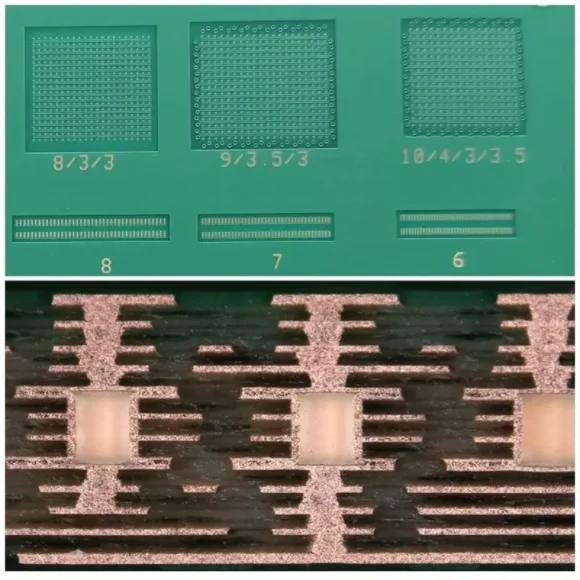
Stacked microvias require via fill (resin injection into the via barrel) and planarization (mechanical or chemical surface leveling) between lamination cycles. This inter-cycle processing adds 8–16 hours per stacked-via layer. Converting to staggered microvias (offset minimum 0.25mm between layer transitions) eliminates fill and planarization entirely, saving 1–2 business days per lamination cycle.
The routing area cost of staggering: 5–8% additional area in the BGA fanout zone. For boards that have available routing area in the BGA corner, this trade-off is almost universally worth taking for both lead time and cost benefits.
5.3 File Completeness and DFM Status
The most commonly overlooked lead time factor: file quality and DFM cleanliness. A job that releases to production on Day 0 starts lamination on Day 1. A job with an unresolved DFM query starts on Day 3–5 after the engineering back-and-forth resolves. For programs with tight schedule, submitting DFM-complete files — with via specifications confirmed, impedance targets specified, and drill file verified — eliminates this delay entirely.
The DFM queries most frequently responsible for job hold delays at Highleap: unspecified blind via depth (laser drill cannot be programmed without confirmed target layer), missing controlled impedance specifications (stackup cannot be validated without trace width and layer assignment), and conflicting drill files (through-hole drill file shows vias that the Gerber layer stackup shows as blind). Providing these three items complete in the initial submission eliminates the most common job release delays.
5.4 IPC Class Selection
Class 3 inspection adds 1–2 business days versus Class 2: extended cross-section analysis for first articles, stricter AOI accept/reject thresholds requiring manual re-inspection, and more comprehensive electrical test coverage. For programs where Class 2 inspection is sufficient (the large majority of commercial and industrial applications), specifying Class 2 from the outset avoids the schedule premium. Upgrading from Class 2 to Class 3 on a production order mid-program adds both cost and lead time.
6) How to Plan HDI Production Schedules Accurately
6.1 Building a Realistic HDI Schedule Buffer
For first-time production of a new HDI design, add these buffers to the quoted lead time:
- Material confirmation: Confirm material is stocked or in procurement before starting the clock. Add material lead time if non-stocked.
- First-article review: 3–5 business days for internal engineering review of first-article inspection report, electrical test results, and cross-section data before releasing to full production.
- Incoming inspection at your facility: 1–2 business days for dimensional check, ionic contamination test (if required), and any application-specific incoming criteria.
Realistic total from order placement to boards available in your assembly: quoted lead time + 4–8 days for first-article programs.
6.2 Batching Strategy for Recurring Orders
For recurring HDI programs (quarterly or monthly orders), lead time management improves significantly over the first order because:
- Tooling is retained — no NRE delay on re-orders
- Material can be consigned or pre-ordered to eliminate procurement lead time
- First-article review is completed — inspection can be streamlined to IQC sampling only
- Factory can batch your order with other similar-specification jobs, sometimes achieving better slot scheduling than one-off orders
Effective recurring programs should have purchase orders placed 6–8 weeks before the required delivery date for Type I, and 8–10 weeks for Type II/III, allowing standard lead time with no expedite premium. For urgent schedules requiring fast turnaround, see our guide on expedite options and the design changes that compress lead time below standard benchmarks.
6.3 Documenting Lead Time Requirements in the Specification
Lead time should be a documented specification element, not a verbal expectation. Purchase orders for HDI programs should state: required completion date (not just ship date), acceptable delivery window (±2 days is reasonable for complex HDI), escalation protocol for early warning if production falls behind schedule, and replacement policy for boards that fail electrical test (replacement delivery timing guaranteed).
Get Lead Time Quote for Your HDI Design
7) Predictable Blind Buried Via PCB Lead Times from Highleap
7.1 Standard Lead Times Highleap Commits To
| HDI Type | Standard Lead Time | Expedite Option | Super Rush (Type I only) |
|---|---|---|---|
| Type I with stocked materials | 10–12 business days | 7 business days (+25–40%) | 5 business days (+50–70%) |
| Type II with stocked materials | 14–16 business days | 10 business days (+30–45%) | Not available |
| Type III with stocked materials | 18–22 business days | 14 business days (+35–55%) | Not available |
| Any type with non-stocked specialty materials | Material lead time + above | Material lead time + expedited fabrication | Material lead time + super rush (Type I) |
7.2 Material Stocking Program
Highleap stocks standard FR-4, high-Tg FR-4, and halogen-free FR-4 in all common thicknesses as standard. For volume customers using Megtron 6, I-Tera MT40, or specialty low-loss laminate families, dedicated material consignment programs are available. Consigned material eliminates material procurement lead time entirely and provides lot-to-lot Dk consistency for programs where impedance repeatability requires it.
7.3 On-Time Delivery Commitment
Highleap commits to on-time delivery with replacement guarantee: if a production run ships more than 2 business days after the committed date, replacement boards are provided at no charge on the next available production slot. This guarantee applies to standard and expedited orders. On-time performance data for HDI programs is available on request.
7.4 DFM Review and File Readiness Check
Every new Highleap HDI order receives a free DFM review within 24 hours of file submission (48 hours for complex Type III). The review identifies all issues that would cause engineering queries and job holds before the order is placed in production queue. Jobs submitted with complete, DFM-clean files typically start lamination within 4 hours of order confirmation — maximizing utilization of the committed lead time window.

Recommended Posts
TMM3 PCB Manufacturing for RF Modules
TMM3 PCB manufacturing is most useful where the RF module...
TMM6 PCB Fabrication
TMM6 fabrication is the process-control page for a mid-Dk...

TMM10 PCB Manufacturing for Compact RF Designs
Table of contentsHow TMM10 Shrinks RF StructuresTMM10 vs...

TMM10i PCB Fabrication and DFM
TMM10i PCB fabrication has a stronger DFM emphasis because...
How to get a quote for PCBs
Let us run DFM/DFA analysis for you and get back to you with a report.
You can upload your files securely through our website.
We require the following information in order to give you a quote:
-
- Gerber, ODB++, or .pcb, spec.
- BOM list if you require assembly
- Quantity
- Turn time