
AI Training Server PCB Fabrication Services For Hyperscalers

Figure 1. AI Training Server PCB Design
Looking for an AI training server PCB fabrication partner? Highleap Electronics is a full-service PCB manufacturing and PCB assembly facility with proven build capability across compute mainboards, NVSwitch and NVLink switch carriers, InfiniBand and Ethernet fabric line cards, optical module host boards, DPU carriers, and rack-scale infrastructure. This page covers our AI training server PCB fabrication capability matrix, materials strategy, quality flow, and OEM engagement model.
Table of Contents
- Why AI Training Programs Need a Specialized AI Training Server PCB Fabrication Partner
- AI Training Server PCB Fabrication Capability Matrix
- Board Types Built Under Our AI Training Server PCB Fabrication Capability
- Materials & Stackup Strategy for AI Training Server PCB Fabrication
- Quality Flow & AVL Documentation for AI Training Server PCB Fabrication
- Engaging Highleap for Your AI Training Server PCB Fabrication Program
1. Why AI Training Programs Need a Specialized AI Training Server PCB Fabrication Partner
AI training clusters are not built like enterprise servers, and the PCBs inside them aren’t fabricated like enterprise server PCBs. Training a frontier large language model is a months-long, multi-hundred-million-dollar operation running across thousands of GPUs synchronized at microsecond precision. A single PCB defect in that cluster can stall the entire training run. The economics make AI training server PCB fabrication quality and signal integrity the most expensive variables on the build sheet.
The signaling-density problem in AI training server PCB fabrication
A modern 8-GPU baseboard carries over 1,000 high-speed differential pairs across 24–32 layers in roughly 460 × 350 mm of board area. A back-end InfiniBand NDR switch board concentrates 64 × 400G ports into one chassis, with several thousand differential pairs per board. A 1.6T spine switch board pushes that further. At every layer, traces of different rates run parallel to each other, near sensitive analog references, with constant pressure to fit more in less space. An AI training server PCB fabrication partner must hold every parameter under control simultaneously — not just one or two.
The signaling-rate problem
Current AI training hardware operates at 112G PAM4 per lane for both scale-up (NVLink) and scale-out (InfiniBand NDR, 800G Ethernet). Next-generation platforms move to 224G PAM4 per lane. Every doubling of signaling rate compresses the loss-budget margin, demands tighter back-drill control, and amplifies the impact of glass-weave skew, surface roughness, and via stub inductance. Materials that worked at 56G have no margin at 112G; materials that work at 112G are at their limit for 224G. AI training server PCB fabrication must keep pace with each generation — the rate progression maps directly onto our high-speed PCB manufacturing capability roadmap.
What this means for AI training server PCB fabrication partner selection
- High-layer-count expertise: 28–32 layer hybrid stackups with mixed material types co-laminated in a single press cycle — our multilayer PCB manufacturing line is structured for AI training server PCB fabrication builds.
- Ultra-low-loss material handling: Tachyon 100G, Megtron 7/8, and equivalent materials processed at production yield, not just on prototype panels.
- Tight impedance discipline: ±5% on critical differential pairs, verified per panel — see our impedance control PCB tolerance bands.
- Back-drilling at scale: hundreds of back-drilled vias per board with ±5 mil stub control verified on every AI training server PCB fabrication panel.
- Glass-weave-aware processing: fine glass styles, differential pair rotation guidance, spread-glass options.
- Coupon-level S-parameter test: measured insertion loss, return loss, crosstalk to 40 GHz delivered with each AI training server PCB fabrication panel.
- Capacity flex: AI training platform volumes can ramp 10× in a quarter when a sovereign AI program or new hyperscaler order book hits.
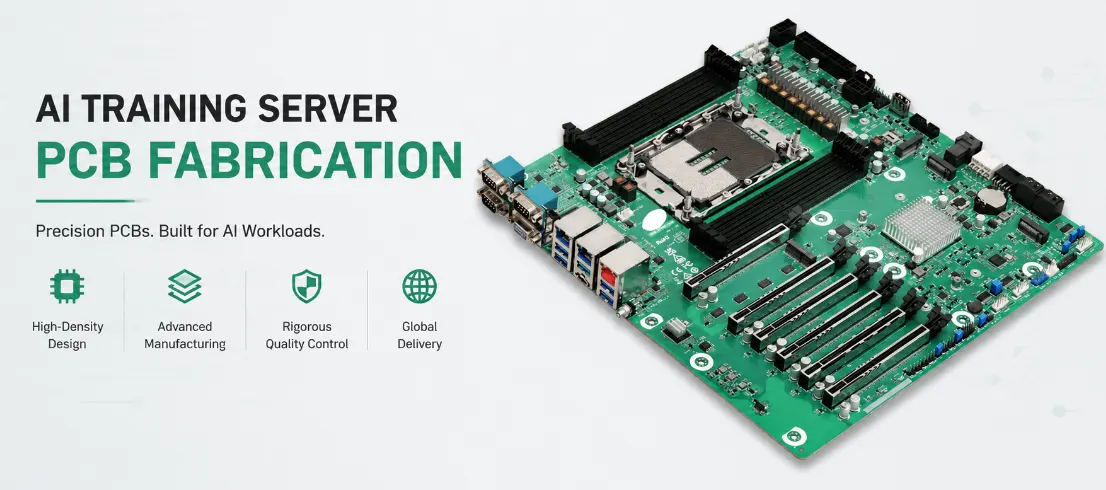
Figure 2. AI training server PCBA
2. AI Training Server PCB Fabrication Capability Matrix
What a qualified AI training server PCB fabrication partner confirms in writing during AVL qualification — production-line numbers proven across multiple platform generations.
| Parameter | AI Training Server PCB Fabrication Spec |
|---|---|
| Layer count | 12 to 36 layers production-qualified |
| Minimum trace / space | 0.060 / 0.060 mm production; 0.050 / 0.050 mm prototype |
| Microvia diameter | 0.075 mm minimum laser drill; 0.10 mm with 0.20 mm capture pad standard |
| Controlled impedance tolerance | ±5% on Gen5/NVLink/InfiniBand differential pairs |
| Back-drill residual stub | ≤8 mil with ±5 mil tolerance |
| Maximum board size | 600 × 500 mm — covers 8-GPU baseboard and director-class switch line cards |
| Copper weight | 0.5 oz to 4 oz inner; 0.5 oz to 3 oz outer |
| Imaging | LDI at 25 µm resolution across all AI training server PCB fabrication lines |
| Electrical test | 100% flying probe or fixture; TDR per panel; S-parameter to 40 GHz |
| Quality certifications | ISO 9001:2015, IATF 16949, UL recognition, AS9100D-aligned |
| IPC acceptance class | IPC-A-600 Class 2 standard; Class 3 for high-reliability programs |
| Prototype turnaround | 10–14 working days for 24–28 layer; 14–18 for 32+ layer builds |
3. Board Types Built Under Our AI Training Server PCB Fabrication Capability
A single AI training rack contains dozens of distinct board types. AI training server PCB fabrication for a complete program means handling all of them under coordinated change control.
Scale-up boards — NVSwitch, NVLink Switch, GPU baseboards
- 8-GPU baseboards: 24–32 layer HGX-class or OAM-class baseboards — the centerpiece of every AI training server PCB fabrication program.
- NVSwitch carrier boards: 24–30 layer carriers; some of the densest high-speed routing in our portfolio.
- NVLink bridge boards: small high-frequency boards built fully on Tachyon 100G.
- NVLink Switch System boards (multi-rack scale-up): 28–32 layer line cards for 9-rack and 18-rack scale-up domains.
Scale-out fabric switch line cards
- InfiniBand NDR switch line cards: 28–36 layer line cards hosting Quantum-2 NDR switch chips with 64 × 400G or 32 × 800G ports.
- 800G Ethernet switch line cards: Tomahawk 5, Spectrum-4, or equivalent 51.2 Tbps switch chips; 30–36 layer construction.
- InfiniBand HDR legacy line cards: continued AI training server PCB fabrication for HDR-based existing clusters.
- Spine and leaf switch boards: different form factors and signaling rates within the same fabrication portfolio.
Optical host boards and NIC/DPU carriers
- OSFP and QSFP-DD host boards: 8×112G PAM4 or 8×50G PAM4 host-side interfaces.
- OSFP-XD host boards (1.6T): 16×112G or 8×224G PAM4 emerging on next-generation AI training server PCB fabrication programs.
- ConnectX-7/8 NIC carriers: 400G/800G InfiniBand or Ethernet host adapter boards.
- BlueField-3 DPU mainboards: 16–22 layer DPU carriers with ARM cores, embedded accelerators, and 400G/800G interfaces.
Liquid-cooling integration boards
- Cold plate carrier mainboards: precision-flatness PCBs for liquid-cooled AI training mainboards; tooling-hole positional tolerance ±0.10 mm.
- CDU control boards: coolant distribution unit electronics for rack-level liquid cooling management.
- Manifold sensor boards: distributed flow, temperature, and pressure sensors across the rack.
- Leak detection boards: capacitive or resistive leak sensors with real-time BMC integration.
Rack-scale infrastructure boards
- 48V power shelf and PSU control boards: heavy-copper power distribution backplanes.
- Rack BMC mainboards: rack-level management of compute, storage, networking, cooling.
- Top-of-rack management switch boards: isolated management network infrastructure.
- Environmental and sensor aggregation boards: distributed monitoring infrastructure.

Figure 3. High-performance AI training server hardware, supported by Highleap’s advanced AI training server PCB fabrication and HDI carrier board manufacturing.
4. Materials & Stackup Strategy for AI Training Server PCB Fabrication
Material selection drives both the cost ceiling and the performance ceiling on any AI training server PCB fabrication build. Our line carries every laminate listed below in production qualification.
| Application | Signal Rate | Recommended Material | Cost vs FR4 |
|---|---|---|---|
| Compute mainboard signal layers | 112G PAM4 NVLink | Tachyon 100G / Megtron 7 | 5–8× |
| Compute mainboard — next gen | 224G PAM4 | Tachyon-100GX / Megtron 8 | 8–12× |
| InfiniBand NDR switch line card | 112G PAM4 | Tachyon 100G throughout signal layers | 5–8× |
| 800G Ethernet switch line card | 112G PAM4 | Tachyon 100G / Megtron 7 | 5–8× |
| NVSwitch carrier boards | 112G PAM4 | Tachyon 100G / Megtron 7 | 5–8× |
| 800G optical host board | 8×112G PAM4 | Tachyon 100G | 5× |
| DPU mainboard high-speed | 32 GT/s Gen5 + 100G+ | I-Tera MT40 / Tachyon 100G | 2–5× |
| Power layers across all boards | DC + 100 kHz switching | Isola 370HR or equivalent — see FR4 PCB manufacturing | 1.2× |
| BMC / management boards | under 1 Gbps | IS410 or 370HR | 1.0–1.2× |
Hybrid stackup discipline on AI training server PCB fabrication
The economics of AI training server PCB fabrication strongly favor hybrid stackups: ultra-low-loss material on layers carrying the highest-speed signals, high-Tg FR4 on power, ground, and slower-signal layers. A 32-layer training mainboard might use Tachyon 100G on 8 signal layers and 370HR on the remaining 24 — cutting material cost 50–60% versus all-Tachyon construction while preserving high-speed performance. Co-lamination compatibility verified at process release: Tachyon 100G + 370HR, Megtron 7 + Megtron 4, I-Tera MT40 + 370HR all qualify under single-press cycles on our AI training server PCB fabrication line.
5. Quality Flow & AVL Documentation for AI Training Server PCB Fabrication
AI training server platforms ship into hyperscaler environments where a single PCB defect can take down a training run worth thousands of GPU-hours. The cost of any field issue is orders of magnitude higher than the cost of catching it at AI training server PCB fabrication.
Process control on AI training server PCB fabrication
- Dielectric thickness: ±5% on signal-bearing layers; post-lamination cross-section sampling.
- Trace width: ±10 µm via laser direct imaging; etch compensation tuned per material.
- Impedance: ±5% on critical pairs; TDR coupon verification per panel.
- Back-drill depth: ±5 mil; cross-section verification at first article and sampling frequency.
- Plated through-hole copper: 25 µm minimum; XRF + coupon microsection.
- Layer-to-layer registration: X-ray verification ±3 mil on high-layer-count builds.
S-parameter test per panel
- Insertion loss to 40 GHz on test coupons
- Return loss measurement on connector launches and via transitions
- Differential NEXT/FEXT crosstalk on representative coupon structures
- Time-domain or frequency-domain phase skew on length-matched differential pairs
- Customer IBIS-AMI model overlay against measured S-parameters (on request)
Documentation package for hyperscaler AVL on AI training server PCB fabrication
- Certificate of Conformance per panel with material lot + process run traceability
- Material certifications (laminate, prepreg, copper foil)
- 100% electrical test report
- TDR impedance test report per panel
- S-parameter test report on coupons
- Microsection report (first article + agreed sampling frequency)
- AOI inspection logs
- Visual inspection per IPC-A-600 Class 2 or 3
- Cross-section verification of back-drill depth (sampling per panel)
- RoHS, REACH, and conflict-minerals declarations
- Full process traceability log
AVL qualification flow for AI training server PCB fabrication
- Pre-qualification audit: customer quality team site visit; equipment, process, environmental controls, quality lab, operator certification review.
- Sample build qualification: 25–200 piece sample build of representative AI training board with full documentation package.
- Process control documentation: SPC data on critical fabrication parameters, control plans, FMEA documentation.
- Environmental testing: thermal cycling, humidity, mechanical shock per customer protocols.
- Cybersecurity and supply-chain due diligence: customers verify IT security controls in addition to manufacturing quality.
- Cross-functional sign-off: engineering, quality, manufacturing, procurement formal approval.
6. Engaging Highleap for Your AI Training Server PCB Fabrication Program
For AI training cluster OEMs, hyperscaler ODMs, and sovereign AI program builders, the engagement model on AI training server PCB fabrication depends on program scope and timeline:
- Platform reference design: early-stage stackup consultation, material recommendation, impedance modeling — typically engaged 9–12 months before first prototype.
- Prototype build: 10–50 piece prototype quantity across the board family (compute mainboard, switch line card, NIC carrier, optical host); 10–14 working day turnaround on 24–28 layer AI training server PCB fabrication builds.
- Qualification sample build: 100–500 pieces per board for environmental qualification, thermal cycling, system-level validation, and customer AVL approval.
- Pilot production: first volume runs (1,000–10,000 units) with capacity reserved against customer commit; quality data accumulates for AVL maintenance.
- Volume production: scheduled monthly or weekly deliveries against rolling forecast; multi-board family supply coordinated under unified change control.
Highleap Electronics is ISO 9001 and IATF 16949 certified, with AS9100D-aligned process flow available for AI training server PCB fabrication programs requiring elevated quality system support. Our PCB manufacturing line is equipped with laser direct imaging at 25 µm resolution, controlled-depth back drilling at ±5 mil tolerance, 100% impedance test coverage with TDR, S-parameter characterization to 40 GHz, X-ray layer-to-layer registration verification, and microsection capability for first-article and in-process validation. Standard quick-turn delivery for AI training server PCB fabrication prototypes is 10–14 working days on 24–28 layer mainboards.
Submit Gerber files, drill data, stackup specifications, channel performance targets, and target quantities through our online quote portal for a 24-hour response covering DFM feedback, impedance verification, material recommendation, and pricing for prototype through volume production. For complex AI training server PCB fabrication programs, our team can engage directly to discuss multi-board family scope, capacity reservation, and qualification timeline. For sister-product capability content, see our pages on AI server PCB solutions, AI motherboard PCB manufacturing, and AI computing hardware PCB manufacturing.

Recommended Posts
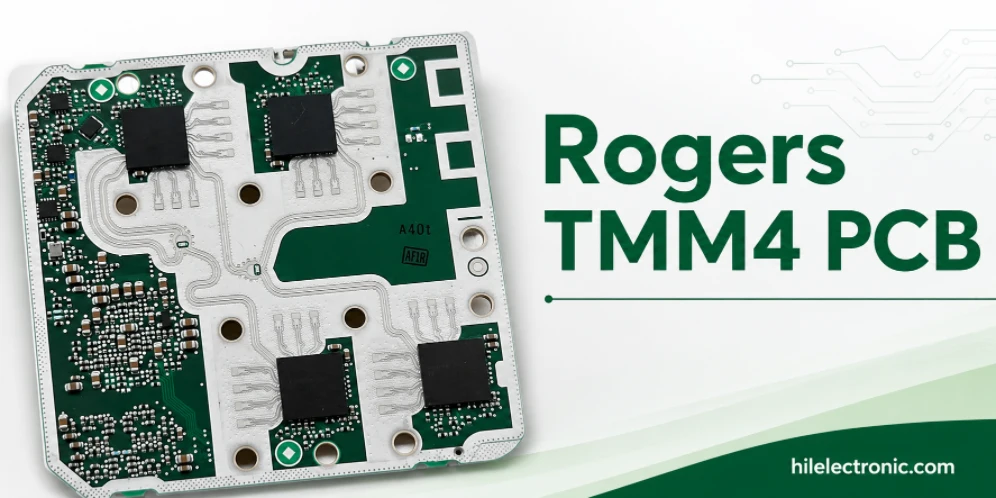
TMM4 Filter PCB Manufacturing
TMM4 filter PCB manufacturing is controlled by the...
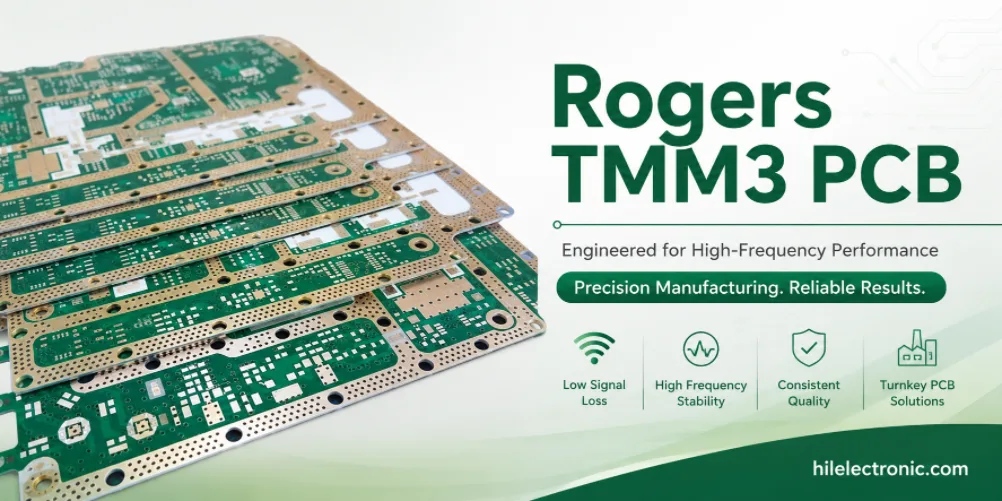
TMM3 PCB Manufacturing for RF Modules
TMM3 PCB manufacturing is most useful where the RF module...
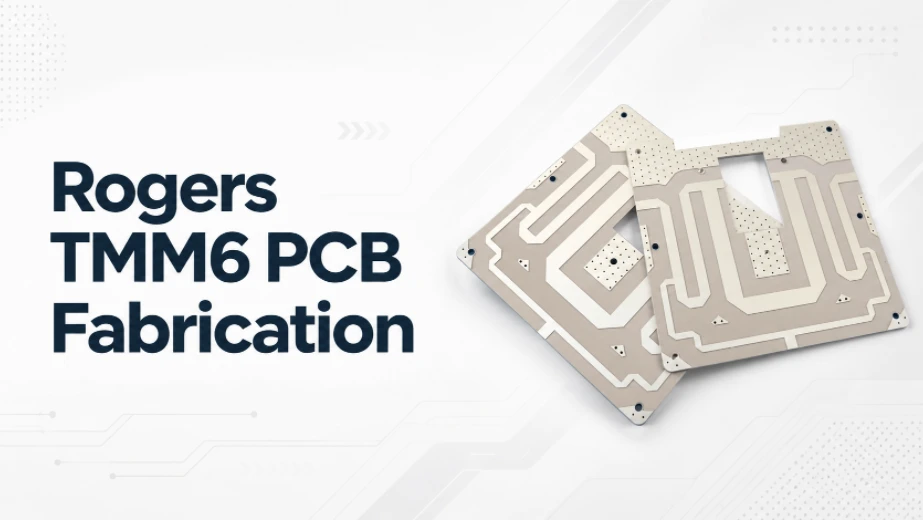
TMM6 PCB Fabrication
TMM6 fabrication is the process-control page for a mid-Dk...
TMM10 PCB Manufacturing for Compact RF Designs
Table of contentsHow TMM10 Shrinks RF StructuresTMM10 vs...
How to get a quote for PCBs
Let‘s run DFM/DFA analysis for you and get back to you with a report. You can upload your files securely through our website. We require the following information in order to give you a quote:
-
- Gerber, ODB++, or .pcb, spec.
- BOM list if you require assembly
- Quantity
- Turn time
For PCBA services, please provide your BOM (Bill of Materials) and any specific assembly instructions. We also offer DFM/DFA analysis to optimize your designs for manufacturability and assembly, ensuring a smooth production process.