
High CTI FR-4 PCB Manufacturing for Insulation-Critical Boards
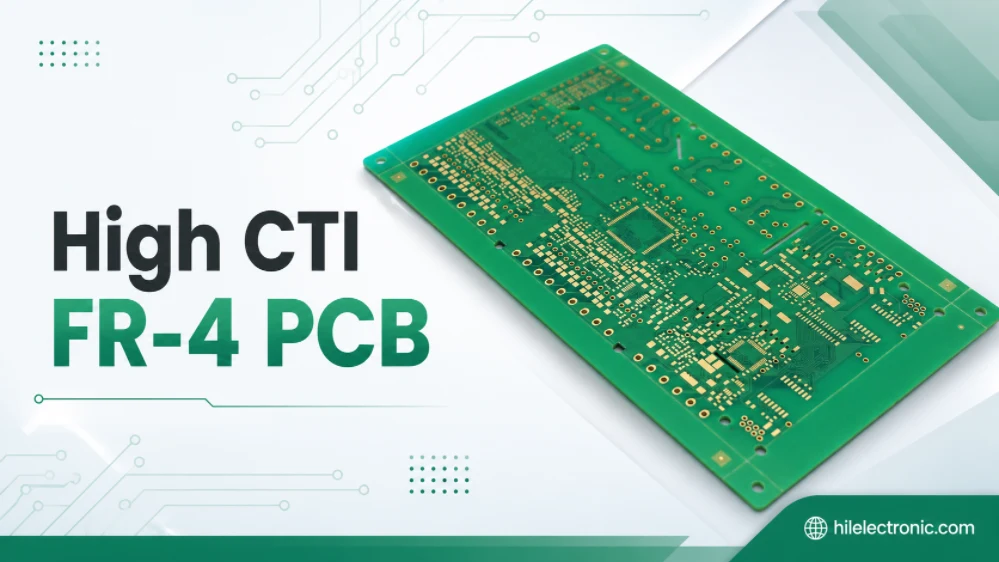
High CTI FR-4 is used when a PCB design needs stronger resistance to surface tracking than ordinary FR-4 can reliably provide. In real PCB manufacturing, this requirement is normally connected with working voltage, creepage distance, contamination risk, product safety, customer specifications, or an approved material list. It is not simply a higher-grade FR-4 label.
Highleap Electronics manufactures and assembles PCB and PCBA projects using customer-approved high CTI FR-4 laminates and prepregs. We do not manufacture the laminate itself. The production task is to convert the CTI requirement into controlled material sourcing, stackup confirmation, DFM review, fabrication notes, assembly cleanliness control, documentation, and repeatable production delivery.
High CTI FR-4 projects often appear in power electronics, industrial control boards, automotive electronics, battery-related systems, medical electronics, appliances, and other products where insulation reliability cannot be left to generic FR-4 assumptions. Related manufacturing topics can connect to multilayer PCB manufacturing, PCB assembly services, and Highleap quick quote when the design is ready for engineering review.
High CTI FR-4 PCB Manufacturing for Insulation Reliability
High CTI FR-4 becomes important when the PCB substrate is part of the product’s insulation system. The design may carry mains voltage, high DC voltage, battery voltage, motor-drive voltage, or isolated power sections. In these cases, the laminate’s resistance to tracking must be considered together with creepage distance, clearance, surface cleanliness, solder mask openings, slotting, coating, and the final assembly environment.
For a PCB manufacturer, the CTI requirement should be visible in the fabrication drawing, stackup note, material specification, AVL, or customer standard. If the requirement is only mentioned in an email but not included in the production package, it can be missed during purchasing, CAM review, or repeat production.
CTI value is a design requirement, not a decorative material label
CTI stands for Comparative Tracking Index. It measures the relative resistance of an insulating material to surface tracking under a standardized test condition. In PCB production, a higher CTI value can support safer insulation design, but it does not replace correct creepage distance, air clearance, board cleaning, conformal coating, or product-level safety validation.
- Power supply and inverter control boards
- Industrial control and automation electronics
- Battery management and energy storage boards
- Automotive and EV auxiliary electronics
- Medical, appliance, and safety-related PCB assemblies
The manufacturing goal is to preserve the approved insulation design through material control, board fabrication, assembly process control, and documentation. If a design calls for high CTI FR-4, substitution with ordinary FR-4 should not be made without customer approval and engineering confirmation.
High CTI FR-4 Material Requirements and Typical Properties
High CTI FR-4 should be specified by an actual material grade or by a clear CTI target supported by the customer’s approved material list. The most common high-intent search term is “CTI 600 FR-4,” but the exact value must come from the laminate supplier’s data sheet, UL recognition, or customer qualification record.
Typical high CTI FR-4 projects still require the usual FR-4 checks: Tg, Td, CTE, Dk, Df, copper peel strength, solder heat resistance, CAF performance, and lead-free process compatibility. CTI is important, but it is only one part of the material decision.
Typical high CTI FR-4 property range to verify
| Property | Typical high CTI FR-4 project target | Manufacturing meaning |
|---|---|---|
| CTI value | Often CTI ≥ 600 V when Material Group I is required | Must be confirmed from the approved laminate data sheet or customer specification |
| Base material | Glass-reinforced epoxy FR-4 laminate and prepreg | Handled through normal multilayer PCB lamination with grade-specific controls |
| Tg | Commonly 135°C to 180°C, depending on selected grade | Affects lead-free assembly margin and thermal reliability |
| Td | Often above 310°C, with higher values on higher-reliability grades | Important for lamination, soldering, and repeat thermal exposure |
| Dk / Df | Usually similar to FR-4 unless a special low-loss grade is specified | Do not assume high CTI also means high-speed low-loss performance |
| Lead-free compatibility | Must be checked separately | Needed when the board goes through lead-free reflow or selective soldering |
| Halogen-free status | Not automatic | High CTI and halogen-free are separate requirements unless both are specified |
| CAF resistance | Grade-dependent | Important for dense via fields, humidity exposure, and high-voltage spacing |
This table should be used as a manufacturing checklist, not as a universal data sheet. Every high CTI FR-4 build should be matched to the actual laminate grade purchased for that order.
CTI 600 FR-4 for Creepage Distance and High-Voltage PCB Design
Many customers request high CTI FR-4 because the board has creepage-related safety requirements. CTI helps define the insulation material group used in standards-based design decisions, but the PCB fabricator does not decide the final creepage distance alone. That decision depends on working voltage, overvoltage category, pollution degree, product standard, coating strategy, slot design, and the approved material group.
When a drawing specifies CTI 600 FR-4, the fabrication package should identify whether the requirement applies to the entire board or only to selected insulation-critical regions. This distinction can affect material selection, panel planning, routing, slots, solder mask clearance, documentation, and inspection.
Creepage requirement depends on CTI group and operating environment
High CTI material can support compact insulation design, but it does not make poor layout safe. Copper spacing, exposed metal, contamination, flux residue, sharp copper features, routing burrs, carbonized contamination, and insufficient cleaning can still reduce real-world insulation performance.
- Define creepage and clearance in the product safety design, not during final CAM cleanup
- Show high-voltage nets, isolation barriers, slots, and keepout zones clearly on the drawing
- Confirm whether conformal coating is part of the insulation strategy
- Keep solder mask openings and silkscreen away from critical insulation paths when required
- Use manufacturing notes to prevent unapproved copper, via, or marking changes in insulation zones
If the same PCB also needs thermal control, the insulation design should be coordinated with PCB thermal management techniques. High-voltage power boards often need both insulation spacing and heat flow, and these two requirements can compete for board area.
High CTI FR-4 vs Standard FR-4 for PCB Fabrication
The comparison between standard FR-4 and high CTI FR-4 should not be used to justify an unapproved downgrade. It is useful when a drawing, AVL, customer specification, or safety requirement already identifies a CTI target and the project team needs to understand how that target affects material selection, fabrication, assembly, cost, and lead time.
Some standard FR-4 materials may be acceptable for general electronics, but insulation-critical products often require a specific CTI value or material group. If high CTI FR-4 is specified, the safest manufacturing approach is to keep the approved material requirement visible through quotation, purchasing, CAM, production, assembly, and shipment documentation.
Material substitution must keep the approved CTI target
| Item | Standard FR-4 | High CTI FR-4 | Manufacturing decision |
|---|---|---|---|
| Primary reason for use | General PCB cost and availability | Improved tracking resistance for insulation-critical designs | Do not treat the two as interchangeable if CTI is specified |
| CTI value | Depends on grade | Often specified as CTI ≥ 600 V for high CTI builds | Confirm the exact CTI from the approved material data |
| Creepage design | May require larger creepage depending on material group | Can support higher CTI material group when documented | Final spacing remains a product design responsibility |
| Lead-free assembly | Grade-dependent | Grade-dependent | Check Tg, Td, solder heat resistance, and assembly profile separately |
| High-speed performance | Depends on Dk, Df, copper, and glass style | Not automatically low loss | Use PCB impedance control review if signal integrity matters |
| Procurement control | May allow multiple equivalent grades | Requires CTI target and approved material control | AVL and substitution rules should be defined before quotation |
For projects where price is sensitive, the quote should separate material cost from manufacturing complexity. High CTI FR-4 may change laminate purchasing, minimum order quantity, lead time, documentation, and inspection expectations. It should not be hidden under a generic FR-4 line item when the project has safety or compliance requirements.
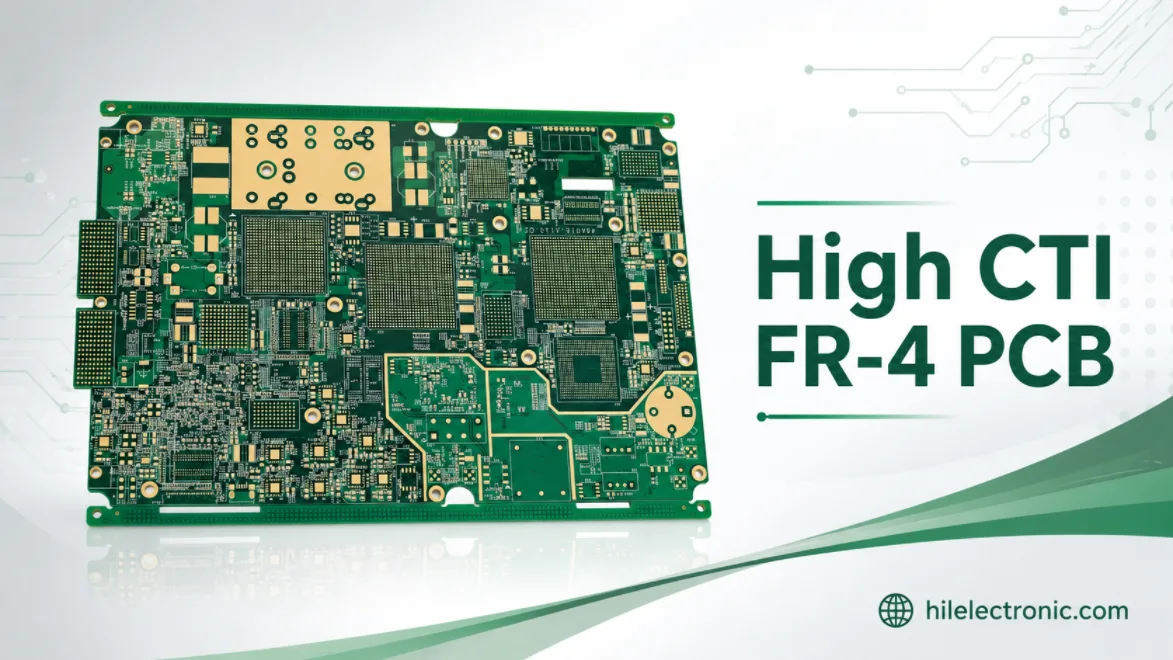
High CTI FR-4 Material Sourcing and Supplier Approval
Highleap sources high CTI FR-4 according to the customer drawing, AVL, approved equivalent list, or project-specific material requirement. The factory role is to purchase and process the approved laminate and prepreg, not to manufacture the base material. This distinction matters because the CTI value must be supported by the laminate supplier’s documentation.
Depending on availability and customer approval, high CTI FR-4 projects may involve suppliers such as Shengyi, Kingboard, ITEQ, EMC, Nan Ya, Panasonic, Isola, Ventec, or other qualified laminate manufacturers. The correct choice depends on CTI target, Tg, Td, halogen-free status, lead-free compatibility, thickness availability, copper option, certification requirement, and production volume.
Laminate selection follows drawing, AVL, and supplier data sheet
A practical sourcing review should confirm whether the customer requires an exact material model or allows approved equivalents. If a model is fixed, the quote should be based on that model. If alternatives are allowed, the engineering response should identify which properties must remain unchanged.
- CTI value or CTI material group requirement
- Exact laminate and prepreg model, if specified
- Tg, Td, CTE, CAF, and lead-free assembly requirements
- Halogen-free status, if required separately
- UL, RoHS, REACH, or customer documentation requirements
- Prototype, pilot, and mass production material availability
Nearby material pages such as KB-6160 PCB laminate, KB-6165 PCB laminate, ITEQ IT-180A, and Shengyi S1000-2M PCB materials can support internal material comparison when the design also needs high Tg, low CTE, or lead-free reliability.
PCB Fabrication Controls for High CTI FR-4 Boards
High CTI FR-4 fabrication is not only a purchasing action. The production process must preserve the electrical insulation intent across drilling, plating, routing, solder mask, surface finish, cleaning, inspection, and panel handling. This is especially important when high-voltage spacing, slots, isolation barriers, and dense component placement appear on the same board.
The fabrication package should make insulation-critical zones easy to recognize. If slots, cutouts, creepage paths, and high-voltage clearances are not clearly defined, CAM optimization may solve a manufacturing issue but accidentally weaken the original insulation strategy.
Fabrication control keeps the insulation design manufacturable
- Confirm material grade and CTI requirement before CAM tooling
- Review creepage slots, routed cutouts, and high-voltage isolation barriers
- Control copper pullback, solder mask clearance, and exposed metal in insulation zones
- Check drill quality, routing burrs, and edge cleanliness near high-voltage areas
- Define surface finish and cleanliness expectations for insulation-critical products
- Use panelization that protects slots, narrow bridges, and mechanical strength
For multilayer boards, the material review should be linked with 10-layer PCB materials and prepreg material for multilayer PCB when the design combines high CTI, high layer count, and controlled dielectric thickness. These requirements should be solved in the stackup stage, not after production tooling has started.
High CTI FR-4 PCB Assembly and Cleanliness Control
High CTI FR-4 can improve the material side of tracking resistance, but PCBA cleanliness still matters. Flux residue, ionic contamination, solder balls, metal particles, moisture, coating defects, and trapped residues under components can reduce insulation reliability on the assembled board.
Assembly planning should be completed before the bare board is released when the product includes high-voltage nets, isolation barriers, conformal coating, large power components, relays, connectors, transformers, optocouplers, or fuse areas. The bare board design and the assembly process must support the same insulation plan.
Assembly residue can reduce the benefit of a high CTI material
- Review solder paste, flux type, cleaning process, and no-clean compatibility
- Keep component placement away from creepage paths when required
- Confirm conformal coating keepout, coating coverage, and masking requirements
- Use AOI, X-ray, ICT, functional test, or hipot test according to customer instructions
- Control handling, packaging, and moisture exposure for high-reliability products
For turnkey projects, PCB assembly services should be quoted together with the bare board when the insulation requirement affects process control, test coverage, or documentation. A bare board quote alone cannot reflect cleaning, coating, functional testing, or high-voltage inspection requirements.
High CTI FR-4 PCB Quote Requirements
A high CTI FR-4 quote should identify the insulation requirement clearly. Without the CTI target, approved material grade, stackup, voltage zones, and assembly requirements, the quote may look faster but can create engineering holds later.
The most useful RFQs give the factory enough information to price the correct material, process route, inspection level, documentation package, and production lead time. This is especially important for products that will pass safety certification or customer qualification.
RFQ package should identify the CTI requirement clearly
- Gerber, ODB++, or IPC-2581 files
- Fabrication drawing with high CTI FR-4 material requirement
- Exact CTI target, such as CTI ≥ 600 V, if required
- Approved laminate model or allowed equivalent list
- Stackup drawing with core, prepreg, copper weight, and finished thickness
- High-voltage net areas, creepage slots, cutouts, and isolation barrier notes
- Surface finish, solder mask, marking, cleanliness, and coating requirements
- BOM, pick-and-place file, assembly drawing, and test instructions for PCBA
- Required certificates, material declaration, inspection reports, or traceability records
- Prototype quantity, forecast volume, target lead time, and repeat production plan
If the project is still being finalized, a manufacturing review before release can reduce later changes. Submit the complete package through the Highleap quick quote form and identify the high CTI requirement in the message or fabrication notes.
High CTI FR-4 FAQ
The following questions are common during early sourcing, DFM review, and PCBA planning for high CTI FR-4 projects.
What is High CTI FR-4?
High CTI FR-4 is an FR-4 laminate system with improved resistance to surface tracking compared with lower-CTI insulating materials. It is used when PCB insulation reliability, creepage distance, product safety, or customer specifications require a higher CTI value.
What does CTI 600 FR-4 mean?
CTI 600 FR-4 usually refers to FR-4 material with a Comparative Tracking Index of at least 600 V. In standards-based insulation design, CTI ≥ 600 V is commonly associated with Material Group I. The actual value must be confirmed from the selected laminate’s data sheet or certification record.
Can High CTI FR-4 replace standard FR-4?
High CTI FR-4 can be used in place of standard FR-4 when the project requires improved tracking resistance, but the change should be approved by the customer because it may affect cost, availability, stackup, documentation, and qualification. If the drawing already requires high CTI FR-4, ordinary FR-4 should not be substituted without approval.
Does High CTI FR-4 reduce creepage distance?
A higher CTI material group may support reduced creepage distance in some standards-based designs, but the final creepage requirement depends on working voltage, pollution degree, product standard, coating, environment, and safety approval. The PCB manufacturer should build to the approved design rather than decide the final creepage distance independently.
Is High CTI FR-4 the same as halogen-free FR-4?
No. High CTI and halogen-free are different requirements. A laminate can be high CTI, halogen-free, both, or neither depending on the material formulation and supplier data. If both requirements are needed, both should be included in the drawing or AVL.
Which laminate suppliers provide High CTI FR-4?
High CTI FR-4 grades may be available from suppliers such as Shengyi, Kingboard, ITEQ, EMC, Nan Ya, Panasonic, Isola, Ventec, and other qualified laminate manufacturers. The final selection should follow the customer’s approved material list, CTI target, and production requirements.
Can Highleap source customer-approved High CTI FR-4 materials?
Yes. Highleap can source customer-approved high CTI FR-4 laminates and prepregs for PCB fabrication and PCBA projects. The quote should identify the exact material model or approved equivalent rules so material purchasing and production documentation can be controlled correctly.
What information is needed for a High CTI FR-4 PCB quote?
The quote package should include Gerber or ODB++ files, fabrication drawing, CTI requirement, approved material grade, stackup, copper weight, surface finish, creepage and slot notes, BOM, assembly files, test requirements, documentation needs, quantity, and lead time target.
Request a High CTI FR-4 PCB Engineering Review
Highleap Electronics supports high CTI FR-4 PCB manufacturing and PCB assembly for B2B customers who need insulation-critical boards, high-voltage layouts, material traceability, clean assembly, and repeatable production. The factory role is to manufacture and assemble the approved PCB design with the specified material requirement, not to change the insulation strategy after release.
To start a review, send the Gerber or ODB++ files, fabrication drawing, stackup, CTI requirement, approved material list, BOM, pick-and-place file, test instructions, and expected quantity through the Highleap quick quote form. A complete package allows engineering, purchasing, fabrication, assembly, and quality teams to evaluate the project without guessing from incomplete data.

Recommended Posts

Taconic RF-35 PCB Manufacturing Service — Prototype Through Volume Production
Figure 1. Taconic RF-35 PCBTaconic RF-35 is the workhorse...

Isola Astra MT77 PCB Manufacturing
Figure 1. Isola Astra MT77 PCB ManufacturingIsola Astra...

Custom Rogers RO4835 PCB Fabrication & Assembly Services
Figure 1. Rogers RO4835 PCBRogers RO4835 PCB is a...

Nelco N4000-13 PCB Material and Manufacturing Guide | Highleap Electronics
Figure 1. Nelco N4000-13 PCBNelco N4000-13 PCB is a...
How to get a quote for PCBs
Let’s run DFM/DFA analysis for you and get back to you with a report. You can upload your files securely through our website. We require the following information in order to give you a quote:
-
- Gerber, ODB++, or .pcb, spec.
- BOM list if you require assembly
- Quantity
- Turn time
For PCBA services, please provide your BOM (Bill of Materials) and any specific assembly instructions. We also offer DFM/DFA analysis to optimize your designs for manufacturability and assembly, ensuring a smooth production process.